
What is TraumaInformed Care TraumaInformed Care Implementation Resource
- Slides: 16
What is Trauma-Informed Care? Trauma-Informed Care Implementation Resource Center is a Center for Health Care Strategies website developed with support from the Robert Wood Johnson Foundation. The views expressed here do not necessarily reflect the views of the Foundation. Trauma. Informed. Care. chcs. org
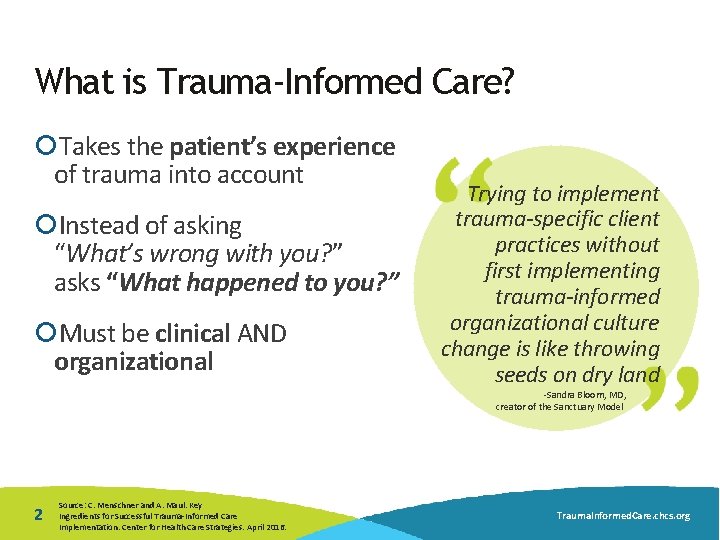
What is Trauma-Informed Care? Takes the patient’s experience of trauma into account Instead of asking “What’s wrong with you? ” asks “What happened to you? ” Must be clinical AND organizational Trying to implement trauma-specific client practices without first implementing trauma-informed organizational culture change is like throwing seeds on dry land -Sandra Bloom, MD, creator of the Sanctuary Model 2 Source: C. Menschner and A. Maul. Key Ingredients for Successful Trauma-Informed Care Implementation. Center for Health Care Strategies. April 2016. Trauma. Informed. Care. chcs. org
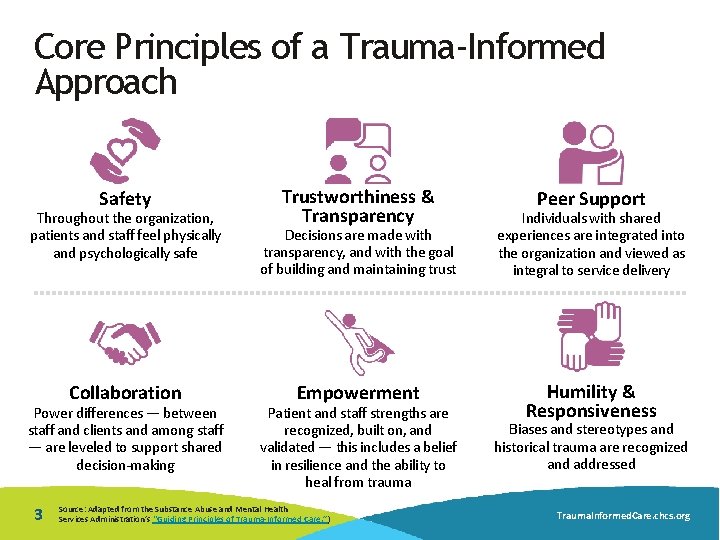
Core Principles of a Trauma-Informed Approach Safety Throughout the organization, patients and staff feel physically and psychologically safe Collaboration Power differences — between staff and clients and among staff — are leveled to support shared decision-making 3 Trustworthiness & Transparency Decisions are made with transparency, and with the goal of building and maintaining trust Empowerment Patient and staff strengths are recognized, built on, and validated — this includes a belief in resilience and the ability to heal from trauma Source: Adapted from the Substance Abuse and Mental Health Services Administration’s “Guiding Principles of Trauma-Informed Care. ” ) Peer Support Individuals with shared experiences are integrated into the organization and viewed as integral to service delivery Humility & Responsiveness Biases and stereotypes and historical trauma are recognized and addressed Trauma. Informed. Care. chcs. org
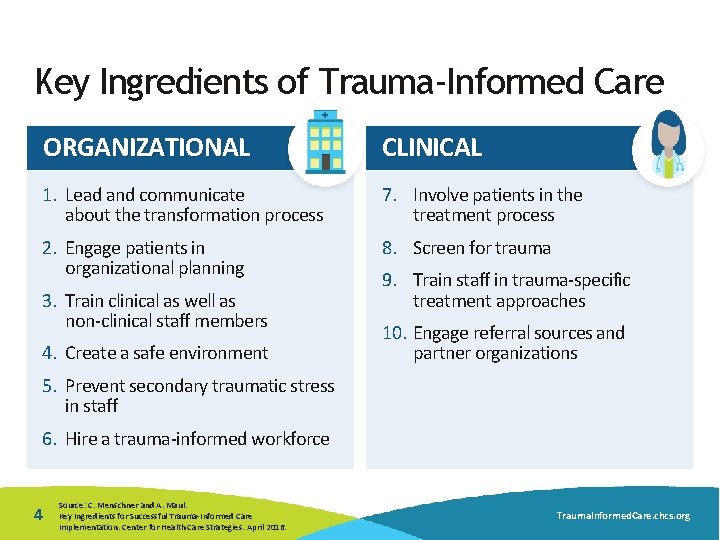
Key Ingredients of Trauma-Informed Care ORGANIZATIONAL CLINICAL 1. Lead and communicate about the transformation process 7. Involve patients in the treatment process 2. Engage patients in organizational planning 8. Screen for trauma 3. Train clinical as well as non-clinical staff members 4. Create a safe environment 9. Train staff in trauma-specific treatment approaches 10. Engage referral sources and partner organizations 5. Prevent secondary traumatic stress in staff 6. Hire a trauma-informed workforce 4 Source: C. Menschner and A. Maul. Key Ingredients for Successful Trauma-Informed Care Implementation. Center for Health Care Strategies. April 2016. Trauma. Informed. Care. chcs. org
KEY INGREDIENTS OF TRAUMA-INFORMED CARE 1. Lead and Communicate about the Transformation Process Engage senior leadership Communicate the importance and value of TIC to generate staff buy-in Ensure that both staff and patients understand why changes will be made to how the organization functions Successful transformation will require investments, including: » Training time for staff » Technical assistance » Making physical modifications to the facility 5 Trauma. Informed. Care. chcs. org
KEY INGREDIENTS OF TRAUMA-INFORMED CARE 2. Engage Patients in Organizational Planning Invite patients with lived experience of trauma to join stakeholder committees Consider compensating patients and community members for their time 6 Trauma. Informed. Care. chcs. org
KEY INGREDIENTS OF TRAUMA-INFORMED CARE 3. Train Clinical as well as Non-Clinical Staff Members All staff should be well-versed in how to create a welcoming, trusting, non-threatening environment Non-clinical staff (e. g. , front-desk workers, security guards, drivers, etc. ) play a key role in patient engagement. They interact with patients first, and more often than clinical providers 7 Trauma. Informed. Care. chcs. org
KEY INGREDIENTS OF TRAUMA-INFORMED CARE 4 a. Create a Safe Physical Environment Keep parking lots, common areas, bathrooms, entrances, and exits well-lit Keep noise levels in waiting room low Use welcoming language on all signage Make sure patients have clear access to the door in exam rooms and can easily exit if desired 8 Trauma. Informed. Care. chcs. org
KEY INGREDIENTS OF TRAUMA-INFORMED CARE 4 b. Create a Safe Social-Emotional Environment Welcome patients and ensure that they feel respected and supported Ensure that staff maintain healthy interpersonal boundaries and can manage conflict appropriately Maintain consistent schedules and procedures Practice cultural humility and responsiveness with staff and patients 9 Trauma. Informed. Care. chcs. org
KEY INGREDIENTS OF TRAUMA-INFORMED CARE 5. Prevent Secondary Traumatic Stress in Staff Provide trainings that raise awareness of secondary traumatic stress Offer opportunities for staff to explore their own trauma histories Support reflective supervision, in which a service provider and supervisor meet regularly to address feelings regarding patient interactions Encourage and incentivize physical activity, yoga, and meditation Allow staff to take “mental health days” 10 Trauma. Informed. Care. chcs. org
KEY INGREDIENTS OF TRAUMA-INFORMED CARE 6. Hire a Trauma-informed Workforce Graduate programs do not yet incorporate trauma-informed principles into curricula Organizations can hire staff with personality characteristics well suited for trauma-informed work Hiring managers can use behavioral interviewing to screen for empathy, non-judgment, and collaboration 11 Trauma. Informed. Care. chcs. org
KEY INGREDIENTS OF TRAUMA-INFORMED CARE 7. Involve Patients in the Treatment Process Engage patients in treatment planning with an empowered role in decision-making Build on patient strengths an resources in the development of treatment goals Use peer support workers who have lived trauma experience to build patient trust and engagement 12 Trauma. Informed. Care. chcs. org
KEY INGREDIENTS OF TRAUMA-INFORMED CARE 8. Screen for Trauma Differing views exist on when and how to screen for trauma Consensus around the following aspects of screening: » Treatment setting should guide screening practices » Screening should benefit the patient » Re-screening should be avoided » Provide ample training before implementing screening 13 Trauma. Informed. Care. chcs. org
KEY INGREDIENTS OF TRAUMA-INFORMED CARE 9. Train Staff in Trauma-Specific Treatment Approaches Select Adult-Focused Models: » Prolonged Exposure Therapy (PE Therapy) » Eye Movement Desensitization and Reprocessing (EMDR) » Seeking Safety Select Child-Focused Models: » Child-Parent Psychotherapy » Attachment, Self-Regulation, and Competency (ARC) » Trauma-Focused Cognitive Behavioral Therapy (TF-CBT) 14 Trauma. Informed. Care. chcs. org
KEY INGREDIENTS OF TRAUMA-INFORMED CARE 10. Engage Referral Sources and Partner Organizations Work with community partners and within a system of care to develop a trauma-informed referral network Opportunities to engage potential referral sources include: » Inviting them to participate in internal training » Hosting community-wide trauma-informed care training efforts » Encouraging patients serving on the advisory board to lobby community-based organizations to become trauma-informed 15 Trauma. Informed. Care. chcs. org
Learn More This presentation is a product of Advancing Trauma-Informed Care, a national initiative focused on better understanding how traumainformed approaches can be practically implemented across the health care sector, made possible by the Robert Wood Johnson Foundation and led by the Center for Health Care Strategies (CHCS). CHCS is a nonprofit policy center dedicated to improving the health of low-income Americans. For more information, visit CHCS’ Trauma. Informed Care Implementation Resource Center at Trauma. Informed. Care. chcs. org. 16 Trauma. Informed. Care. chcs. org