
What is Trauma DSM 5 2013 Direct exposure
- Slides: 16
What is Trauma? DSM 5 (2013) • Direct exposure to actual or threatened death, serious injury and abuse • Witnessing traumatic events happening to those close to us. • Repeated extreme exposure to aversive details of traumatic events. www. cambridgesupervisiontraining. com Anthea Millar
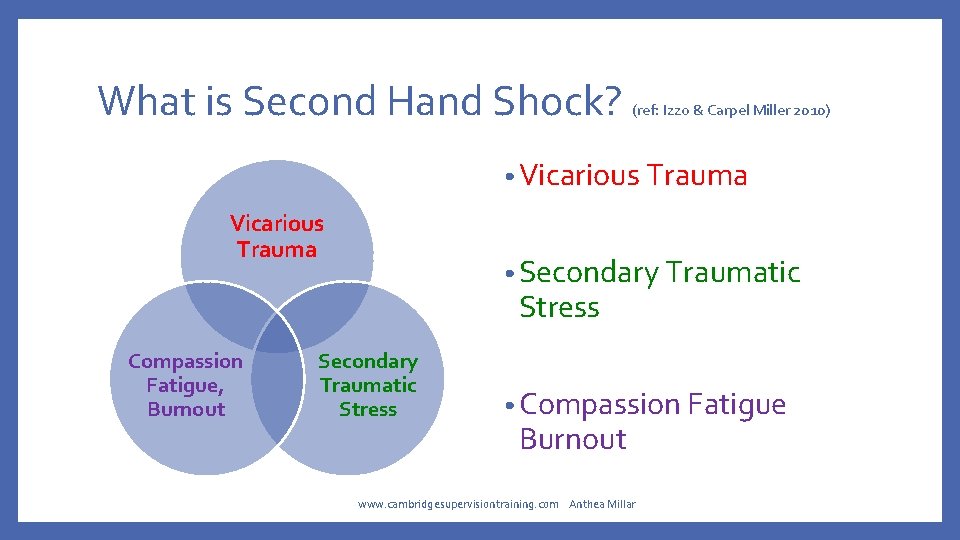
What is Second Hand Shock? (ref: Izzo & Carpel Miller 2010) • Vicarious Trauma • Secondary Traumatic Stress Compassion Fatigue, Burnout Secondary Traumatic Stress • Compassion Fatigue Burnout www. cambridgesupervisiontraining. com Anthea Millar
Secondary Traumatic Stress • Secondary exposure to a traumatic event – happens rapidly and associated with a particular event • Traumatic stress symptoms paralleling PTSD • A natural rather than ‘pathological’ response. www. cambridgesupervisiontraining. com Anthea Millar
Vicarious Trauma • Cumulative effect of being compassionate to others when listening to the trauma experiences of others…… • …. . whilst ALSO controlling natural empathic responses OR being unconscious of impact of empathy www. cambridgesupervisiontraining. com Anthea Millar
Compassion Fatigue and Burnout • Long term exhaustion and diminished interest in one’s work. • Lessening of compassion over time as a result of the continual challenge of extending compassion to those in need www. cambridgesupervisiontraining. com Anthea Millar
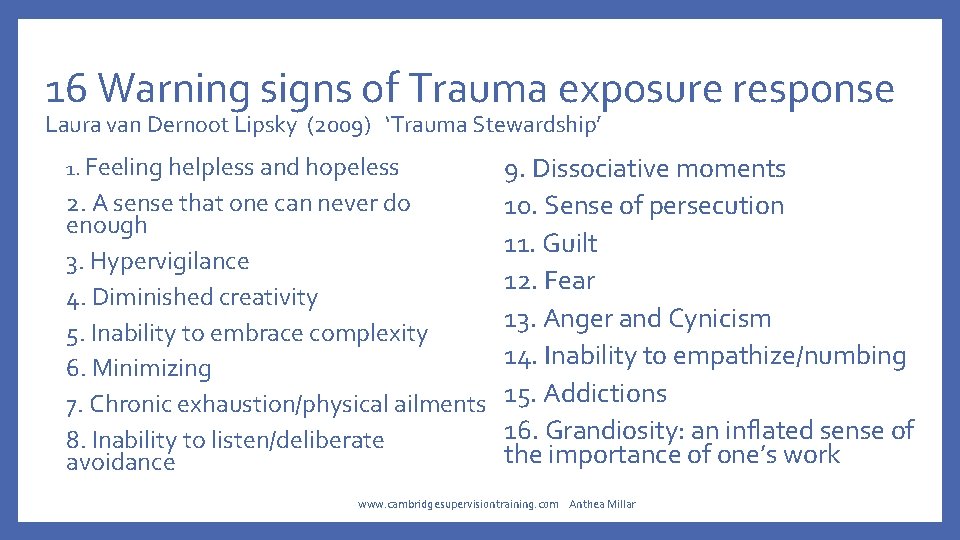
16 Warning signs of Trauma exposure response Laura van Dernoot Lipsky (2009) ‘Trauma Stewardship’ 9. Dissociative moments 2. A sense that one can never do 10. Sense of persecution enough 11. Guilt 3. Hypervigilance 12. Fear 4. Diminished creativity 13. Anger and Cynicism 5. Inability to embrace complexity 14. Inability to empathize/numbing 6. Minimizing 7. Chronic exhaustion/physical ailments 15. Addictions 16. Grandiosity: an inflated sense of 8. Inability to listen/deliberate the importance of one’s work avoidance 1. Feeling helpless and hopeless www. cambridgesupervisiontraining. com Anthea Millar
The Challenge of Empathy Empathic Strain Wilson and Lindy (1994), Etherington 2009 • Empathic Withdrawal • Empathic Repression • Empathic Enmeshment Anthea Millar
Facial mimicry and the Botox challenge Sensory feedback from the movement of facial muscles is essential to help us: • Recognise our own emotions • Recognise emotions in others Botox impairs this recognition (Neal and Chartrand 2011) Without facial mimicry it’s easy to misinterpret the emotional content of emails and texts www. cambridgesupervisiontraining. com Anthea Millar
Mirror Neurons (Rizzolatti and Gallese 1996) • Our brains are social organs primed to tune into other’s moods and experiences • When exposed indirectly to trauma our brain activates mirror neurons in the pre frontal cortex • The process forms a neurological loop which creates in the listener similar body sensations as if they are actually experiencing the event www. cambridgesupervisiontraining. com Anthea Millar
Counter-Transference: The Wounded Healer and the Double Whammy • Reaction TO the client in relation to our own ‘stuff’ • ‘Double whammy’ when our ‘stuff’ links with the clients’. May result in stuckness and boundary difficulties www. cambridgesupervisiontraining. com Anthea Millar
Boundaries • Ethical issues • Physical distance comfort zone • Body awareness • Controlled imagery exercises www. cambridgesupervisiontraining. com Anthea Millar
Body /Mind /Energy exercises • ‘Un-mirroring’ • Strong Back – Soft Front • Zip Up • Mindfulness – breathing space www. cambridgesupervisiontraining. com Anthea Millar
Organisational stress The approach of the organisation is central to prevention and reduction of vicarious and secondary trauma. Bober and Regehr (2006): www. cambridgesupervisiontraining. com Anthea Millar
Books and Articles • Izzo, E. , and Carpel Miller, V. (2010) Vicarious Trauma. Arizona: HCI Press Second Hand Shock: Surviving and Overcoming • Mathieu, F. (2012) Compassion Fatigue Workbook: Creative tools for transforming Compassion Fatigue and Vicarious Traumatisation • Rothschild, B. (2006) Help for the Helper: Self-Care Strategies for Managing Burnout and Stress. New York: Norton • Saakvitne, K. W. , Pearlman, L. A. , (1996). Transforming the pain: A workbook on Vicarious Traumatization. New York: W. W. Norton. • Lipsky, Laura van Dernoot. (2009) Trauma Stewardship: An everyday guide to caring for self while caring for others. San Francisco: Berrett-Koehler. www. cambridgesupervisiontraining. com Anthea Millar
Online Resources • Vicarious Trauma Institute; Izzo & Carpel Miller http: //www. vicarioustrauma. com/ • TEND Academy http: //www. tendacademy. ca • Vicarious Trauma. Headington Institute institute. org • Compassion Fatigue: Charles Figley http: //www. headington- http: //www. compassionfatigue. org/ • Professional Quality of Life: Version 5 (Pro. QOL). www. proqol. org • Carl Marci: Neurobiology and Physiology of Empathy http: //vimeo. com/61816660 www. cambridgesupervisiontraining. com Anthea Millar
Cambridge Supervision Training cst CST Diploma in Supervision Sept 2017 - March 2018 An Integrative Approach | Accredited by ASIIP. Two places left Next Full Diploma Sept 2018 to June 2019 All enquiries: Contact Jim Holloway on 01223 846884 email: cstpartnership@gmail. com www. cambridgesupervisiontraining. com Anthea Millar