
What is this hadith about Describe the man
�What is this hadith about? �Describe the man who came to the Prophet peace be upon him? �What is Islam? �What is Zakat? �What is Shahadah? REVISION FROM PART 1
Explain the following statement in your own words. “the herdsmen of the sheep (competing with each other) in raising lofty buildings”
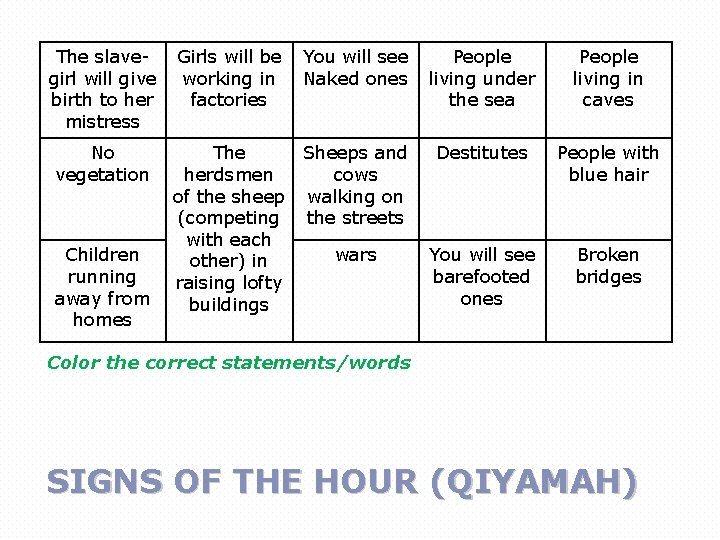
The slavegirl will give birth to her mistress No vegetation Children running away from homes Girls will be working in factories You will see Naked ones The Sheeps and herdsmen cows of the sheep walking on (competing the streets with each wars other) in raising lofty buildings People living under the sea People living in caves Destitutes People with blue hair You will see barefooted ones Broken bridges Color the correct statements/words SIGNS OF THE HOUR (QIYAMAH)
What is the name of the son of Umar bin Al Khattab? What is qadar?
Who was the teacher and who was the student in this hadith?

lessons This hadith teaches the adab (ethics) of seeking knowledge: ü We should be ---- and wear clean clothes. ü We should sit ------ and ----- to the speaker. ü Asking questions for ----- understanding. ü Seek knowledge from the -----source/authority. ü The method of seeking knowledge is through -----------------. ü The type of questions we ask should be --------- - questions that will lead to valuable knowledge and good action. Islam Iman Ihsan
Whom should we seek knowledge from?
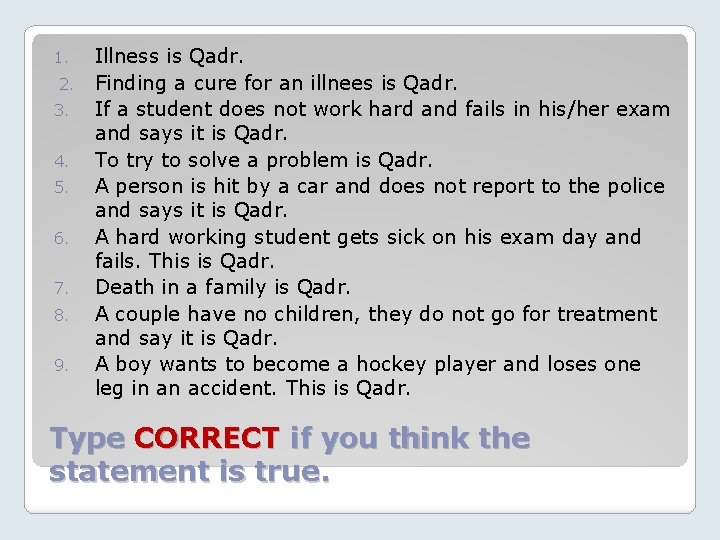
Illness is Qadr. 2. Finding a cure for an illnees is Qadr. 3. If a student does not work hard and fails in his/her exam and says it is Qadr. 4. To try to solve a problem is Qadr. 5. A person is hit by a car and does not report to the police and says it is Qadr. 6. A hard working student gets sick on his exam day and fails. This is Qadr. 7. Death in a family is Qadr. 8. A couple have no children, they do not go for treatment and say it is Qadr. 9. A boy wants to become a hockey player and loses one leg in an accident. This is Qadr. 1. Type CORRECT if you think the statement is true.
Happy Land for Islamic Teachings-Hadith 2 – PART 2
- Slides: 9