
What is thing called Rhetoric Origins Rooted in
- Slides: 29
What is thing called Rhetoric?
Origins § Rooted in “words” or “speech” § Greek Rhema “a word” and Rhetor “a teacher of oratory” § Stems from the Greek verb eiro “I say” § English noun Rhetoric dervies from the Greek feminine adjective rhetorike and rhetorike techne “the art of the rhetor or orator” connected to speaking
Definitions § Rhetoric= the art or discipline that deals with the use of discourse (spoken or written) to inform, persuade, or motivate an audience § - Formal, premeditated, sustained monologue that seeks an effect on an audience § - Many definitions provided on page 1 of Rhetoric text
What is important to remember? § No jokes, small talk, greetings, exclamations, gossip, simple explanations, or directions § Significance of strategy: choices available to meet ends
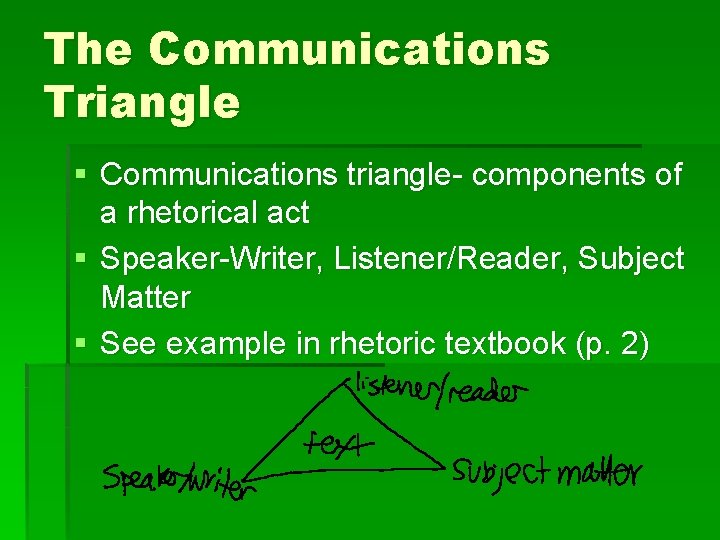
The Communications Triangle § Communications triangle- components of a rhetorical act § Speaker-Writer, Listener/Reader, Subject Matter § See example in rhetoric textbook (p. 2)
An Overview § 3 Kinds of Persuasive Discourse § 1. Deliberative Discourse (political, hortative, advisory) § - Seek to persuade someone to do something or to accept your point of view § - Concerned with the future, expedient, exhortation
Cont. § § 2. Forensic (legal, judicial) - Defend or condemn actions - Concerned with past time - Topics: justice and injustice, accusation and defense
Cont. § 3. Ceremonial (epideictic, demonstrative, declamatory, panegyrical) § - Pleasing or inspiring § - Ceremonial is the most elaborate § - Concerned with the present time § - Topics: honor and dishonor, praise and blame
Where do we see Rhetoric? § Advertising: pictorial and verbal parts of the ad, imperative language, classical texts § Rhetoric is an inescapable activity in our lives. We either use it or are exposed to it daily. § Examples?
Negative types of Rhetoric § Propaganda § Demagoguery: exploit specific arguments, half truths, emotional appeal for personal gain § Brainwashing § Doublespeak: language used to deceive or confuse
Why do we learn/study Rhetoric? § To be put on guard against the influence of negative persuasion § Strengthen own arguments § Respond critically to rhetorical efforts § Analytical art: break down what has been composed § Respond critically and appreciatively to advertisements, commercials, political messages, satires, irony, and double speak § Become an effective writer (gives general principles that can be adapted)
Rhetoric in the Classical World § Form: exordium, narration, proof, peroration, disposition § Five Cannons of Rhetoric § Inventio: Invention/Discovery (1) § Dispositio: disposition, arrangement, organization (2) § Exordium: ingratiate with audience or conciliate to indifferent, reluctant, or hostile audience, makes audience receptive § Narratio: Exposition of the state of affairs at the moment § divisio: outline of points or steps in an argument § confirmatio: proof of one’s case. “All the available means of persuasion” § peroration: conclusion
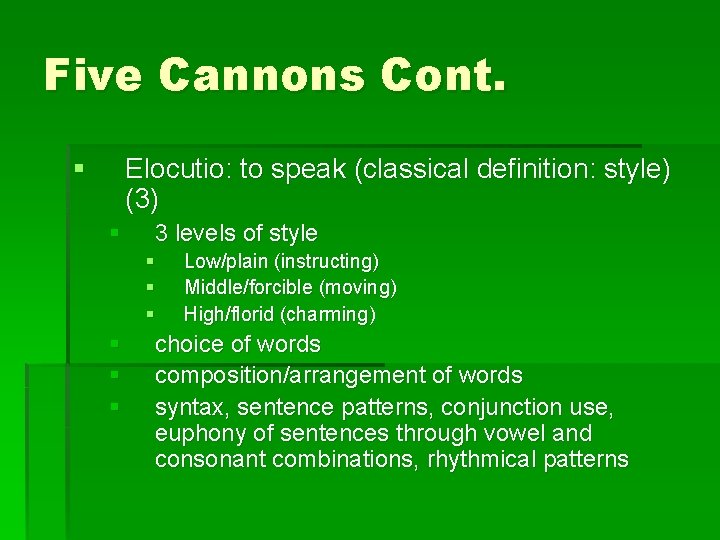
Five Cannons Cont. § Elocutio: to speak (classical definition: style) (3) § 3 levels of style § § § Low/plain (instructing) Middle/forcible (moving) High/florid (charming) choice of words composition/arrangement of words syntax, sentence patterns, conjunction use, euphony of sentences through vowel and consonant combinations, rhythmical patterns
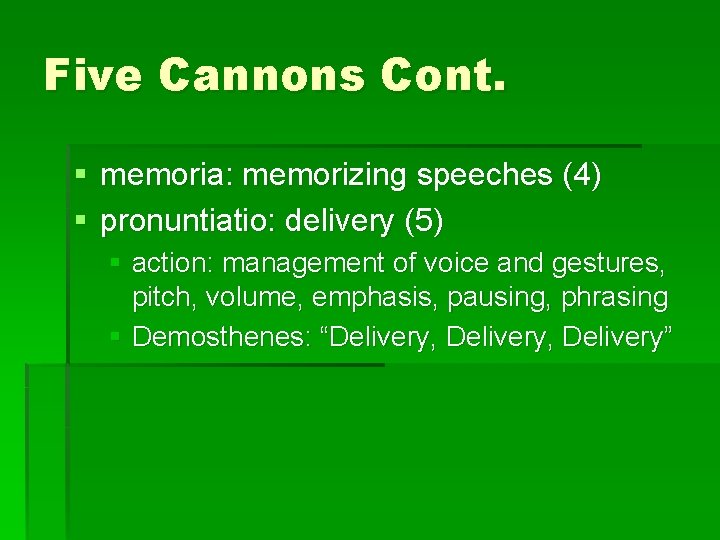
Five Cannons Cont. § memoria: memorizing speeches (4) § pronuntiatio: delivery (5) § action: management of voice and gestures, pitch, volume, emphasis, pausing, phrasing § Demosthenes: “Delivery, Delivery”
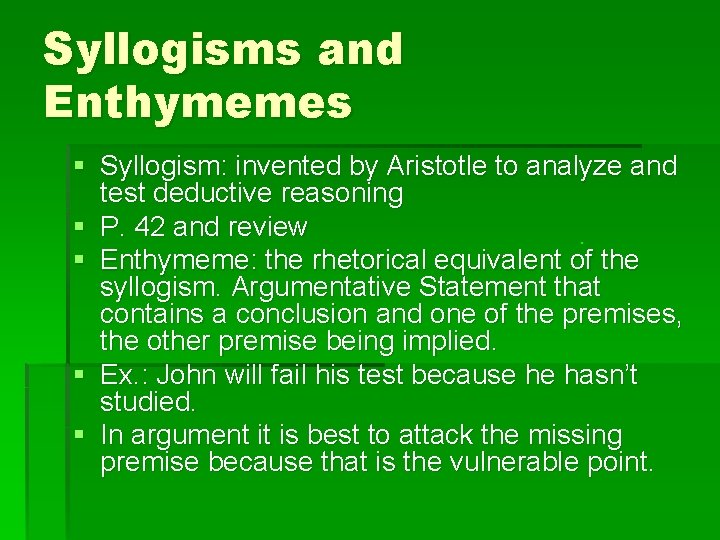
Syllogisms and Enthymemes § Syllogism: invented by Aristotle to analyze and test deductive reasoning § P. 42 and review § Enthymeme: the rhetorical equivalent of the syllogism. Argumentative Statement that contains a conclusion and one of the premises, the other premise being implied. § Ex. : John will fail his test because he hasn’t studied. § In argument it is best to attack the missing premise because that is the vulnerable point.
Enthymeme cont. § Common syntactic pattern for enthymeme pg. 57 § Difference between reason and premise from which a conclusion is drawn
Signs § Sign: indication of something else, may occur before or simultaneously with or after something else, used in enthymeme § Infallible sign: sign that invariably accompanies something else (ex. Smoke) § Fallible sign: sign that does not exclusively accompany something else (ex. Fast breathing), these never prove but they can persuade
The Example § The Example: inductive reasoning’s rhetorical equivalent. § Induction review: particular to general, validity and truth depended on particulars studied, inferences are made from verifiable phenomena § We cannot give all the facts and examples needed. Select one or two that best support the generalization. § Example: pg. 61
Example cont. § Argument by example doesn’t prove anything; it shows probability. It’s persuasive because we believe it to be true or because it happens most of the time. § To argue against the example: look for a similar example where the outcome was the opposite of the one cited.
Fallacies § The Fallacies: be aware of them in order to refute arguments that oppose our position § Fallacy: 1. a false statement, an untruth (matter of the argument) 2. invalid or deceptive reasoning (form or mode of the argument) § Fallacies of Matter § We cannot disprove a statement until we have discovered the facts. Must prove yourself if you challenge the generally accepted view. § Assertion does NOT equal proof = bad argument § Half-truths = bad argument due to distortion
Do I have to prove everything? § § Things that don’t have to be proven: Self-evident truths “true by definition” ex. 2+2=4 statement about matters even the minimally informed person should know
Fallacies cont. § Fallacies of Reasoning § Equivocation: using the same term with two or more meanings or referents (used often in syllogisms) § Either/Or Fallacy: two-valued system where something or someone is either one way or another. There are only two sides to the issue when there typically should be more. § Faulty Generalization: “jump to a conclusion” from inadequate evidence (irrelevant, unrepresentative, not numerous enough to make that conclusion) § Faulty Causal Generalizations: cause and effect inferences that are not established correctly § Faulty Analogy: concentrate on irrelevant or inconsequential similarities between two situations and overlook significant dissimilarities
Fallacies cont. § § § Begging the Question: circular reasoning. Ex. “God exists” “How do you know? ” “The Bible says so” “Why should I believe the Bible? ” “Because it’s the inspired word of God” Ad Hominem (“to the man”): Emotional argument where personalities are discussed and not issues. Attack on the person’s character Ad Populum (“to the people”): emotional appeal to the irrational fears and prejudices to prevent audiences from facing the issues. “weasel words” that color the emotional atmosphere The “Red Herring”: ignoring or avoiding the issue The Complex Question: impossible to give a short answer to because it has two parts
Other Advertising Terminology § Undistributed Middle: An argument in which the middle term is undistributed, meaning that not all the instances of things that are C are also instances of things that are A or of B. In other words, the first premise tells us that everything that is an A is also a C. It doesn’t tell us anything about whether things that are C are also things that are A. Similarly, in the second premise, we are told that everything that is a B is also a C. But again, we know nothing about things that are C. § Questionable Use of Statistics: Employing statistics that are questionable without further support. There are several subcategories here. § Hasty Conclusion: Accepting an argument on the basis of too little evidence. § Small Sample: Drawing conclusions on the basis of a sample that is too small to be reliable. § Unrepresentative Sample: Reasoning from a sample that is not representative of the general population.
§ Appeal to Authority: Accepting the word of authorities when we lack good reasons for thinking that they have the information we need or when we think that they might be biased, or when we ought to figure the matter out for ourselves, or when the authority in question is not really an expert in the relevant area. § Suppressed Evidence: A failure to mention or otherwise acknowledge important, relevant evidence. Suppressing evidence is not always a fallacy (for instance, defense lawyers are professionally obligated to ignore evidence of their client’s guilt), but ignoring relevant facts is often a sign of an attempt to mislead. § Straw Man: A subcategory of red herring that involves misrepresenting an opponent’s position to make it easier to attack. The origin of the phrase derives from soldiers who learn to use bladed weapons by attacking straw-filled dummies – a much easier target than live people who are attempting to stab back.
§ Vagueness: A lack of clarity or precision in language. Words or groups of words are vague when their meanings are inexact or when it is unclear to which things the word or words apply. § Genetic Fallacy: Rejecting an argument based on its origins rather than on its own merits. A related form accepts or rejects arguments based on others who endorse or reject those same arguments.
§ Humor: Using Humor to appeal to audiences § Snob appeal: People want the sense that they are getting a luxurious product, or one that is believed to be so § Appeal to sense of value: Using sales, pricing information, percentages off. § Bandwagon: Everyone is using this product… so you should too! § Card stacking: Presenting overwhelming evidence for one side and not the other or leading questions.
§ Glittering generality: Highly general, abstract statements that can't really be proven. § Name calling: When companies deliberately mock each other in ads. § Testimonial: The use of celebrities or well known people who lend their reputation to a product. § Plain folks: The average person depicted in advertisements to sell a product § Transfer: The speaker's intent to transfer the prestige, qualities, or history of an image transferred on to him/herself.
To wrap it up… § One main use of Rhetoric is to persuade or convince an audience. Where truth cannot easily be found, persuade the audience to adopt a point of view or a course of action on the basis of what is probable or what people believe to be true.