
What is thermal structure of a subduction zone
What is thermal structure of a subduction zone?
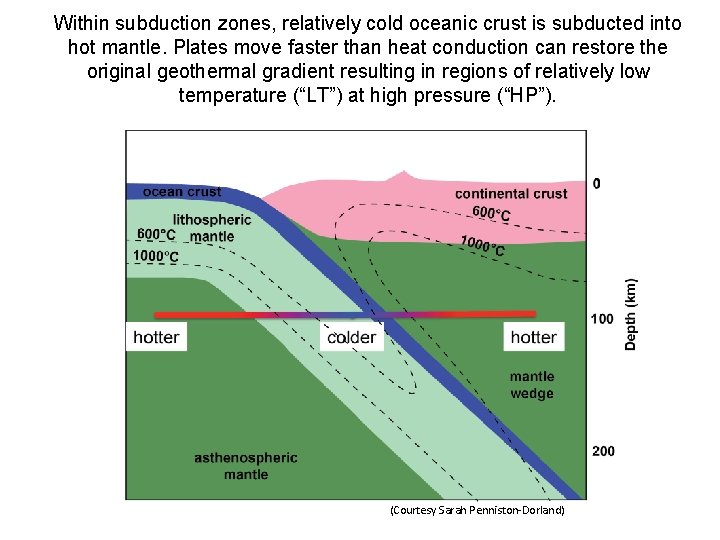
Within subduction zones, relatively cold oceanic crust is subducted into hot mantle. Plates move faster than heat conduction can restore the original geothermal gradient resulting in regions of relatively low temperature (“LT”) at high pressure (“HP”). (Courtesy Sarah Penniston-Dorland)
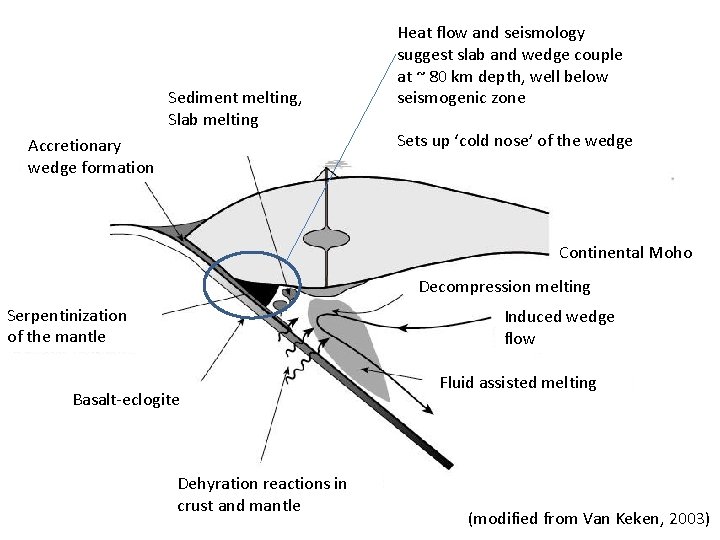
Sediment melting, Slab melting Accretionary wedge formation Heat flow and seismology suggest slab and wedge couple at ~ 80 km depth, well below seismogenic zone Sets up ‘cold nose’ of the wedge Continental Moho Decompression melting Serpentinization of the mantle Induced wedge flow Basalt-eclogite Dehyration reactions in crust and mantle Fluid assisted melting (modified from Van Keken, 2003)
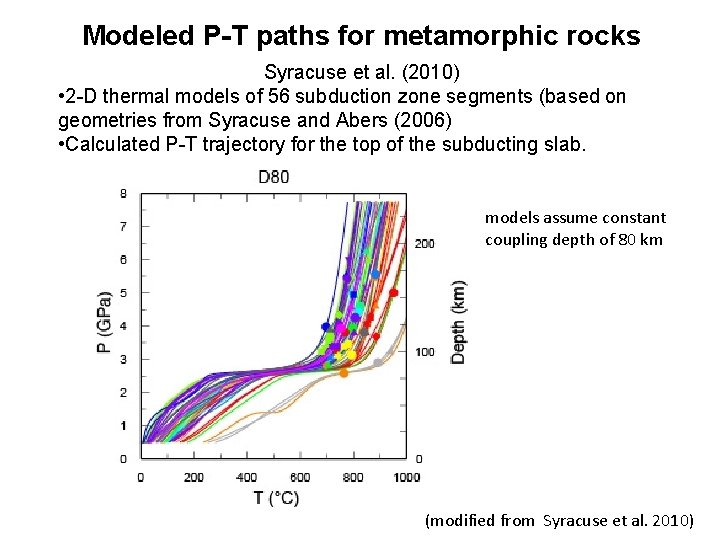
Modeled P-T paths for metamorphic rocks Syracuse et al. (2010) • 2 -D thermal models of 56 subduction zone segments (based on geometries from Syracuse and Abers (2006) • Calculated P-T trajectory for the top of the subducting slab. models assume constant coupling depth of 80 km (modified from Syracuse et al. 2010)
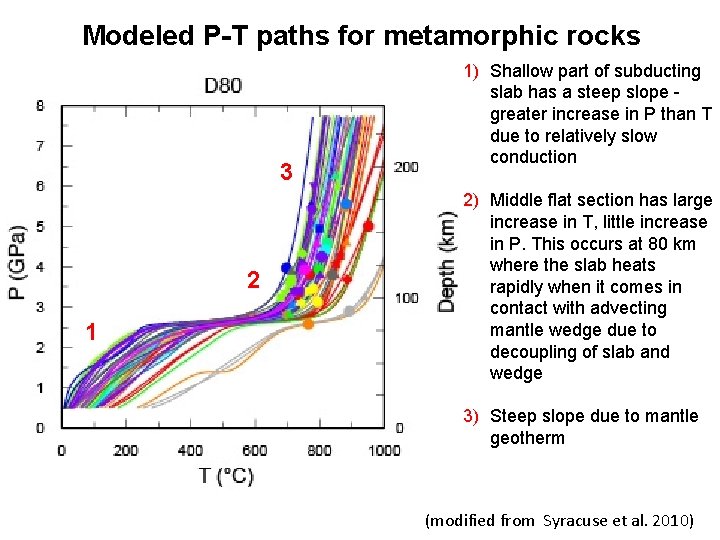
Modeled P-T paths for metamorphic rocks 3 2 1 1) Shallow part of subducting slab has a steep slope greater increase in P than T due to relatively slow conduction 2) Middle flat section has large increase in T, little increase in P. This occurs at 80 km where the slab heats rapidly when it comes in contact with advecting mantle wedge due to decoupling of slab and wedge 3) Steep slope due to mantle geotherm (modified from Syracuse et al. 2010)
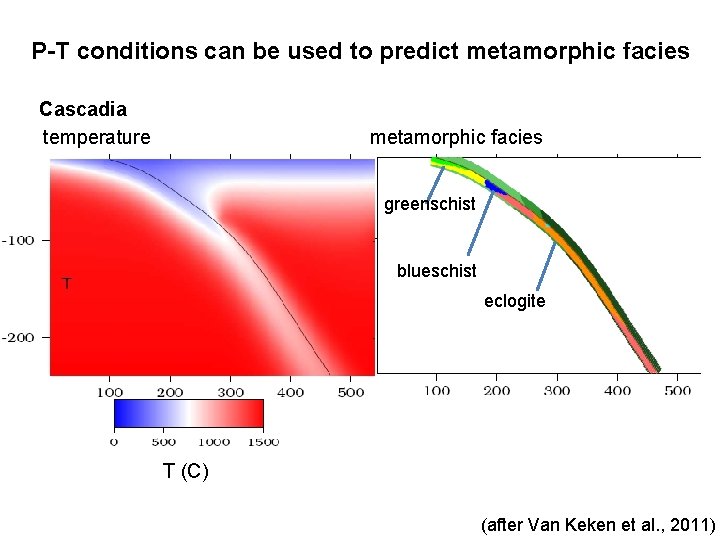
P-T conditions can be used to predict metamorphic facies Cascadia temperature metamorphic facies greenschist blueschist eclogite T (C) (after Van Keken et al. , 2011)
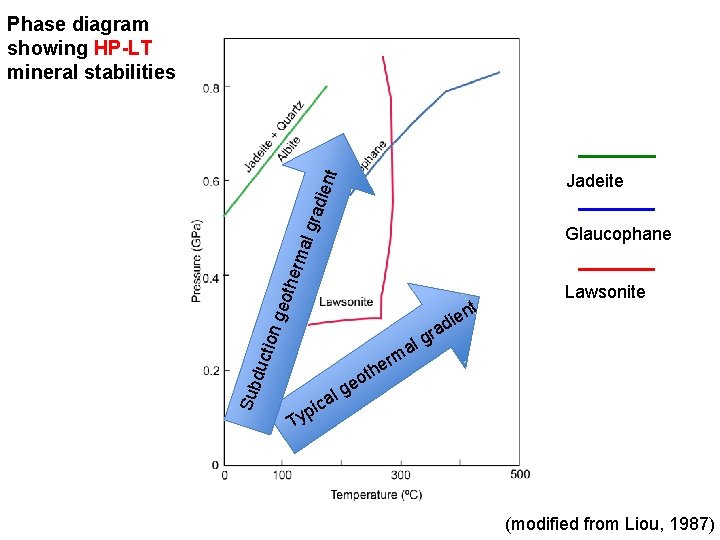
Phase diagram showing HP-LT mineral stabilities radi ent Jadeite geo ther mal g Glaucophane tion ra lg a m duc Sub nt e i d Lawsonite er h t o e lg a c i p Ty (modified from Liou, 1987)
- Slides: 7