
What is theatre Week 1 Introduction to Theatre
![Theater/Theatre Definition (according to the Oxford Dictionary) [ˈTHēədər] • • • Is a NOUN](https://slidetodoc.com/presentation_image_h2/5903e413f31b68ad348aad600a1d5169/image-2.jpg "Theater/Theatre Definition (according to the Oxford Dictionary) [ˈTHēədər] • • • Is a NOUN")
- Slides: 19
What is theatre? Week 1 Introduction to Theatre College of the Desert
Theater/Theatre Definition (according to the Oxford Dictionary) [ˈTHēədər] • • • Is a NOUN Theatres (plural noun) or theaters (plural noun) It stands for a building or outdoor area in which plays and other dramatic performances are given. • Synonyms for theatre are: – Playhouse · auditorium · amphitheater · cinema · movie theater · movie house · nickelodeon · scene · arena · field/sphere/place of action · setting · site • It can also mean: – The activity or profession of acting in, producing, directing, or writing plays: • “What made you want to go into theater? " – A play or other activity or presentation considered in terms of its dramatic quality: • “This is intense, moving, and inspiring theater!" – A room or hall for lectures, etc. , with seats in tiers. – The area in which something happens: • “A new theater of war has been opened up. " – Denoting weapons for use in a particular region between tactical and strategic: • “He was working on theater defense missiles. " ORIGIN • The origin of the word comes from the late Middle English (originally as ‘theatre’), from Old French, or from Latin theatrum, from Greek theatron, from theasthai ‘behold. ’
Why study theatre? There are FOUR reasons to study theatre: 1. Theatre as a Humanity / Liberal Art – Theatre can help us understand the world and our place in it. – Theatre reflects and possibly affects its society's view of the world: • • • Its history Philosophy Religious attitudes Social structure Theoretical assumptions Its way of thinking about humanity and the world and nature – Each society in history had and still has theatre that can help them learn about their world and can help us to learn about other societies besides our own.
Why study theatre? 2. Theatre as a social force –Theatre is perhaps the world's second oldest profession and has been praised and ridiculed throughout history. –Plato, in his most famous work (The Republic) felt that poetry (which included drama and art) was fiction / lying / morally suspect.
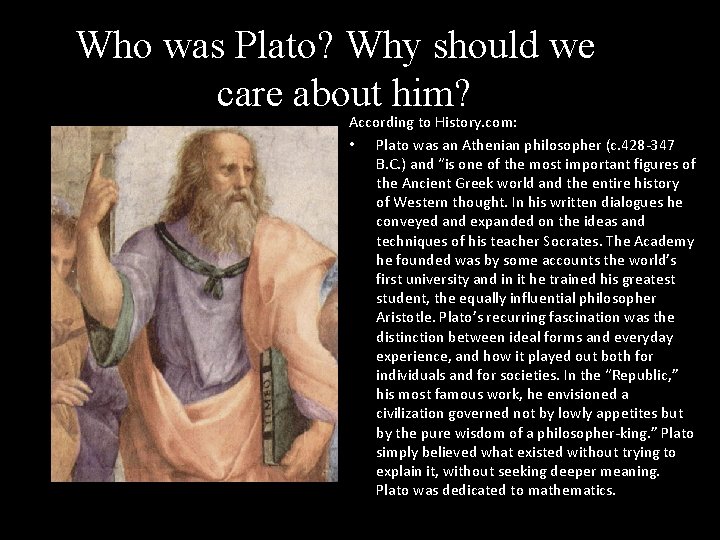
Who was Plato? Why should we care about him? According to History. com: • Plato was an Athenian philosopher (c. 428 -347 B. C. ) and “is one of the most important figures of the Ancient Greek world and the entire history of Western thought. In his written dialogues he conveyed and expanded on the ideas and techniques of his teacher Socrates. The Academy he founded was by some accounts the world’s first university and in it he trained his greatest student, the equally influential philosopher Aristotle. Plato’s recurring fascination was the distinction between ideal forms and everyday experience, and how it played out both for individuals and for societies. In the “Republic, ” his most famous work, he envisioned a civilization governed not by lowly appetites but by the pure wisdom of a philosopher-king. ” Plato simply believed what existed without trying to explain it, without seeking deeper meaning. Plato was dedicated to mathematics.
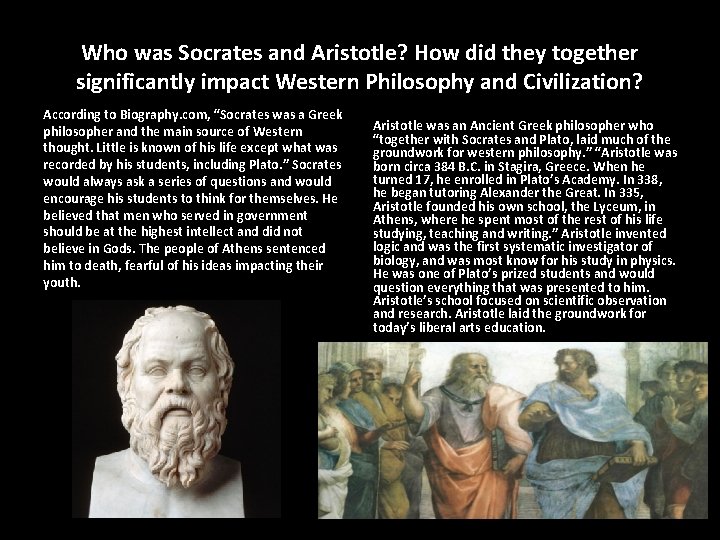
Who was Socrates and Aristotle? How did they together significantly impact Western Philosophy and Civilization? According to Biography. com, “Socrates was a Greek philosopher and the main source of Western thought. Little is known of his life except what was recorded by his students, including Plato. ” Socrates would always ask a series of questions and would encourage his students to think for themselves. He believed that men who served in government should be at the highest intellect and did not believe in Gods. The people of Athens sentenced him to death, fearful of his ideas impacting their youth. Aristotle was an Ancient Greek philosopher who “together with Socrates and Plato, laid much of the groundwork for western philosophy. ” “Aristotle was born circa 384 B. C. in Stagira, Greece. When he turned 17, he enrolled in Plato’s Academy. In 338, he began tutoring Alexander the Great. In 335, Aristotle founded his own school, the Lyceum, in Athens, where he spent most of the rest of his life studying, teaching and writing. ” Aristotle invented logic and was the first systematic investigator of biology, and was most know for his study in physics. He was one of Plato’s prized students and would question everything that was presented to him. Aristotle’s school focused on scientific observation and research. Aristotle laid the groundwork for today’s liberal arts education.
Why study theatre? 2. Theatre as a social force • In Plato’s writing, The Republic, he stated that: • People are once removed from the ideal / God (we are merely an imitation of the ideal). • Art is therefore an imitation of the ideal… thus three times removed from reality / ideal. • In Aristotle’s writings, the Poetics, (c. 335 B. C. ), he suggested that "tragedy" came from a natural tendency of humans to imitate. • All poetry, Aristotle argues, is imitation or mimesis. Aristotle imagines that poetry springs from a basic human delight in imitation. Humans learn through imitating and take pleasure in looking at imitations of the perceived world. • The imitative dimension of the poetic arts, according to Aristotle, is always representational; he does not seem to recognize anything like the twentieth-century concept of "abstract" art. • Aristotle believes that drama is an "imitation of an action. " • He wanted to look at it objectively…what it is, what it does, how it does it.
Why study theatre? 2. Theatre as a social force – Actors were often denied the sacrament, as theatre was thought to be immoral. • The sacrament was a religious ceremony or act of the Christian Church that is regarded as an outward and visible sign of inward and spiritual divine grace, in particular. – Some famous examples of actors who were impacted by their profession throughout history include: • Molière, a famous French playwright and actor who is considered to be one of the greatest masters of comedy in Western literature. Molière was denied the sacrament after collapsing on stage during one of his plays in 1673. King Louis the 14 th, had to intervene to grant Molière a Christian burial. • Molière’s most famous play is Tartuffe. • The Little Church around the Corner, in New York City, was for quite a while the only church in New York that performers were accepted. • Justinian, a holy Roman emperor, married Theodora only after she denounced her profession, which was an actress.
Why study theatre? 2 a. Theatre as education - a social force Didactic Definition (according to the Oxford Dictionary) di·dac·tic [dīˈdaktik] – Is an ADJECTIVE – The word means intended to teach, particularly in having moral instruction as an ulterior motive. • “A didactic novel that set out to expose social injustice. " – Synonyms: instructive · instructional · educative · informational · improving · perceptive · moralistic – The word can also mean, in the manner of a teacher, particularly so as to treat someone in a patronizing way. • “Slow-paced, didactic lecturing. “ • Patronizing means to treat someone with an apparent kindness that betrays a feeling of superiority – "“She's a good-hearted girl, ” he said in a patronizing voice. "
Why study theatre? 2 a. Theatre as education - a social force Theatre has often been used primarily as a teaching mechanism – throughout history theatre has often been a primary means of teaching. – For example: • Medieval theatre taught about the Bible and Christianity • The Blue Blouse troupes in Russia taught about how to be a good communist • Shakespeare's histories can be seen as defending the Elizabethan monarchy [according to Eric Bentley]. – Eric Russell Bentley is a British-born American critic, playwright, singer, editor and translator. When theatre is used as a "weapon" for social / political change, as propaganda, is can be called "agit-prop" (or agitprop, for agitation propaganda). – Two agitprop theatre companies still active are: • El teatro campasino (Luis Valdez, director) • Bread and Puppet Theatre (Peter Shumann, director)
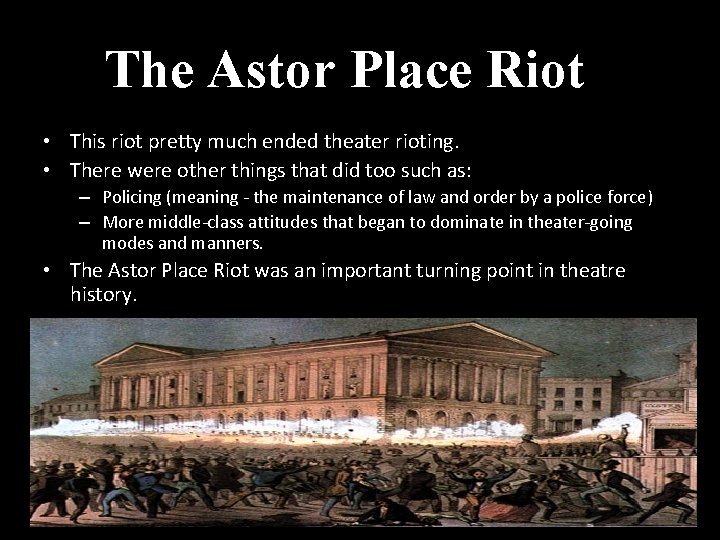
Why study theatre? 2 b. Theatre as influencer and reflector of social values Theatre does not need to have social purpose or effect, but it has caused riots: – A simple spat between rival actors turned into what's now known as the Astor Place Riot. – The Astor Place Riot occurred on May 10, 1849 at the now-demolished Astor Opera House in Manhattan, New York City and left at least 25 dead and more than 120 injured. – According to theater historian, Bruce Mc. Conachie, Macbeth was being performed at theatre and the two rival Macbeth’s who started this riot was the English master William Charles Mc. Cready versus the American Edwin Forrest. – Their rivalry had been simmering for several years. Both were international stars, both had toured to each other's countries. Forrest, in 1845, had hissed at Macready in Edinburgh. Macready was not too interested in engaging in this rivalry and was trying to avoid it, but Forrest wanted to press his point. So when Macready had his own tour to New York in 1849, Forrest's followers decided to avenge their hero and they're the ones that put together the riot.
The Astor Place Riot • Riots in those days, especially in theaters, were planned ahead of time. And they were usually intended to oppose a specific policy at theater, not always a rival actor, sometimes a stage manager or even a piece of music that might have been played and ruffled the patriotic feathers in the audience. People would break up some furniture, throw things at the stage, and then retire, go home to their dinners, and theater manager would take care of the problem and life would go on.
The Astor Place Riot What happened on May 10 th? • Forrest's supporters gathered their forces outside the hated Astor Place Opera House. They used Macready's performance as a means of protesting what they took to be elitist privileges in New York City. • This was an opera house that had been built two years before and they had special dress codes, higher prices, so a lot of the rest of the population couldn't get into the opera house. • So Macready became a symbol of English oppression, of aristocratic privilege. • Most of the protestors were just using their hands and throwing some things at the stage to get Macready to apologize for even being there. Macready did leave but the rioting continued, and finally the state militia was called up and brought in. They came to Astor Place Square, fired over the heads of a lot of the rioters, and ended up killing 22 onlookers.
The Astor Place Riot • This riot pretty much ended theater rioting. • There were other things that did too such as: – Policing (meaning - the maintenance of law and order by a police force) – More middle-class attitudes that began to dominate in theater-going modes and manners. • The Astor Place Riot was an important turning point in theatre history.
Why study theatre? 2 b. Theatre as influencer and reflector of social values Some other theatre riots included: – Victor Hugo's play, Hernani (1830) • His play caused riots because it was not a true "neoclassical" play. • According to the Drama Online Library, a neoclassical play was the “concept of drama that originated in the writings of 15 th century Italian scholars and came to dominate the stage in 17 th- and 18 th-century France. ” “Neoclassical theorists advocated a return to the values and conventions of classical Greek drama as these were then understood. In particular, they ascribed a great importance to the Poetics of Aristotle, and to the unities of time, place, and action that they gathered from this work. ” – "Waiting for Lefty, " (Clifford Odets's play from the 1930's), el teatro campasino, and the Bread and Puppet Theatre have had some kind of "influence“ on society. To reflect social values, some plays have actually been changed: – In 1818, Thomas Bowdler, M. D. , published the "Family Shakespeare" omitting "those words and expressions which cannot with propriety be read aloud in the family. "
Why study theatre? 3. Theatre as a personal force – Personal commitment to preparing a show – Teamwork – Concern feeling of community in endeavoring to do a job well – Personal satisfaction – Build and develop character (interpersonal skills) – Creativity – Critical thinking – Self-direction – A part of life-long learning
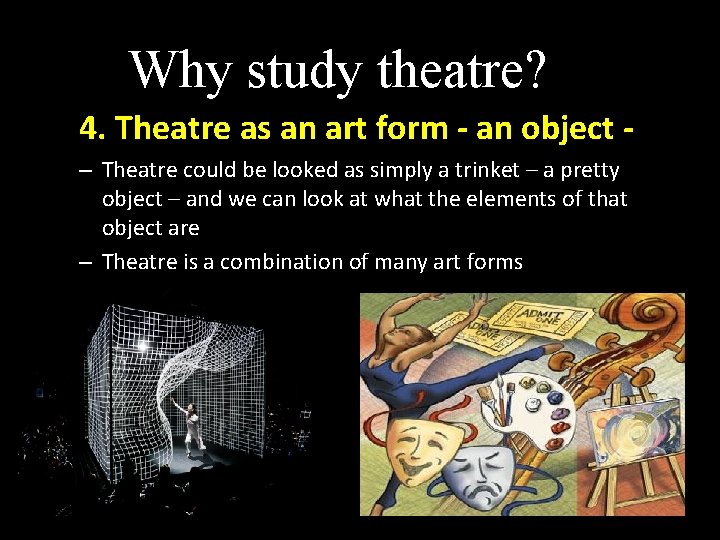
Why study theatre? 4. Theatre as an art form - an object – Theatre could be looked as simply a trinket – a pretty object – and we can look at what the elements of that object are – Theatre is a combination of many art forms
Works Citied Aristotle. (2017, July 08). Retrieved July 29, 2017, from https: //www. biography. com/people/aristotle-9188415? _escaped_fragment_= Astor Place: rocked by a deadly riot. (2009, September 14). Retrieved July 29, 2017, from https: //ephemeralnewyork. wordpress. com/2009/09/14/astor-place-rocked-by-a -deadly-riot/ Bloomsbury Publishing Plc. (2011). Neoclassical. Retrieved July 29, 2017, from http: //www. dramaonlinelibrary. com/periods/neoclassical-iid-2349 History. com Staff. (2009). Plato. Retrieved July 29, 2017, from http: //www. history. com/topics/ancient-history/plato Kraut, R. (n. d. ). Socrates. Retrieved July 29, 2017, from https: //www. britannica. com/biography/Socrates
Works Citied Mcconachie, B. (Ed. ). (2006, May 13). Remembering New York City's Opera Riots. Retrieved July 29, 2017, from http: //www. npr. org/templates/story. php? story. Id=5402902 Oxford Dictionaries - Dictionary, Thesaurus, & Grammar. (n. d. ). Retrieved July 29, 2017, from https: //en. oxforddictionaries. com/ Plato Phaedrus. (n. d. ). Retrieved July 29, 2017, from http: //imgarcade. com/platophaedrus. html Santinelli, S. (2014, November 26). Hakanaï – an intriguing and innovative contemporary art form. Retrieved July 29, 2017, from http: //oneeurope. net/hakana%C 3%AF-an-intriguing-and-innovative-contemporary-art-form Timmons, G. (2017, April 28). Socrates. Retrieved July 29, 2017, from https: //www. biography. com/people/socrates-9488126? _escaped_fragment_=