
What is the WHT anyway and why are
![Small[1]. file "s_1. c" . version "01. 01" gcc 2_compiled. : . text. align](https://slidetodoc.com/presentation_image/53db8002a2a8cc2d74b25785afa95793/image-19.jpg "Small[1]. file \"s_1. c\" . version \"01. 01\" gcc 2_compiled. : . text. align")
- Slides: 26
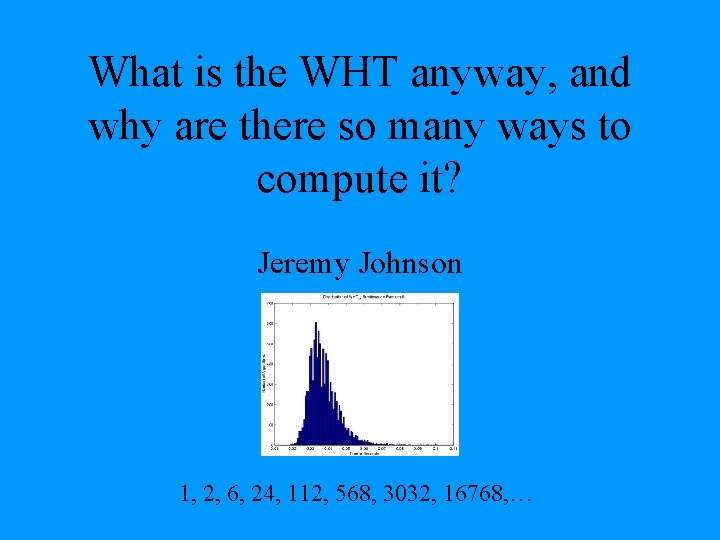
What is the WHT anyway, and why are there so many ways to compute it? Jeremy Johnson 1, 2, 6, 24, 112, 568, 3032, 16768, …
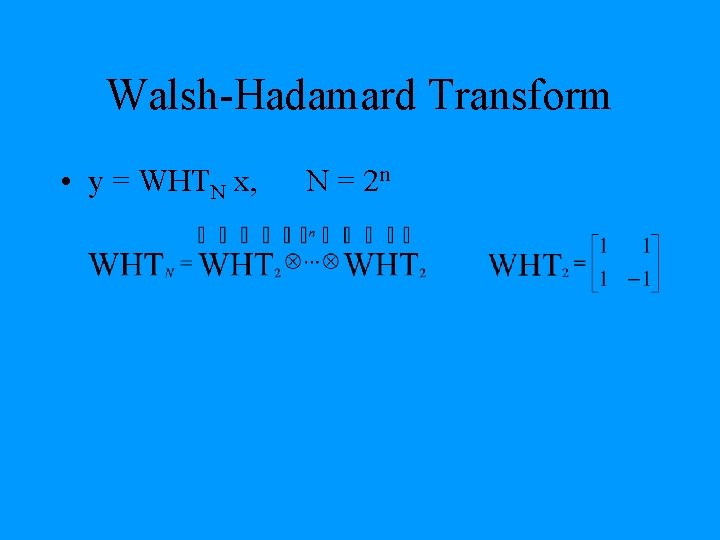
Walsh-Hadamard Transform • y = WHTN x, N = 2 n
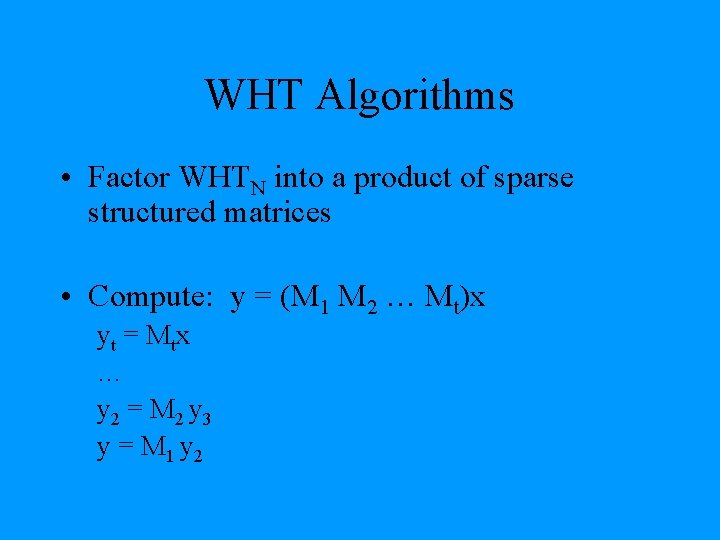
WHT Algorithms • Factor WHTN into a product of sparse structured matrices • Compute: y = (M 1 M 2 … Mt)x yt = Mtx … y 2 = M 2 y 3 y = M 1 y 2
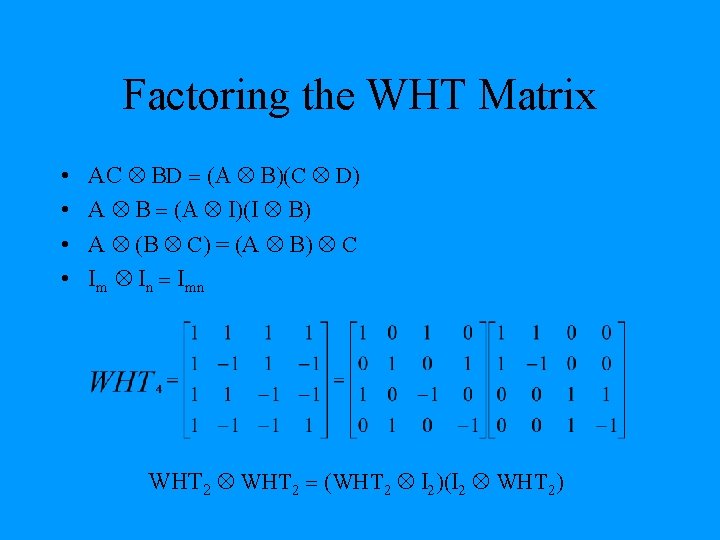
Factoring the WHT Matrix • • AC BD = (A B)(C D) A B = (A I)(I B) A (B C) = (A B) C Im In = Imn WHT 2 = (WHT 2 I 2)(I 2 WHT 2)
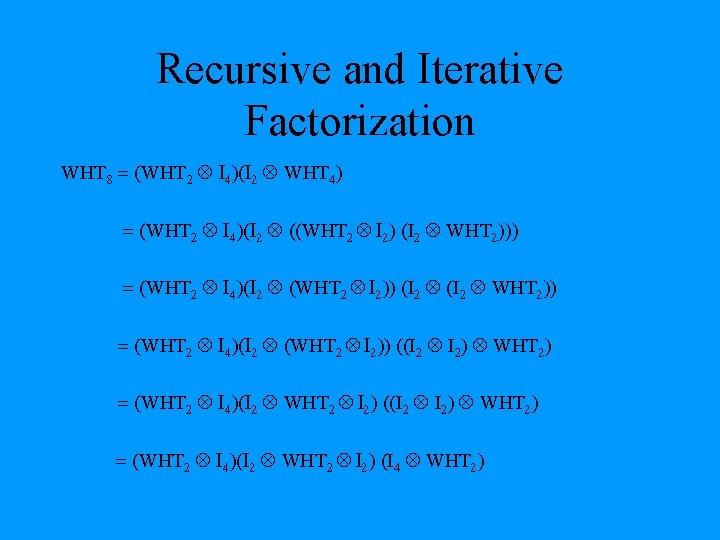
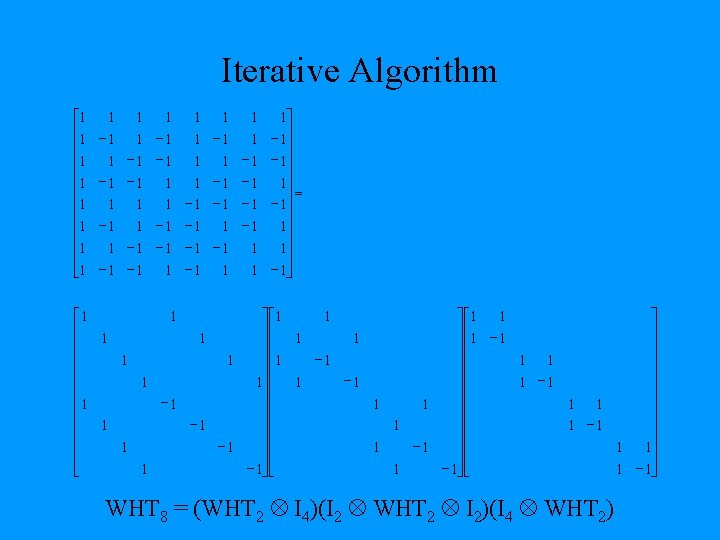
Recursive and Iterative Factorization WHT 8 = (WHT 2 I 4)(I 2 WHT 4) = (WHT 2 I 4)(I 2 ((WHT 2 I 2) (I 2 WHT 2))) = (WHT 2 I 4)(I 2 (WHT 2 I 2)) (I 2 WHT 2)) = (WHT 2 I 4)(I 2 (WHT 2 I 2)) ((I 2 I 2) WHT 2) = (WHT 2 I 4)(I 2 WHT 2 I 2) (I 4 WHT 2)
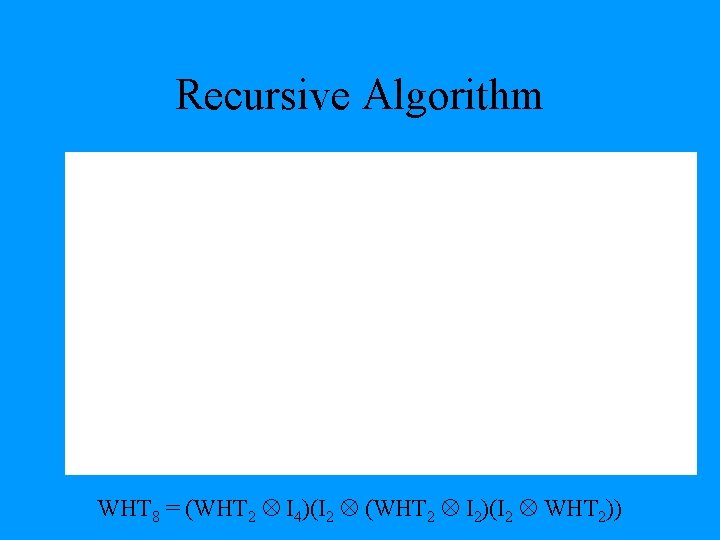
Recursive Algorithm WHT 8 = (WHT 2 I 4)(I 2 (WHT 2 I 2)(I 2 WHT 2))
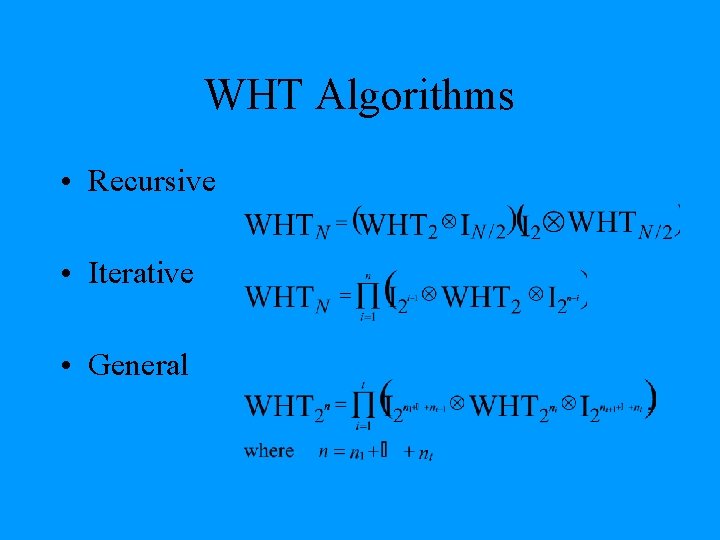
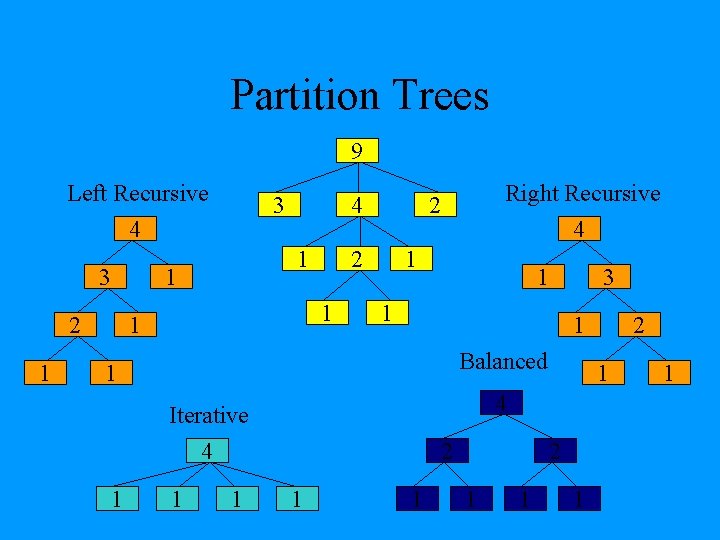
WHT Algorithms • Recursive • Iterative • General
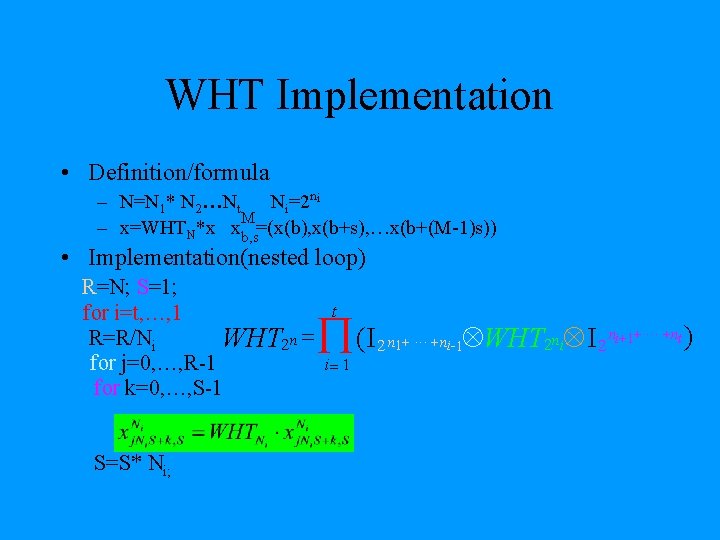
WHT Implementation • Definition/formula – N=N 1* N 2 Nt Ni=2 ni M – x=WHTN*x xb, s=(x(b), x(b+s), …x(b+(M-1)s)) • Implementation(nested loop) R=N; S=1; for i=t, …, 1 R=R/Ni WHT 2 n = for j=0, …, R-1 for k=0, …, S-1 S=S* Ni; t Õ (I i= 1 WHT 2 n i I 2 ni+1+ ··· +nt) 2 n 1+ ··· +ni-1
Partition Trees 9 Left Recursive 3 4 3 1 1 1 2 4 2 1 1 Right Recursive 2 4 1 1 Balanced 1 1 1 2 1 4 Iterative 4 1 3 1 1
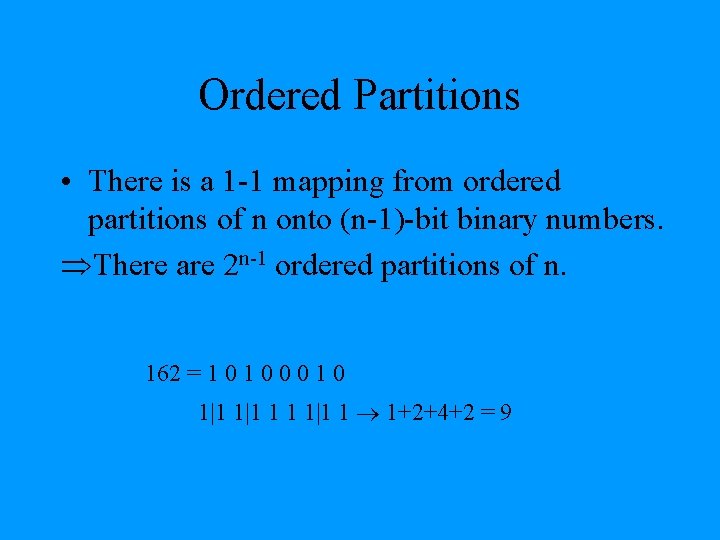
Ordered Partitions • There is a 1 -1 mapping from ordered partitions of n onto (n-1)-bit binary numbers. ÞThere are 2 n-1 ordered partitions of n. 162 = 1 0 0 0 1|1 1 1 1|1 1 1+2+4+2 = 9
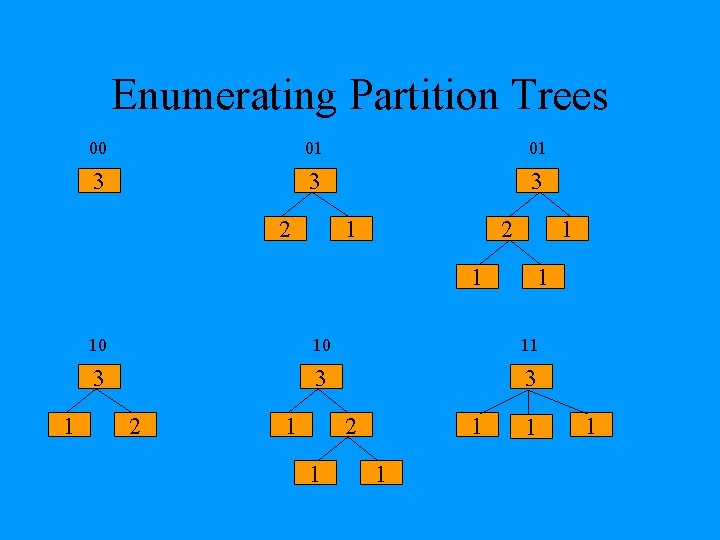
Enumerating Partition Trees 00 01 01 3 3 3 2 1 1 10 10 11 3 3 3 2 1 1 1
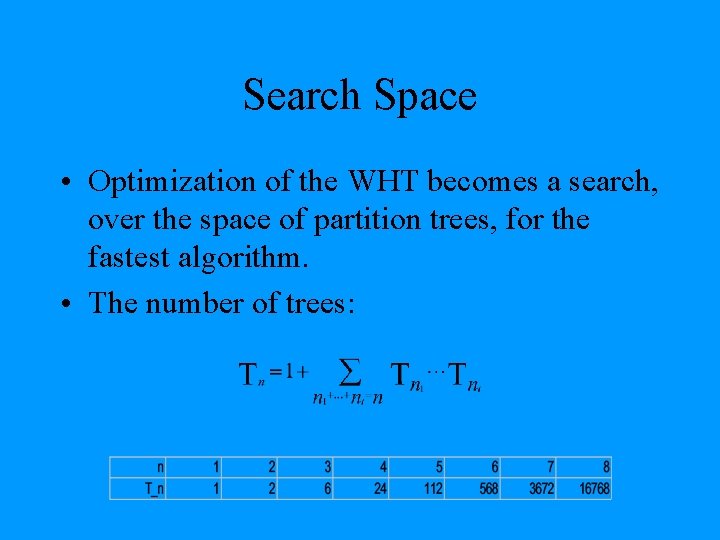
Search Space • Optimization of the WHT becomes a search, over the space of partition trees, for the fastest algorithm. • The number of trees:
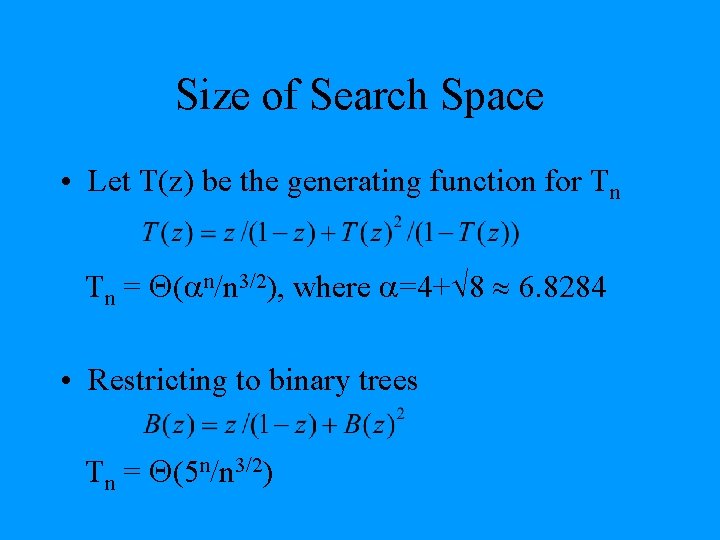
Size of Search Space • Let T(z) be the generating function for Tn Tn = ( n/n 3/2), where =4+ 8 6. 8284 • Restricting to binary trees Tn = (5 n/n 3/2)
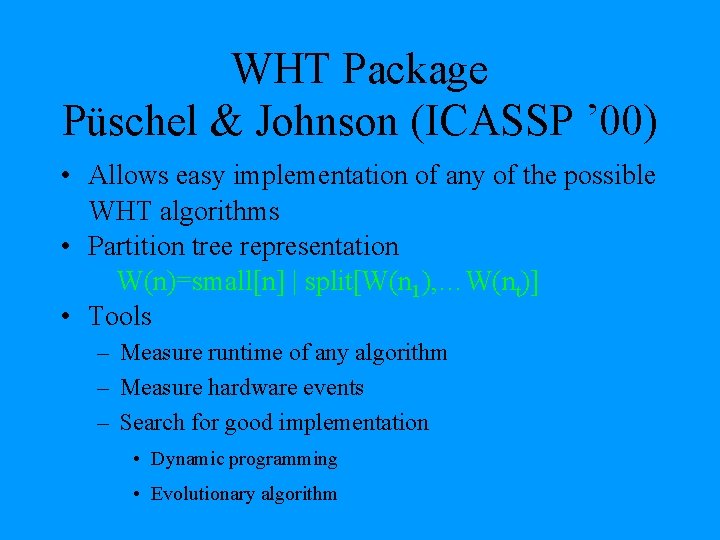
WHT Package Püschel & Johnson (ICASSP ’ 00) • Allows easy implementation of any of the possible WHT algorithms • Partition tree representation W(n)=small[n] | split[W(n 1), …W(nt)] • Tools – Measure runtime of any algorithm – Measure hardware events – Search for good implementation • Dynamic programming • Evolutionary algorithm
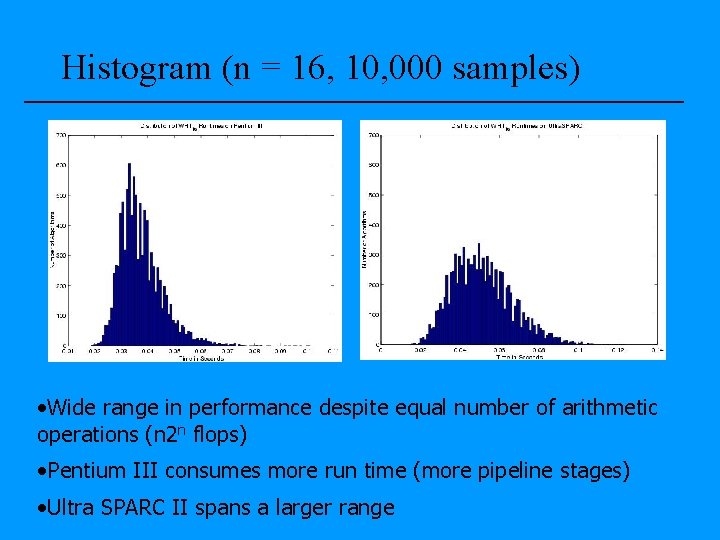
Histogram (n = 16, 10, 000 samples) • Wide range in performance despite equal number of arithmetic operations (n 2 n flops) • Pentium III consumes more run time (more pipeline stages) • Ultra SPARC II spans a larger range
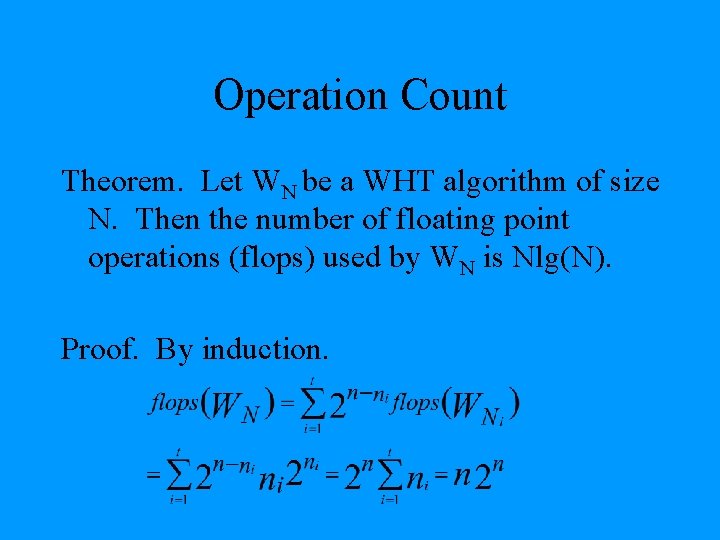
Operation Count Theorem. Let WN be a WHT algorithm of size N. Then the number of floating point operations (flops) used by WN is Nlg(N). Proof. By induction.
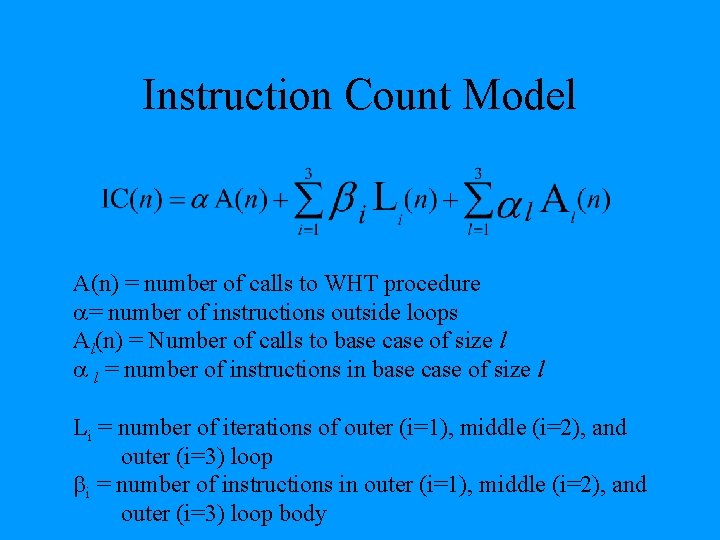
Instruction Count Model A(n) = number of calls to WHT procedure = number of instructions outside loops Al(n) = Number of calls to base case of size l l = number of instructions in base case of size l Li = number of iterations of outer (i=1), middle (i=2), and outer (i=3) loop i = number of instructions in outer (i=1), middle (i=2), and outer (i=3) loop body
Small[1]. file "s_1. c" . version "01. 01" gcc 2_compiled. : . text. align 4. globl apply_small 1. type apply_small 1, @function apply_small 1: movl 8(%esp), %edx //load stride S to EDX movl 12(%esp), %eax //load x array's base address to EAX fldl (%eax) // st(0)=R 7=x[0] fldl (%eax, %edx, 8) //st(0)=R 6=x[S] fld %st(1) //st(0)=R 5=x[0] fadd %st(1), %st // R 5=x[0]+x[S] fxch %st(2) //st(0)=R 5=x[0], s(2)=R 7=x[0]+x[S] fsubp %st, %st(1) //st(0)=R 6=x[S]-x[0] ? ? ? fxch %st(1) //st(0)=R 6=x[0]+x[S], st(1)=R 7=x[S]-x[0] fstpl (%eax) //store x[0]=x[0]+x[S] fstpl (%eax, %edx, 8) //store x[0]=x[0]-x[S] ret
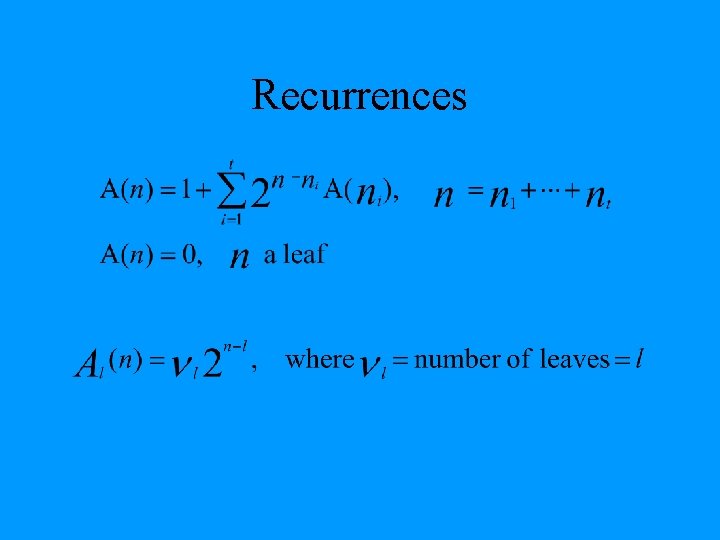
Recurrences
Recurrences
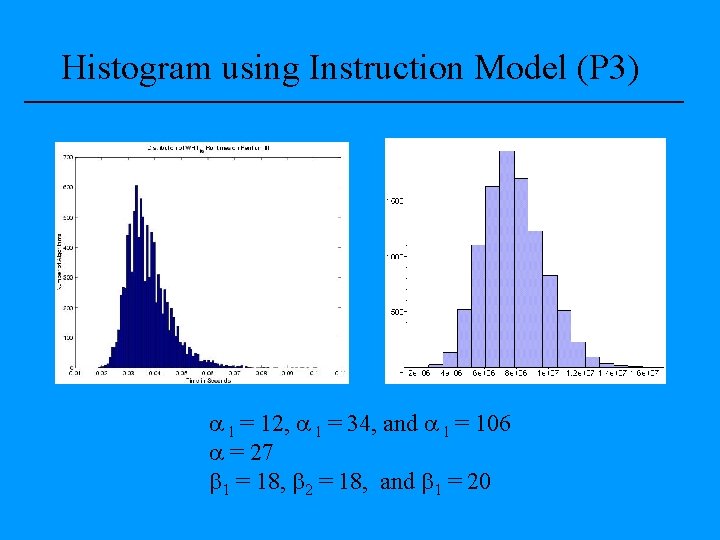
Histogram using Instruction Model (P 3) l = 12, l = 34, and l = 106 = 27 1 = 18, 2 = 18, and 1 = 20
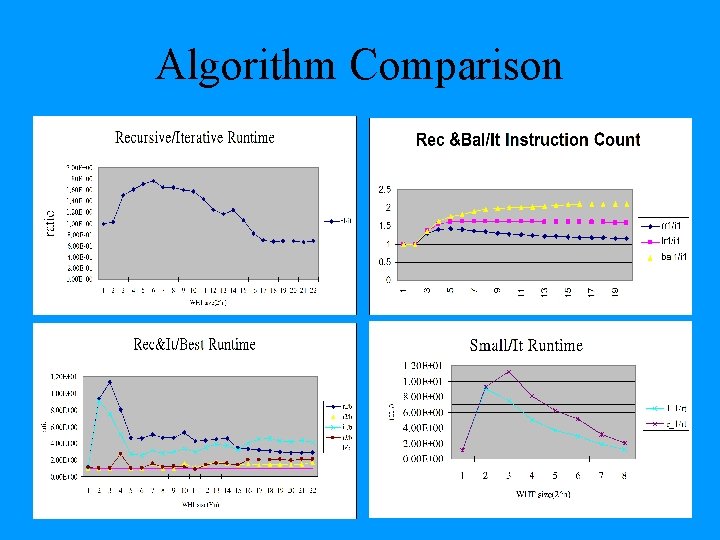
Algorithm Comparison
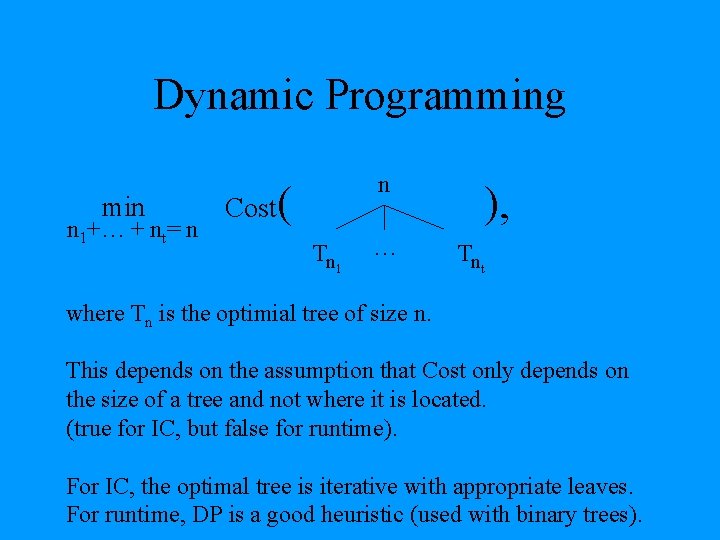
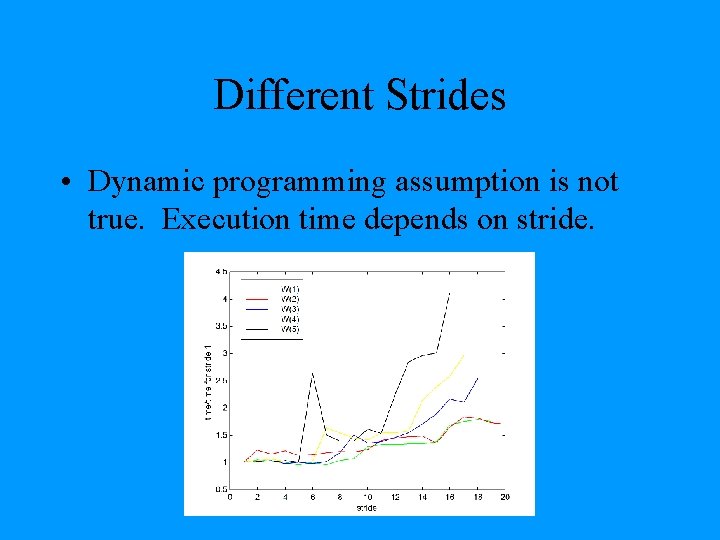
Dynamic Programming min n 1+… + nt= n n Cost( Tn … 1 ), Tnt where Tn is the optimial tree of size n. This depends on the assumption that Cost only depends on the size of a tree and not where it is located. (true for IC, but false for runtime). For IC, the optimal tree is iterative with appropriate leaves. For runtime, DP is a good heuristic (used with binary trees).
Different Strides • Dynamic programming assumption is not true. Execution time depends on stride.