
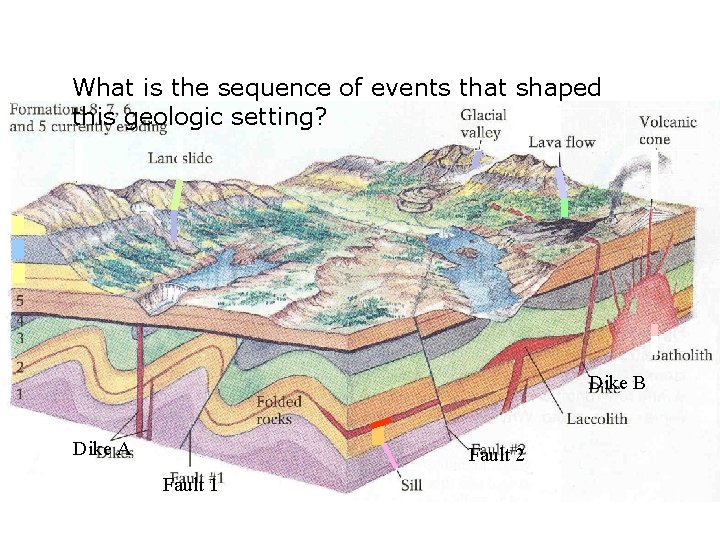
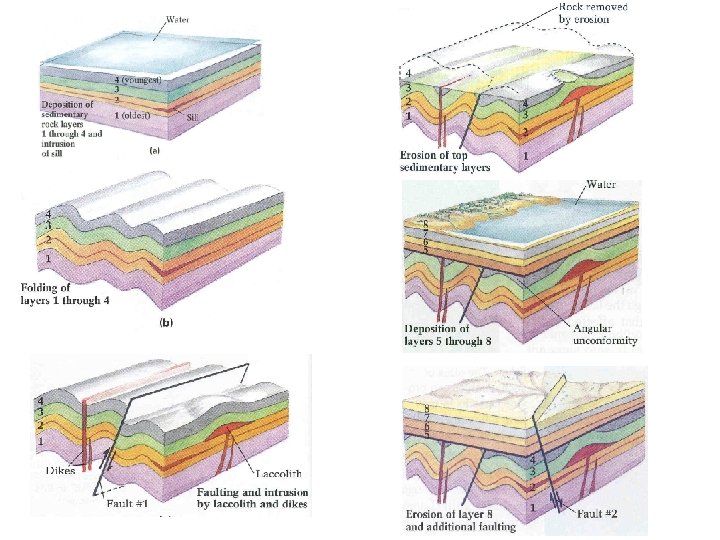
What is the sequence of events that shaped
- Slides: 18
What is the sequence of events that shaped this geologic setting? Dike B Dike A Fault 2 Fault 1
TODAY: Chapter 10 Part 2 Geologic Time 1. 3) Fossils as time-pieces 2. 4) Absolute dating w/ radioactivity 3. 5) Geologic time scale 6)Regional correlation of rock layers
3. Fossils as timepieces u Fossils William Smith (late 1700 s) noted that sedimentary strata in widely separated area could be identified and correlated by their distinctive fossil content èfossil organisms succeed each other in systematic fashion, always in order e. g. , age of trilobites, age of fishes, age of reptiles, age of mammals èany time period can be determined by fossil content “principle of fossil succession”
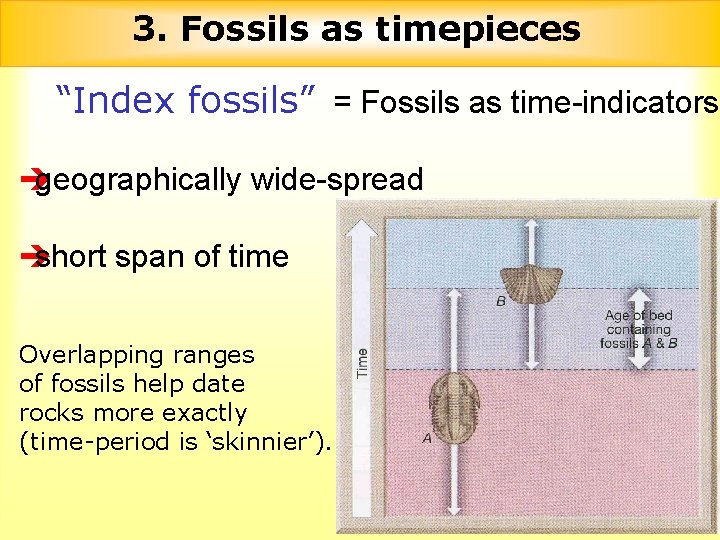
3. Fossils as timepieces “Index fossils” = Fossils as time-indicators è geographically wide-spread è short span of time Overlapping ranges of fossils help date rocks more exactly (time-period is ‘skinnier’).
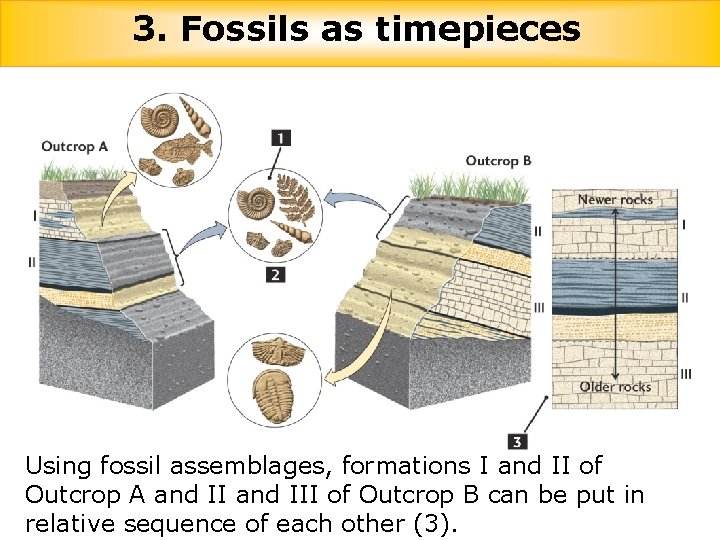
3. Fossils as timepieces Using fossil assemblages, formations I and II of Outcrop A and III of Outcrop B can be put in relative sequence of each other (3).
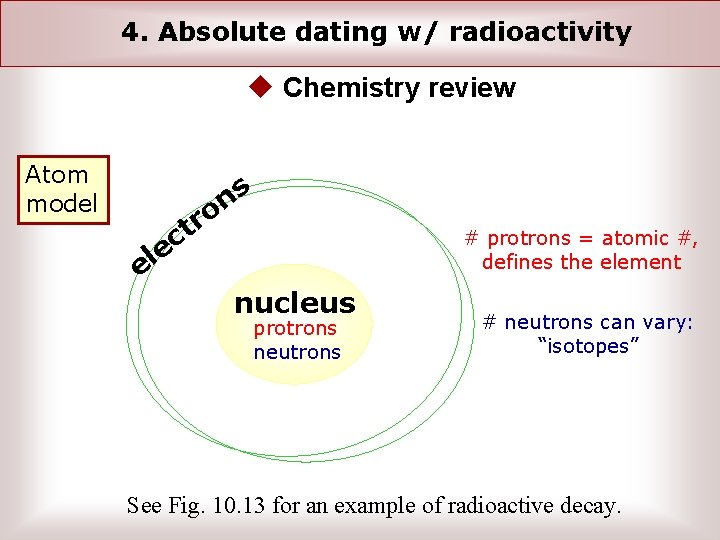
4. Absolute dating w/ radioactivity u Chemistry review Atom model s n o r t ec # protrons = atomic #, defines the element el nucleus protrons neutrons # neutrons can vary: “isotopes” See Fig. 10. 13 for an example of radioactive decay.
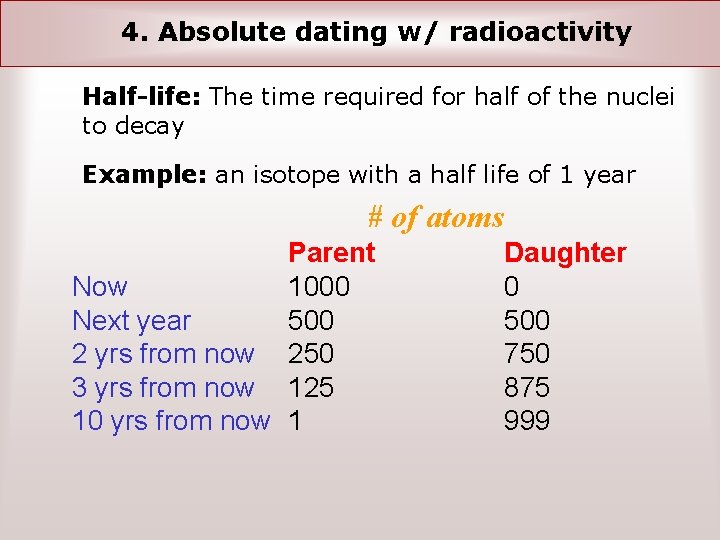
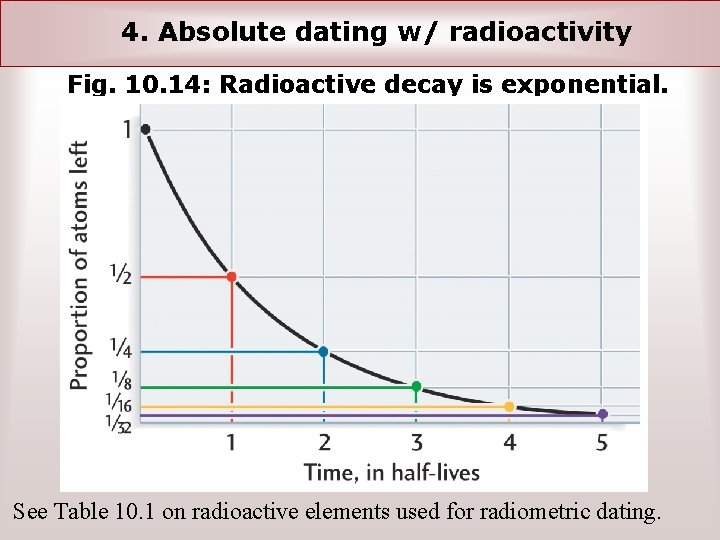
4. Absolute dating w/ radioactivity Half-life: The time required for half of the nuclei to decay Example: an isotope with a half life of 1 year # of atoms Parent Now 1000 Next year 500 2 yrs from now 250 3 yrs from now 125 10 yrs from now 1 Daughter 0 500 750 875 999
4. Absolute dating w/ radioactivity Fig. 10. 14: Radioactive decay is exponential. See Table 10. 1 on radioactive elements used for radiometric dating.
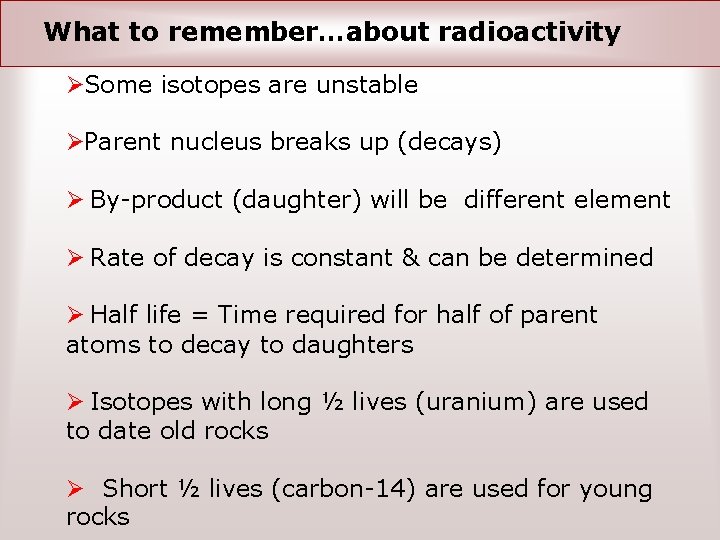
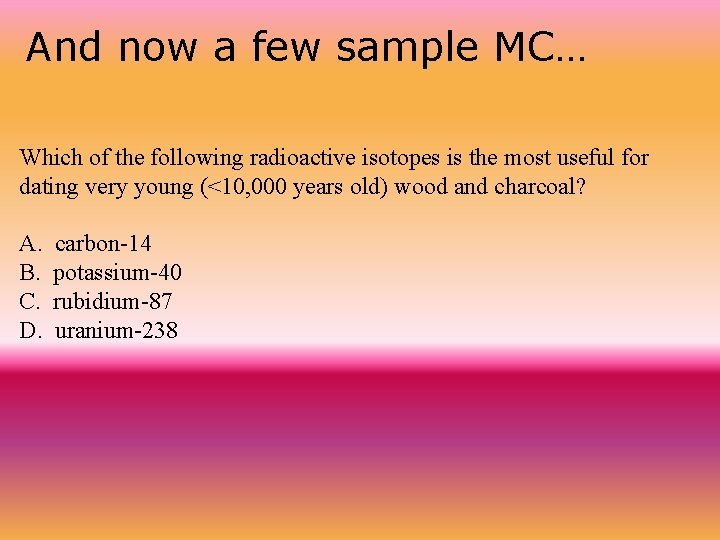
What to remember…about radioactivity Ø Some isotopes are unstable Ø Parent nucleus breaks up (decays) Ø By-product (daughter) will be different element Ø Rate of decay is constant & can be determined Ø Half life = Time required for half of parent atoms to decay to daughters Ø Isotopes with long ½ lives (uranium) are used to date old rocks Ø Short ½ lives (carbon-14) are used for young rocks
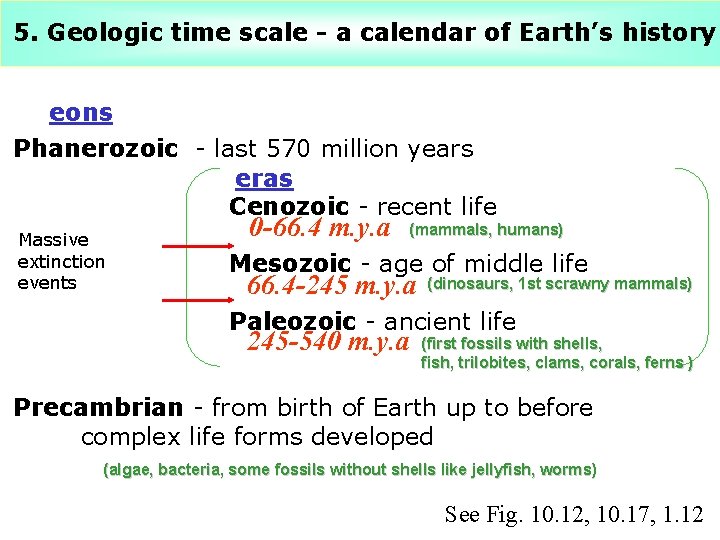
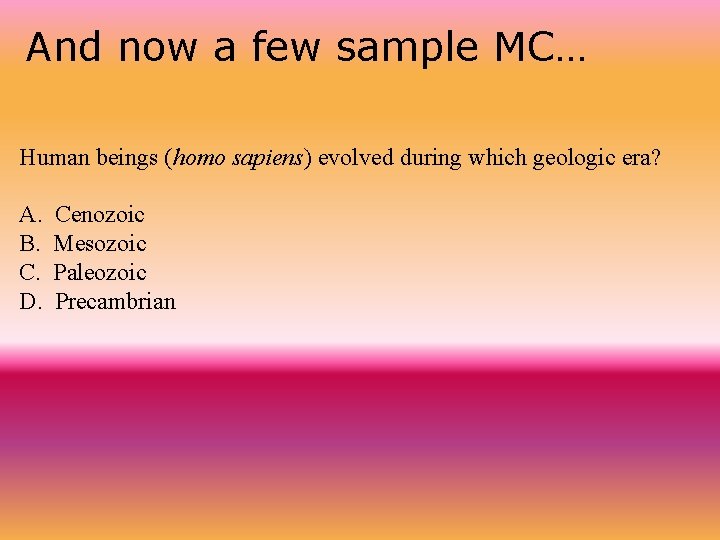
5. Geologic time scale - a calendar of Earth’s history eons Phanerozoic - last 570 million years eras Cenozoic - recent life Massive extinction events 0 -66. 4 m. y. a (mammals, humans) Mesozoic - age of middle life 66. 4 -245 m. y. a (dinosaurs, 1 st scrawny mammals) Paleozoic - ancient life 245 -540 m. y. a (first fossils with shells, fish, trilobites, clams, corals, ferns ) Precambrian - from birth of Earth up to before complex life forms developed (algae, bacteria, some fossils without shells like jellyfish, worms) See Fig. 10. 12, 10. 17, 1. 12
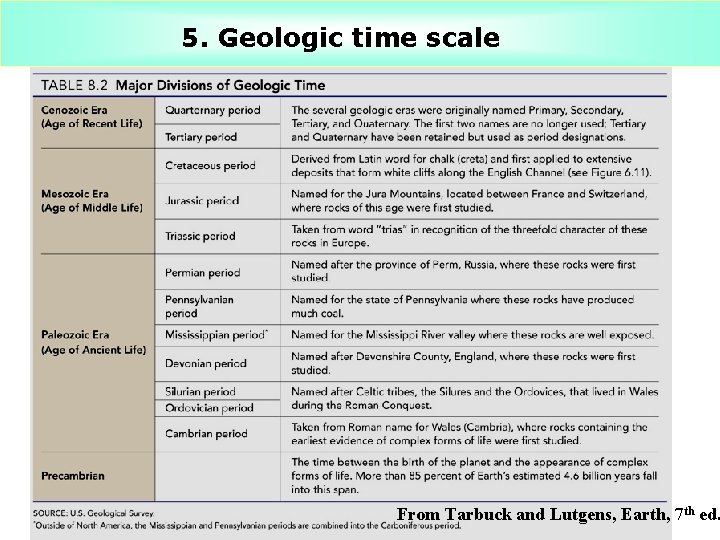
5. Geologic time scale From Tarbuck and Lutgens, Earth, 7 th ed.
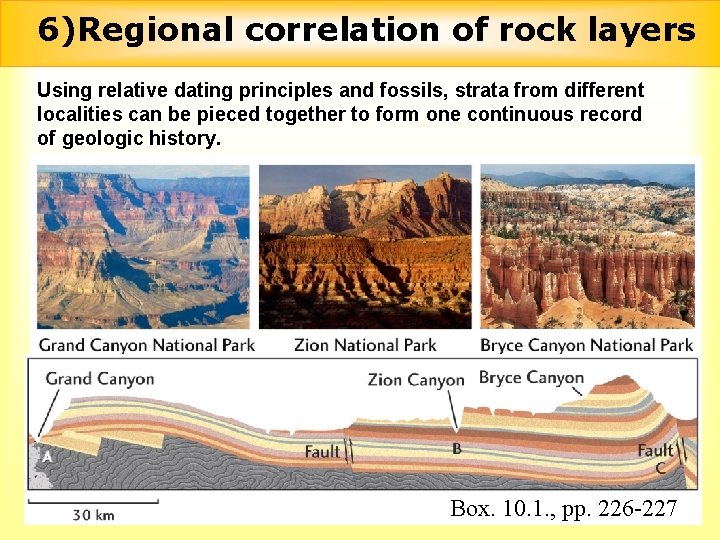
6)Regional correlation of rock layers Using relative dating principles and fossils, strata from different localities can be pieced together to form one continuous record of geologic history. Box. 10. 1. , pp. 226 -227
And now a few sample MC… The principle of superposition states that _____. A. a fault is younger than the rocks it cuts B. sediments are deposited as essentially horizontal layers C. the present is the key to the past D. undisturbed sedimentary layers get progressively younger from bottom
And now a few sample MC… What is an unconformity? A. a gap in the geologic record B. a period of deposition C. a sedimentary layer of variable thickness D. a sequence of deformed rocks
And now a few sample MC… The study of faunal succession allows _____. A. absolute dating of fossil-bearing strata B. correlation of marine fossils with modern mammals C. reconstruction of paleoclimates D. rocks to be correlated from different outcrops
And now a few sample MC… Which of the following radioactive isotopes is the most useful for dating very young (<10, 000 years old) wood and charcoal? A. carbon-14 B. potassium-40 C. rubidium-87 D. uranium-238
And now a few sample MC… Human beings (homo sapiens) evolved during which geologic era? A. Cenozoic B. Mesozoic C. Paleozoic D. Precambrian