
What is the role of imagery in memory








- Slides: 30
What is the role of imagery in memory? 1. Mental images vary in purpose 2. Mental images vary in amount of detail they contain 3. Mental images vary in how long they last 4. As a result, mental images vary in their role in memory. 6/7/2021
The basic idea: What do you think of when I say, “Cat? ” Probably, “Dog. ” But which dog? A specific image? Or a general image which captures some essential ‘dogness’? 6/7/2021
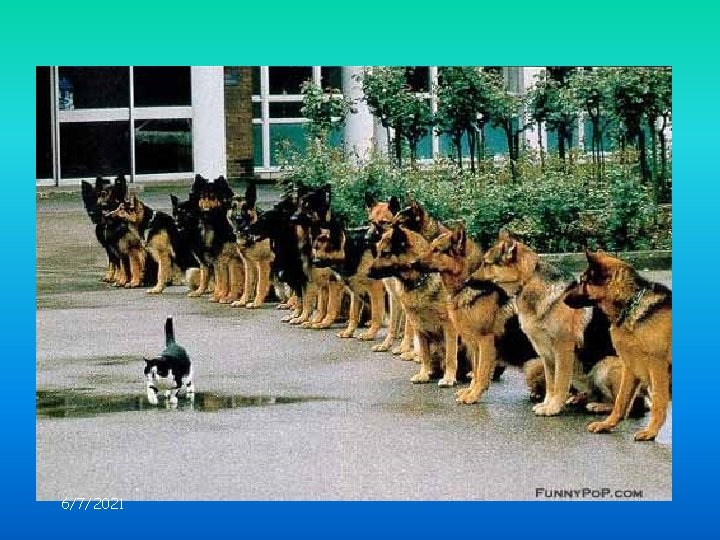
Dog vs. “Dog” In the next slide, notice that every dog is different in some way. They vary in colour, in posture, even in size a little bit. Yet, there is some general ‘dogness’ on display, as well. That suggests two ways we can represent things. 6/7/2021
6/7/2021
Two ways we can represent things As a specific object in a specific location, with great detail Useful for controlling specific responses (e. g. picking up a given cup in a given location) Does not generalize well (e. g. , handle on next cup may be thinner than handle on this cup) Store only long enough to execute response. 6/7/2021
Two ways to represent things 2. As a general object, with less detail Contains information that may be relevant in a similar but not identical situation E. g. , are cups as delicate as soap bubbles? How do dogs behave when you reach for the milkbones? These we may store for years. 6/7/2021
Two ways to represent things Each of these ways has its own purpose. • To behave towards some object in the world, you need a detailed representation of that specific object – size, shape, location, texture… • To learn a lesson for future reference, or make a plan, you need a less detailed (visual) representation which generalizes better. 6/7/2021
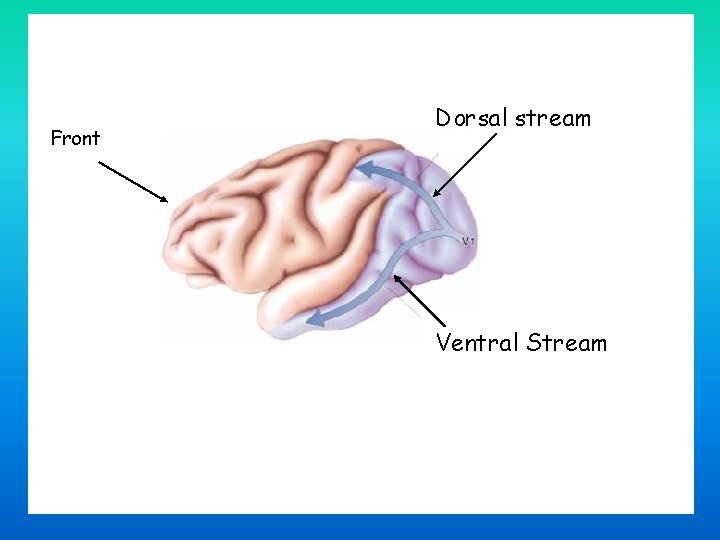
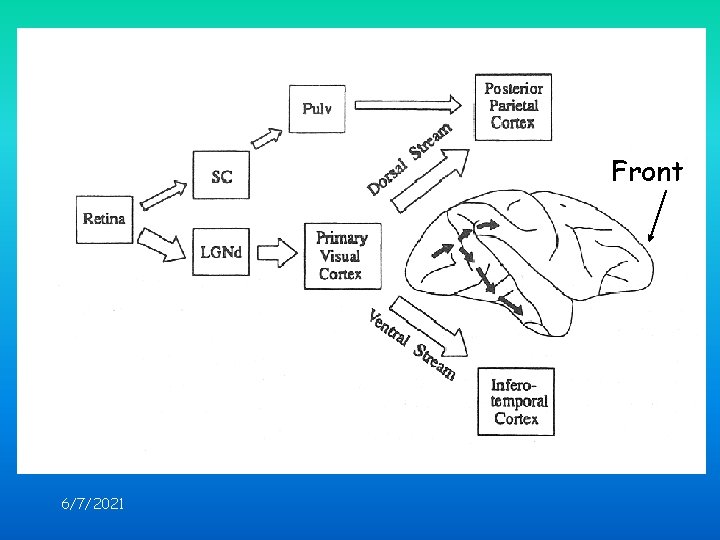
Two visual systems Milner & Goodale (1995) Humans have two separate (though interacting) visual systems: – Dorsal stream, responsible for visually-guided action. – Ventral stream, responsible for visual perception. – Mel Goodale is a professor at Western 6/7/2021
Front Dorsal stream Ventral Stream 6/7/2021
Front 6/7/2021
Dorsal stream Milner & Goodale argue that visual system evolved originally for control of action, not for conscious perception. Question: what does seeing add to our survival capacity? Dorsal stream produces very detailed repns. These repns. do not last very long. Why? Dorsal stream terminates near motor area. 6/7/2021
Ventral stream provides information about what is out there. It produces our visual perception. – Less detailed than dorsal representations. – Output is a conclusion about what is out there. – Ventral stream terminates near memory centres. 6/7/2021
Two visual systems and illusions Ventral stream is susceptible to many illusions, but dorsal stream is not. Consider the Ebbinghaus Illusion on the next slide. People over- or under-estimate size of central circle verbally, but grip aperture for picking circles up is not susceptible to the illusion (Haffenden & Goodale, 2000). 6/7/2021
6/7/2021
Dorsal stream and memory • If Dorsal system was susceptible to illusion, our motor responses would fail • We need a good, reliable, internal representation of object dimensions and locations in order to act • But we only need it for a moment. Dorsal representations code aspects of a stimulus that are unlikely to be true next time you meet that stimulus. 6/7/2021
Ventral stream and memory 1. Ventral system eliminates unnecessary detail and computes our perception. That computation can go wrong, as in illusions. • Ventral representations code abstract, non -contingent object properties E. g. , there is a basic sofa-shape, true from one occasion to another, regardless of colour, texture, orientation. • These representations are worth retaining in memory. 6/7/2021
Ventral stream and memory So now we know that ventral stream representations contain less detail describe aspects of objects that will recur are worth remembering But is every recurrent aspect of a stimulus worth remembering? 6/7/2021
Which recurrent features should we store? The ones that make a difference. Nickerson & Adams (1979) U. S. students were poor at discriminating line drawing of a real dime from fakes. How many maple leaves on a Canadian penny? These characteristics are stable, but never influence a response. So, don’t store them. 6/7/2021
Which recurrent features should we store? Simons & Levin (1998) Change blindness – people don’t notice changes in visual scene after brief interruption (when the scene is of little importance) Again, characteristics are stable but don’t (usually) influence a response, so we don’t store them. An issue called continuity in movies. 6/7/2021
Imagery in memory We are now ready to discuss the role of imagery in memory. Among ventral representations, we can distinguish: • stable aspects of a familiar situation – e. g. , the sofa in your living room • general aspects of visual form e. g. , not your sofa, but sofas in general. 6/7/2021
Imagery in memory (1) Stable aspects of a familiar situation can be used deliberately to form associations to new material. E. g. , Method of Loci: associate to-be-learned material with familiar locations such as the rooms in your house. 6/7/2021
Imagery in memory (2) The most abstract forms are the most general (e. g. , not your sofa, but “sofas” in general). They have the least detail in them, so apply most widely to new situations. Because general, such forms are frequently experienced, so highly over-learned. 6/7/2021
Imagery in memory (2) Because they are overlearned, such forms can help us remember experiences, even when we don’t deliberately use mnemonics. The leading account of how this happens is Paivio’s Dual Code Theory. Like Goodale, Paivio was a professor at Western (retired a few years ago). 6/7/2021
Paivio’s Dual Code Theory • Imageable words are stored in two ways: as words and separately as images (pictures). • Episodic exposure more memorable for imageable than for non-imageable words. • To retrieve an imageable word from episodic memory, it suffices to retrieve either the word or the image. 6/7/2021
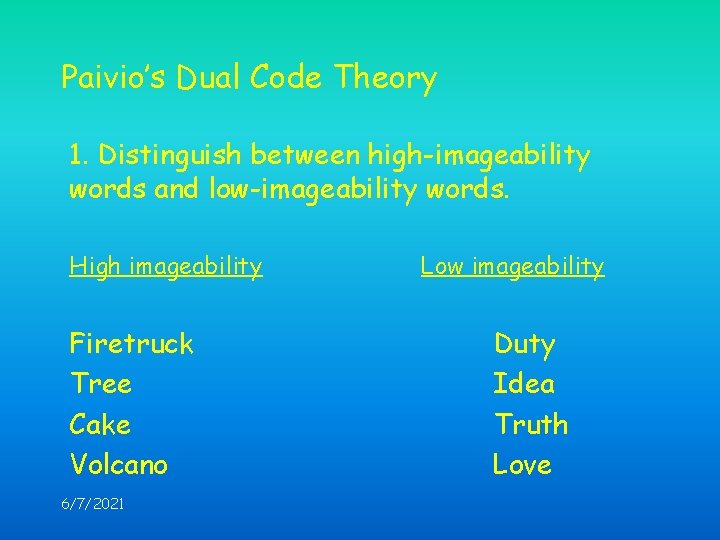
Paivio’s Dual Code Theory 1. Distinguish between high-imageability words and low-imageability words. High imageability Firetruck Tree Cake Volcano 6/7/2021 Low imageability Duty Idea Truth Love
Paivio’s Dual Code Theory 2. Compare recall for high- vs. lowimageability words. Paivio, Smythe, & Yuille (1968) Cued recall. Cue & target varied in imageability. Recall was best when both were high, worst when both were low, intermediate for one of each. 6/7/2021
Paivio’s Dual Code Theory In Method of Loci, there is no necessary connection between two associates (e. g. , hamburger and bathroom). connection must be made deliberately In Paivio’s study, pre-existing associations (e. g. , “tree” with image of tree) are used. 6/7/2021
Review: Detailed representations. support responding in a dynamic world valid (accurate as a description of the world) only on the time scale of seconds memory persists for a short time only 6/7/2021
Review: stable aspects of familiar situations contain less detail, but still distinguish individual objects/locations (e. g. , my sofa and yours) support activities that don’t require dynamic, • constantly-updated information (e. g. , planning routes). worth remembering, because likely to be encountered again in the future support Method of Loci, other deliberate memory strategies. 6/7/2021
Review: general visual forms general -> frequently encountered -> highly-overlearned. as a result, images automatically activated in response to names (words) Paivio: imageable words more likely to be recalled, because automatically encoded using verbal and image representations. 6/7/2021