
What is the Riemann Hypothesis for Zeta Functions
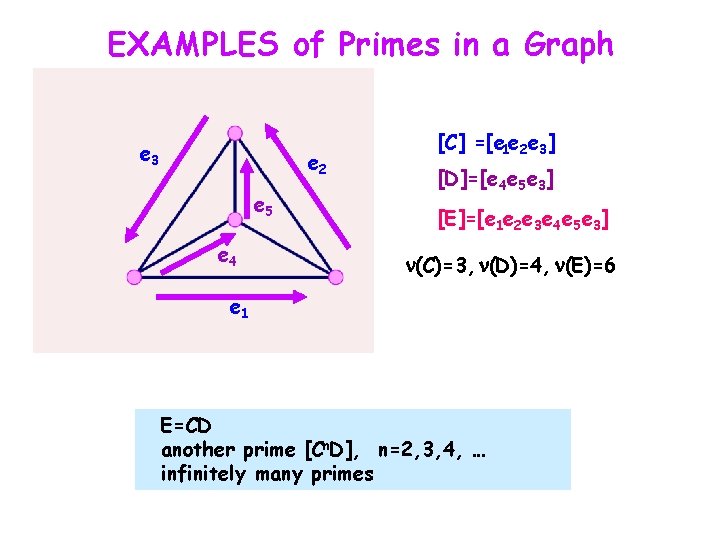
![Primes in Graphs (correspond to geodesics in compact manifolds) are equivalence classes [C] of](https://slidetodoc.com/presentation_image/2a82bbdbfa304a052a84f052486078b0/image-5.jpg "Primes in Graphs (correspond to geodesics in compact manifolds) are equivalence classes [C] of")

- Slides: 22
What is the Riemann Hypothesis for Zeta Functions of Irregular Graphs? Audrey Terras Banff February, 2008 Joint work with H. M. Stark, M. D. Horton, etc.
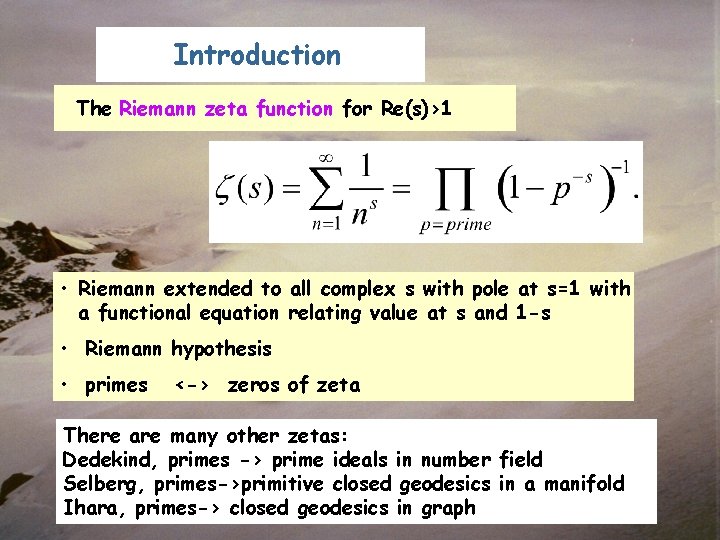
Introduction The Riemann zeta function for Re(s)>1 • Riemann extended to all complex s with pole at s=1 with a functional equation relating value at s and 1 -s • Riemann hypothesis • primes <-> zeros of zeta There are many other zetas: Dedekind, primes -> prime ideals in number field Selberg, primes->primitive closed geodesics in a manifold Ihara, primes-> closed geodesics in graph
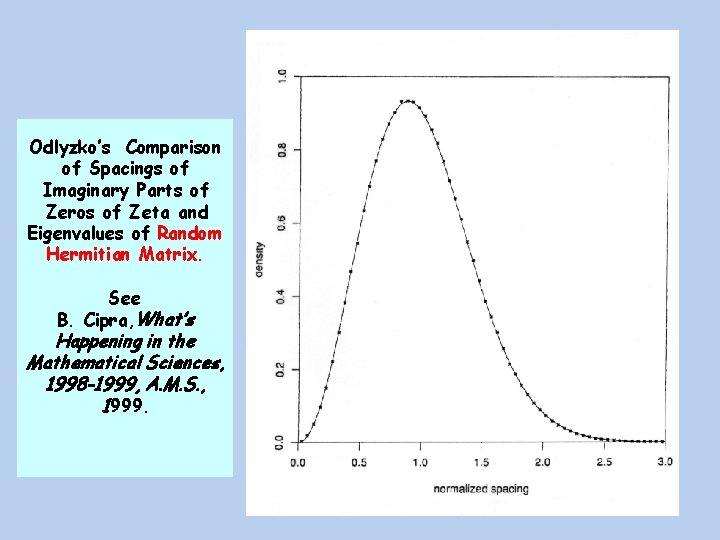
Odlyzko’s Comparison of Spacings of Imaginary Parts of Zeros of Zeta and Eigenvalues of Random Hermitian Matrix. See B. Cipra, What’s Happening in the Mathematical Sciences, 1998 -1999, A. M. S. , 1999.
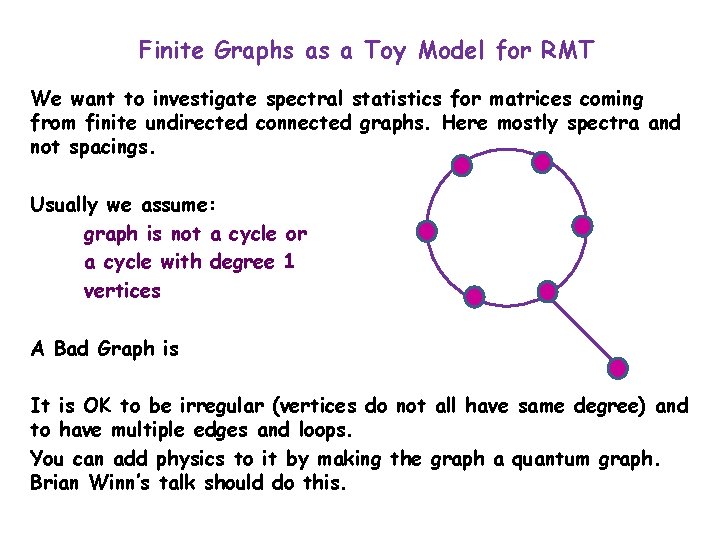
Finite Graphs as a Toy Model for RMT We want to investigate spectral statistics for matrices coming from finite undirected connected graphs. Here mostly spectra and not spacings. Usually we assume: graph is not a cycle or a cycle with degree 1 vertices A Bad Graph is It is OK to be irregular (vertices do not all have same degree) and to have multiple edges and loops. You can add physics to it by making the graph a quantum graph. Brian Winn’s talk should do this.
Primes in Graphs (correspond to geodesics in compact manifolds) are equivalence classes [C] of closed backtrackless tailless primitive paths C DEFINITIONS backtrack equivalence class: change starting point tail Here is the start of the path non-primitive: go around path more than once
EXAMPLES of Primes in a Graph e 3 e 2 e 5 e 4 [C] =[e 1 e 2 e 3] [D]=[e 4 e 5 e 3] [E]=[e 1 e 2 e 3 e 4 e 5 e 3] (C)=3, (D)=4, (E)=6 e 1 E=CD another prime [Cn. D], n=2, 3, 4, … infinitely many primes
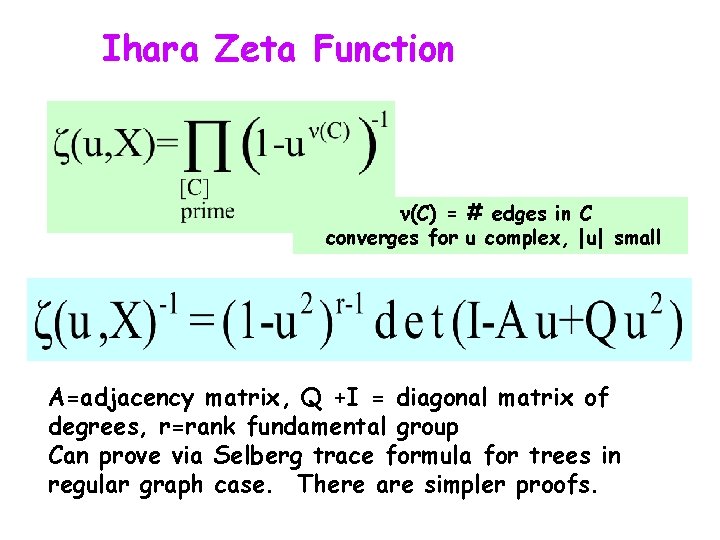
Ihara Zeta Function (C) = # edges in C converges for u complex, |u| small A=adjacency matrix, Q +I = diagonal matrix of degrees, r=rank fundamental group Can prove via Selberg trace formula for trees in regular graph case. There are simpler proofs.
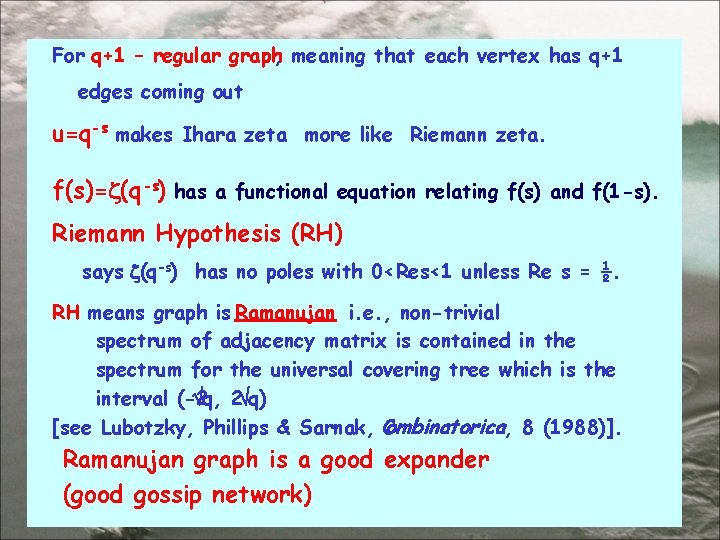
For q+1 – regular graph, meaning that each vertex has q+1 edges coming out u=q-s makes Ihara zeta more like Riemann zeta. f(s)= (q -s) has a functional equation relating f(s) and f(1 -s). Riemann Hypothesis (RH) says (q -s) has no poles with 0<Res<1 unless Re s = ½. RH means graph is Ramanujan i. e. , non-trivial spectrum of adjacency matrix is contained in the spectrum for the universal covering tree which is the interval (-2 q, 2 q) [see Lubotzky, Phillips & Sarnak, C ombinatorica, 8 (1988)]. Ramanujan graph is a good expander (good gossip network)
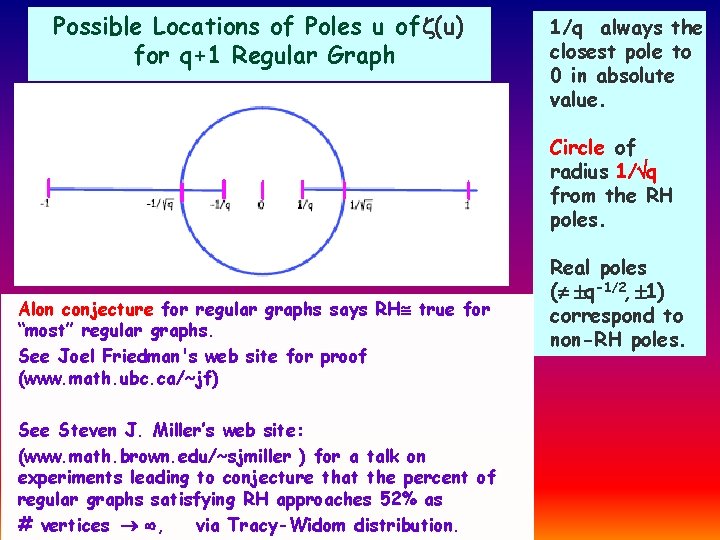
Possible Locations of Poles u of (u) for q+1 Regular Graph 1/q always the closest pole to 0 in absolute value. Circle of radius 1/ q from the RH poles. Alon conjecture for regular graphs says RH true for “most” regular graphs. See Joel Friedman's web site for proof (www. math. ubc. ca/~jf) See Steven J. Miller’s web site: (www. math. brown. edu/~sjmiller ) for a talk on experiments leading to conjecture that the percent of regular graphs satisfying RH approaches 52% as # vertices , via Tracy-Widom distribution. Real poles ( q-1/2, 1) correspond to non-RH poles.
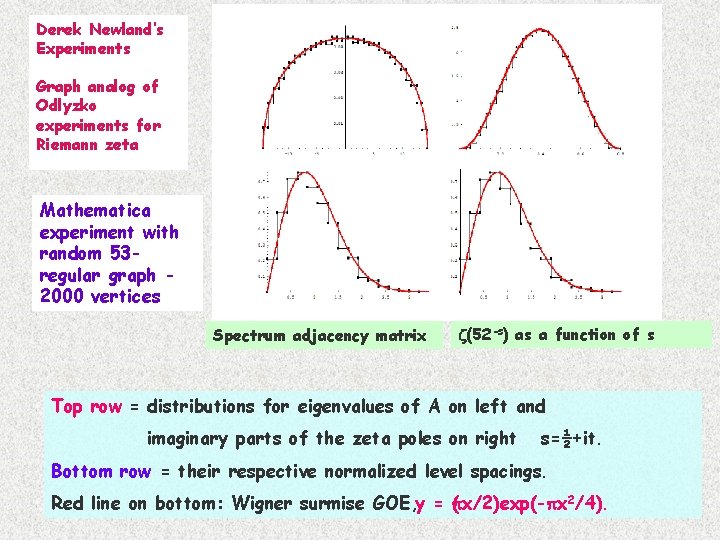
Derek Newland’s Experiments Graph analog of Odlyzko experiments for Riemann zeta Mathematica experiment with random 53 regular graph 2000 vertices Spectrum adjacency matrix (52 -s) as a function of s Top row = distributions for eigenvalues of A on left and imaginary parts of the zeta poles on right s=½+it. Bottom row = their respective normalized level spacings. Red line on bottom: Wigner surmise GOE, y = ( x/2)exp(- x 2/4).
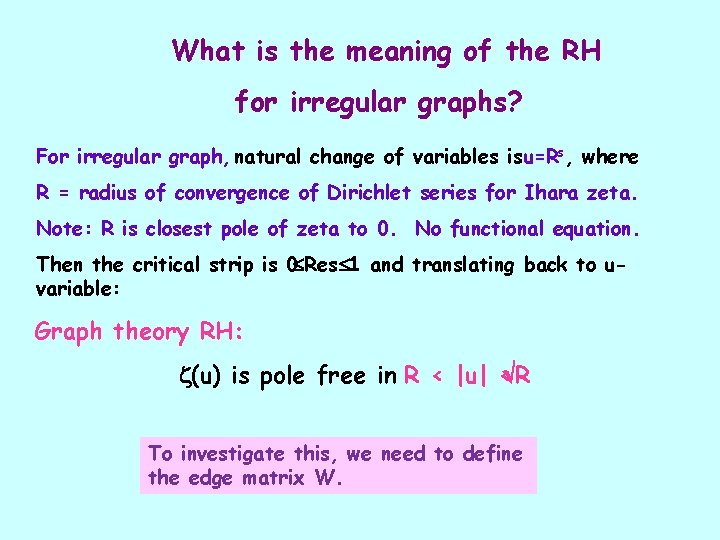
What is the meaning of the RH for irregular graphs? For irregular graph, natural change of variables is u=Rs, where R = radius of convergence of Dirichlet series for Ihara zeta. Note: R is closest pole of zeta to 0. No functional equation. Then the critical strip is 0 Res 1 and translating back to uvariable: Graph theory RH: (u) is pole free in R < |u| < R To investigate this, we need to define the edge matrix W.
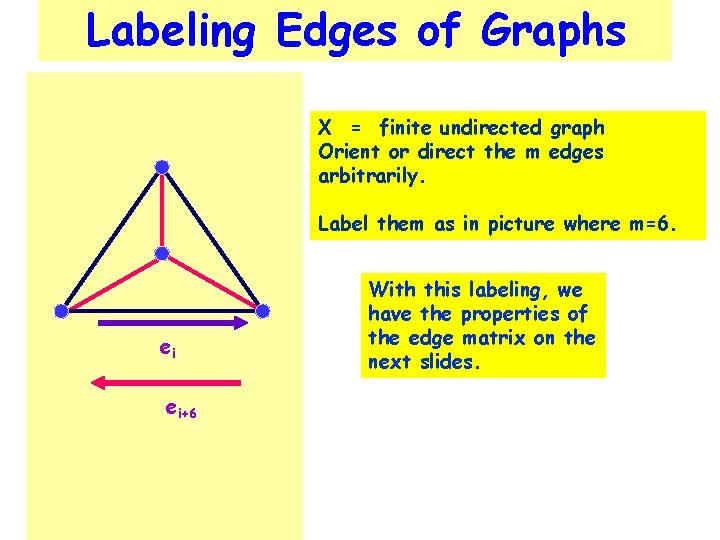
Labeling Edges of Graphs X = finite undirected graph Orient or direct the m edges arbitrarily. Label them as in picture where m=6. ei ei+6 With this labeling, we have the properties of the edge matrix on the next slides.
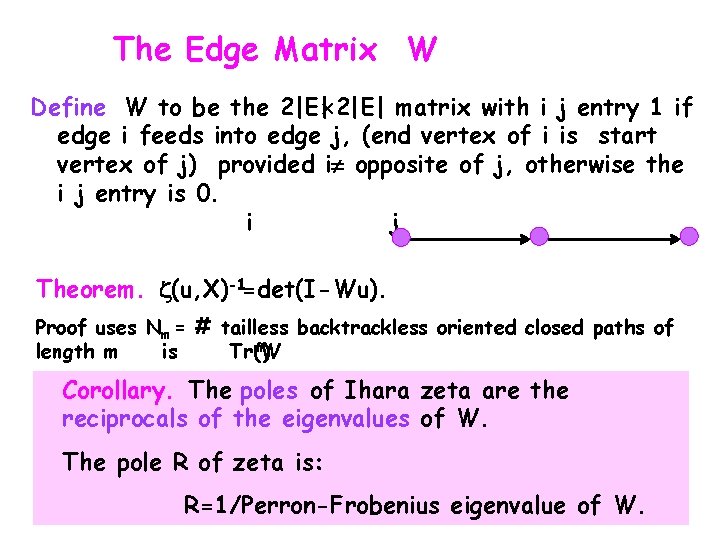
The Edge Matrix W Define W to be the 2|E| matrix with i j entry 1 if edge i feeds into edge j, (end vertex of i is start vertex of j) provided i opposite of j, otherwise the i j entry is 0. i j Theorem. (u, X)-1=det(I-Wu). Proof uses Nm = # tailless backtrackless oriented closed paths of m) length m is Tr(W Corollary. The poles of Ihara zeta are the reciprocals of the eigenvalues of W. The pole R of zeta is: R=1/Perron-Frobenius eigenvalue of W.
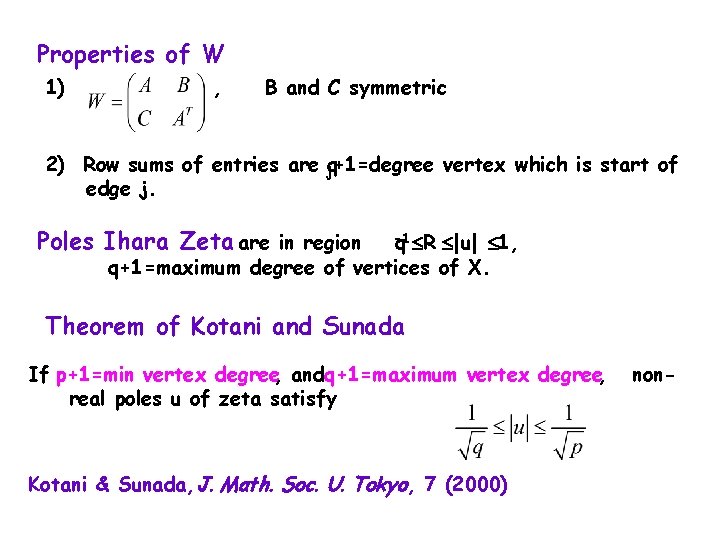
Properties of W 1) , B and C symmetric 2) Row sums of entries are jq+1=degree vertex which is start of edge j. Poles Ihara Zeta are in region -1 q R |u| 1, q+1=maximum degree of vertices of X. Theorem of Kotani and Sunada If p+1=min vertex degree, and q+1=maximum vertex degree, real poles u of zeta satisfy Kotani & Sunada, J. Math. Soc. U. Tokyo, 7 (2000) non-
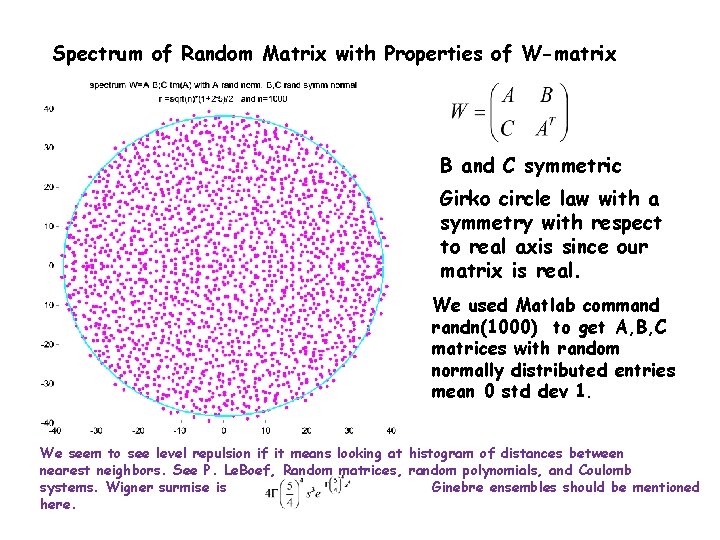
Spectrum of Random Matrix with Properties of W-matrix B and C symmetric Girko circle law with a symmetry with respect to real axis since our matrix is real. We used Matlab command randn(1000) to get A, B, C matrices with random normally distributed entries mean 0 std dev 1. We seem to see level repulsion if it means looking at histogram of distances between nearest neighbors. See P. Le. Boef, Random matrices, random polynomials, and Coulomb systems. Wigner surmise is Ginebre ensembles should be mentioned here.
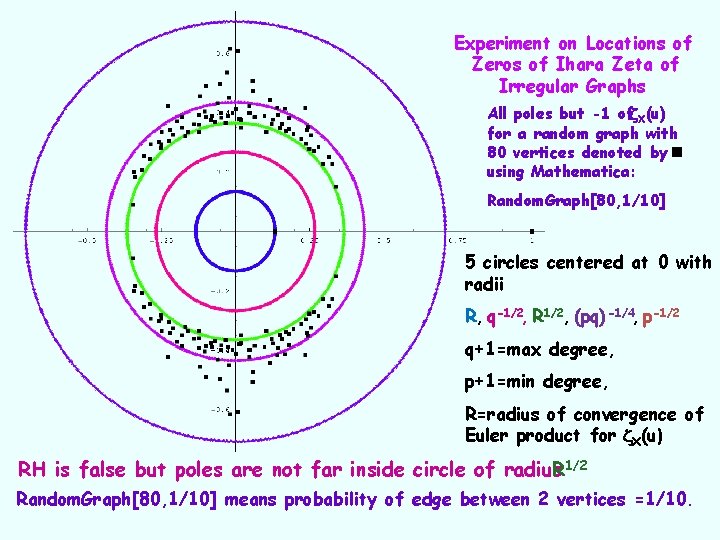
Experiment on Locations of Zeros of Ihara Zeta of Irregular Graphs All poles but -1 of X(u) for a random graph with 80 vertices denoted by using Mathematica: Random. Graph[80, 1/10] 5 circles centered at 0 with radii R, q-1/2, R 1/2, (pq) -1/4, p-1/2 q+1=max degree, p+1=min degree, R=radius of convergence of Euler product for X(u) RH is false but poles are not far inside circle of radius. R 1/2 Random. Graph[80, 1/10] means probability of edge between 2 vertices =1/10.
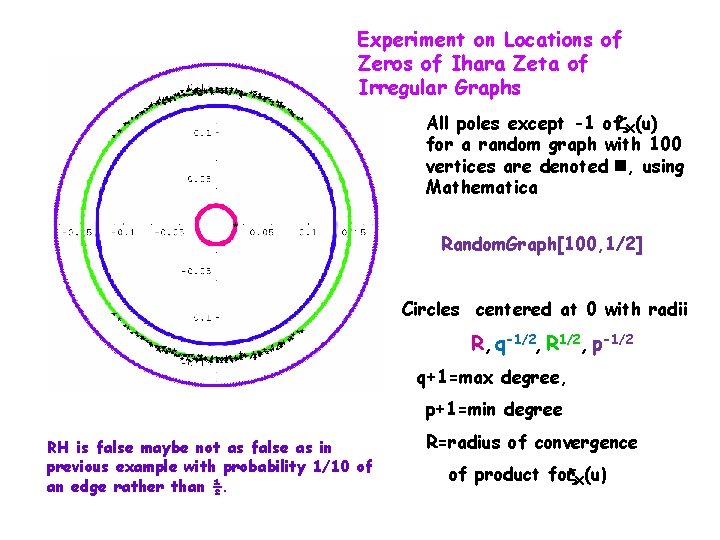
Experiment on Locations of Zeros of Ihara Zeta of Irregular Graphs All poles except -1 of X(u) for a random graph with 100 vertices are denoted , using Mathematica Random. Graph[100, 1/2] Circles centered at 0 with radii R, q-1/2, R 1/2, p-1/2 q+1=max degree, p+1=min degree RH is false maybe not as false as in previous example with probability 1/10 of an edge rather than ½. R=radius of convergence of product for X(u)
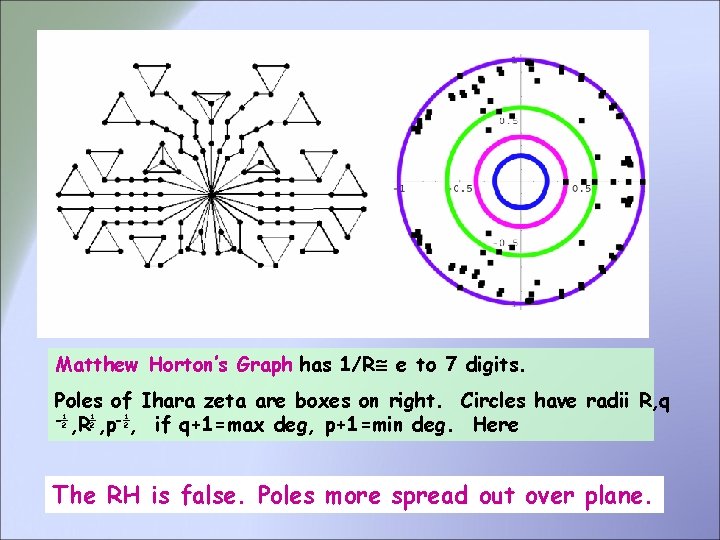
Matthew Horton’s Graph has 1/R e to 7 digits. Poles of Ihara zeta are boxes on right. Circles have radii R, q -½ , R½ , p-½, if q+1=max deg, p+1=min deg. Here The RH is false. Poles more spread out over plane.
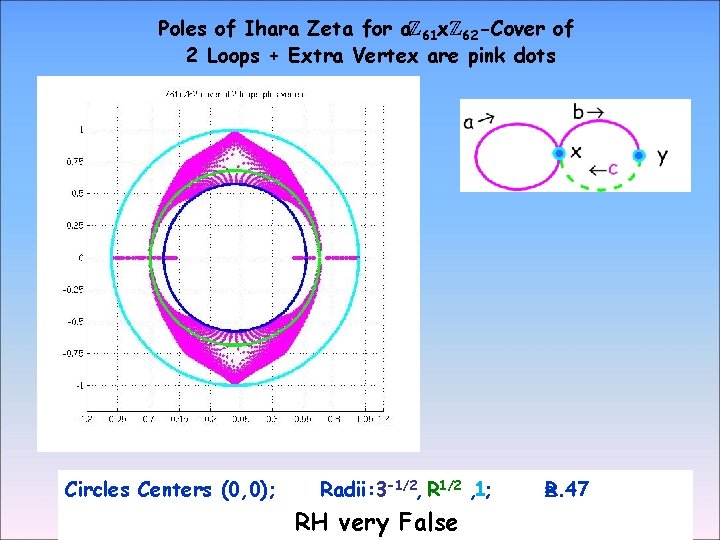
Poles of Ihara Zeta for a. Z 61 x. Z 62 -Cover of 2 Loops + Extra Vertex are pink dots Circles Centers (0, 0); Radii: 3 -1/2, R 1/2 , 1; RH very False R . 47
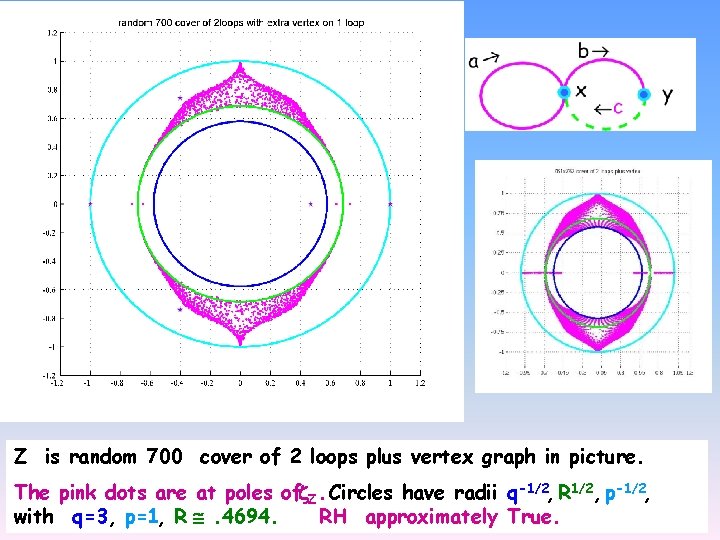
Z is random 700 cover of 2 loops plus vertex graph in picture. The pink dots are at poles of Z. Circles have radii q-1/2, R 1/2, p-1/2, with q=3, p=1, R . 4694. RH approximately True.
References: 3 papers with Harold Stark in. Advances in Math. v Paper with Matthew Horton & Harold Stark in Snowbird Proceedings, Contemporary Mathematics, Volume 415 (2006) Quantum Graphs and Their Applications, Contemporary Mathematics, v. 415, AMS, Providence, RI 2006. v See my draft of a book: www. math. ucsd. edu/~aterras/newbook. pdf v Draft of new paper joint with Horton & Stark: also on my website www. math. ucsd. edu/~aterras/cambridge. pdf v There was a graph zetas special session of this AMS meeting – man interesting papers some on my website. v For work on directed graphs, see Matthew Horton, Ihara zeta functions of digraphs, Linear Algebra and its Applications, 425 (2007) 130– 142. v work of Angel, Friedman and Hoory giving analog of Alon conjecture for irregular graphs, implying our R (see Joel Friedman’s websit: www. math. ubc. ca/~jf)
The End