
What is the question asking me What Maths
- Slides: 28
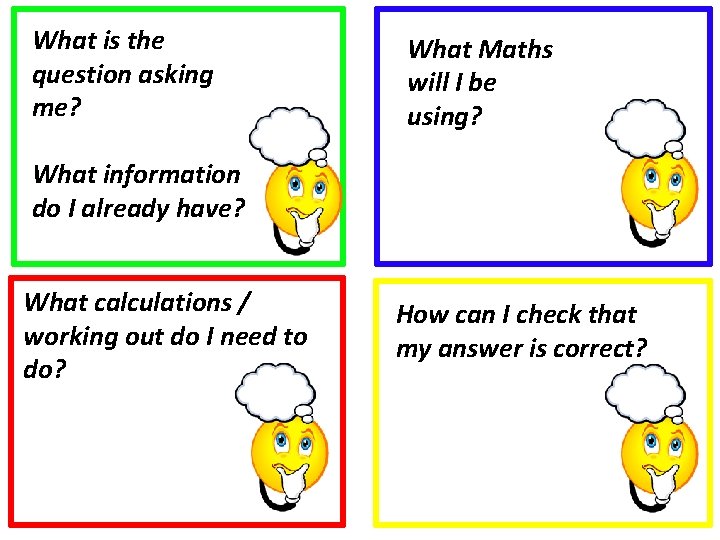
What is the question asking me? What Maths will I be using? What information do I already have? What calculations / working out do I need to do? How can I check that my answer is correct?
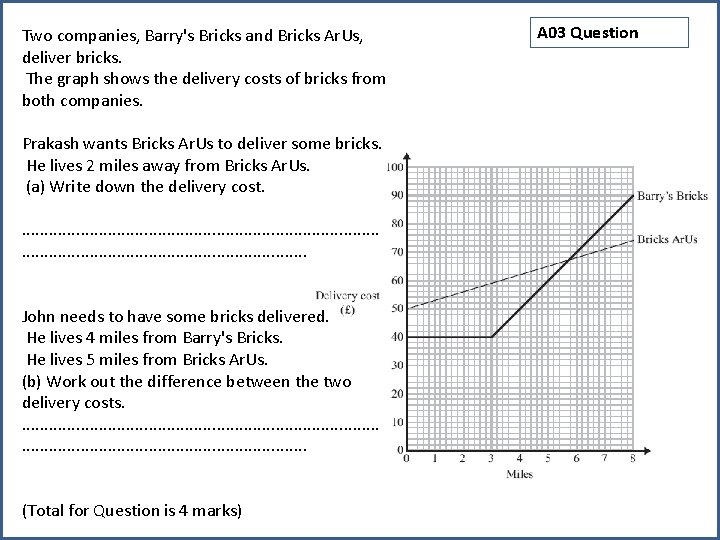
Two companies, Barry's Bricks and Bricks Ar. Us, deliver bricks. The graph shows the delivery costs of bricks from both companies. Prakash wants Bricks Ar. Us to deliver some bricks. He lives 2 miles away from Bricks Ar. Us. (a) Write down the delivery cost. . . . . . . . . . John needs to have some bricks delivered. He lives 4 miles from Barry's Bricks. He lives 5 miles from Bricks Ar. Us. (b) Work out the difference between the two delivery costs. . . . . . . . . (Total for Question is 4 marks) A 03 Question
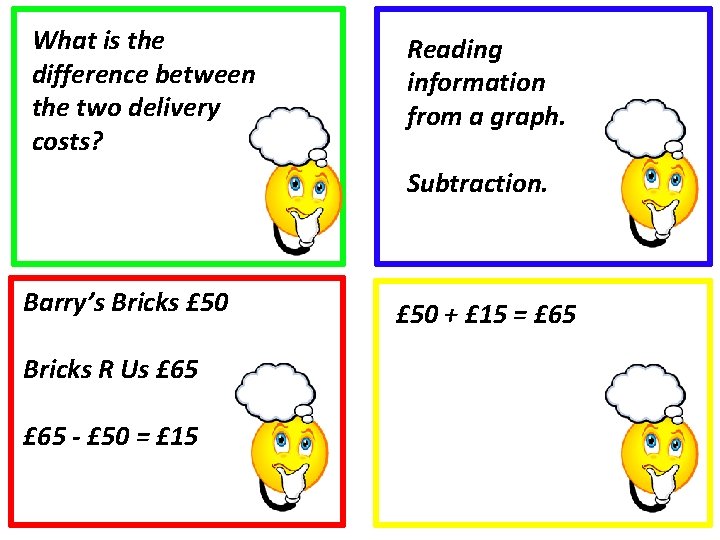
What is the difference between the two delivery costs? Reading information from a graph. Subtraction. Barry’s Bricks £ 50 Bricks R Us £ 65 - £ 50 = £ 15 £ 50 + £ 15 = £ 65
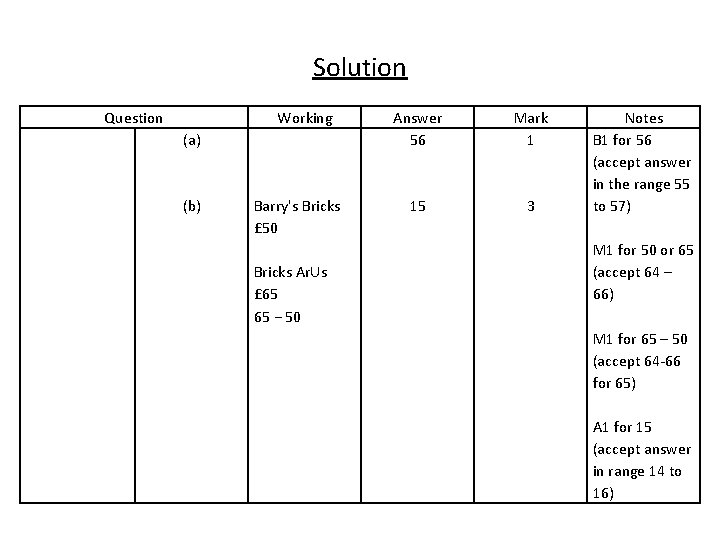
Solution Question Working (a) (b) Barry's Bricks £ 50 Bricks Ar. Us £ 65 65 − 50 Answer 56 Mark 1 15 3 Notes B 1 for 56 (accept answer in the range 55 to 57) M 1 for 50 or 65 (accept 64 – 66) M 1 for 65 – 50 (accept 64 -66 for 65) A 1 for 15 (accept answer in range 14 to 16)
What is the question asking me? What Maths will I be using? What information do I already have? What calculations / working out do I need to do? How can I check that my answer is correct?
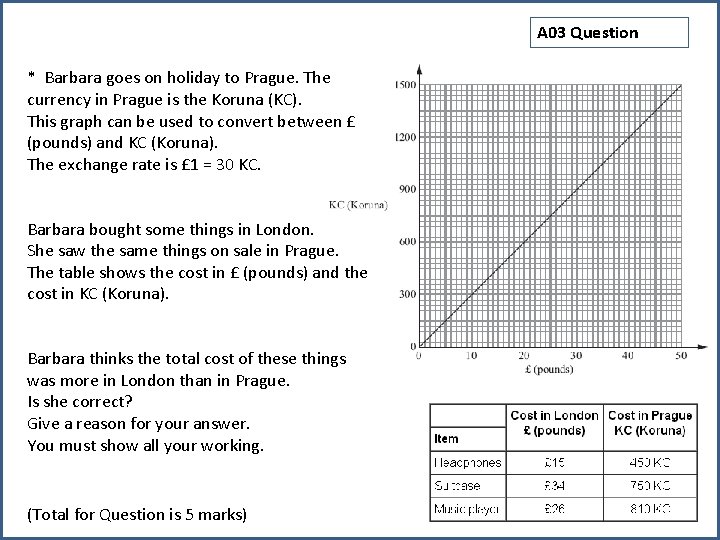
A 03 Question * Barbara goes on holiday to Prague. The currency in Prague is the Koruna (KC). This graph can be used to convert between £ (pounds) and KC (Koruna). The exchange rate is £ 1 = 30 KC. Barbara bought some things in London. She saw the same things on sale in Prague. The table shows the cost in £ (pounds) and the cost in KC (Koruna). Barbara thinks the total cost of these things was more in London than in Prague. Is she correct? Give a reason for your answer. You must show all your working. (Total for Question is 5 marks)
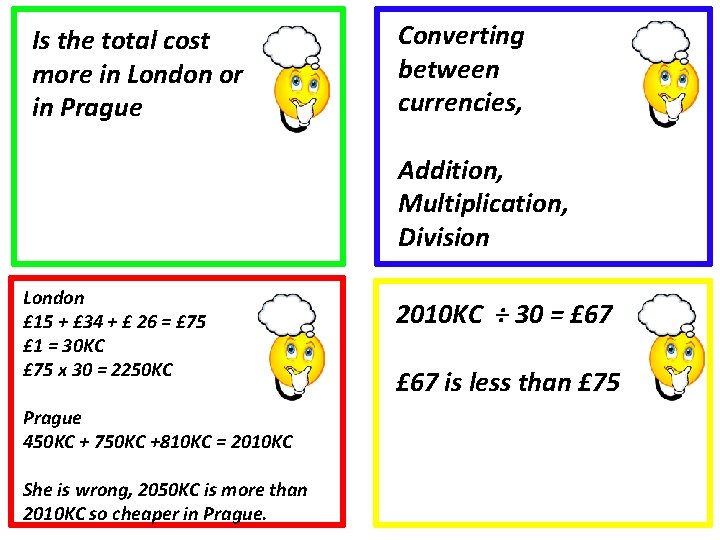
Is the total cost more in London or in Prague Converting between currencies, Addition, Multiplication, Division London £ 15 + £ 34 + £ 26 = £ 75 £ 1 = 30 KC £ 75 x 30 = 2250 KC Prague 450 KC + 750 KC +810 KC = 2010 KC She is wrong, 2050 KC is more than 2010 KC so cheaper in Prague. 2010 KC ÷ 30 = £ 67 is less than £ 75
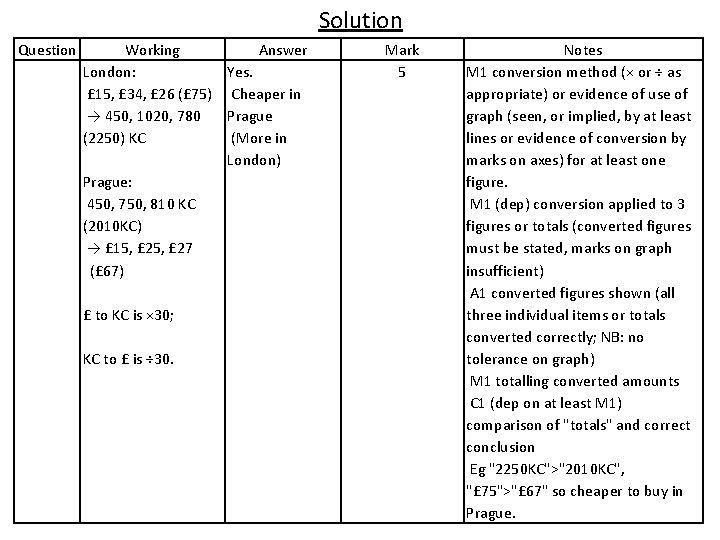
Solution Question Working London: £ 15, £ 34, £ 26 (£ 75) → 450, 1020, 780 (2250) KC Prague: 450, 750, 810 KC (2010 KC) → £ 15, £ 27 (£ 67) £ to KC is × 30; KC to £ is ÷ 30. Answer Yes. Cheaper in Prague (More in London) Mark 5 Notes M 1 conversion method (× or ÷ as appropriate) or evidence of use of graph (seen, or implied, by at least lines or evidence of conversion by marks on axes) for at least one figure. M 1 (dep) conversion applied to 3 figures or totals (converted figures must be stated, marks on graph insufficient) A 1 converted figures shown (all three individual items or totals converted correctly; NB: no tolerance on graph) M 1 totalling converted amounts C 1 (dep on at least M 1) comparison of "totals" and correct conclusion Eg "2250 KC">"2010 KC", "£ 75">"£ 67" so cheaper to buy in Prague.
What is the question asking me? What Maths will I be using? What information do I already have? What calculations / working out do I need to do? How can I check that my answer is correct?
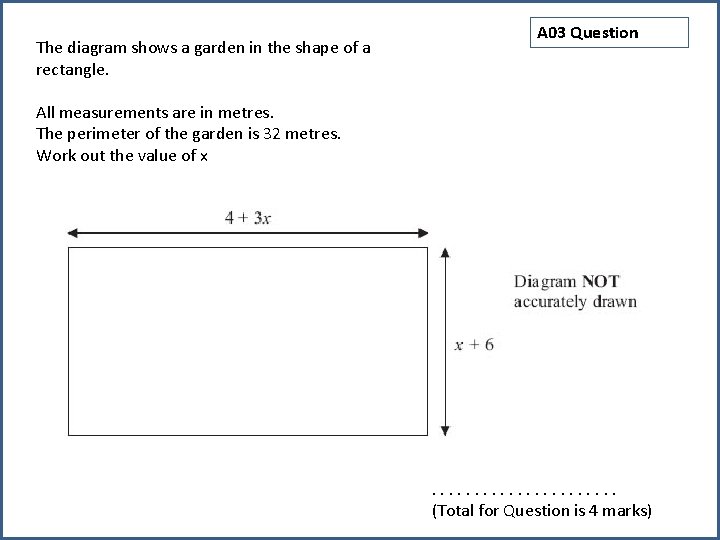
The diagram shows a garden in the shape of a rectangle. All measurements are in metres. The perimeter of the garden is 32 metres. Work out the value of x A 03 Question . . (Total for Question is 4 marks)
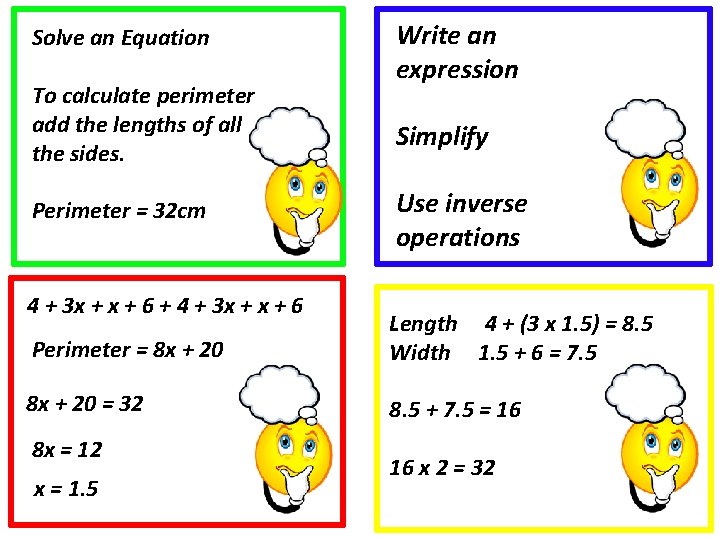
Solve an Equation To calculate perimeter add the lengths of all the sides. Perimeter = 32 cm 4 + 3 x + 6 + 4 + 3 x + 6 Write an expression Simplify Use inverse operations Perimeter = 8 x + 20 Length 4 + (3 x 1. 5) = 8. 5 Width 1. 5 + 6 = 7. 5 8 x + 20 = 32 8. 5 + 7. 5 = 16 8 x = 12 x = 1. 5 16 x 2 = 32
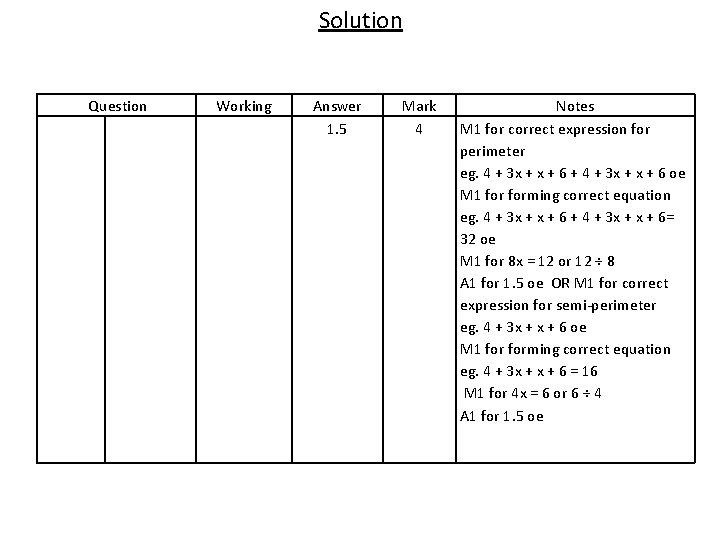
Solution Question Working Answer 1. 5 Mark 4 Notes M 1 for correct expression for perimeter eg. 4 + 3 x + 6 + 4 + 3 x + 6 oe M 1 forming correct equation eg. 4 + 3 x + 6 + 4 + 3 x + 6= 32 oe M 1 for 8 x = 12 or 12 ÷ 8 A 1 for 1. 5 oe OR M 1 for correct expression for semi-perimeter eg. 4 + 3 x + 6 oe M 1 forming correct equation eg. 4 + 3 x + 6 = 16 M 1 for 4 x = 6 or 6 ÷ 4 A 1 for 1. 5 oe
What is the question asking me? What Maths will I be using? What information do I already have? What calculations / working out do I need to do? How can I check that my answer is correct?
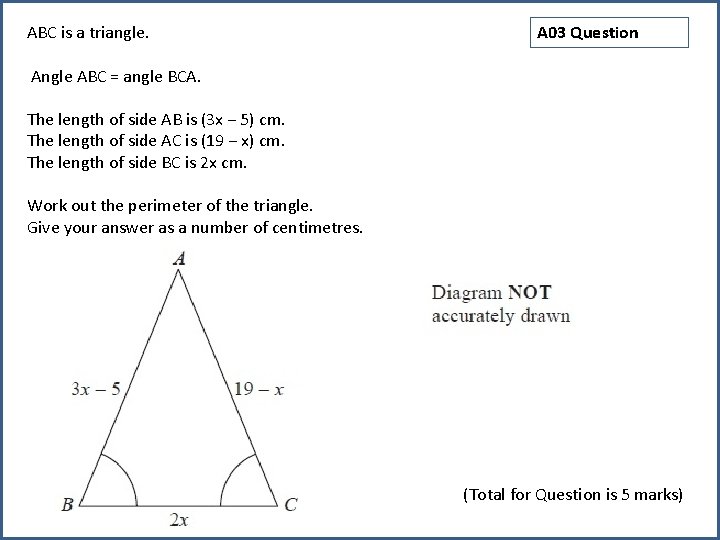
ABC is a triangle. A 03 Question Angle ABC = angle BCA. The length of side AB is (3 x − 5) cm. The length of side AC is (19 − x) cm. The length of side BC is 2 x cm. Work out the perimeter of the triangle. Give your answer as a number of centimetres. (Total for Question is 5 marks)
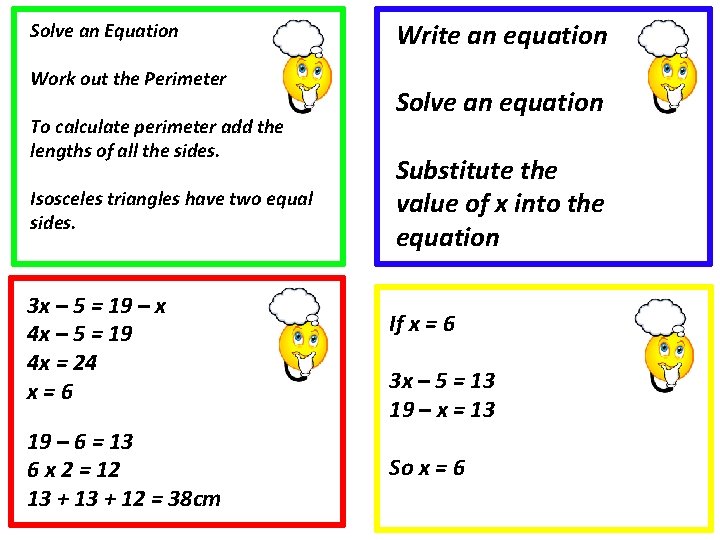
Solve an Equation Work out the Perimeter To calculate perimeter add the lengths of all the sides. Isosceles triangles have two equal sides. 3 x – 5 = 19 – x 4 x – 5 = 19 4 x = 24 x=6 19 – 6 = 13 6 x 2 = 12 13 + 12 = 38 cm Write an equation Solve an equation Substitute the value of x into the equation If x = 6 3 x – 5 = 13 19 – x = 13 So x = 6
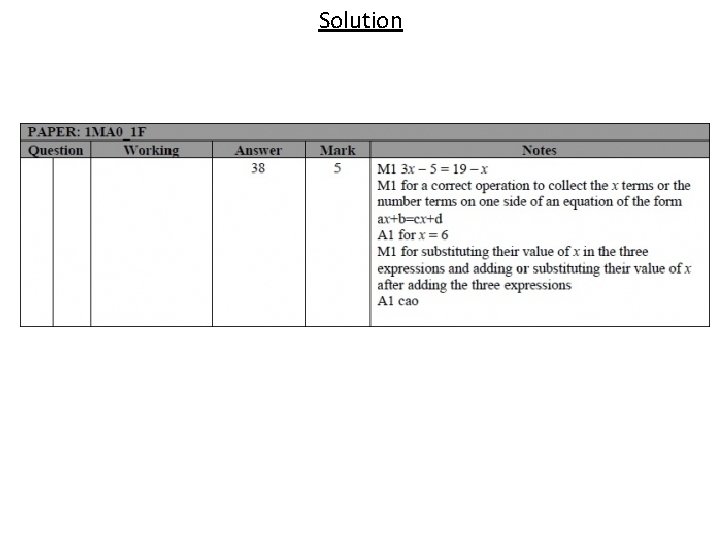
Solution
What is the question asking me? What Maths will I be using? What information do I already have? What calculations / working out do I need to do? How can I check that my answer is correct?
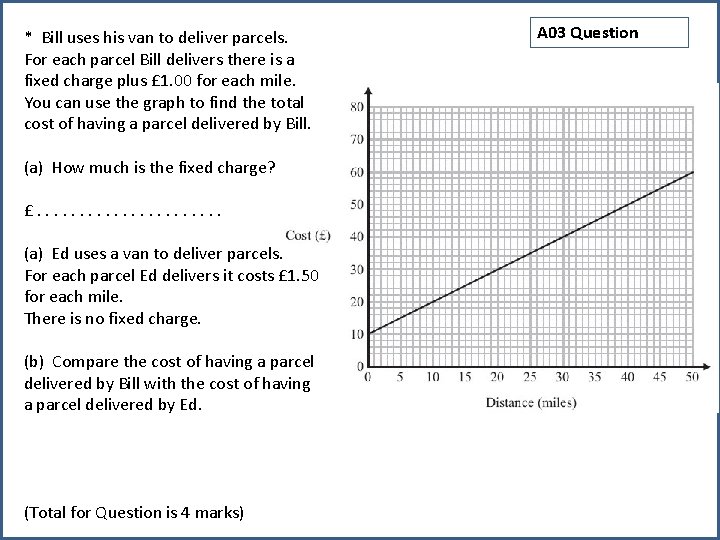
* Bill uses his van to deliver parcels. For each parcel Bill delivers there is a fixed charge plus £ 1. 00 for each mile. You can use the graph to find the total cost of having a parcel delivered by Bill. (a) How much is the fixed charge? £. . . . . (a) Ed uses a van to deliver parcels. For each parcel Ed delivers it costs £ 1. 50 for each mile. There is no fixed charge. (b) Compare the cost of having a parcel delivered by Bill with the cost of having a parcel delivered by Ed. (Total for Question is 4 marks) A 03 Question
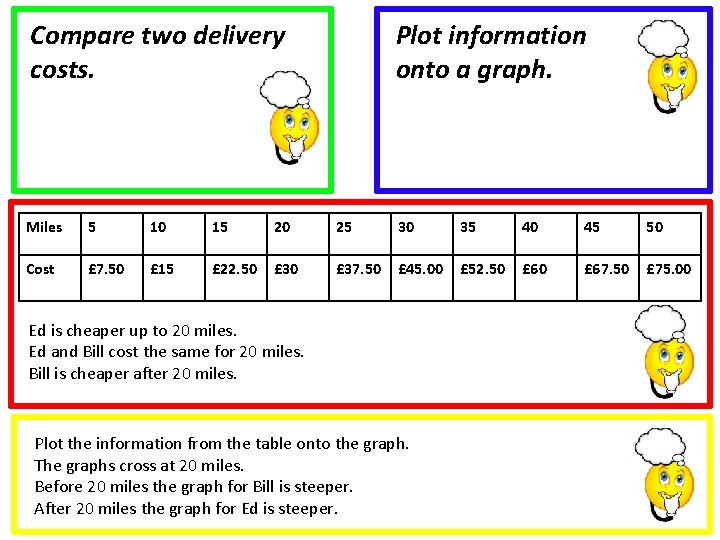
Compare two delivery costs. Plot information onto a graph. Miles 5 10 15 20 25 30 35 40 45 50 Cost £ 7. 50 £ 15 £ 22. 50 £ 37. 50 £ 45. 00 £ 52. 50 £ 67. 50 £ 75. 00 Ed is cheaper up to 20 miles. Ed and Bill cost the same for 20 miles. Bill is cheaper after 20 miles. Plot the information from the table onto the graph. The graphs cross at 20 miles. Before 20 miles the graph for Bill is steeper. After 20 miles the graph for Ed is steeper.
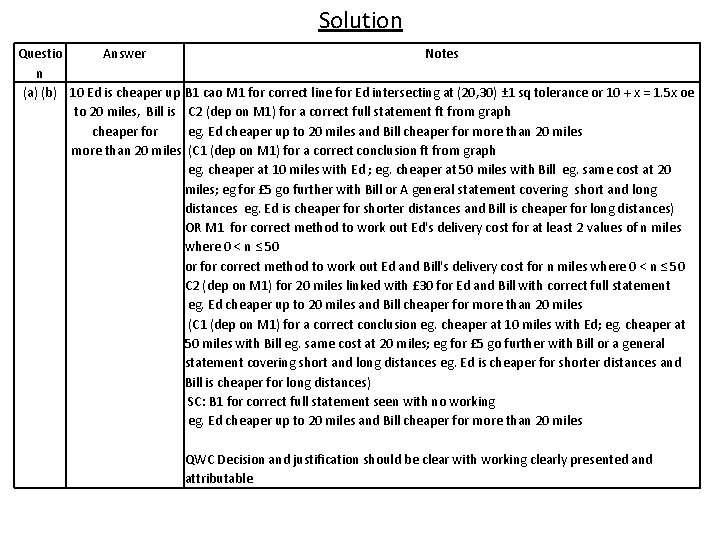
Solution Questio Answer Notes n (a) (b) 10 Ed is cheaper up B 1 cao M 1 for correct line for Ed intersecting at (20, 30) ± 1 sq tolerance or 10 + x = 1. 5 x oe to 20 miles, Bill is C 2 (dep on M 1) for a correct full statement ft from graph cheaper for eg. Ed cheaper up to 20 miles and Bill cheaper for more than 20 miles (C 1 (dep on M 1) for a correct conclusion ft from graph eg. cheaper at 10 miles with Ed ; eg. cheaper at 50 miles with Bill eg. same cost at 20 miles; eg for £ 5 go further with Bill or A general statement covering short and long distances eg. Ed is cheaper for shorter distances and Bill is cheaper for long distances) OR M 1 for correct method to work out Ed's delivery cost for at least 2 values of n miles where 0 < n ≤ 50 or for correct method to work out Ed and Bill's delivery cost for n miles where 0 < n ≤ 50 C 2 (dep on M 1) for 20 miles linked with £ 30 for Ed and Bill with correct full statement eg. Ed cheaper up to 20 miles and Bill cheaper for more than 20 miles (C 1 (dep on M 1) for a correct conclusion eg. cheaper at 10 miles with Ed; eg. cheaper at 50 miles with Bill eg. same cost at 20 miles; eg for £ 5 go further with Bill or a general statement covering short and long distances eg. Ed is cheaper for shorter distances and Bill is cheaper for long distances) SC: B 1 for correct full statement seen with no working eg. Ed cheaper up to 20 miles and Bill cheaper for more than 20 miles QWC Decision and justification should be clear with working clearly presented and attributable
What is the question asking me? What Maths will I be using? What information do I already have? What calculations / working out do I need to do? How can I check that my answer is correct?
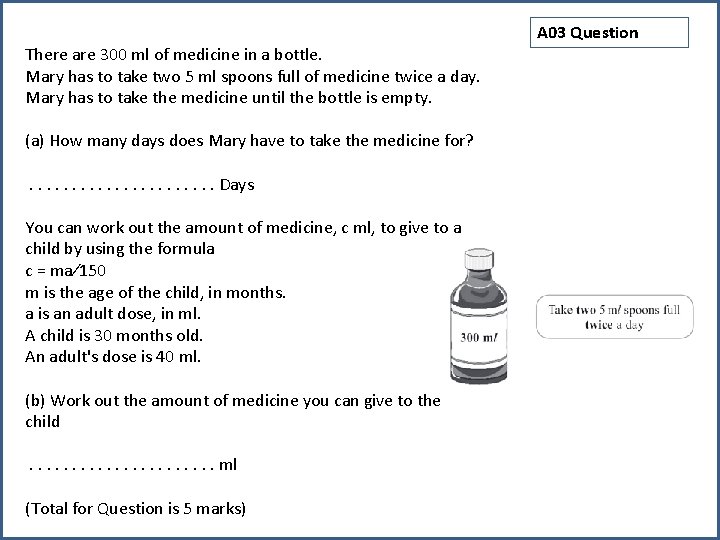
There are 300 ml of medicine in a bottle. Mary has to take two 5 ml spoons full of medicine twice a day. Mary has to take the medicine until the bottle is empty. (a) How many days does Mary have to take the medicine for? . . Days You can work out the amount of medicine, c ml, to give to a child by using the formula c = ma⁄150 m is the age of the child, in months. a is an adult dose, in ml. A child is 30 months old. An adult's dose is 40 ml. (b) Work out the amount of medicine you can give to the child . . ml (Total for Question is 5 marks) A 03 Question
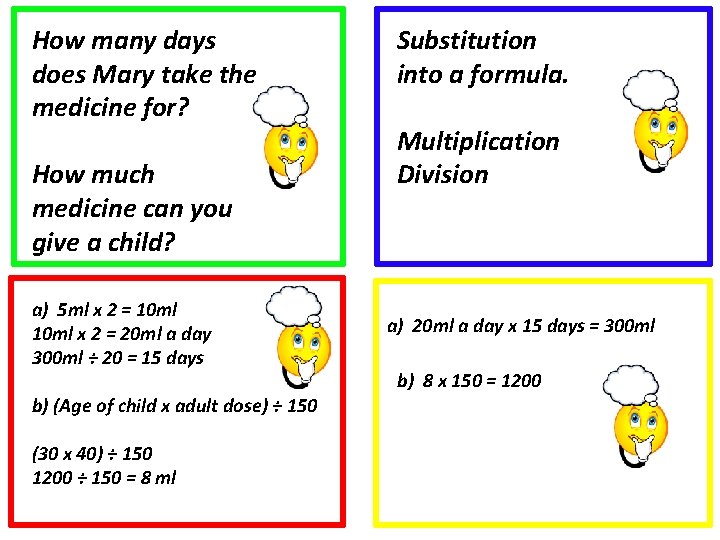
How many days does Mary take the medicine for? How much medicine can you give a child? a) 5 ml x 2 = 10 ml x 2 = 20 ml a day 300 ml ÷ 20 = 15 days b) (Age of child x adult dose) ÷ 150 (30 x 40) ÷ 150 1200 ÷ 150 = 8 ml Substitution into a formula. Multiplication Division a) 20 ml a day x 15 days = 300 ml b) 8 x 150 = 1200
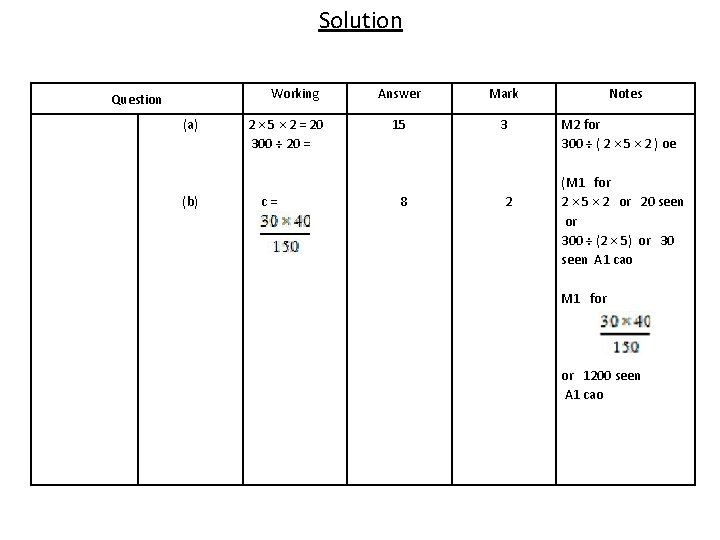
Solution Working Question (a) (b) 2 × 5 × 2 = 20 300 ÷ 20 = c = Answer Mark 15 3 8 2 Notes M 2 for 300 ÷ ( 2 × 5 × 2 ) oe (M 1 for 2 × 5 × 2 or 20 seen or 300 ÷ (2 × 5) or 30 seen A 1 cao M 1 for 1200 seen A 1 cao
What is the question asking me? What Maths will I be using? What information do I already have? What calculations / working out do I need to do? How can I check that my answer is correct?
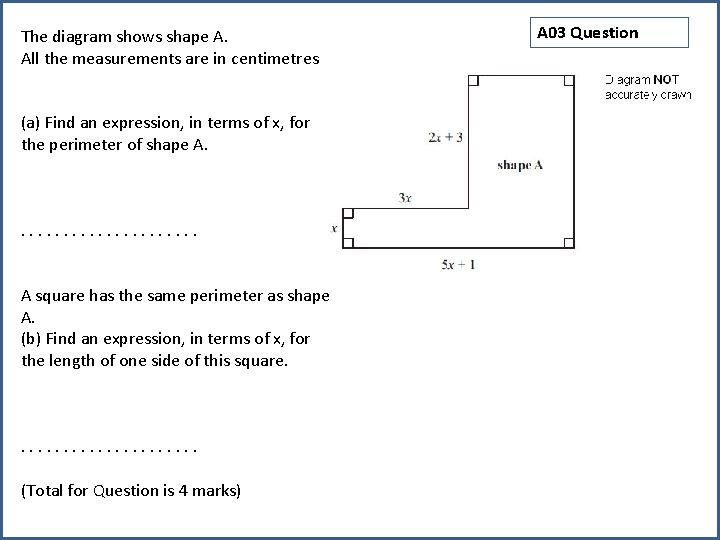
The diagram shows shape A. All the measurements are in centimetres. (a) Find an expression, in terms of x, for the perimeter of shape A. . . A square has the same perimeter as shape A. (b) Find an expression, in terms of x, for the length of one side of this square. . . (Total for Question is 4 marks) A 03 Question
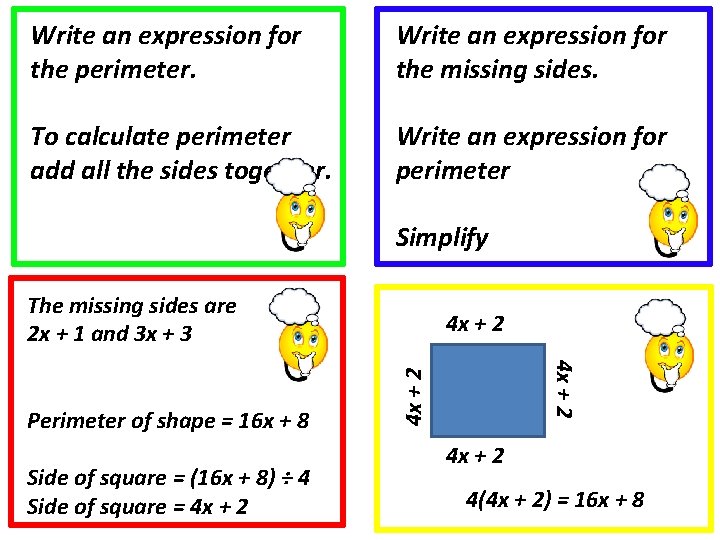
Write an expression for the perimeter. Write an expression for the missing sides. To calculate perimeter add all the sides together. Write an expression for perimeter Simplify The missing sides are 2 x + 1 and 3 x + 3 Side of square = (16 x + 8) ÷ 4 Side of square = 4 x + 2 Perimeter of shape = 16 x + 8 4 x + 2 4(4 x + 2) = 16 x + 8
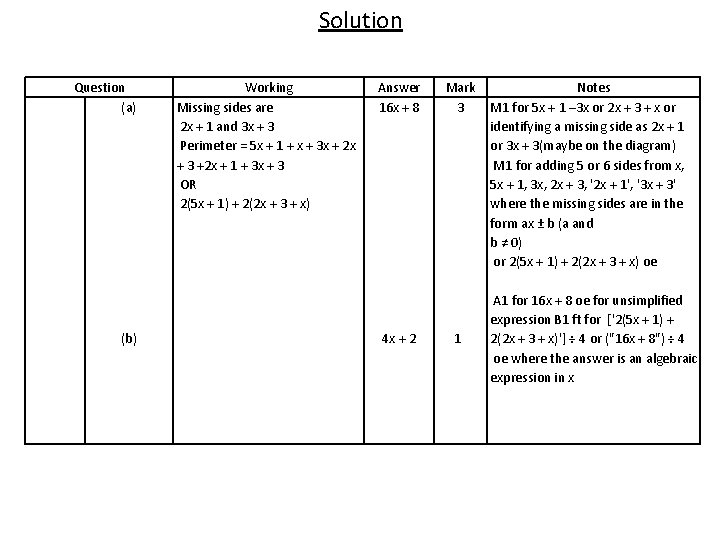
Solution Question (a) (b) Working Missing sides are 2 x + 1 and 3 x + 3 Perimeter = 5 x + 1 + x + 3 x + 2 x + 3 +2 x + 1 + 3 x + 3 OR 2(5 x + 1) + 2(2 x + 3 + x) Answer 16 x + 8 4 x + 2 Mark 3 1 Notes M 1 for 5 x + 1 – 3 x or 2 x + 3 + x or identifying a missing side as 2 x + 1 or 3 x + 3(maybe on the diagram) M 1 for adding 5 or 6 sides from x, 5 x + 1, 3 x, 2 x + 3, '2 x + 1', '3 x + 3' where the missing sides are in the form ax ± b (a and b ≠ 0) or 2(5 x + 1) + 2(2 x + 3 + x) oe A 1 for 16 x + 8 oe for unsimplified expression B 1 ft for ['2(5 x + 1) + 2(2 x + 3 + x)'] ÷ 4 or ("16 x + 8") ÷ 4 oe where the answer is an algebraic expression in x