
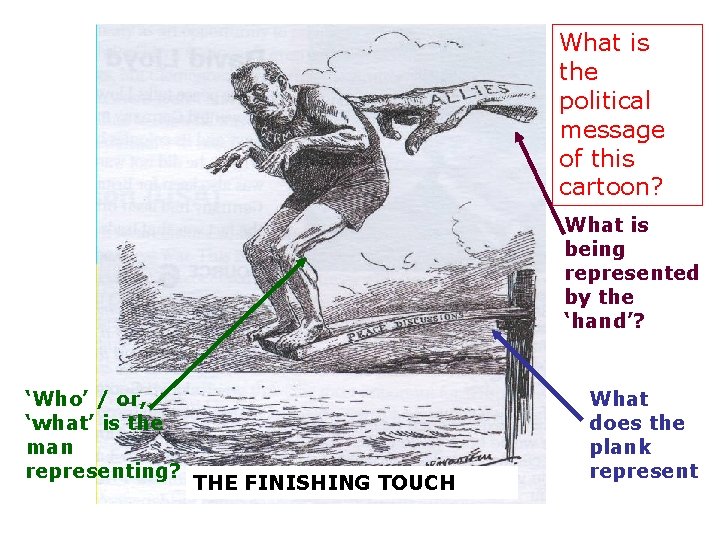
What is the political message of this cartoon
![David Lloyd-George [Great Britain] Orlando [Italy] Woodrow Wilson [USA] Georges Clemenceau [France]](https://slidetodoc.com/presentation_image_h2/7656f3cd64eb99d7b2c83a2f831ec5a4/image-6.jpg "David Lloyd-George [Great Britain] Orlando [Italy] Woodrow Wilson [USA] Georges Clemenceau [France]")
- Slides: 17
What is the political message of this cartoon? What is being represented by the ‘hand’? ‘Who’ / or, ‘what’ is the man representing? THE FINISHING TOUCH What does the plank represent
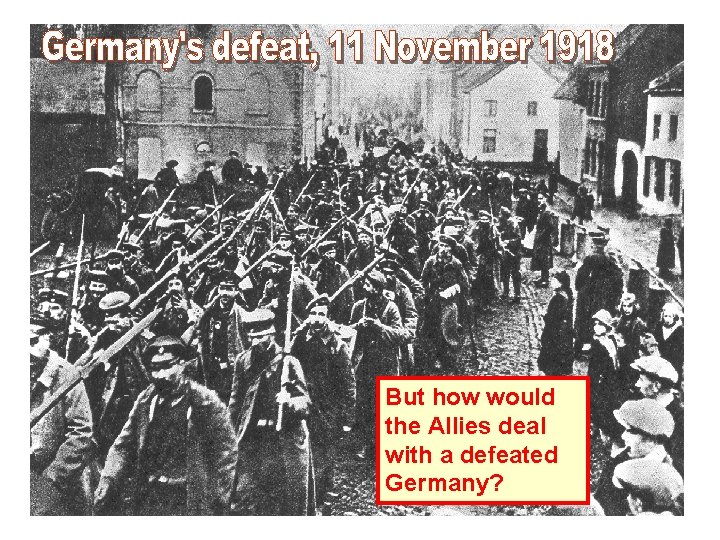
But how would the Allies deal with a defeated Germany?
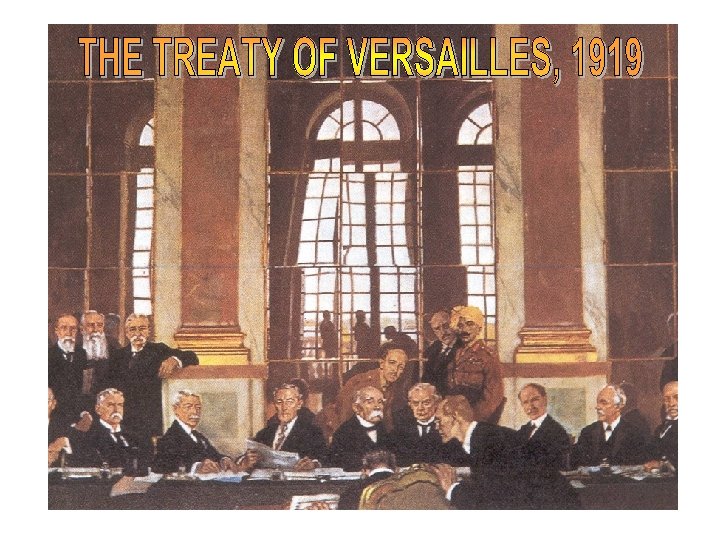
Debating the Treaty of Versailles • On June 28, 1919, the Big Four and the leaders of the defeated nations gathered in the Hall of Mirrors of the Palace of Versailles to sign the peace treaty. • Everyone hoped that the treaty would create stability for a rebuilt Europe. Instead, anger held sway.
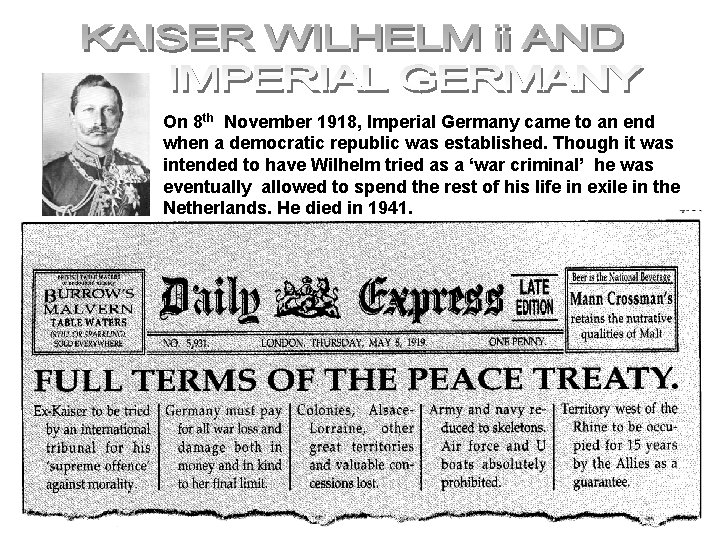
On 8 th November 1918, Imperial Germany came to an end when a democratic republic was established. Though it was intended to have Wilhelm tried as a ‘war criminal’ he was eventually allowed to spend the rest of his life in exile in the Netherlands. He died in 1941.
David Lloyd-George [Great Britain] Orlando [Italy] Woodrow Wilson [USA] Georges Clemenceau [France]
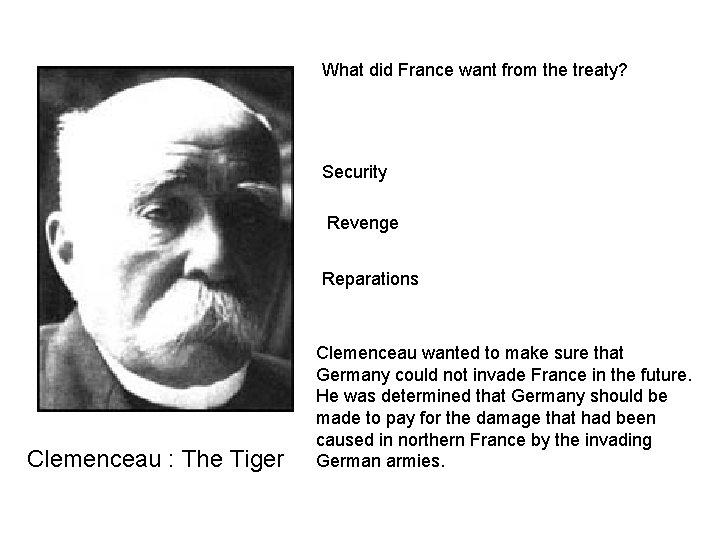
What did France want from the treaty? Security Revenge Reparations Clemenceau : The Tiger Clemenceau wanted to make sure that Germany could not invade France in the future. He was determined that Germany should be made to pay for the damage that had been caused in northern France by the invading German armies.
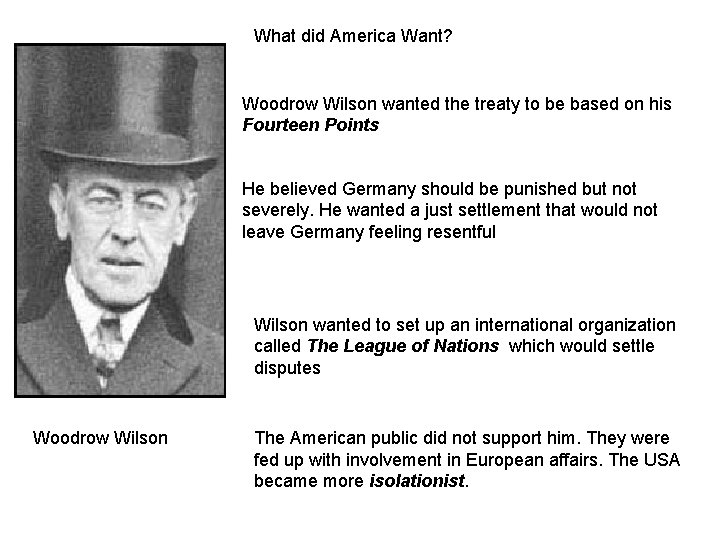
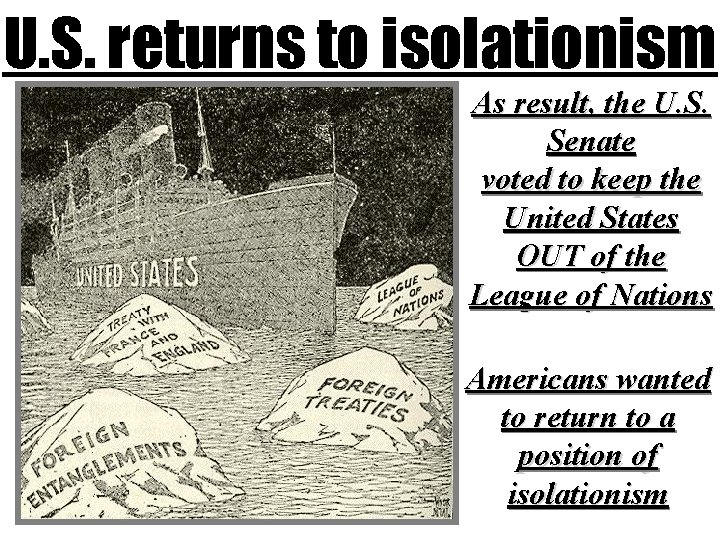
What did America Want? Woodrow Wilson wanted the treaty to be based on his Fourteen Points He believed Germany should be punished but not severely. He wanted a just settlement that would not leave Germany feeling resentful Wilson wanted to set up an international organization called The League of Nations which would settle disputes Woodrow Wilson The American public did not support him. They were fed up with involvement in European affairs. The USA became more isolationist.
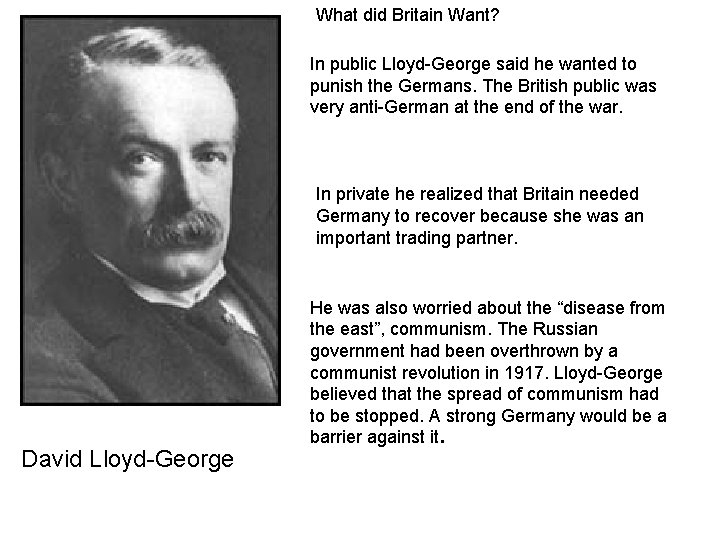
What did Britain Want? In public Lloyd-George said he wanted to punish the Germans. The British public was very anti-German at the end of the war. In private he realized that Britain needed Germany to recover because she was an important trading partner. David Lloyd-George He was also worried about the “disease from the east”, communism. The Russian government had been overthrown by a communist revolution in 1917. Lloyd-George believed that the spread of communism had to be stopped. A strong Germany would be a barrier against it.
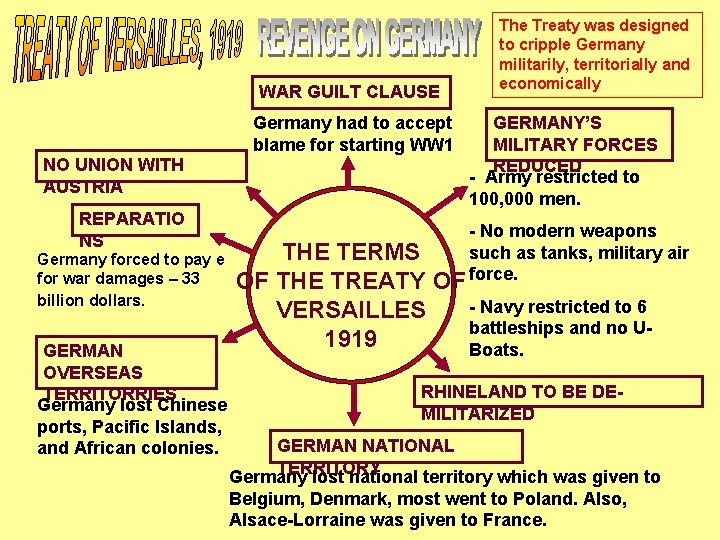
WAR GUILT CLAUSE Germany had to accept blame for starting WW 1 NO UNION WITH AUSTRIA REPARATIO NS Germany forced to pay e for war damages – 33 billion dollars. GERMAN OVERSEAS TERRITORRIES Germany lost Chinese ports, Pacific Islands, and African colonies. THE TERMS OF THE TREATY VERSAILLES 1919 The Treaty was designed to cripple Germany militarily, territorially and economically GERMANY’S MILITARY FORCES REDUCED - Army restricted to 100, 000 men. - No modern weapons such as tanks, military air OF force. - Navy restricted to 6 battleships and no UBoats. RHINELAND TO BE DEMILITARIZED GERMAN NATIONAL TERRITORY Germany lost national territory which was given to Belgium, Denmark, most went to Poland. Also, Alsace-Lorraine was given to France.
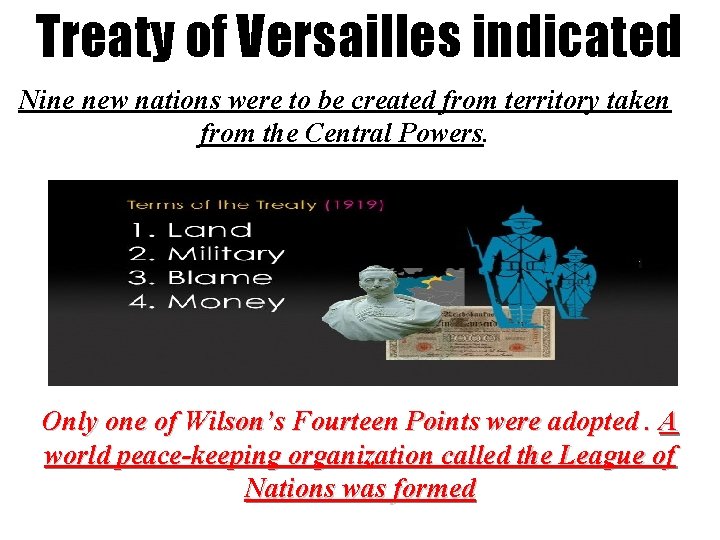
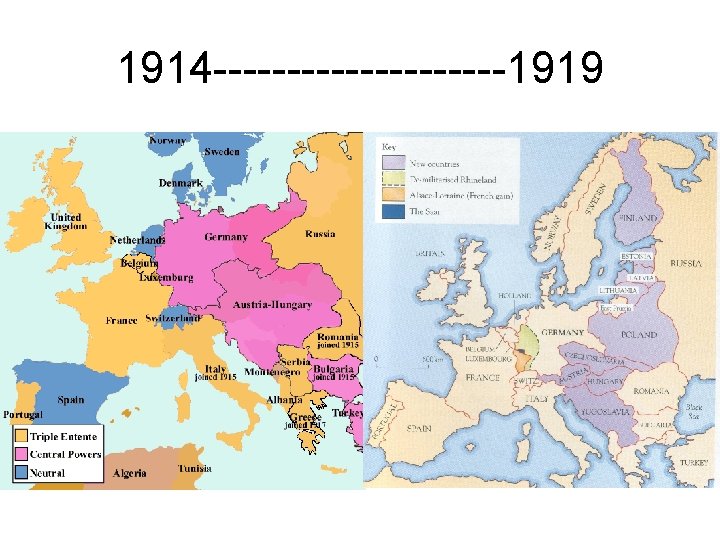
Treaty of Versailles indicated Nine new nations were to be created from territory taken from the Central Powers. Only one of Wilson’s Fourteen Points were adopted. A world peace-keeping organization called the League of Nations was formed
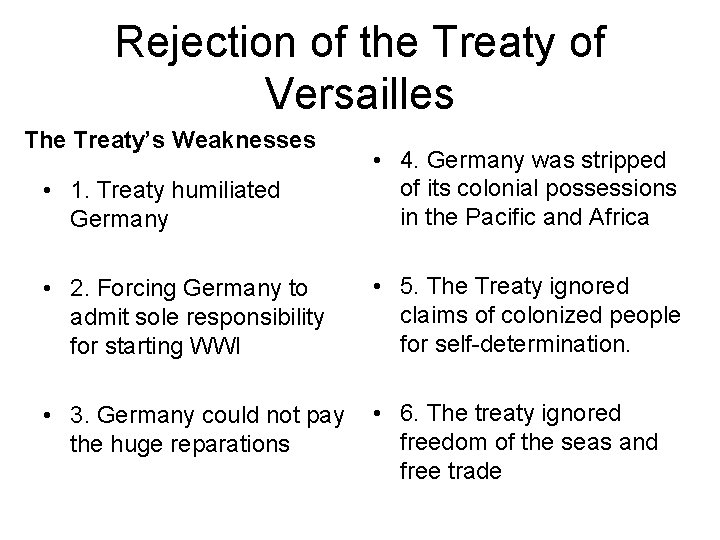
Rejection of the Treaty of Versailles The Treaty’s Weaknesses • 1. Treaty humiliated Germany • 4. Germany was stripped of its colonial possessions in the Pacific and Africa • 2. Forcing Germany to admit sole responsibility for starting WWI • 5. The Treaty ignored claims of colonized people for self-determination. • 3. Germany could not pay the huge reparations • 6. The treaty ignored freedom of the seas and free trade
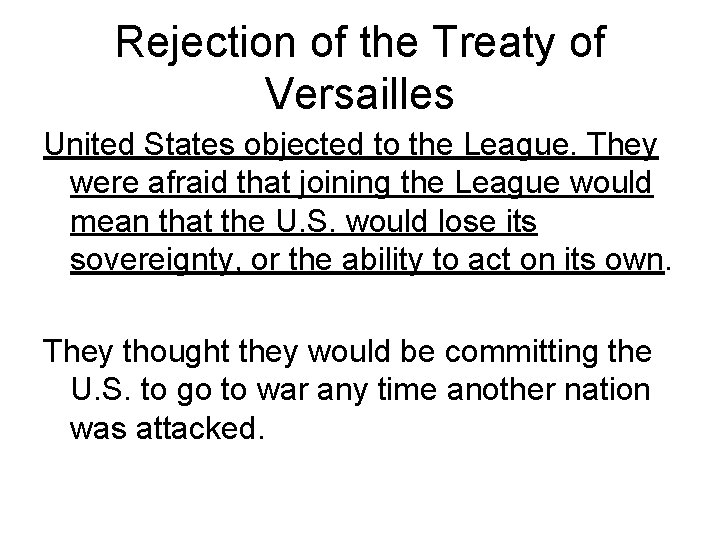
Rejection of the Treaty of Versailles United States objected to the League. They were afraid that joining the League would mean that the U. S. would lose its sovereignty, or the ability to act on its own. They thought they would be committing the U. S. to go to war any time another nation was attacked.
U. S. returns to isolationism As result, the U. S. Senate voted to keep the United States OUT of the League of Nations Americans wanted to return to a position of isolationism
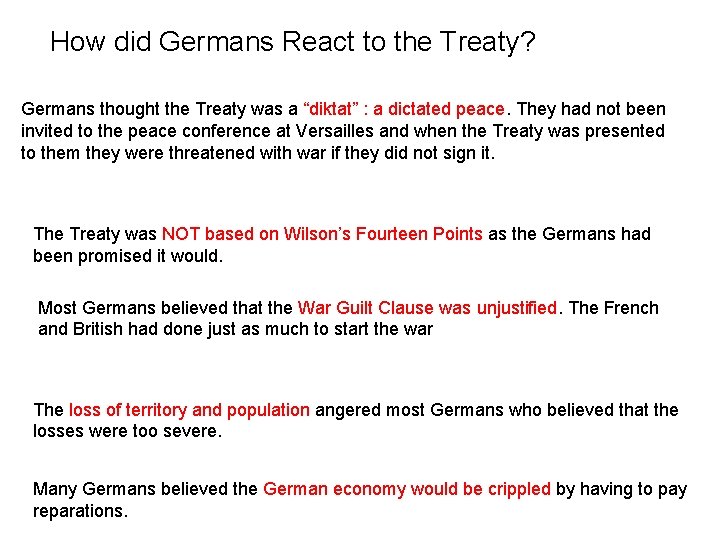
How did Germans React to the Treaty? Germans thought the Treaty was a “diktat” : a dictated peace. They had not been invited to the peace conference at Versailles and when the Treaty was presented to them they were threatened with war if they did not sign it. The Treaty was NOT based on Wilson’s Fourteen Points as the Germans had been promised it would. Most Germans believed that the War Guilt Clause was unjustified. The French and British had done just as much to start the war The loss of territory and population angered most Germans who believed that the losses were too severe. Many Germans believed the German economy would be crippled by having to pay reparations.
1914 ----------1919
The Treaty of Versailles was signed on 28 th June 1919. It officially ended the 1 st World War. Many historians believe that it was a major cause of World War II. Most Germans were horrified by the harshness of the Treaty. There was anger amongst all groups in Germany, no matter what their political beliefs. Some German newspapers called for revenge for the humiliation of Versailles. However anger was also directed against the government in Germany. Already there was a myth growing in the country that the German army had been “stabbed in the back” by politicians…the so called “November Criminals”. Now these same politicians had signed the “Diktat”, the dictated peace. The new democracy in Germany was now closely linked with the humiliation of Versailles. The End