
What is the Next Generation of HumanComputer Interaction
- Slides: 6
What is the Next Generation of Human-Computer Interaction? Bernd Bruegge, Asa Mac. Williams Department of Informatics Chair for Applied Software Engineering Technical University Munich Asim Smailagic Institute Complex Engineering Systems Carnegie Mellon University, Pittsburgh
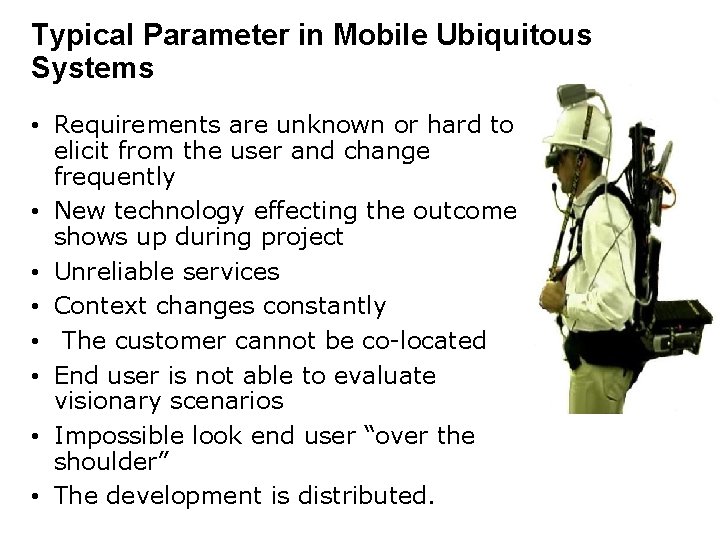
Typical Parameter in Mobile Ubiquitous Systems • Requirements are unknown or hard to elicit from the user and change frequently • New technology effecting the outcome shows up during project • Unreliable services • Context changes constantly • The customer cannot be co-located • End user is not able to evaluate visionary scenarios • Impossible look end user “over the shoulder” • The development is distributed.
A Developer’s Perspective • Traditional view • System is a collection of unreliable components • Lots of energy into V&V before delivery • Assumptions behind requirements not questioned • New view • Unbundling V&V: Moving from trying to verify components to integrating unreliable components • Ill-defined requirements are a fact • Extreme Modeling (“Design at Runtime”): Parts of the system are deployed — and tested by the end user — before others are even developed • Jam Sessions: Synchronous group activity (ala XP, but on a running system) • Continuous Extension: Developers and users cooperate asynchronously.
Jam Session • A synchronous activity of users & developers, cooperating to improve a running system, • Basic unit: feedback–develop cycle • End user suggests improvement • Developer takes component off-line and changes it => the rest of the system remains running • Many develop–feedback cycles at the same time => different parts of the system can be improved simultaneously.
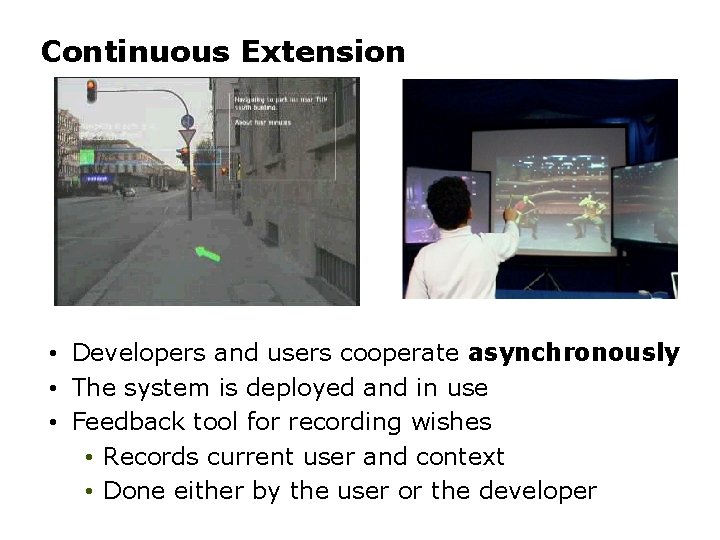
Continuous Extension • Developers and users cooperate asynchronously • The system is deployed and in use • Feedback tool for recording wishes • Records current user and context • Done either by the user or the developer
Challenges based on extreme modeling • User Interface of the development evironment • Gesture-based administration • Software architecture • A-hoc connection of components (service discovery) • Infrastructure support • Dynamic stakeholder connection, feedback support, context collection • Rationale management • Getting assumptions behind requirements (user context) • Build management • Rapidly build systems with unreliable components • Demo Management • Opportunistic release management, Feedback cycle support • Tools: • DWARF, Sisyphus, Cruise-control