
What is the meaning of laser LASER is
- Slides: 16
What is the meaning of laser? LASER is the abbreviation(縮寫) of Light Amplification(放 大 ) by Stimulated(受 激 ) Emission of Radiation Taiwan 雷射 (取其音) China 激光 (取其意) 國立彰化師範大學物理學系 謝尚衛 2
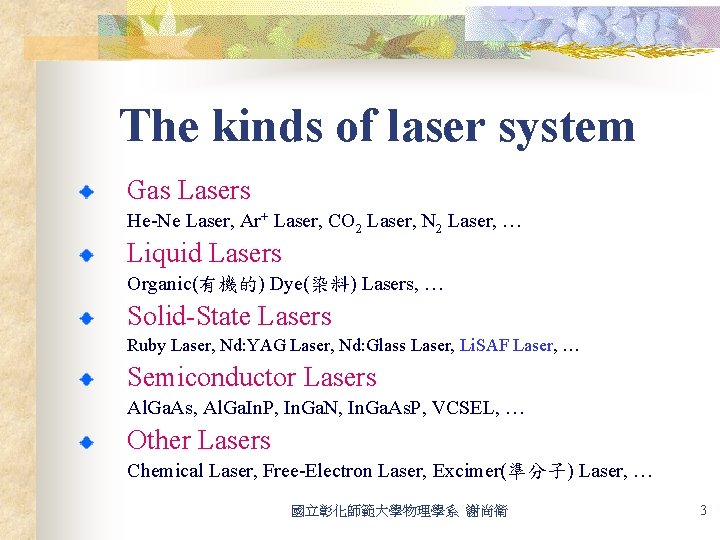
The kinds of laser system Gas Lasers He-Ne Laser, Ar+ Laser, CO 2 Laser, N 2 Laser, … Liquid Lasers Organic(有機的) Dye(染料) Lasers, … Solid-State Lasers Ruby Laser, Nd: YAG Laser, Nd: Glass Laser, Li. SAF Laser, … Semiconductor Lasers Al. Ga. As, Al. Ga. In. P, In. Ga. N, In. Ga. As. P, VCSEL, … Other Lasers Chemical Laser, Free-Electron Laser, Excimer(準分子) Laser, … 國立彰化師範大學物理學系 謝尚衛 3
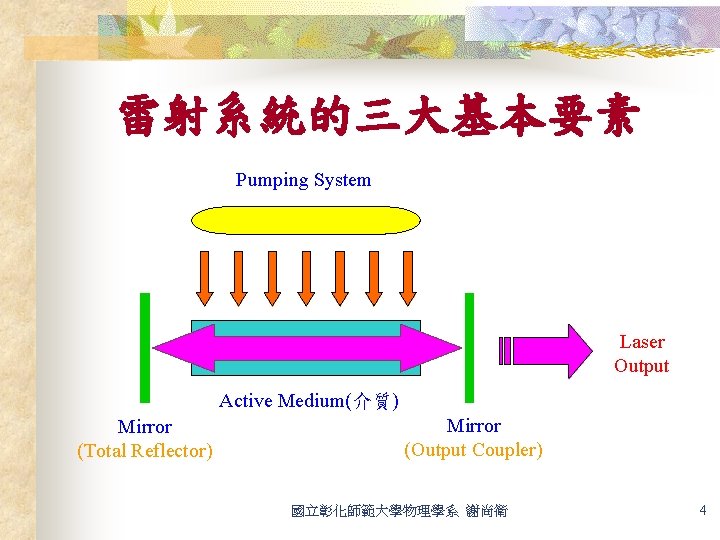
雷射系統的三大基本要素 Pumping System Laser Output Active Medium(介質) Mirror (Total Reflector) Mirror (Output Coupler) 國立彰化師範大學物理學系 謝尚衛 4
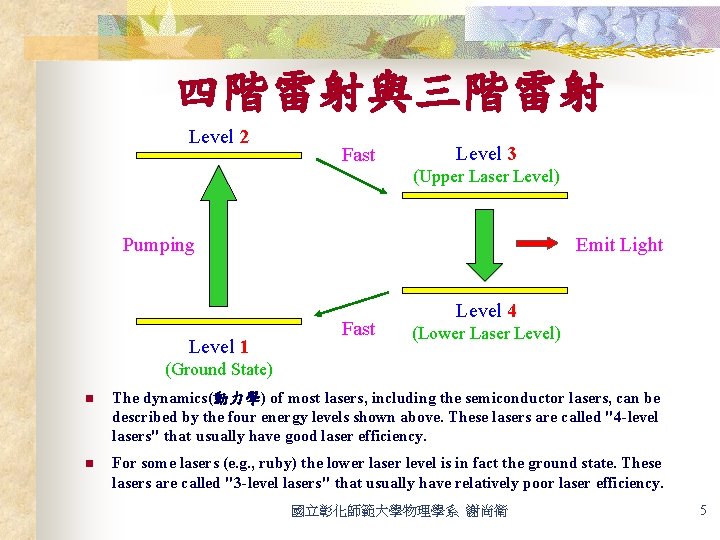
四階雷射與三階雷射 Level 2 Fast Level 3 (Upper Laser Level) Emit Light Pumping Level 1 Fast Level 4 (Lower Laser Level) (Ground State) n The dynamics(動力學) of most lasers, including the semiconductor lasers, can be described by the four energy levels shown above. These lasers are called "4 -level lasers" that usually have good laser efficiency. n For some lasers (e. g. , ruby) the lower laser level is in fact the ground state. These lasers are called "3 -level lasers" that usually have relatively poor laser efficiency. 國立彰化師範大學物理學系 謝尚衛 5
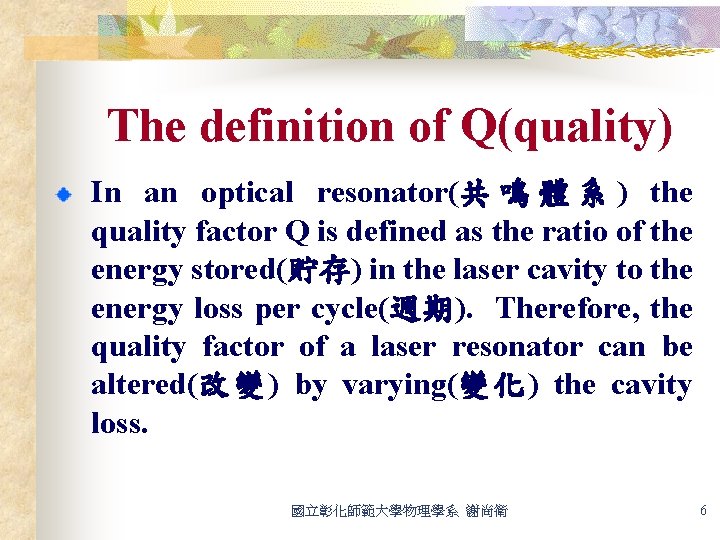
The definition of Q(quality) In an optical resonator(共 鳴 體 系 ) the quality factor Q is defined as the ratio of the energy stored(貯存) in the laser cavity to the energy loss per cycle(週期). Therefore, the quality factor of a laser resonator can be altered(改 變 ) by varying(變 化 ) the cavity loss. 國立彰化師範大學物理學系 謝尚衛 6
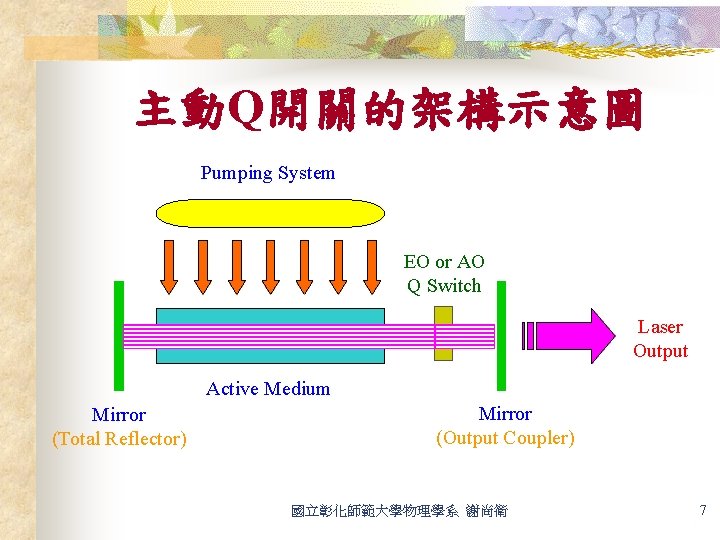
主動Q開關的架構示意圖 Pumping System EO or AO Q Switch Laser Output Active Medium Mirror (Total Reflector) Mirror (Output Coupler) 國立彰化師範大學物理學系 謝尚衛 7
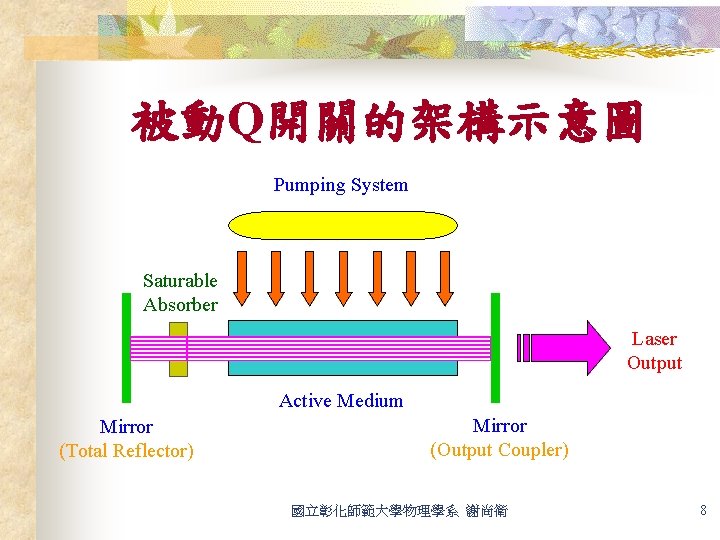
被動Q開關的架構示意圖 Pumping System Saturable Absorber Laser Output Active Medium Mirror (Total Reflector) Mirror (Output Coupler) 國立彰化師範大學物理學系 謝尚衛 8
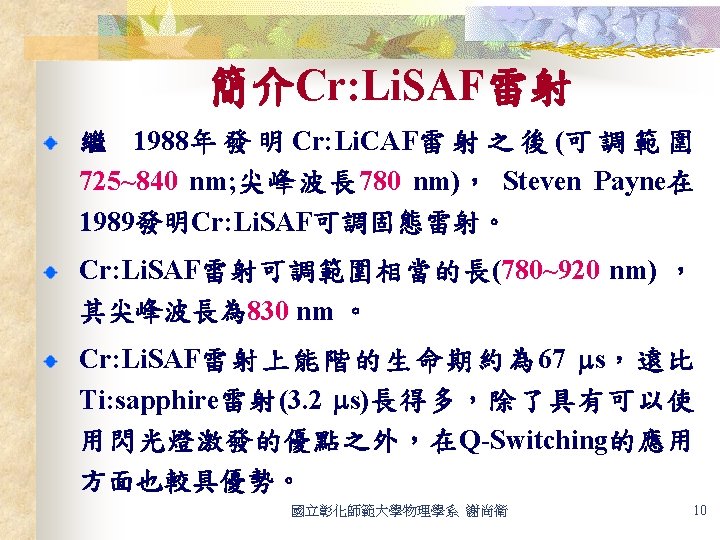
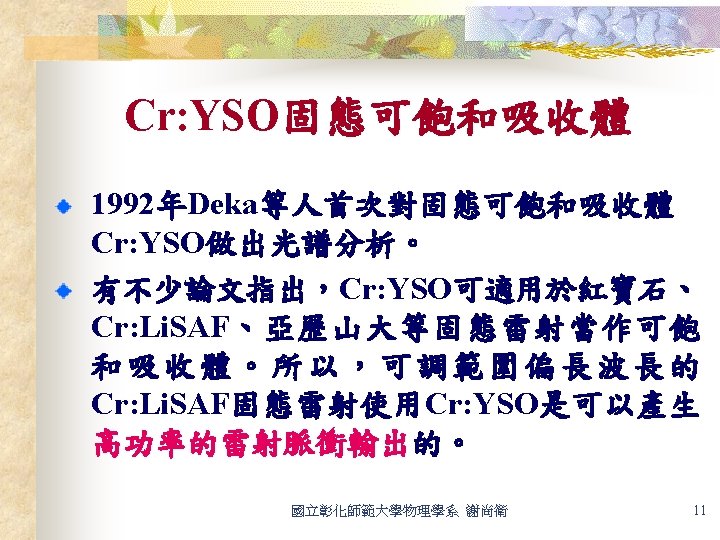
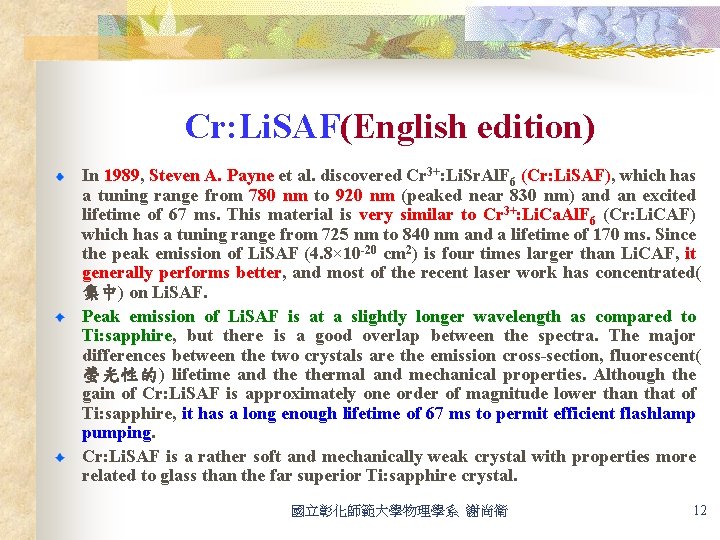
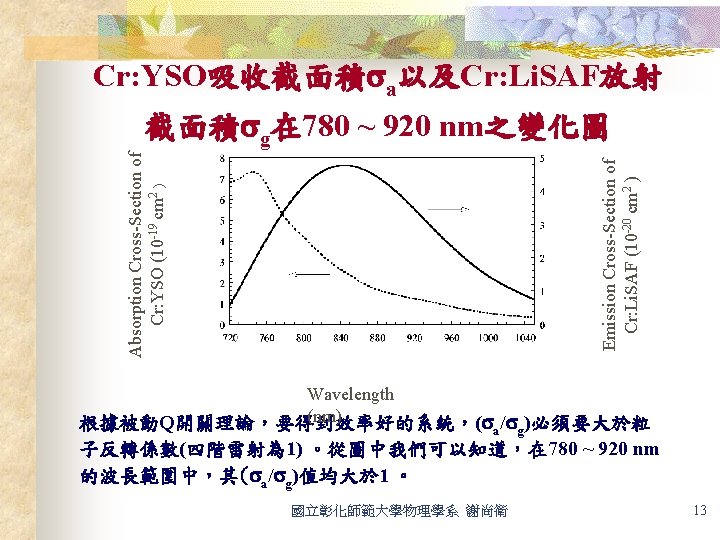
Cr: Li. SAF(English edition) In 1989, Steven A. Payne et al. discovered Cr 3+: Li. Sr. Al. F 6 (Cr: Li. SAF), which has a tuning range from 780 nm to 920 nm (peaked near 830 nm) and an excited lifetime of 67 ms. This material is very similar to Cr 3+: Li. Ca. Al. F 6 (Cr: Li. CAF) which has a tuning range from 725 nm to 840 nm and a lifetime of 170 ms. Since the peak emission of Li. SAF (4. 8× 10 -20 cm 2) is four times larger than Li. CAF, it generally performs better, and most of the recent laser work has concentrated( 集中) on Li. SAF. Peak emission of Li. SAF is at a slightly longer wavelength as compared to Ti: sapphire, but there is a good overlap between the spectra. The major differences between the two crystals are the emission cross-section, fluorescent( 螢光性的) lifetime and thermal and mechanical properties. Although the gain of Cr: Li. SAF is approximately one order of magnitude lower than that of Ti: sapphire, it has a long enough lifetime of 67 ms to permit efficient flashlamp pumping. Cr: Li. SAF is a rather soft and mechanically weak crystal with properties more related to glass than the far superior Ti: sapphire crystal. 國立彰化師範大學物理學系 謝尚衛 12