
What is the evidence for Plate Tectonics Seafloor
- Slides: 22
What is the evidence for Plate Tectonics? • • Sea-floor spreading & Paleomagnetism Earthquake patterns Ocean drilling Hot spots
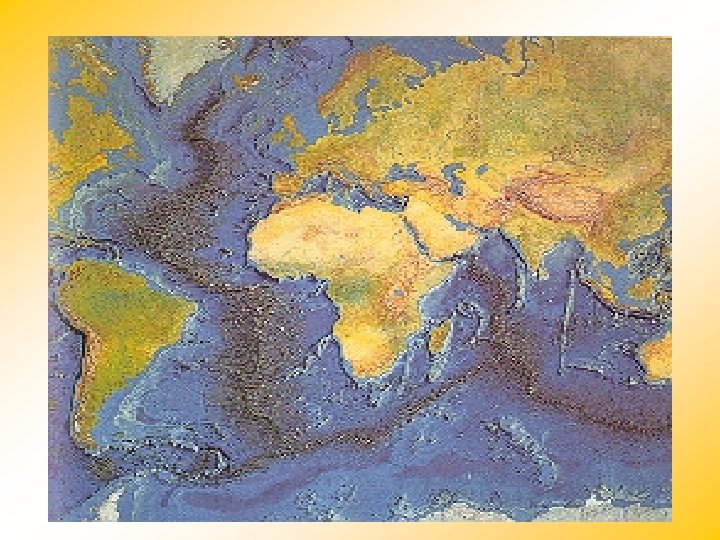
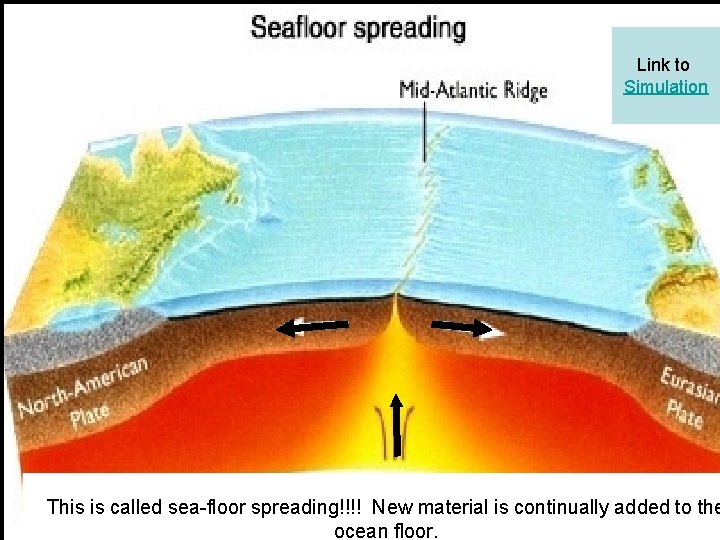
Where does the sea-floor spread? • The Earth’s ocean floors move like conveyor belts, carrying the continents along with them. • This movement begins at the mid-ocean ridge.
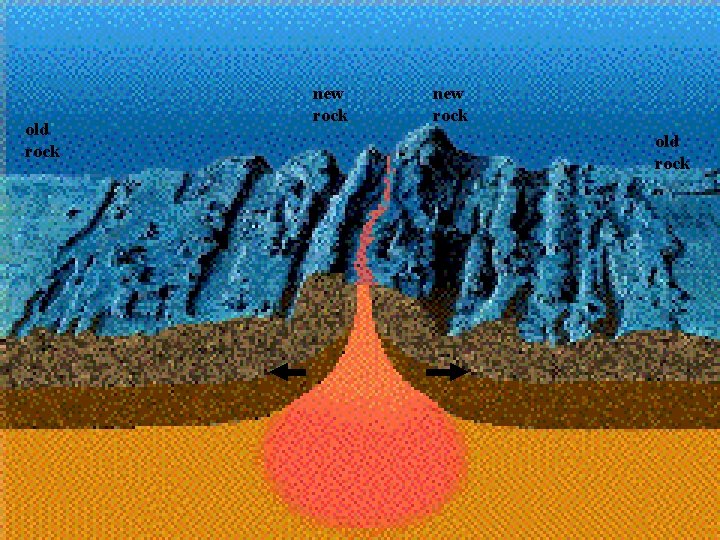
How does the sea-floor spread? 1. Melted rock (molten material) rises and erupts at the mid-ocean ridge because it is less dense than the surrounding crust. 2. The molten material then spreads out, pushing older rock to both sides of the ridge. 3. As the molten material cools, it forms a strip of solid rock in the center of the ridge. 4. Then more molten material erupts continuing the sea-floor spreading!
Link to Simulation This is called sea-floor spreading!!!! New material is continually added to the ocean floor.
9. 4 Testing Plate Tectonics What is paleomagnetism? u Paleomagnetism is using a rock’s magnetic properties to determine the location of the poles at the time the rock formed. u The Earth’s magnetic field periodically reverses polarity (north pole becomes south pole and vice versa) u When minerals in rocks solidify, iron-rich mineral grains will be permanently magnetized in the direction of the Earth’s magnetic field
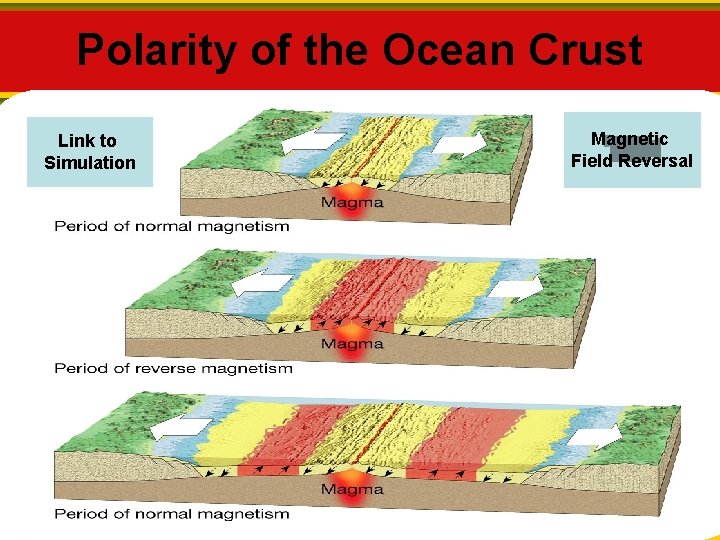
9. 4 Testing Plate Tectonics How does paleomagnetism show evidence for Sea-floor spreading? u The rocks that make up the ocean floor lie in patterns of magnetized “stripe”. u These stripes hold a record of the reversals in Earth’s magnetic field. u Since the pattern is the same on both sides of the ridge, this means that at one time, those stripes used to be together in the middle of the ridge. u These magnetic stripes are the best evidence for sea-floor spreading.
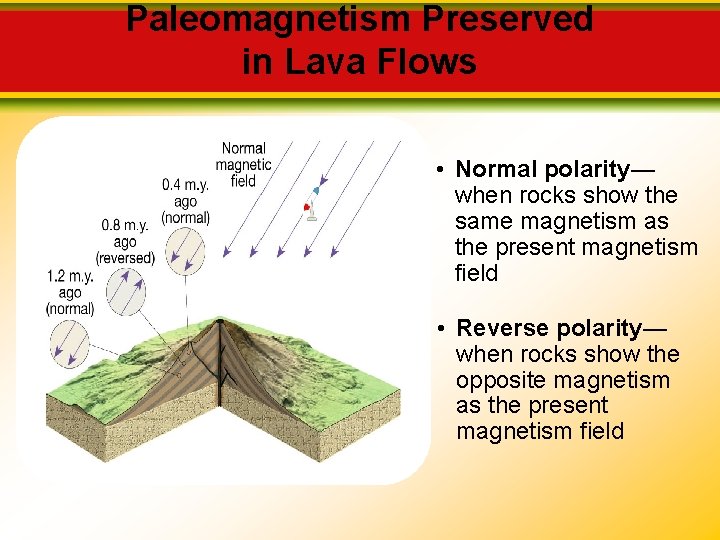
Paleomagnetism Preserved in Lava Flows • Normal polarity— when rocks show the same magnetism as the present magnetism field • Reverse polarity— when rocks show the opposite magnetism as the present magnetism field
Polarity of the Ocean Crust Link to Simulation Magnetic Field Reversal
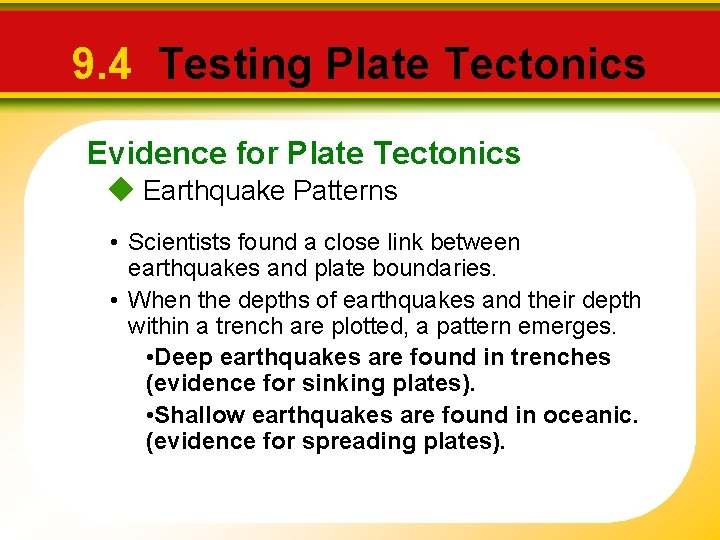
9. 4 Testing Plate Tectonics Evidence for Plate Tectonics Earthquake Patterns • Scientists found a close link between earthquakes and plate boundaries. • When the depths of earthquakes and their depth within a trench are plotted, a pattern emerges. • Deep earthquakes are found in trenches (evidence for sinking plates). • Shallow earthquakes are found in oceanic. (evidence for spreading plates).
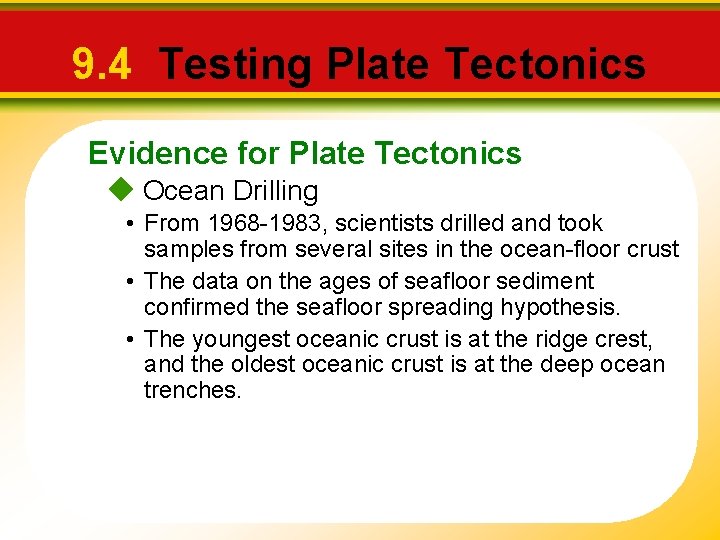
9. 4 Testing Plate Tectonics Evidence for Plate Tectonics Ocean Drilling • From 1968 -1983, scientists drilled and took samples from several sites in the ocean-floor crust • The data on the ages of seafloor sediment confirmed the seafloor spreading hypothesis. • The youngest oceanic crust is at the ridge crest, and the oldest oceanic crust is at the deep ocean trenches.
old rock new rock old rock
9. 4 Testing Plate Tectonics Evidence for Plate Tectonics What is a Hot Spot? • A hot spot is a concentration of heat in the mantle capable of producing magma, which rises to Earth’s surface.
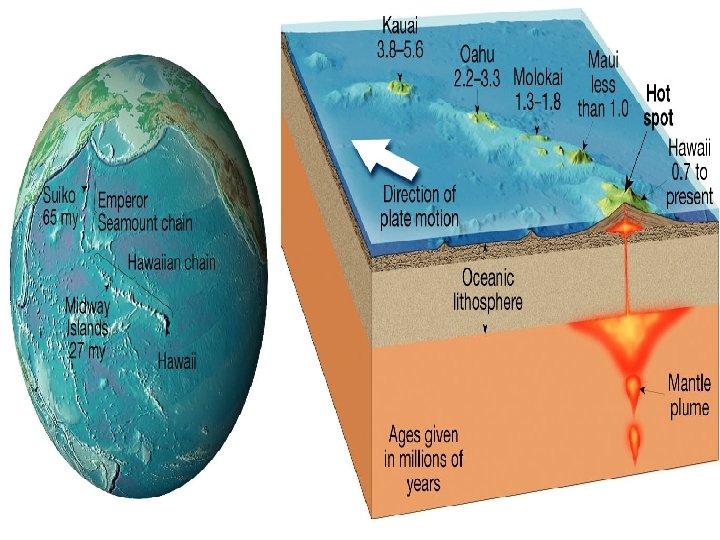
How do hot spots provide evidence for Plate Tectonics? • The Hawaiian Islands in the Pacific are formed by hot spots. • Dates of volcanoes in this chain increase with age with increasing distance from the east most island of Hawaii. • The age of each volcano shows the time when it was located over the hot spot. • This shows that the pacific plate is moving north-west.
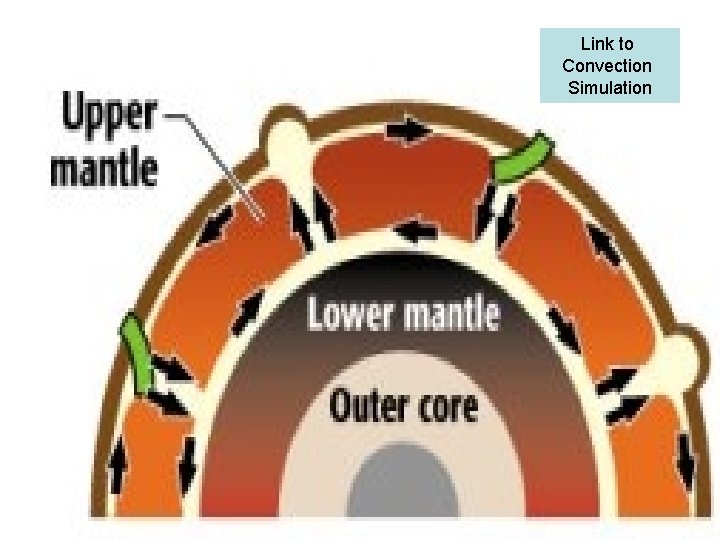
9. 5 Mechanisms of Plate Motion Causes of Plate Motion u The plates of the lithosphere float on top of the asthenosphere. u Convection currents within the asthenosphere push the plates of the lithosphere.
Link to Convection Simulation
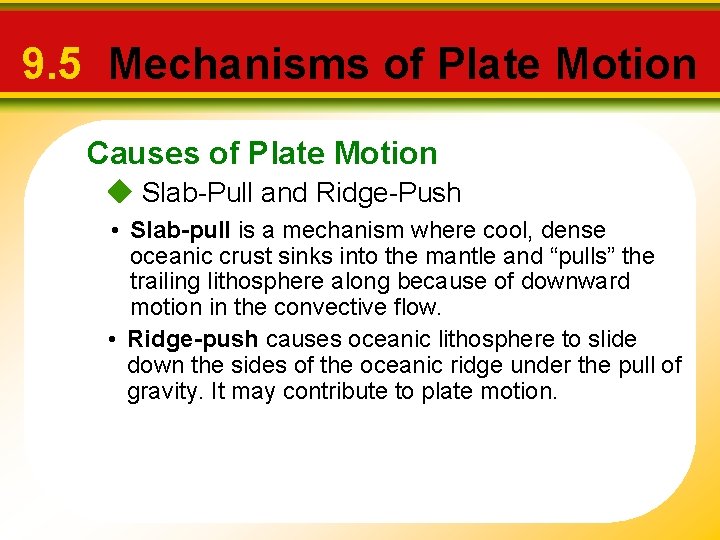
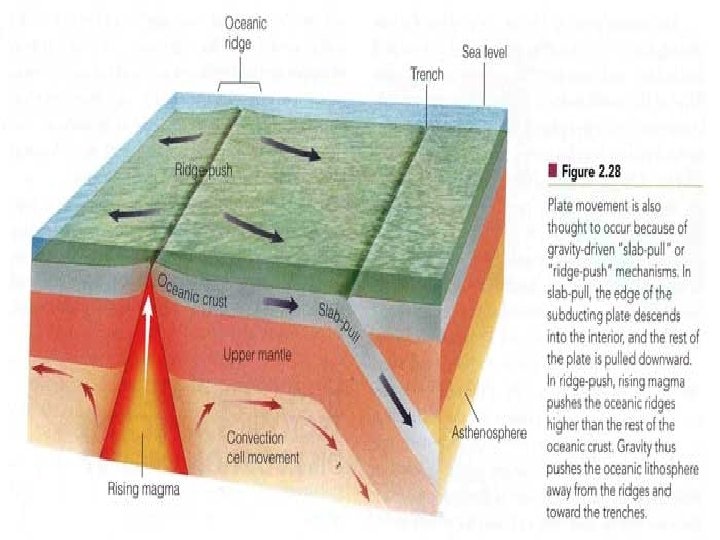
9. 5 Mechanisms of Plate Motion Causes of Plate Motion Slab-Pull and Ridge-Push • Slab-pull is a mechanism where cool, dense oceanic crust sinks into the mantle and “pulls” the trailing lithosphere along because of downward motion in the convective flow. • Ridge-push causes oceanic lithosphere to slide down the sides of the oceanic ridge under the pull of gravity. It may contribute to plate motion.
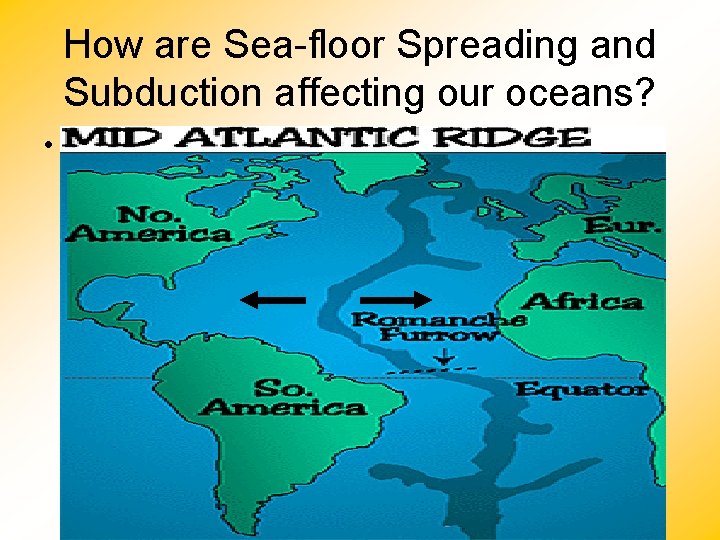
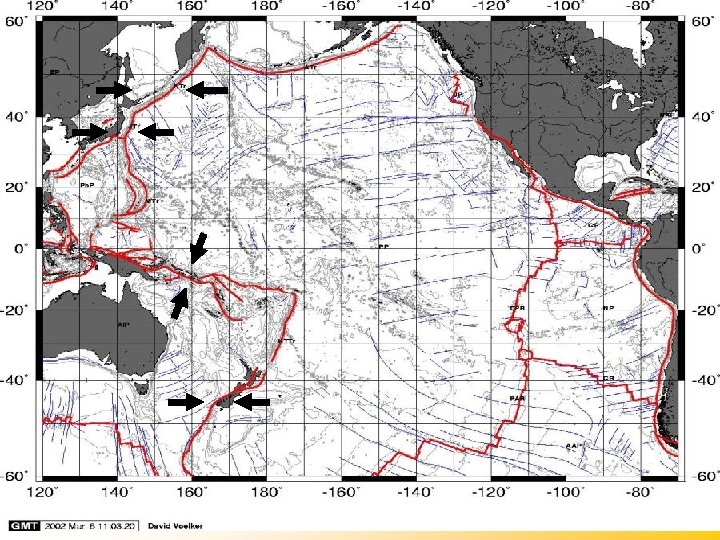
How are Sea-floor Spreading and Subduction affecting our oceans? • The Atlantic Ocean has very few trenches. As a result, the Atlantic Ocean is getting wider. As it spreads, it pushes the continents further away.
How are Sea-floor Spreading and Subduction affecting our oceans? • The Atlantic Ocean has very few trenches. As a result, the Atlantic Ocean is getting wider. As it spreads, it pushes the continents further away. • The Pacific Ocean covers almost 1/3 of the planet, yet it’s shrinking! The Pacific is surrounded by many trenches. The deep-ocean trenches swallow more oceanic crust than the mid-ocean ridge can create.
How long does it take for new rock to be recycled? • New rock that is formed at the mid-ocean ridge takes about 200 million years to move across the ocean, and sink into a trench.