
What is the Difference Between Training and Education
What is the Difference Between Training and Education Last Update 2011. 01. 12 1. 1. 0 Copyright 2010 Kenneth M. Chipps Ph. D. www. chipps. com 1
Training v Education • This is not a training company • This is a university Copyright 2010 Kenneth M. Chipps Ph. D. www. chipps. com 2
What is the Difference • Training is for the short term – Specific intense training over a short time period to master a transitory skill • Education is for life – Learning and using in different situations throughout your life skills such as • • The theoretical basis of your field Critical thinking Math English Copyright 2010 Kenneth M. Chipps Ph. D. www. chipps. com 3
What is the Difference • Education teaches you how to learn • It also teaches you current knowledge, but just like experience and certifications this current knowledge will soon be out of date • What will not ever be out of date is your ability to learn Copyright 2000 -2010 Kenneth M. Chipps Ph. D. www. chipps. com 4
Training v Education • In our case we are focusing in this class and in all of the networking classes on a combination of transitory skills as well as theoretical basis of the field of networking Copyright 2010 Kenneth M. Chipps Ph. D. www. chipps. com 5
Training v Education • Why – You need the transitory skills as these are the ones used today on the job – You need theoretical knowledge to understand apply new technology as it is developed and deployed – You will learn and apply this new technology using theoretical basis of the field of networking as well as critical thinking, math, and so forth learned in those other courses Copyright 2010 Kenneth M. Chipps Ph. D. www. chipps. com 6
Three Aspects to Success • There are three aspects to success in the network field – Certification – Experience – Education • Many people get by for years or forever with only one of these elements • So why do I say you need all three Copyright 2000 -2010 Kenneth M. Chipps Ph. D. www. chipps. com 7
Why All Three • Certification – Certification gives you basic familiarity with current systems and procedures – However this will change over time – Therefore certifications require constant updating Copyright 2010 Kenneth M. Chipps Ph. D. www. chipps. com 8
Why All Three • Experience – Experience gives you speed – By having done the same thing several times before you need not think about it, just do it, thereby saving time Copyright 2000 -2010 Kenneth M. Chipps Ph. D. www. chipps. com 9
Why All Three • Education – Education gives you understanding, so that when the basic familiarity gained through certification is not enough or past experience lets you down, you can figure it out for yourself – Because you understand how it works Copyright 2000 -2010 Kenneth M. Chipps Ph. D. www. chipps. com 10
Why All Three • Where the person that is certified will know how to do something • The person who has experience may know two ways to do something • The person with education will know the why about the something Copyright 2000 -2010 Kenneth M. Chipps Ph. D. www. chipps. com 11
Why All Three • This why, this knowing how it works, will allow the person with the degree to get back on track when the one way the certified person learned for the test does not work, and neither do the two ways the person with experience knows • The person who knows how it works, can make it work • So of the three, all are important Copyright 2000 -2010 Kenneth M. Chipps Ph. D. www. chipps. com 12
Why All There • But education in the field is the major element in my view • You need to know the why, not just the how Copyright 2000 -2010 Kenneth M. Chipps Ph. D. www. chipps. com 13
Training v Education • What is an example of a training organization Copyright 2010 Kenneth M. Chipps Ph. D. www. chipps. com 14
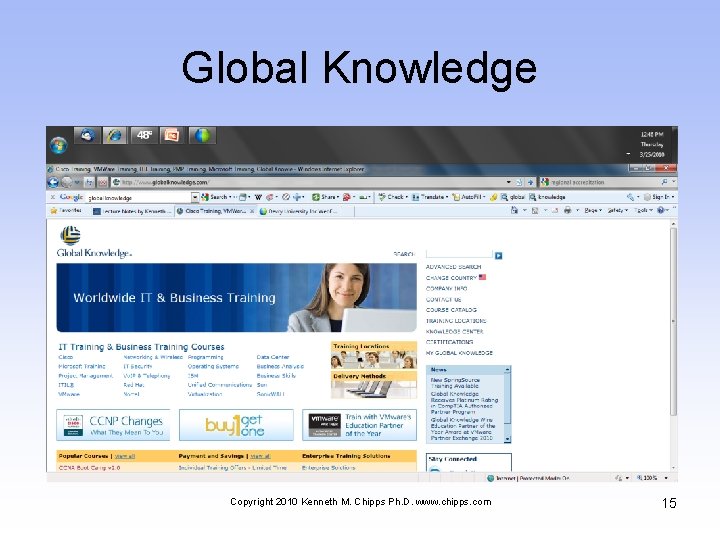
Global Knowledge Copyright 2010 Kenneth M. Chipps Ph. D. www. chipps. com 15
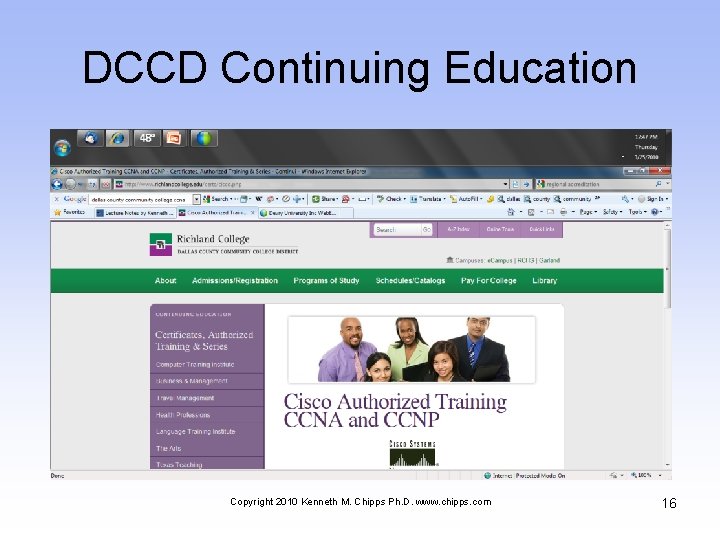
DCCD Continuing Education Copyright 2010 Kenneth M. Chipps Ph. D. www. chipps. com 16
What is a University • To understand what a university is let’s consider what every university student’s favorite research source Wikipedia says – A university is an institution of higher education and research, which grants academic degrees in a variety of subjects – A university is a corporation that provides both undergraduate education and postgraduate education Copyright 2010 Kenneth M. Chipps Ph. D. www. chipps. com 17
What is a College • The difference between a college and a university is that a college just offers a collection of degrees in one specific area, while a university is a collection of colleges • When you go to a university you are going to be graduating from one of their colleges, such as the business college • Single colleges tend to be smaller while universities are bigger Copyright 2010 Kenneth M. Chipps Ph. D. www. chipps. com 18
Types of University • There are two types of universities – Research – Teaching Copyright 2010 Kenneth M. Chipps Ph. D. www. chipps. com 19
Research University • There are several levels of research universities – A top level Research I university • • • Offers a full range of baccalaureate programs Provides graduate education through the doctorate Gives high priority to research Awards 50 or more doctoral degrees each year Receives $40 million or more in federal support per year Copyright 2010 Kenneth M. Chipps Ph. D. www. chipps. com 20
Research University • Notice that nowhere on that list is anything about teaching students • In this type of school the main responsibility of faculty is not teaching, it is research for publication and bringing grant funds into the school Copyright 2010 Kenneth M. Chipps Ph. D. www. chipps. com 21
Teaching University • In a teaching university – The faculty does not do research for publication as their primary responsibility – Instead they teach students – Research is a secondary and voluntary activity Copyright 2010 Kenneth M. Chipps Ph. D. www. chipps. com 22
UTA • Let’s look at a typical lower tier research university • UTA is an example of this type of school • UTA is a research school, but it is not a tier 1 school • UTA faculty get ahead by doing research Copyright 2010 Kenneth M. Chipps Ph. D. www. chipps. com 23
Teaching Assistant • At a research school usually the undergraduate courses are taught by teaching assistants • TAs are graduate students hoping some day to do research at a research university Copyright 2010 Kenneth M. Chipps Ph. D. www. chipps. com 24
Research • When you ask a faculty member at a school like this what they do a typical response is – Research – Teaching – Service • Let’s look at a job posting for a faculty position at UTA Copyright 2010 Kenneth M. Chipps Ph. D. www. chipps. com 25
Job Description • Here is part of the job description for a current opening in the Computer Science and Engineering department at UTA – The CSE faculty are active researchers, many with multiple grants and established research programs Copyright 2010 Kenneth M. Chipps Ph. D. www. chipps. com 26
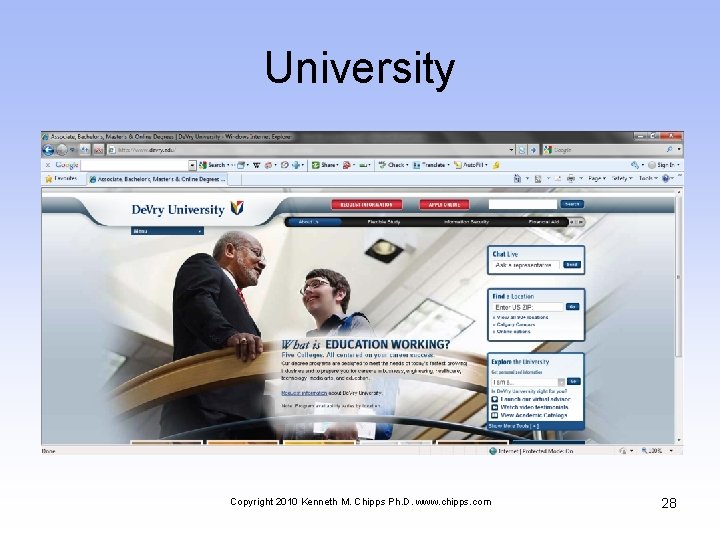
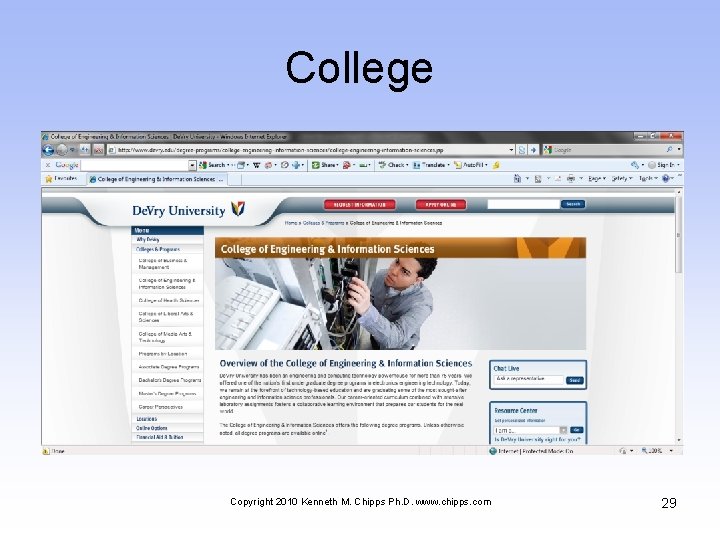
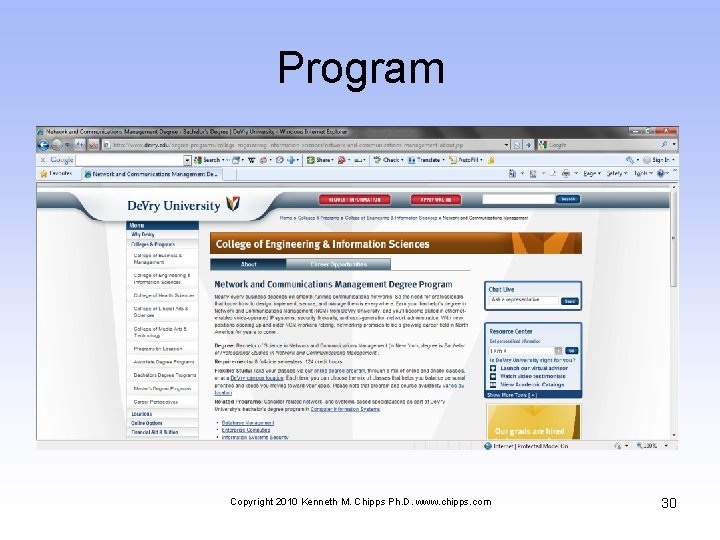
De. Vry • Just like other universities De. Vry is – A regional accredited university – Organized as a series of colleges – With a set of programs within each of these colleges • You are in the Network and Communication Management program in the College of Engineering and Information Sciences Copyright 2010 Kenneth M. Chipps Ph. D. www. chipps. com 27
University Copyright 2010 Kenneth M. Chipps Ph. D. www. chipps. com 28
College Copyright 2010 Kenneth M. Chipps Ph. D. www. chipps. com 29
Program Copyright 2010 Kenneth M. Chipps Ph. D. www. chipps. com 30
Job Description • Here is part of the job description for a current opening in the Network and Communications Management program at De. Vry – Full-time faculty provides the educational focus of teaching, academic advising, and committee work in our academic courses – Service to the College, community, profession, and scholarly activities are integral aspects of this position Copyright 2010 Kenneth M. Chipps Ph. D. www. chipps. com 31
Job Description – The qualified individual would be responsible for teaching courses that provide students with a background in network systems administration as applied to practical business situations – These courses would address installing, configuring, securing and administering network systems comprising users, shared resources and network elements, such as routers, in local and Internet-based environments 32 Copyright 2010 Kenneth M. Chipps Ph. D. www. chipps. com
How is De. Vry Different • What is different between a research university and De. Vry – The main difference is the added value – I bring decades of on the job experience in this field into the classroom – I do nothing but keep up with developments in this field – I look at what needs to be added – I look at what needs to be deleted Copyright 2010 Kenneth M. Chipps Ph. D. www. chipps. com 33
Accreditation • The two major forms of accreditation are – Regional – National • The difference is regionally accredited schools are predominantly academically oriented, non-profit institutions • Nationally accredited schools are predominantly for-profit and offer vocational, career or technical programs Copyright 2010 Kenneth M. Chipps Ph. D. www. chipps. com 34
Accreditation – Even though we are a for-profit company we are one of the regionally accredited universities based on our commitment to high quality education, as opposed to simple vocational training schools Copyright 2010 Kenneth M. Chipps Ph. D. www. chipps. com 35
Regional Accreditation • All high quality universities including De. Vry are accredited by one of the regional accrediting bodies • These are – Middle States Association of Colleges and Schools – New England Association of Schools and Colleges – North Central Association of Colleges and Schools Copyright 2010 Kenneth M. Chipps Ph. D. www. chipps. com 36
Regional Accreditation – Northwest Association of Accredited Schools – Western Association of Schools and Colleges – Southern Association of Colleges and Schools • De. Vry is part of the North Central Association Copyright 2010 Kenneth M. Chipps Ph. D. www. chipps. com 37
North Central Association • Who else is accredited by the North Central Association that you might recognize – Colorado State University – Cornell – Iowa State University – Kent State – Michigan State University – Ohio State University Copyright 2010 Kenneth M. Chipps Ph. D. www. chipps. com 38
North Central Association – Oklahoma State University – Purdue – University of Chicago – University of Michigan – University of Oklahoma Copyright 2010 Kenneth M. Chipps Ph. D. www. chipps. com 39
Texas Specific Accreditation • In addition in Texas we are governed by the Texas Higher Education Coordinating Board Copyright 2010 Kenneth M. Chipps Ph. D. www. chipps. com 40
- Slides: 40