
What is the difference between crime and deviance
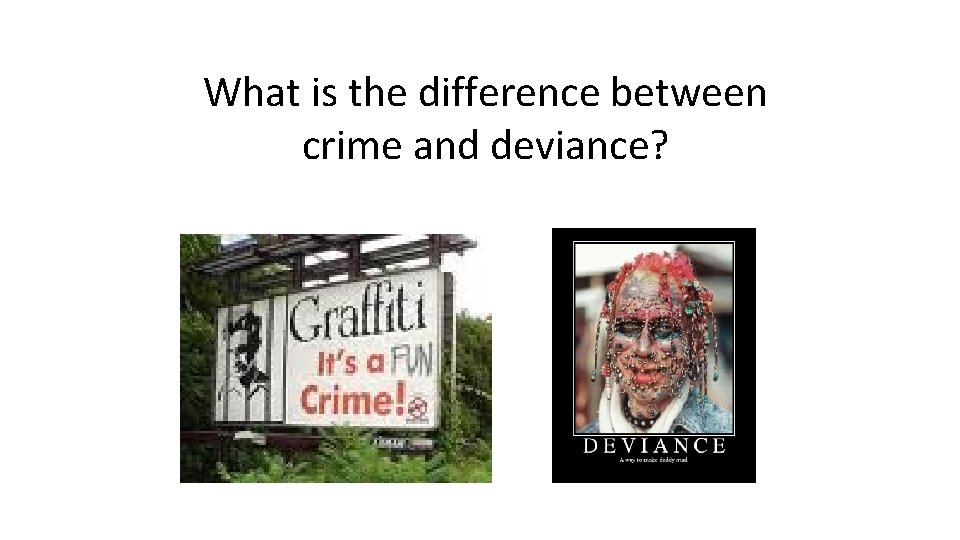
What is the difference between crime and deviance?

• Crime: An act which breaks the criminal law of a society • Deviance : behaviour that is disapproved of by most people in society and does not conform to a societies norms and values
Socially Defined • Many sociologists believe that deviance is socially defined. • This means that whether an act is considered deviant or not depends on the setting in which it takes place • Crime and deviance is relative: it can only be defined in relation to a particular standard of behaviour in a particular culture at a particular moment in time. Time, place, culture, social setting




Reactions to deviance • Sociologists argue that what is considered deviant depends NOT on the act itself, but on how people react to it; how they see, define and label and act. • Deviance, therefore is defined according to the social setting in which the act takes place - it is socially defined.
Social control: • Refers to the methods that are used to control individual and group behaviour • Leads to conformity to the rules of that particular society • Types: - Informal, e. g. work, friends, family - Formal, e. g. the police, religion

Marxists • Agents of social control are there in order to keep the classes separate. Laws reflect the interests of the richest and most powerful in society, who have managed to impose their way of thinking on people through agencies of social control. • Powerful keep their power by saying anything against their interests is illegal/deviant.
Functionalists • Agents of social control are actually agents of social integration. Social rules and laws are made and enforced for the benefit of everyone. They are a valuable part of society without which society would not function properly. • Crime threatens these norms and values • But it also strengthens bonds and reaffirms values • Crime being punished demonstrates clear values
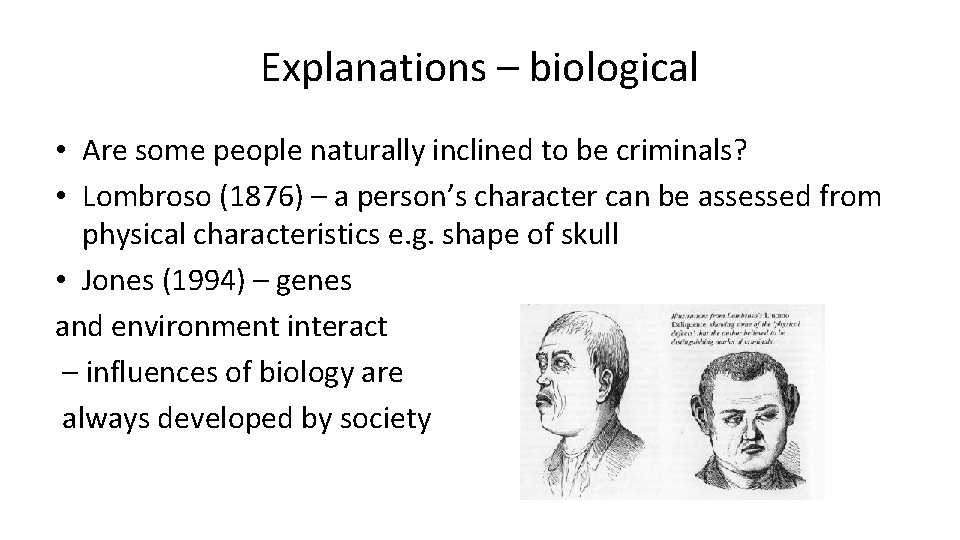
Explanations – biological • Are some people naturally inclined to be criminals? • Lombroso (1876) – a person’s character can be assessed from physical characteristics e. g. shape of skull • Jones (1994) – genes and environment interact – influences of biology are always developed by society
Sociological explanations of crime and deviance • • • Socialisation Influence of the peer group Labelling theory The opportunity structure Poverty – relative deprivation – Marxism
How do we measure the amount of criminal behaviour? • Official Statistics: Statistics collected from police reports • Self report studies: questionnaires where people own up to committing crimes, whether they have been discovered or not • Victim Surveys: people admitting to being the victim of a crime, whether or not they have reported it. • There are problems with all of these methods….
Not all crimes are included in official statistics… • Many crimes are undetected (e. g. small amounts of money being taken from a wallet) • Many crimes are unreported - Fear of criminal/police - Too ‘private’ e. g. domestic violence - Sensitive or embarrassing, e. g. rape - Crime in the workplace – no need for police? • Only about 40% of crimes reported are recorded by the police. - Too trivial? - Not a crime? - Investigation justified? THEREFORE, CRIME STATISTICS LACK VALIDITY
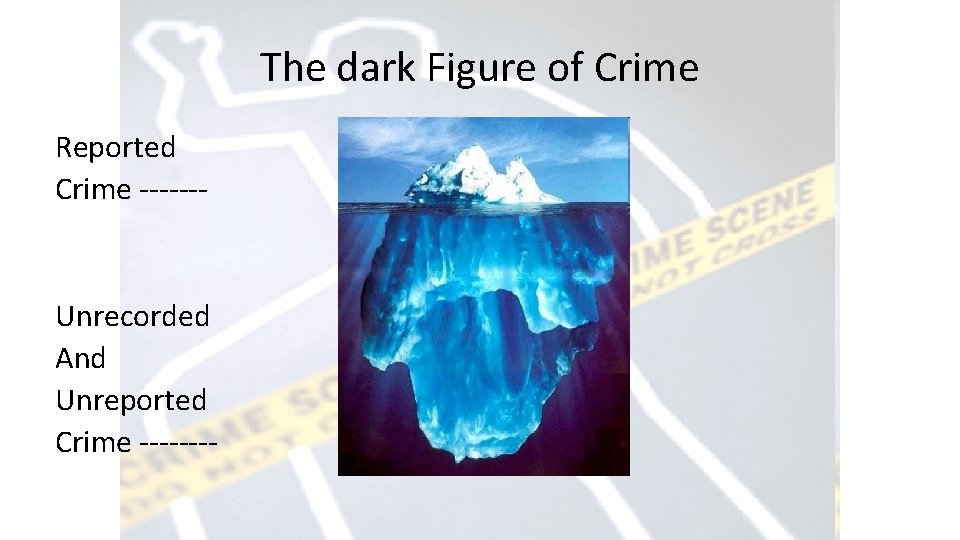
The dark Figure of Crime Reported Crime ------- Unrecorded And Unreported Crime ----
Who commits crime? • • - Crime and gender Statistics show men commit more crimes than women Explaining the differences Different socialisation Opportunity to commit crime Social control Chivalry thesis Inaccurate statistics
Who commits crime? 2 • Crime and age - Statistics tend to suggest that most people receiving criminal convictions will be between 14 and 24 years of age • Crime and ethnicity - Afro-Caribbean males and Asian males are over-represented in the prison population
Who commits crime? • Crime and social class - Socialisation – different values? - Material deprivation - Anomie (sense of ‘normlessness’) - Education – low paid jobs – lack of ££ White collar crime - Hard to research - Many crimes ‘victimless’ - Fear of reporting - may lose public confidence?
- Slides: 19