
What is the difference between contribution and profit
What is the difference between contribution and profit?
Thursday, September 17, 2020 How to analyse profitability Objectives; p. Calculate and interpret the Gross Profit Margin and Operating Profit Margin p. Identify methods of improving profitability p. Recognise weaknesses in lowering quality and raising price to increase profitability
This profit, that profit and the other… p Profit margin …a comparison of profit to sales revenue p Gross Profit (loss)… the revenue (or deficit) left over after the initial cost of the item which has been sold is deducted p Operating Profit (loss)… the profit (loss) left after other expenses (direct and indirect costs) have been deducted from Gross Profit
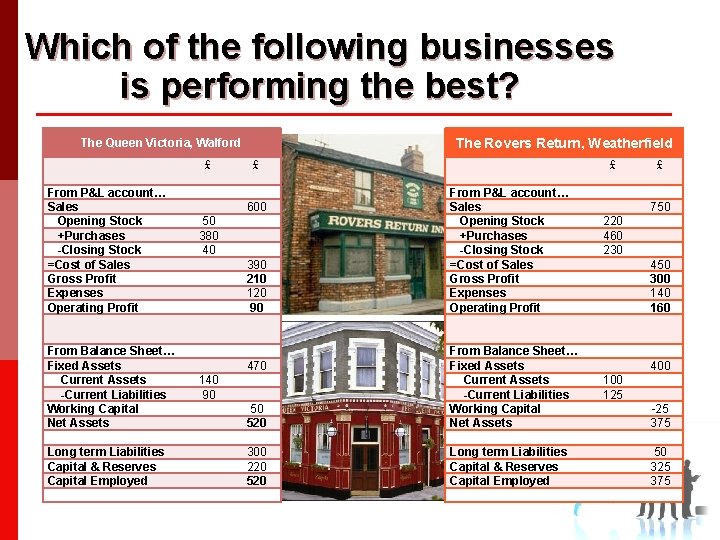
Which of the following businesses is performing the best? The Rovers Return, Weatherfield The Queen Victoria, Walford From P&L account… Sales Opening Stock +Purchases -Closing Stock =Cost of Sales Gross Profit Expenses Operating Profit From Balance Sheet… Fixed Assets Current Assets -Current Liabilities Working Capital Net Assets Long term Liabilities Capital & Reserves Capital Employed £ £ 50 380 40 600 390 210 120 90 470 140 90 50 520 300 220 520 From P&L account… Sales Opening Stock +Purchases -Closing Stock =Cost of Sales Gross Profit Expenses Operating Profit From Balance Sheet… Fixed Assets Current Assets -Current Liabilities Working Capital Net Assets Long term Liabilities Capital & Reserves Capital Employed £ £ 220 460 230 750 450 300 140 160 400 125 -25 375 50 325 375
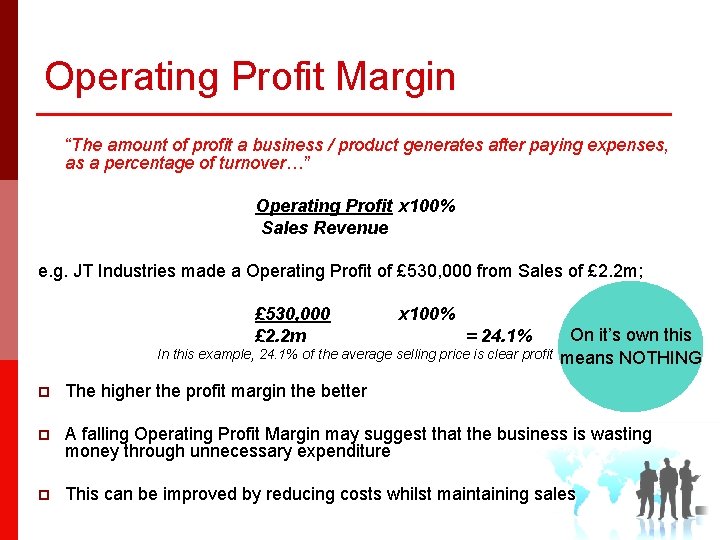
Operating Profit Margin “The amount of profit a business / product generates after paying expenses, as a percentage of turnover…” Operating Profit x 100% Sales Revenue e. g. JT Industries made a Operating Profit of £ 530, 000 from Sales of £ 2. 2 m; £ 530, 000 £ 2. 2 m x 100% = 24. 1% In this example, 24. 1% of the average selling price is clear profit On it’s own this means NOTHING p The higher the profit margin the better p A falling Operating Profit Margin may suggest that the business is wasting money through unnecessary expenditure p This can be improved by reducing costs whilst maintaining sales
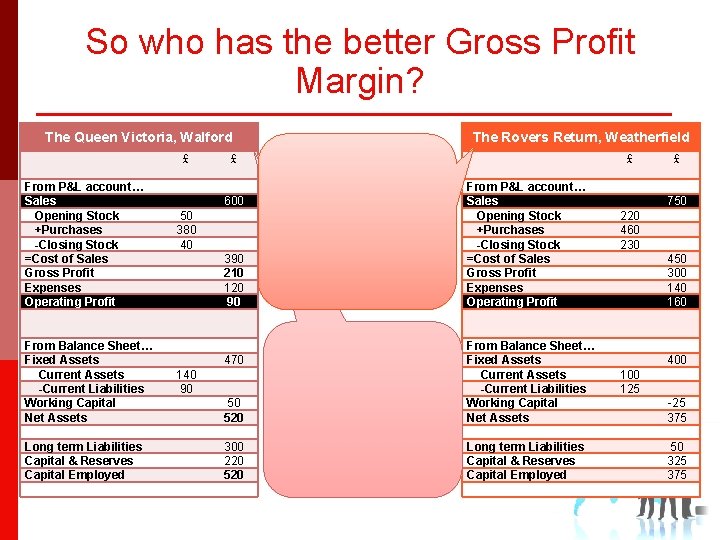
So who has the better Gross Profit Margin? The Queen Victoria, Walford From P&L account… Sales Opening Stock +Purchases -Closing Stock =Cost of Sales Gross Profit Expenses Operating Profit From Balance Sheet… Fixed Assets Current Assets -Current Liabilities Working Capital Net Assets Long term Liabilities Capital & Reserves Capital Employed £ £ 50 380 40 600 390 210 120 90 470 140 90 50 520 300 220 520 The Rovers Return, Weatherfield From P&L account… Sales Opening Stock +Purchases -Closing Stock =Cost of Sales Gross Profit Expenses Operating Profit From Balance Sheet… Fixed Assets Current Assets -Current Liabilities Working Capital Net Assets Long term Liabilities Capital & Reserves Capital Employed £ £ 220 460 230 750 450 300 140 160 400 125 -25 375 50 325 375
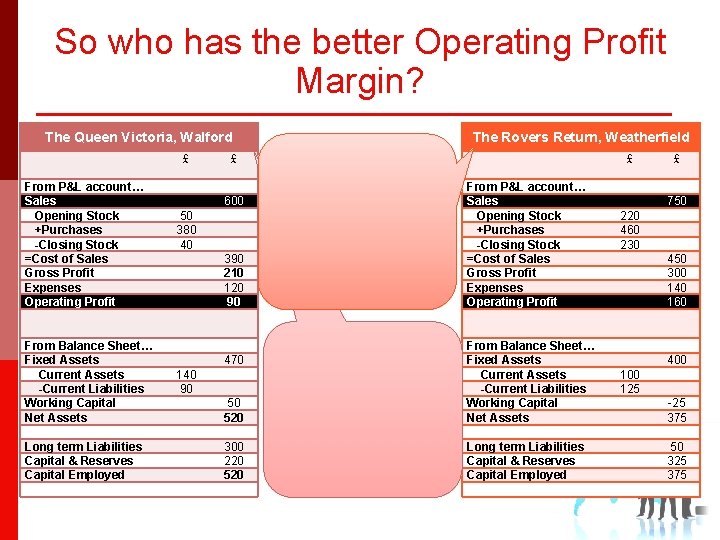
So who has the better Operating Profit Margin? The Queen Victoria, Walford From P&L account… Sales Opening Stock +Purchases -Closing Stock =Cost of Sales Gross Profit Expenses Operating Profit From Balance Sheet… Fixed Assets Current Assets -Current Liabilities Working Capital Net Assets Long term Liabilities Capital & Reserves Capital Employed £ £ 50 380 40 600 390 210 120 90 470 140 90 50 520 300 220 520 The Rovers Return, Weatherfield From P&L account… Sales Opening Stock +Purchases -Closing Stock =Cost of Sales Gross Profit Expenses Operating Profit From Balance Sheet… Fixed Assets Current Assets -Current Liabilities Working Capital Net Assets Long term Liabilities Capital & Reserves Capital Employed £ £ 220 460 230 750 450 300 140 160 400 125 -25 375 50 325 375
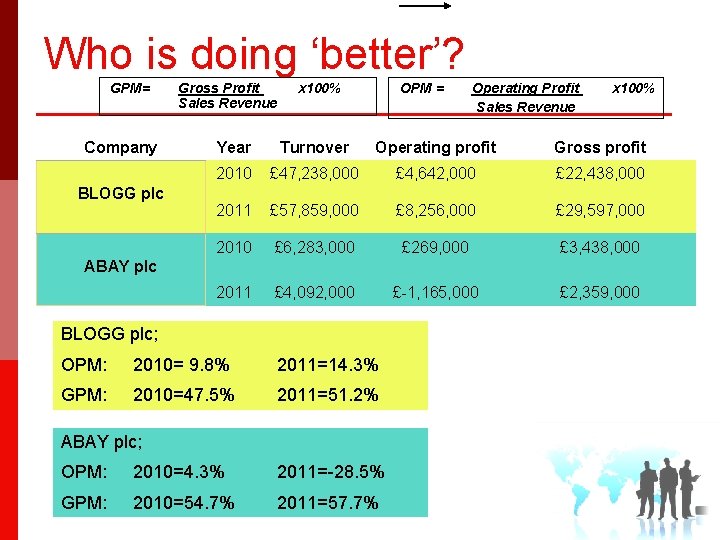
Who is doing ‘better’? GPM= Company BLOGG plc Gross Profit Sales Revenue x 100% OPM = Operating Profit Sales Revenue x 100% Year Turnover Operating profit Gross profit 2010 £ 47, 238, 000 £ 4, 642, 000 £ 22, 438, 000 2011 £ 57, 859, 000 £ 8, 256, 000 £ 29, 597, 000 2010 £ 6, 283, 000 £ 269, 000 £ 3, 438, 000 2011 £ 4, 092, 000 £-1, 165, 000 £ 2, 359, 000 ABAY plc BLOGG plc; OPM: 2010= 9. 8% 2011=14. 3% GPM: 2010=47. 5% 2011=51. 2% ABAY plc; OPM: 2010=4. 3% 2011=-28. 5% GPM: 2010=54. 7% 2011=57. 7%
Why measure? p Comparisons can be made between; n n p Previous & Current Performance Own & Competitor Performance Progress can be tracked and monitored; n n n Allows analysis of adverse changes Allows objectives to be set linked to performance Actions can be taken to improve performance
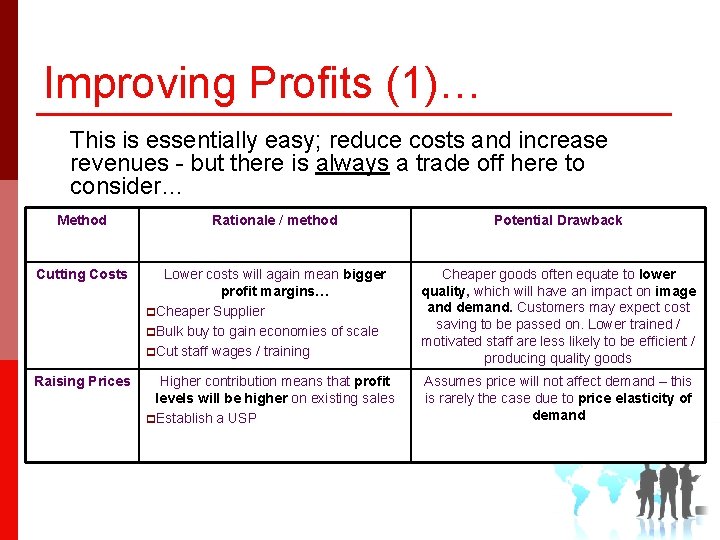
Improving Profits (1)… This is essentially easy; reduce costs and increase revenues - but there is always a trade off here to consider… Method Rationale / method Potential Drawback Cutting Costs Lower costs will again mean bigger profit margins… p. Cheaper Supplier p. Bulk buy to gain economies of scale p. Cut staff wages / training Cheaper goods often equate to lower quality, which will have an impact on image and demand. Customers may expect cost saving to be passed on. Lower trained / motivated staff are less likely to be efficient / producing quality goods Raising Prices Higher contribution means that profit levels will be higher on existing sales p. Establish a USP Assumes price will not affect demand – this is rarely the case due to price elasticity of demand
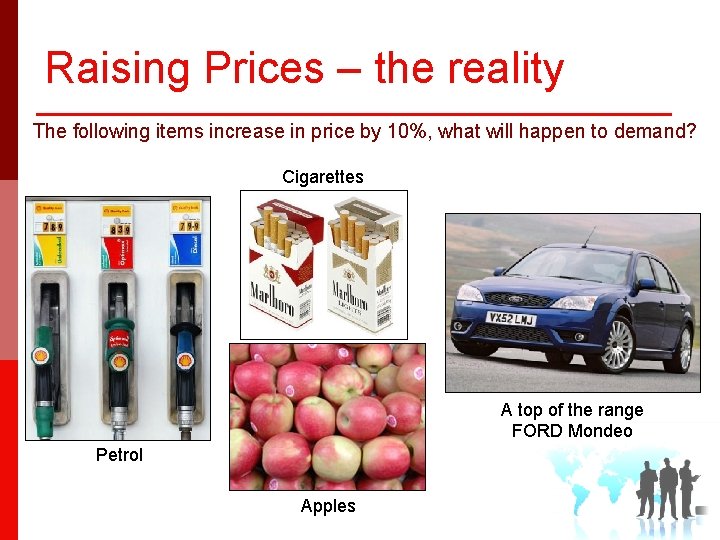
Raising Prices – the reality The following items increase in price by 10%, what will happen to demand? Cigarettes A top of the range FORD Mondeo Petrol Apples
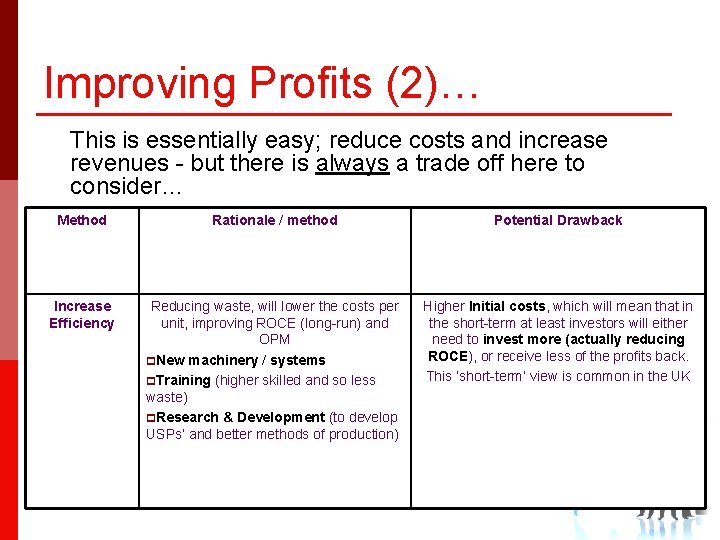
Improving Profits (2)… This is essentially easy; reduce costs and increase revenues - but there is always a trade off here to consider… Method Rationale / method Potential Drawback Increase Efficiency Reducing waste, will lower the costs per unit, improving ROCE (long-run) and OPM p. New machinery / systems p. Training (higher skilled and so less waste) p. Research & Development (to develop USPs’ and better methods of production) Higher Initial costs, which will mean that in the short-term at least investors will either need to invest more (actually reducing ROCE), or receive less of the profits back. This ‘short-term’ view is common in the UK
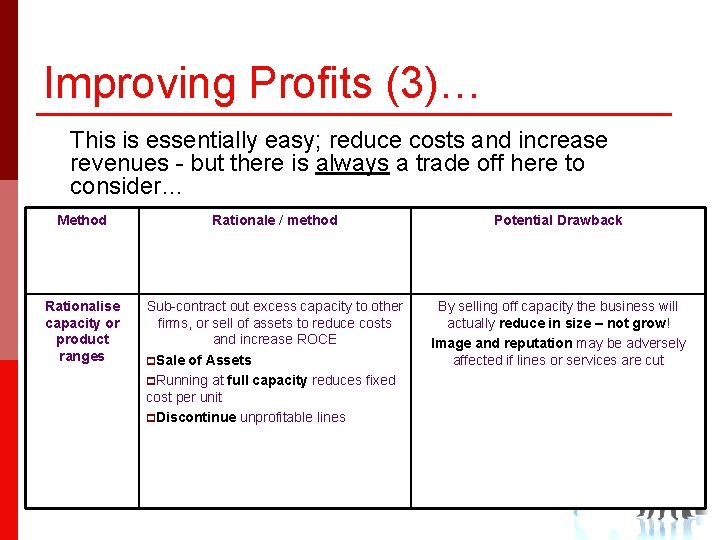
Improving Profits (3)… This is essentially easy; reduce costs and increase revenues - but there is always a trade off here to consider… Method Rationale / method Potential Drawback Rationalise capacity or product ranges Sub-contract out excess capacity to other firms, or sell of assets to reduce costs and increase ROCE p. Sale of Assets p. Running at full capacity reduces fixed cost per unit p. Discontinue unprofitable lines By selling off capacity the business will actually reduce in size – not grow! Image and reputation may be adversely affected if lines or services are cut
Task p Assessment activities (page 231) – questions 5 -15
- Slides: 14