
What is the difference between act and rule
What is the difference between act and rule utilitarianism? BWS
What is the difference between act utilitarianism and rule utilitarianism? Distinguishing between the two BWS
January 2022 Act Utilitarianism and Rule Utilitarianism BWS
How practical do you think it is to calculate each? Do you think Bentham demands that we do a calculation each time? BWS
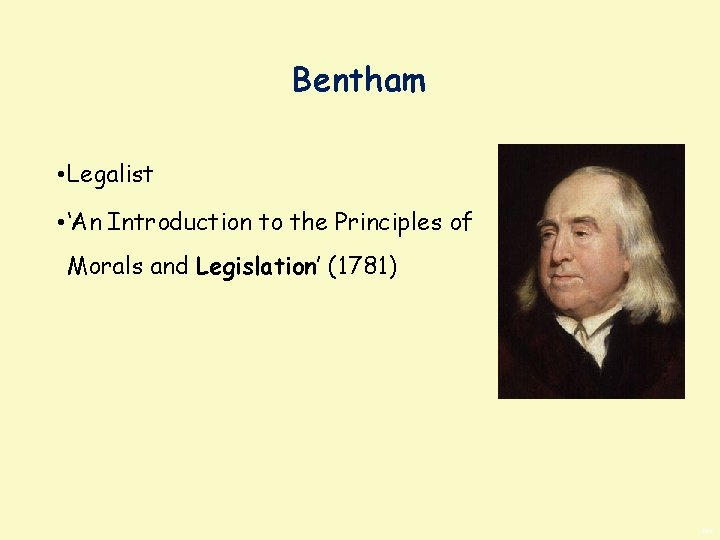
Bentham • Legalist • ‘An Introduction to the Principles of Morals and Legislation’ (1781) BWS
I say of every action whatsoever, and therefore not only of every action of a private individual, but of every measure of government. Bentham: Principle of Utility BWS
Bentham: associated with act utilitarianism • (main audience: legalists, legislators) • But – principle of utility applies, or ought to be applied, to individual actions BWS
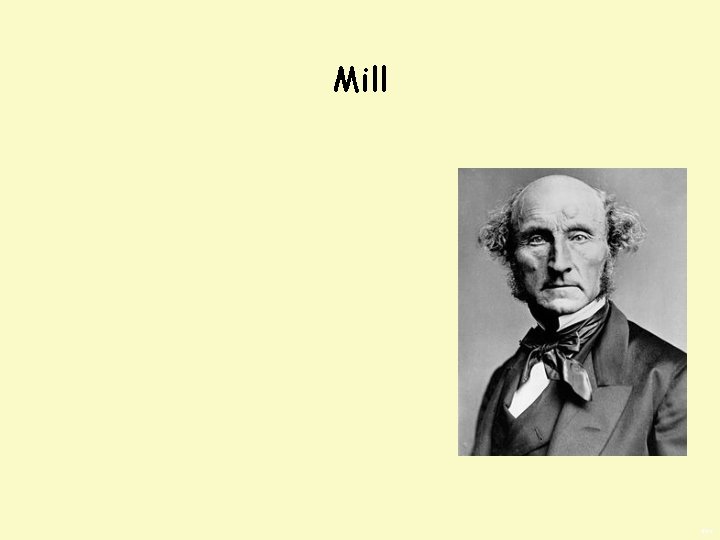
Mill BWS
Act U v Rule U • Problem 1 with U: calculation • Problem 2 with U: it justifies certain abhorrent acts (sadistic guards). • Solution: apply Principle of Utility, not to acts, but to rules BWS
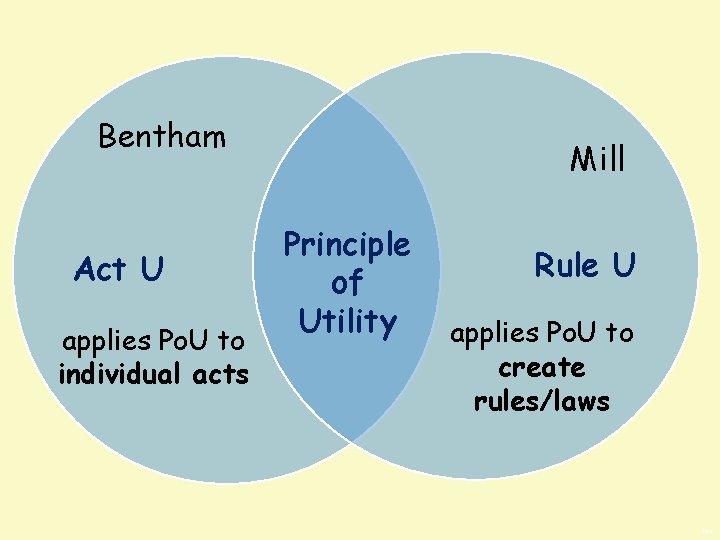
Bentham Act U applies Po. U to individual acts Mill Principle of Utility Rule U applies Po. U to create rules/laws BWS
What laws would you create… BWS
What laws would you create… • New school rule: Pupils to spend 2 hours per day engaged in physical exercise. • New school rule 2: All pupils to shave hair and keep it to no longer than 2 mm in length. BWS
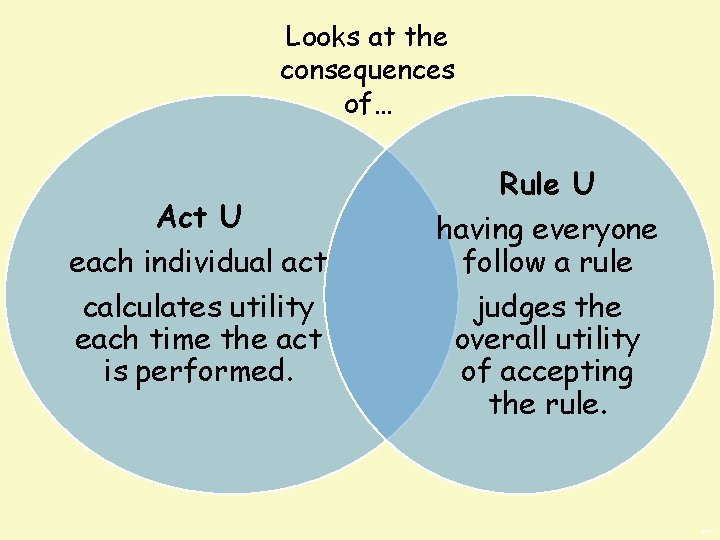
Looks at the consequences of… Act U each individual act calculates utility each time the act is performed. Rule U having everyone follow a rule judges the overall utility of accepting the rule. BWS
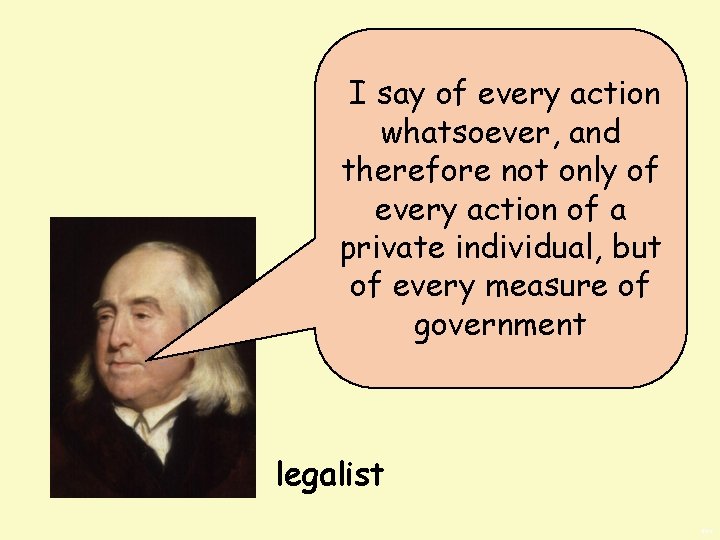
I say of every action whatsoever, and therefore not only of every action of a private individual, but of every measure of government legalist BWS
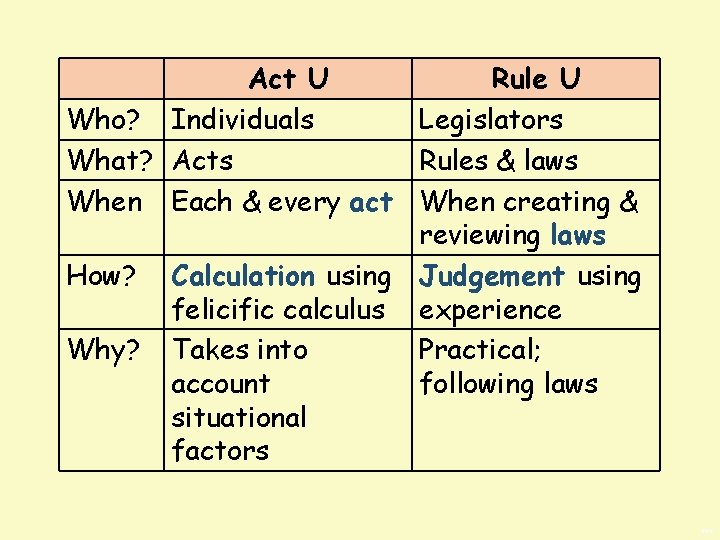
Act U Rule U Who? Individuals Legislators What? Acts Rules & laws When Each & every act When creating & reviewing laws How? Calculation using Judgement using felicific calculus experience Why? Takes into Practical; account following laws situational factors BWS
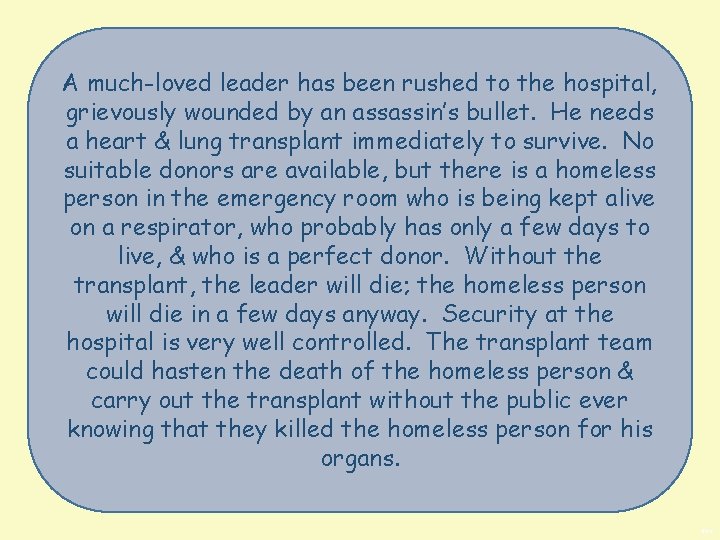
A much-loved leader has been rushed to the hospital, grievously wounded by an assassin’s bullet. He needs a heart & lung transplant immediately to survive. No suitable donors are available, but there is a homeless person in the emergency room who is being kept alive on a respirator, who probably has only a few days to live, & who is a perfect donor. Without the transplant, the leader will die; the homeless person will die in a few days anyway. Security at the hospital is very well controlled. The transplant team could hasten the death of the homeless person & carry out the transplant without the public ever knowing that they killed the homeless person for his organs. BWS
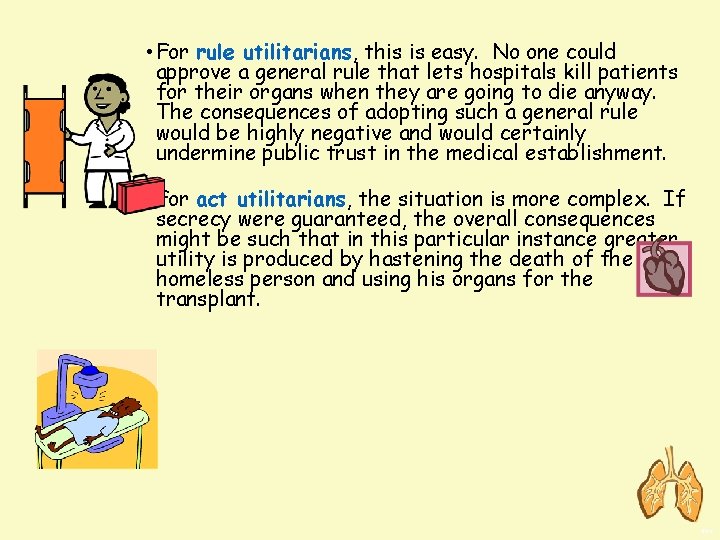
• For rule utilitarians, this is easy. No one could approve a general rule that lets hospitals kill patients for their organs when they are going to die anyway. The consequences of adopting such a general rule would be highly negative and would certainly undermine public trust in the medical establishment. • For act utilitarians, the situation is more complex. If secrecy were guaranteed, the overall consequences might be such that in this particular instance greater utility is produced by hastening the death of the homeless person and using his organs for the transplant. BWS
Strong Rule Utilitarianism versus and Weak Rule Utilitarianism The strong form of theory maintains that rules established through the application of utilitarian principles should never be broken The weak version tries to account for the possibility that those same utilitarian principles can take precedence in a particular situation over a general rule. However, the rule would still form part of the decision making process. BWS

Simon Blackburn BWS
Strength of Rule Utilitarianism • Unlike deontology • Rule U provides a rational way of creating rules • …and of reviewing rules • …and of resolving conflicts between rules: apply Po. U • …and of acknowledging that ‘extreme situations require extreme measures’ (Hume, Barclay) BWS
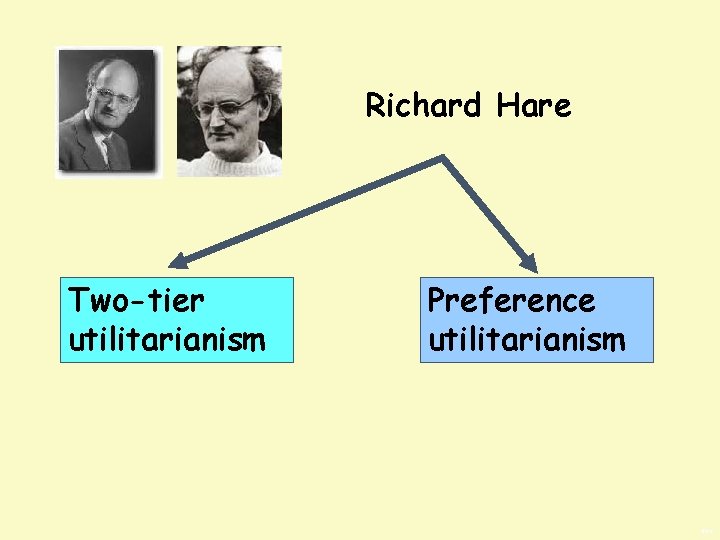
Richard Hare Two-tier utilitarianism Preference utilitarianism BWS
Two-tier utilitarianism • Act utilitarianism – the criterion (judge) of an action (the why) • Rule utilitarianism – principle of deliberation (the how) • Revert to act utilitarianism if needed BWS
BWS
- Slides: 23