
What is the difference between a matchedpairs ttest
What is the difference between a matchedpairs t-test and a two-sample t-test? An easy question to ask yourself is “How was the data collected? ” If the data has one individual or experimental unit performing two tasks, then you must use a matched pairs t-test. If the data was collected from two different groups of individuals or experimental units, then you must use a two-sample t-test.
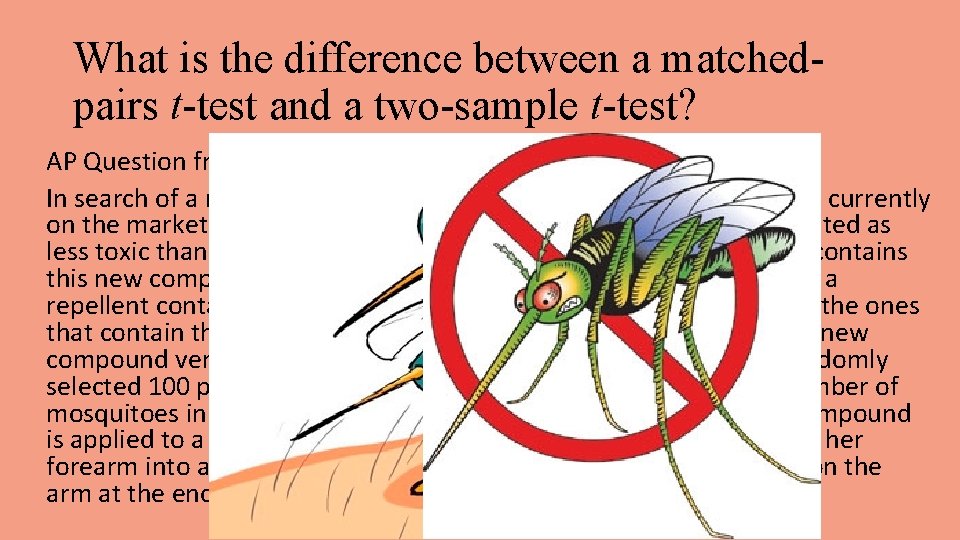
What is the difference between a matchedpairs t-test and a two-sample t-test? AP Question from 2005 form B: In search of a mosquito repellent that is safer than the ones that are currently on the market, scientists have developed a new compound that is rated as less toxic than the current compound, thus making a repellent that contains this new compound safer for human use. Scientists also believe that a repellent containing the new compound will be more effective than the ones that contain the current compound. To test the effectiveness of the new compound versus that of the current compound, scientists have randomly selected 100 people from a state. Up to 100 bins, with an equal number of mosquitoes in each bin, are available for use in the study. After a compound is applied to a participant’s forearm, the participant will insert his or her forearm into a bin for 1 minute, and the number of mosquito bites on the arm at the end of that time will be determined.
What is the difference between a matchedpairs t-test and a two-sample t-test? There are two ways to think about this experiment: 1. Randomly select two groups of 50, with the first group receiving the new compound and the second group receiving the current compound. Each participant than places their arm with the repellant in the container. Count the number of bites after 1 minute and computed the average number of bites for each of the different compounds. Then determine if there is a significant difference between the compounds. 2. Randomly selecting an arm, either right or left, for each participant. The new compound is placed on the arm randomly chosen and the arm not chosen receives the current compound. Both arms are placed into the bin at the same time and after 1 minute the number of bites are counted. The difference in the number of bites is computed for each participant and then the average difference computed to determine if the average is a significantly different from zero.
What is the difference between a matchedpairs t-test and a two-sample t-test? Which of the following is true about how a student should analyze the data for the two procedures described? A) For both procedures described, students should use matched-pairs t-tests. B) For both procedures described, students should use Two-Sample t-tests. C) The first procedure described, students should use a matched-pairs t-test, but for the second procedure, students should use a Two-Sample t-test. D) The first procedure described, students should use a Two-Sample t-test, but for the second procedure, students should use a matched-pairs t-test.
What is the difference between a matchedpairs t-test and a two-sample t-test? Which of the following is true about how a student should analyze the data for the two procedures described? A) For both procedures described, students should use matched-pairs t-tests. B) For both procedures described, students should use Two-Sample t-tests. C) The first procedure described, students should use a matched-pairs t-test, but for the second procedure, students should use a Two-Sample t-test. D) The first procedure described, students should use a Two-Sample t-test, but for the second procedure, students should use a matched-pairs t-test. The first procedure has two distinct groups while the second has one group, with each participant performing two tasks!
How to perform a matched pairs t-test A matched pairs t-test is typically graded like ALL inference procedures using the four step process. Each step is graded E, P, or I, with an E worth 1 point and a P worth ½ point. Papers at half points are graded holistically. 1. State the hypotheses, defining a parameter if needed. 2. Identify the procedure by name or formula AND verify the necessary preconditions have been satisfied. 3. The mechanics of the inference procedure (typically the test statistic and appropriate p-value) 4. The conclusion of the procedure, with linkage to an alpha level, in context. The response should always be in terms of the alternative hypothesis, NEVER the null hypothesis.
State the hypotheses, defining a parameter if needed The hypotheses for a matched pairs test are as follows: Ho : µ d = 0 Ha: µd some inequality 0 where µd is the average difference between the two tasks for the matched pair. ALWAYS in context of the problem.
State the hypotheses, defining a parameter if needed So in the mosquito example: Ho : µ d = 0 H a: µ d < 0 where µd is the average of the differences between the number of mosquito bites on the arm with the new compound and current compound. (µnew-current) Note: We use less than, since we hope the arms with the new compound has fewer bites than the arm with the current one.
Identify the procedure by name or formula AND verify the necessary preconditions have been satisfied. 1. The test procedure is a Matched Pairs t-test 2. There are 3 preconditions: • For observational studies, the data must be gathered from a random sample of the population. For experiments, the treatments must be randomly assigned. • The sampling distribution should be approximately normally distributed. If your sample is large, greater than 30 or 40, this conditions is satisfied. If your sample is small, the data must be graphed to determine if the data seems to be coming from a non-normal distribution. • For observational studies, the sample size should be less than 10% of the population. For experiments, this condition is not necessary, as your result should be about people similar to the volunteers in the experiment.
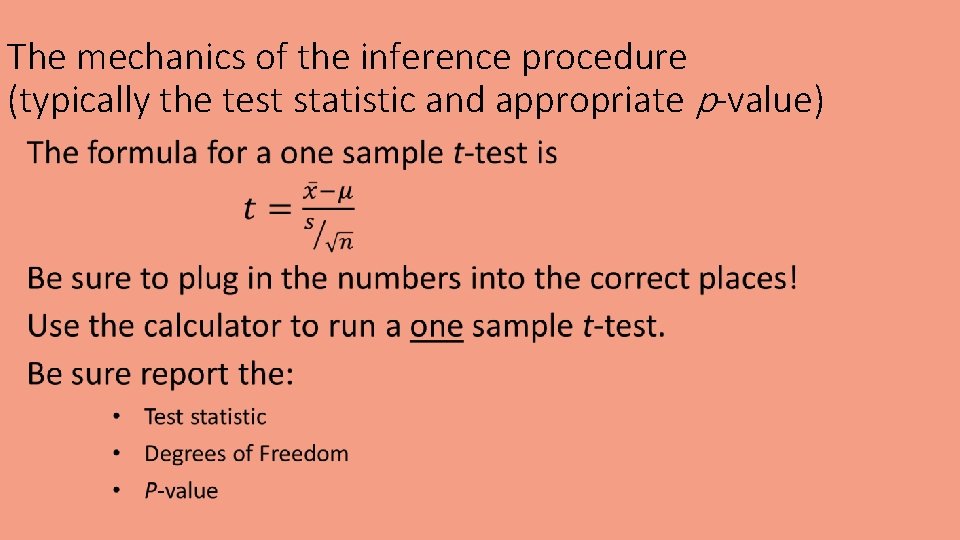
The mechanics of the inference procedure (typically the test statistic and appropriate p-value) •
The conclusion of the procedure, with linkage to an alpha level, in context. The response should always be in terms of the alternative hypothesis, NEVER the null hypothesis! Consider the jury system: Ho: The defendant is INNOCENT Ha: The defendant is GUILTY The jury’s decision is either “NOT GUILTY” (fail to reject Ho) or The jury’s decision is “GUILTY” (reject Ho) In both cases, the jury’s conclusion is with regards to the alternative hypothesis!

Remember: Unlike in Geometry, we never prove anything in this class!
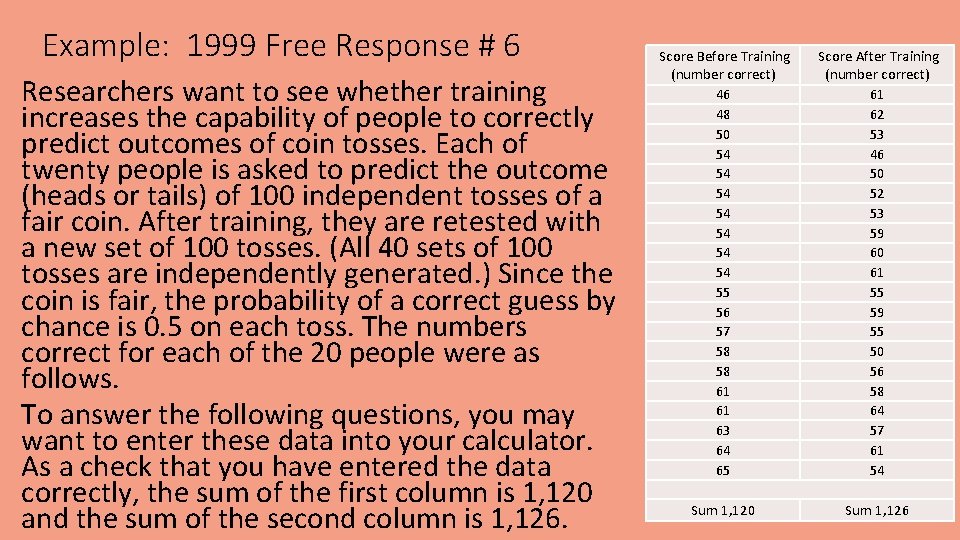
Example: 1999 Free Response # 6 Researchers want to see whether training increases the capability of people to correctly predict outcomes of coin tosses. Each of twenty people is asked to predict the outcome (heads or tails) of 100 independent tosses of a fair coin. After training, they are retested with a new set of 100 tosses. (All 40 sets of 100 tosses are independently generated. ) Since the coin is fair, the probability of a correct guess by chance is 0. 5 on each toss. The numbers correct for each of the 20 people were as follows. To answer the following questions, you may want to enter these data into your calculator. As a check that you have entered the data correctly, the sum of the first column is 1, 120 and the sum of the second column is 1, 126. Score Before Training (number correct) 46 48 50 54 54 55 56 57 58 58 61 61 63 64 65 Score After Training (number correct) 61 62 53 46 50 52 53 59 60 61 55 59 55 50 56 58 64 57 61 54 Sum 1, 120 Sum 1, 126
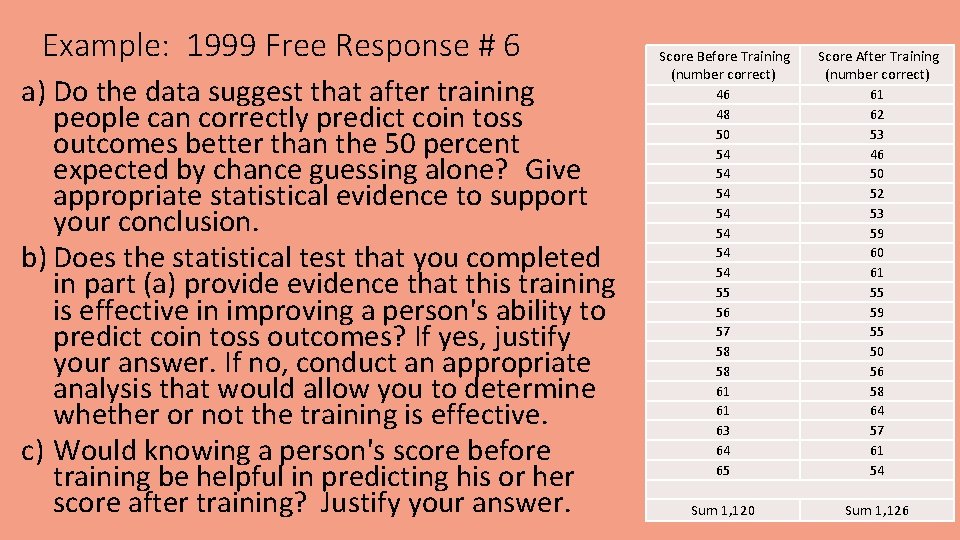
Example: 1999 Free Response # 6 a) Do the data suggest that after training people can correctly predict coin toss outcomes better than the 50 percent expected by chance guessing alone? Give appropriate statistical evidence to support your conclusion. b) Does the statistical test that you completed in part (a) provide evidence that this training is effective in improving a person's ability to predict coin toss outcomes? If yes, justify your answer. If no, conduct an appropriate analysis that would allow you to determine whether or not the training is effective. c) Would knowing a person's score before training be helpful in predicting his or her score after training? Justify your answer. Score Before Training (number correct) 46 48 50 54 54 55 56 57 58 58 61 61 63 64 65 Score After Training (number correct) 61 62 53 46 50 52 53 59 60 61 55 59 55 50 56 58 64 57 61 54 Sum 1, 120 Sum 1, 126
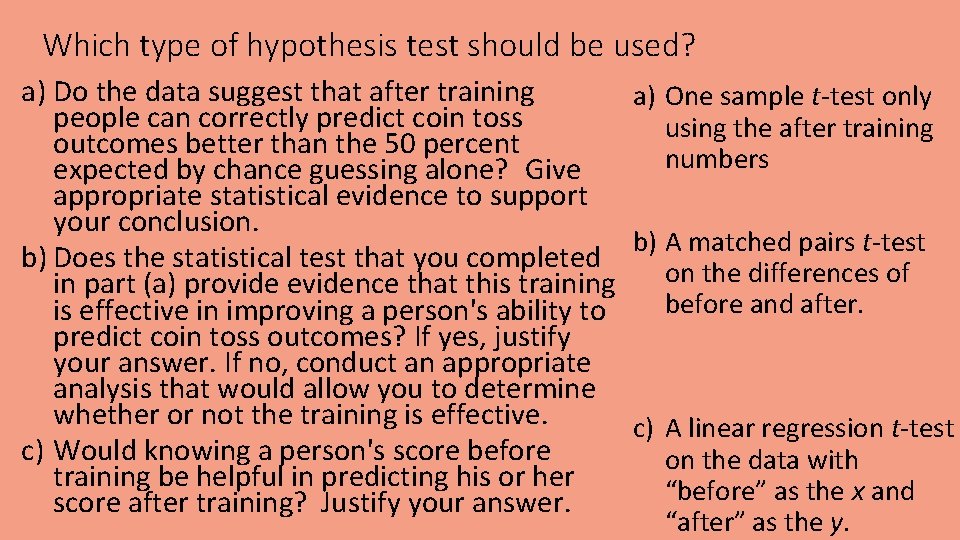
Which type of hypothesis test should be used? a) Do the data suggest that after training a) One sample t-test only people can correctly predict coin toss using the after training outcomes better than the 50 percent numbers expected by chance guessing alone? Give appropriate statistical evidence to support your conclusion. b) A matched pairs t-test b) Does the statistical test that you completed on the differences of in part (a) provide evidence that this training before and after. is effective in improving a person's ability to predict coin toss outcomes? If yes, justify your answer. If no, conduct an appropriate analysis that would allow you to determine whether or not the training is effective. c) A linear regression t-test c) Would knowing a person's score before on the data with training be helpful in predicting his or her “before” as the x and score after training? Justify your answer. “after” as the y.
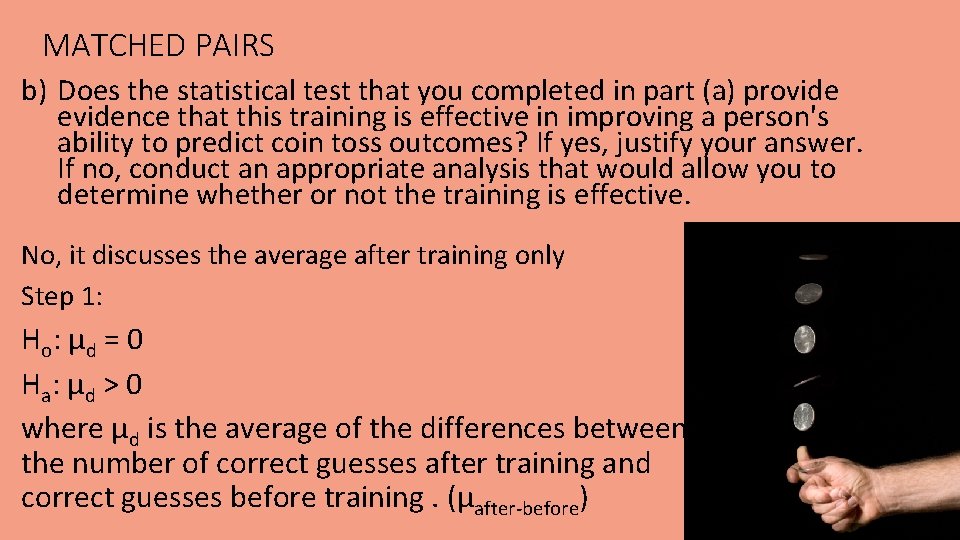
MATCHED PAIRS b) Does the statistical test that you completed in part (a) provide evidence that this training is effective in improving a person's ability to predict coin toss outcomes? If yes, justify your answer. If no, conduct an appropriate analysis that would allow you to determine whether or not the training is effective. No, it discusses the average after training only Step 1: Ho : µ d = 0 H a: µ d > 0 where µd is the average of the differences between the number of correct guesses after training and correct guesses before training. (µafter-before)
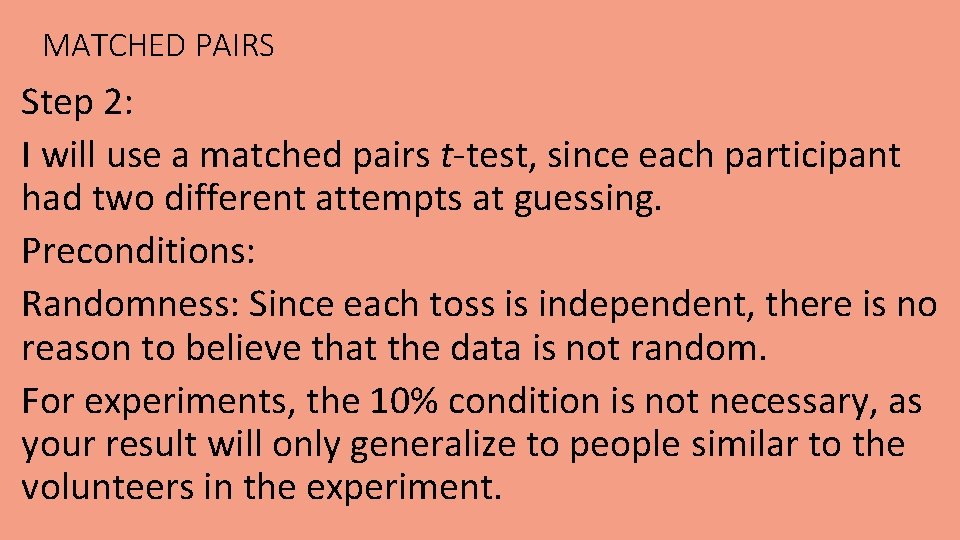
MATCHED PAIRS Step 2: I will use a matched pairs t-test, since each participant had two different attempts at guessing. Preconditions: Randomness: Since each toss is independent, there is no reason to believe that the data is not random. For experiments, the 10% condition is not necessary, as your result will only generalize to people similar to the volunteers in the experiment.
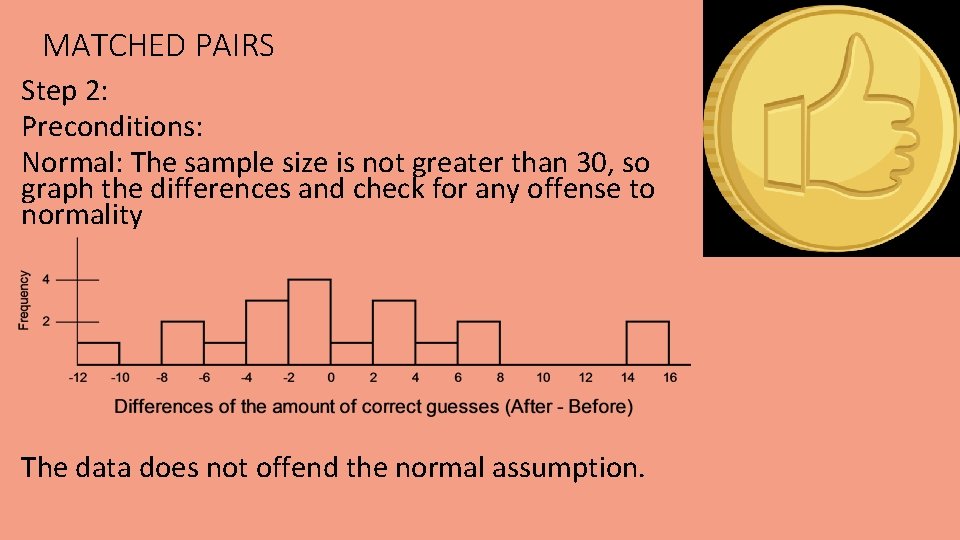
MATCHED PAIRS Step 2: Preconditions: Normal: The sample size is not greater than 30, so graph the differences and check for any offense to normality The data does not offend the normal assumption.
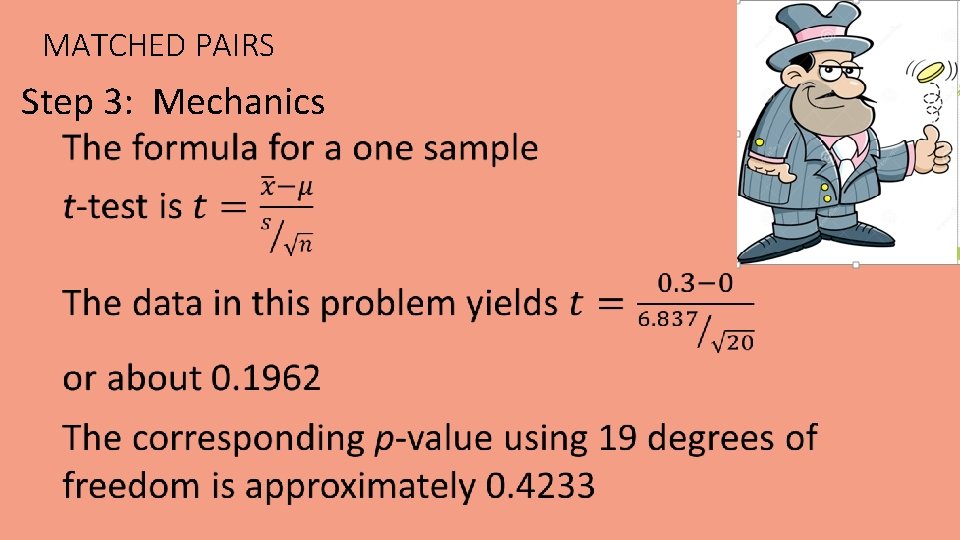
MATCHED PAIRS Step 3: Mechanics
MATCHED PAIRS Step 4: Conclusions Since the p-value of 0. 4233 > 0. 05, I fail to reject Ho There is not enough evidence to suggest µd > 0. There is not enough evidence that training is effective in improving a person’s ability to predict coin toss outcomes.
Maze Activity Pages 39 -42
- Slides: 21