
WHAT IS THE DEFINITION OF LOGICAL CONSTANT Rosen
- Slides: 20
WHAT IS THE DEFINITION OF LOGICAL CONSTANT? Rosen Lutskanov Department of Logic, Institute for Philosophical Research, Bulgarian Academy of Sciences
0. Plan of the talk: 1. 2. 3. 4. 5. Motivation – the importance of the notion of logical constant; Historia calamitatum - a short history of the model-theoretic definitions of the notion of logical constant; The demarcation of logic – what seems to be the problem? ; Sketch of inverse-logical definition of logical constants; The moral of the whole story. LOGICA 2008 Conference
1. The importance of the notion of logical constant A logical concept is what can be expressed by a logical constant in a language. So the question ‘What is logic? ’ drives us to the question ‘What is a logical constant? ’ [Hodes 2004, p. 134] * In the subsequent discussion, I’m relying essentially on the article of Mario Gomez-Torrente The problem of logical constants (2002) LOGICA 2008 Conference
2. A short history of the model-theoretic definition of the notion of logical constant 2. 1 Prehistory: Russell He introduced the term ‘logical constant’ in the opening of his Principles of Mathematics (1903) but failed to provide its purely logical explication: for him logical constants were just those notions which are accountable for the a priori truth of some of the propositions in which they occur. Instead of a definition, he provides us with a laundry list: “logical constants are all notions definable in terms of the following: Implication … the notion of ‘such that’, the notion of relation, and such further notions as may be involved in the general notion of propositions of the above form” [Russell 1903, p. 3] LOGICA 2008 Conference
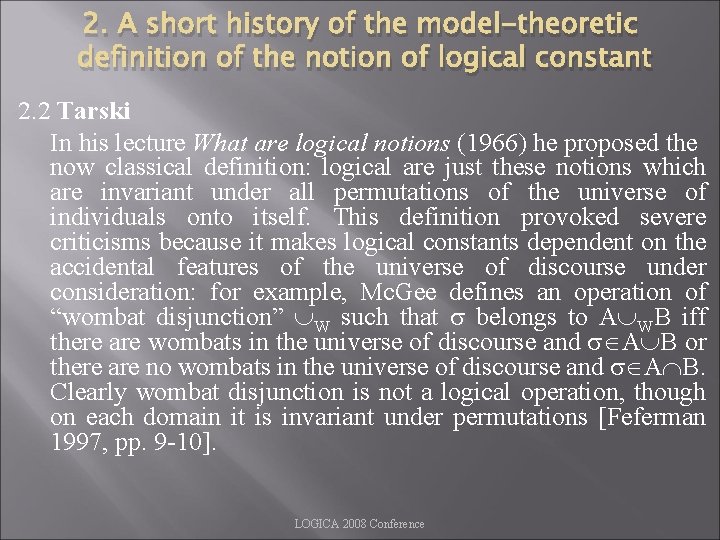
2. A short history of the model-theoretic definition of the notion of logical constant 2. 2 Tarski In his lecture What are logical notions (1966) he proposed the now classical definition: logical are just these notions which are invariant under all permutations of the universe of individuals onto itself. This definition provoked severe criticisms because it makes logical constants dependent on the accidental features of the universe of discourse under consideration: for example, Mc. Gee defines an operation of “wombat disjunction” W such that belongs to A WB iff there are wombats in the universe of discourse and A B or there are no wombats in the universe of discourse and A B. Clearly wombat disjunction is not a logical operation, though on each domain it is invariant under permutations [Feferman 1997, pp. 9 -10]. LOGICA 2008 Conference
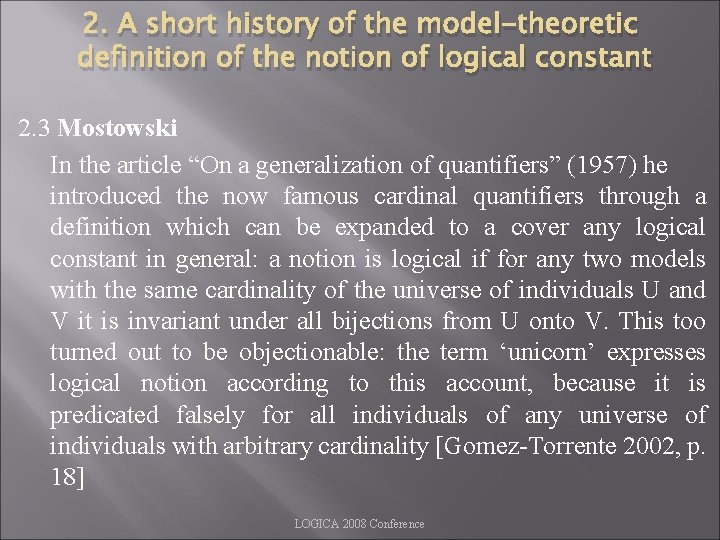
2. A short history of the model-theoretic definition of the notion of logical constant 2. 3 Mostowski In the article “On a generalization of quantifiers” (1957) he introduced the now famous cardinal quantifiers through a definition which can be expanded to a cover any logical constant in general: a notion is logical if for any two models with the same cardinality of the universe of individuals U and V it is invariant under all bijections from U onto V. This too turned out to be objectionable: the term ‘unicorn’ expresses logical notion according to this account, because it is predicated falsely for all individuals of any universe of individuals with arbitrary cardinality [Gomez-Torrente 2002, p. 18] LOGICA 2008 Conference
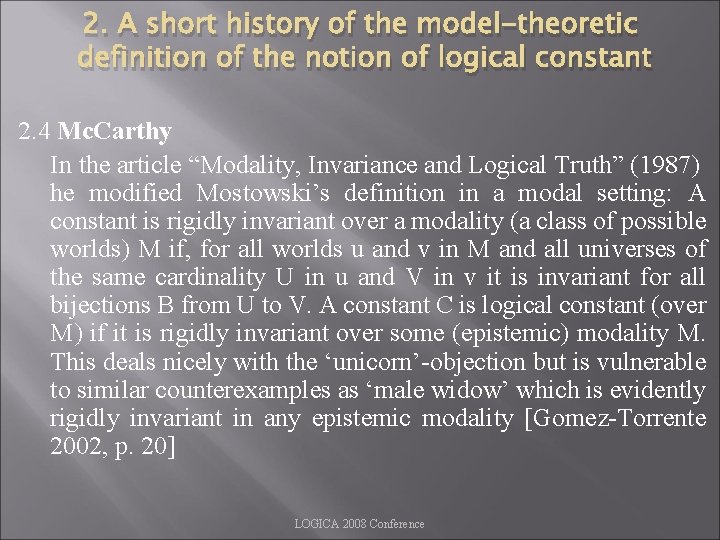
2. A short history of the model-theoretic definition of the notion of logical constant 2. 4 Mc. Carthy In the article “Modality, Invariance and Logical Truth” (1987) he modified Mostowski’s definition in a modal setting: A constant is rigidly invariant over a modality (a class of possible worlds) M if, for all worlds u and v in M and all universes of the same cardinality U in u and V in v it is invariant for all bijections B from U to V. A constant C is logical constant (over M) if it is rigidly invariant over some (epistemic) modality M. This deals nicely with the ‘unicorn’-objection but is vulnerable to similar counterexamples as ‘male widow’ which is evidently rigidly invariant in any epistemic modality [Gomez-Torrente 2002, p. 20] LOGICA 2008 Conference
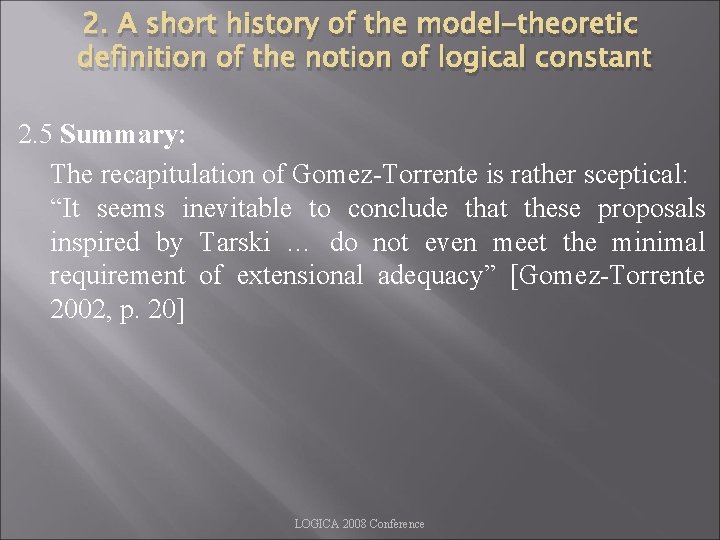
2. A short history of the model-theoretic definition of the notion of logical constant 2. 5 Summary: The recapitulation of Gomez-Torrente is rather sceptical: “It seems inevitable to conclude that these proposals inspired by Tarski … do not even meet the minimal requirement of extensional adequacy” [Gomez-Torrente 2002, p. 20] LOGICA 2008 Conference
3. The demarcation of logic -what seems to be the problem? 3. 1 Tarski’s self-critique: At the foundation of the whole construction [of the concept of following logically] lies the division of all terms of a language into logical and extra-logical … I know no objective reasons which would allow one to draw a precise dividing line between the two categories of terms [Tarski 2002, pp. 188 -189] LOGICA 2008 Conference
3. The demarcation of logic -what seems to be the problem? 3. 2 Wittgenstein’s attack on the traditional demarcation of logic: Every empirical proposition may serve as a rule if it is fixed, like a machine part, made immovable, so that now the whole representation turns around it and it becomes part of the coordinate system, independent of facts [Remarks on the Foundations of Mathematics, § 74] Sentences are often used on the borderline between logic and the empirical, so that their meaning changes back and forth and they count now as expressions of norms, now as expressions of experience [Remarks on Colour, § 32] It might be imagined that some propositions, of the form of empirical propositions, were hardened and functioned as channels for such empirical propositions as were not hardened but fluid; and that this relation altered with time, in that fluid propositions hardened, and hard ones became fluid … the same propositions may get treated at one time as something to test by experience, at another as a rule of testing [On Certainty, §§ 94 -99] LOGICA 2008 Conference
3. The demarcation of logic -what seems to be the problem? 3. 3 Quine’s web of belief metaphor and the fuzzy borderline between logical end empirical propositions: “The totality of our so-called knowledge or beliefs, from the most casual matters of geography and history to the profoundest laws of atomic physics or even of pure mathematics and logic, is a man-made fabric which impinges on experience only along the edges. Or, to change the figure, total science is like a field of force whose boundary conditions are experience. A conflict with experience at the periphery occasions readjustments in the interior of the field … If this view is right, it is misleading to speak of the empirical content of an individual statement … Furthermore it becomes folly to seek a boundary between synthetic statements, which hold contingently on experience, and analytic statements which hold come what may … Conversely, by the same token, no statement is immune to revision” [Quine 1951, pp. 39 -40] LOGICA 2008 Conference
3. The demarcation of logic -what seems to be the problem? 3. 4 Goodman’s theory of the wide reflective equilibrium – the justification of logic in the context of our total system of beliefs: “I have said that deductive inferences are justified by their conformity to valid general rules, and that general rules are justified by their conformity to valid inferences … The process of justification is the delicate one of making mutual adjustments between rules and accepted inferences; and in the agreement achieved lies the only justification needed for either” [Goodman 1983, p. 64] “When theory rejects no example that one is determined to preserve and countenances none is determined to reject, then theory and its terminal set of considered judgments are in, to use Rawls’ s term, wide reflective equilibrium. The equilibrium is wide, because theory is consonant not only with one’ s terminal set of considered judgments of logic, the mark of narrow reflective equilibrium, but also with one’ s broader system of beliefs” [Resnik 2000, p. 188] LOGICA 2008 Conference
3. What seems to be the problem? 3. 5 The task: In view of the exposed impossibility to draw the analytic / synthetic distinction a priori in an uniform manner, it seems to be a legitimate task to search for an account of logical constants that does not presuppose the provisional demarcation between statements true in virtue of their logical form (analytic truths) and statements true in virtue of some facts of the world (synthetic truths). LOGICA 2008 Conference
4. Sketch of inverse-logical definition of logical constants 4. 1 Logical constants are characterized in two ways: Explicitly: by the rules for their introduction and elimination which are supposed to satisfy some further requirements (for example, some form of conservativity over a basic set of correct inferences, as shown by the ‘tonk’ counterexample) Implicitly: by the logical interrelations between elementary propositions (some perfectly reliable inferences are of the form (a) ‘This apple is red’, therefore ‘This apple is not green’ or (b) ‘This man is 2 m high’, therefore ‘This man is not 3 m high’ – These examples show that elementary propositions generally exclude each other although they don’t contradict each other) LOGICA 2008 Conference
4. Sketch of inverse-logical definition of logical constants 4. 2 The importance of the implicit dimension of meaning: “Schlick: Is there not a feeling that the logical constants (the truthfunctions) are something more essential than the particular rules of syntax, that for instance the possibility of constructing a logical product ‘p. q’ is more general, more comprehensive as it were, than the rules of syntax according to which red and blue cannot be in the same place? Wittgenstein: I do not think that there is a difference here. The rules for logical products, etc, cannot be severed from other rules of syntax. Both belong to the method of depicting the world” (Waismann 1979, p. 80 -81) – According to Wittgenstein, the explicit rules of logic that connect the truthconditions of logically articulated propositions have no primacy over the implicit rules of syntax that bind together elementary propositions. LOGICA 2008 Conference
4. Sketch of inverse-logical definition of logical constants 4. 3 Any adequate theory of meaning must acknowledge the implicit dimension of the meaning of logical constants: “we have an adequacy condition on a theory T about the meaning of a sentence A where B is a kind of behavior counted as a sign of grasping the meaning of A: if T is to be adequate, it must be possible to derive in T the implication: if P knows the meaning of A, then P shows behavior B” (Prawitz 1978, p. 27) – If someone asserts the compound proposition “This man is 2 m high and (the same man is) 3 m high”, this act usually counts as a symptom for his lack of understanding of the nature of conjunction (it is impossible to assert simultaneously – conjunctively two mutually exclusive propositions). Therefore, every an adequate theory of meaning must take into account the implicit dimension of meaning (not only the explicit one) and ban such propositions. LOGICA 2008 Conference
4. Sketch of inverse-logical definition of logical constants 4. 4 Dynamics of inference*: a. The inferential process is initialized by a bootstrap set – the set of (elementary and compound) propositions which we view as true according to the information available; b. The dynamics is triggered by the rules for revision of the bootstrap set by introducing propositions (which we view as direct consequences of some subset of the bootstrap set) or eliminating propositions (which we view as incompatible with some subset of the bootstrap set) – here the properties of logical consequence and logical compatibility are supposed to be jointly determined by explicit and implicit rules of inference; * This account relies heavily on Gupta and Belnap’s Revision theory of Truth (1993). LOGICA 2008 Conference
4. Sketch of inverse-logical definition of logical constants 4. 4 Dynamics of inference (continued): cess This c. types of propositions: stable (which receive fixed semantic interpretation at some point of the revision sequence) and unstable (whose semantic interpretation does not settle in the particular revision sequence) – it is important to stress here that the classification of propositions into stable and unstable can not be extracted effectively from the bootstrap set alone; it can not be introduced from the outset thus meeting our requirement (3. 5) above; d. In this setting it would be natural to define as logically valid propositions those propositions which become stable for any reasonable choice of bootstrap set (some choices can be excluded because they are overtly incompatible with the properties of the elementary propositions). LOGICA 2008 Conference
4. Sketch of inverse-logical definition of logical constants 4. 5 In such setting we can explore the possibilities to define the logical notions by techniques similar to the inverselogical approach which was elaborated by van Benthem in the study of generalized quantifiers: instead of choosing some predefined set of logical constants and asking what types of inference are validated by them, we can take some intuitively convincing set of inferences that validate logical propositions (defined as 4. 4 above) and search for the specific constants that are accountable for them. This methodological switch can be viewed as ‘Copernican revolution in logic’ [van Benthem 1984, p. 451] LOGICA 2008 Conference
5. The moral of the whole story Such interpretation of logicality and logical constants fits nicely to the conception of logical necessity developed by Wittgenstein in On certainty: “I do not explicitly learn the propositions that stand fast for me. I can discover them subsequently like the axis around which a body rotates. This axis is not fixed in the sense that anything holds it fast, but the movement around it determines its immobility” [OC, § 152]. In this way it finally becomes possible to acknowledge the continuity of logical and empirical knowledge which was impossible for the model-theoretic tradition in logic. LOGICA 2008 Conference