
WHAT IS THE BIBLE The word bible comes
WHAT IS THE BIBLE? The word bible comes from the Greek "biblia" meaning Books. It is a collection of ancient writings about God (Yahweh)
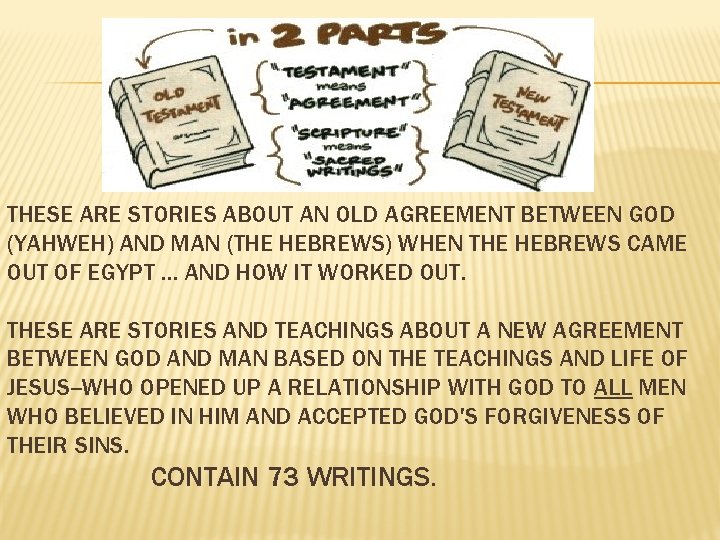
THESE ARE STORIES ABOUT AN OLD AGREEMENT BETWEEN GOD (YAHWEH) AND MAN (THE HEBREWS) WHEN THE HEBREWS CAME OUT OF EGYPT. . . AND HOW IT WORKED OUT. THESE ARE STORIES AND TEACHINGS ABOUT A NEW AGREEMENT BETWEEN GOD AND MAN BASED ON THE TEACHINGS AND LIFE OF JESUS--WHO OPENED UP A RELATIONSHIP WITH GOD TO ALL MEN WHO BELIEVED IN HIM AND ACCEPTED GOD'S FORGIVENESS OF THEIR SINS. CONTAIN 73 WRITINGS.
It was written by many different authors, mostly Hebrews, some unknown.
At different times -- over about 1, 000 years--from about 900 B. C. to 100 A. D. At different places -- Palestine, Babylon, Egypt, Rome, Corinth. For different purposes --to teach religion and patriotism, to describe the Messiah.
For many different purposes --to help you understand God and His works -- to help you know how to live and act --to share stories of human experience in many literary forms -- songs and poetry -- laws and history -- prophecies, wise sayings -- short stories, letters -- to know about the most famous book in history- a Book of 30 Centuries, the all-time best-seller!
The Old Testament (Jewish Scriptures) A collection of religious books in Hebrew written over a period of 900 years, including: 1. Histories 2. Codes of Laws 3. Speeches and Sermons 4. Poetry
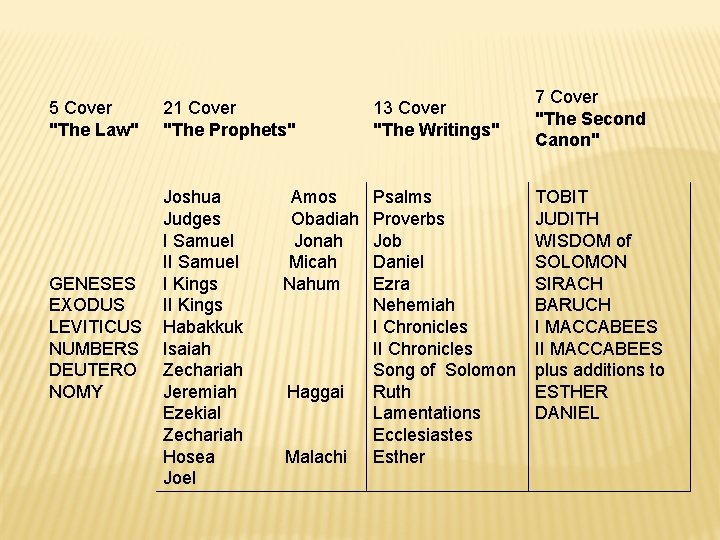
5 Cover "The Law" 21 Cover "The Prophets" 13 Cover "The Writings" GENESES EXODUS LEVITICUS NUMBERS DEUTERO NOMY Joshua Judges I Samuel I Kings II Kings Habakkuk Isaiah Zechariah Jeremiah Ezekial Zechariah Hosea Joel Psalms Proverbs Job Daniel Ezra Nehemiah I Chronicles II Chronicles Song of Solomon Ruth Lamentations Ecclesiastes Esther Amos Obadiah Jonah Micah Nahum Haggai Malachi 7 Cover "The Second Canon" TOBIT JUDITH WISDOM of SOLOMON SIRACH BARUCH I MACCABEES II MACCABEES plus additions to ESTHER DANIEL
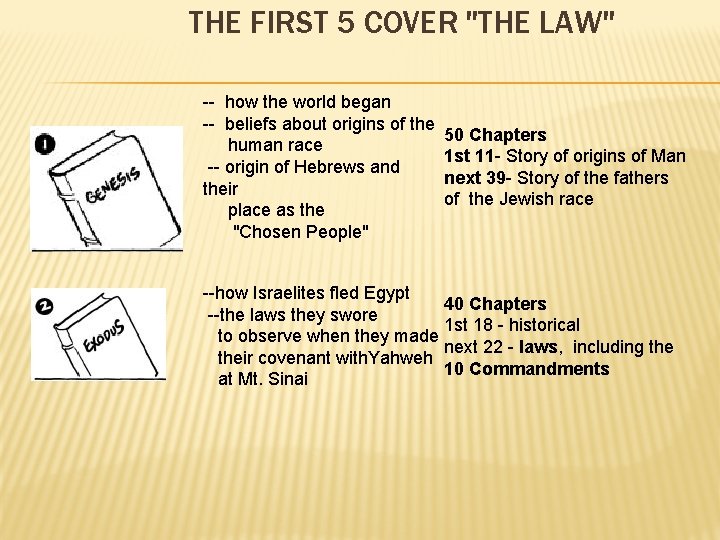
THE FIRST 5 COVER "THE LAW" -- how the world began -- beliefs about origins of the human race -- origin of Hebrews and their place as the "Chosen People" 50 Chapters 1 st 11 - Story of origins of Man next 39 - Story of the fathers of the Jewish race --how Israelites fled Egypt --the laws they swore to observe when they made their covenant with. Yahweh at Mt. Sinai 40 Chapters 1 st 18 - historical next 22 - laws, including the 10 Commandments
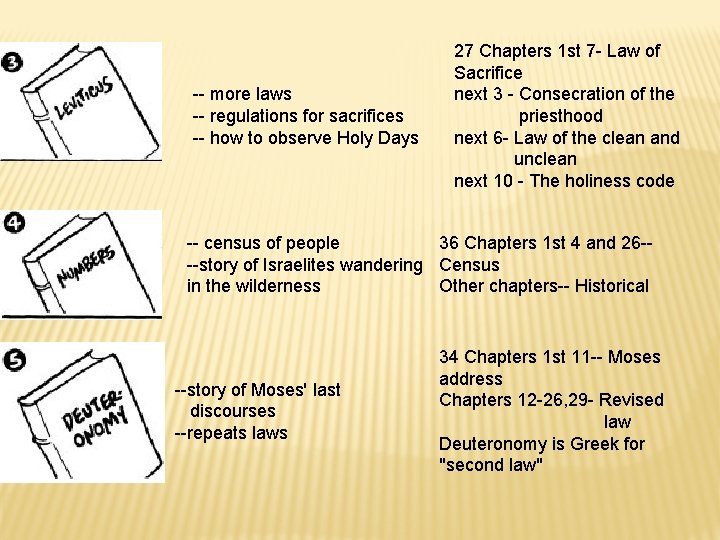
-- more laws -- regulations for sacrifices -- how to observe Holy Days 27 Chapters 1 st 7 - Law of Sacrifice next 3 - Consecration of the priesthood next 6 - Law of the clean and unclean next 10 - The holiness code -- census of people 36 Chapters 1 st 4 and 26 ---story of Israelites wandering Census in the wilderness Other chapters-- Historical --story of Moses' last discourses --repeats laws 34 Chapters 1 st 11 -- Moses address Chapters 12 -26, 29 - Revised law Deuteronomy is Greek for "second law"
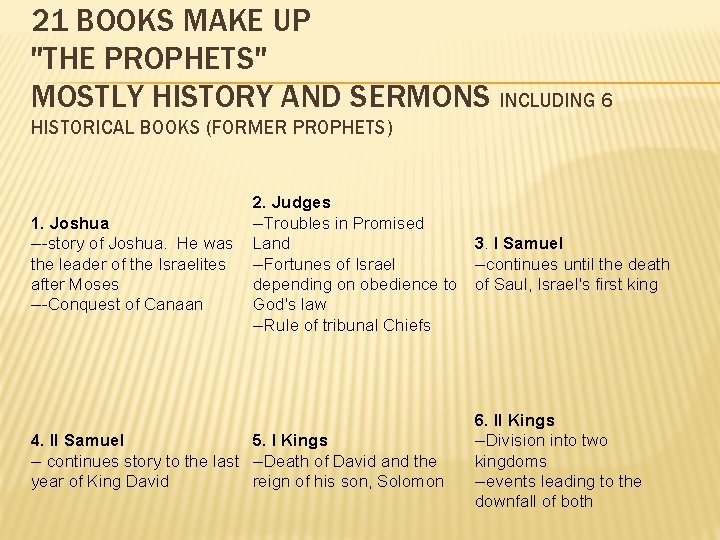
21 BOOKS MAKE UP "THE PROPHETS" MOSTLY HISTORY AND SERMONS INCLUDING 6 HISTORICAL BOOKS (FORMER PROPHETS) 1. Joshua ---story of Joshua. He was the leader of the Israelites after Moses ---Conquest of Canaan 2. Judges --Troubles in Promised Land 3. I Samuel --Fortunes of Israel --continues until the death depending on obedience to of Saul, Israel's first king God's law --Rule of tribunal Chiefs 4. II Samuel 5. I Kings -- continues story to the last --Death of David and the year of King David reign of his son, Solomon 6. II Kings --Division into two kingdoms --events leading to the downfall of both
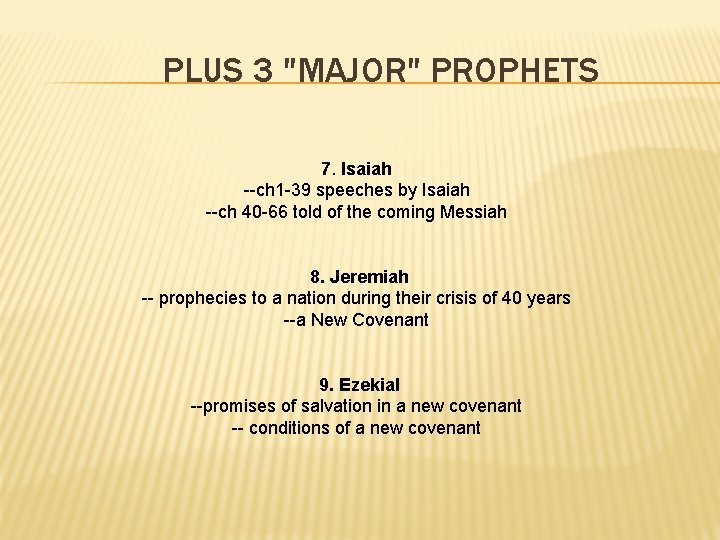
PLUS 3 "MAJOR" PROPHETS 7. Isaiah --ch 1 -39 speeches by Isaiah --ch 40 -66 told of the coming Messiah 8. Jeremiah -- prophecies to a nation during their crisis of 40 years --a New Covenant 9. Ezekial --promises of salvation in a new covenant -- conditions of a new covenant
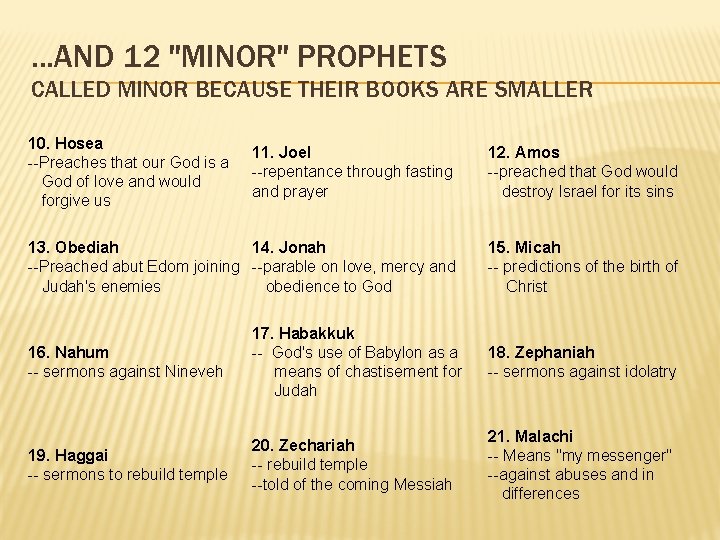
. . . AND 12 "MINOR" PROPHETS CALLED MINOR BECAUSE THEIR BOOKS ARE SMALLER 10. Hosea --Preaches that our God is a God of love and would forgive us 11. Joel --repentance through fasting and prayer 12. Amos --preached that God would destroy Israel for its sins 13. Obediah 14. Jonah --Preached abut Edom joining --parable on love, mercy and Judah's enemies obedience to God 15. Micah -- predictions of the birth of Christ 16. Nahum -- sermons against Nineveh 17. Habakkuk -- God's use of Babylon as a means of chastisement for Judah 18. Zephaniah -- sermons against idolatry 19. Haggai -- sermons to rebuild temple 20. Zechariah -- rebuild temple --told of the coming Messiah 21. Malachi -- Means "my messenger" --against abuses and in differences
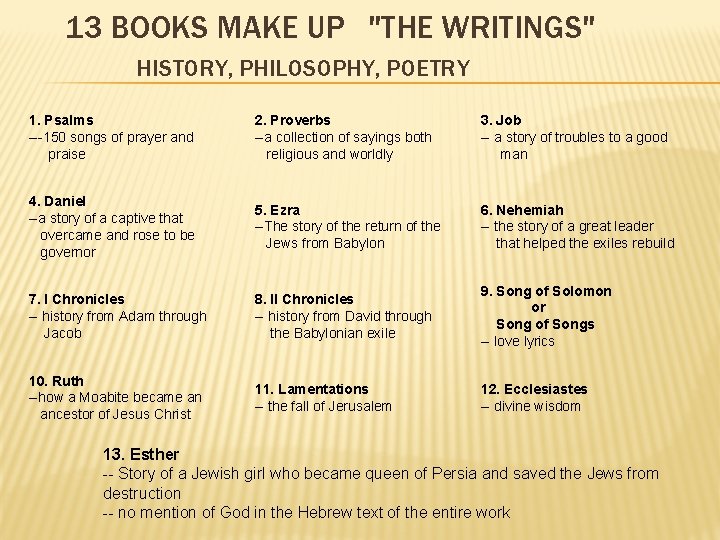
13 BOOKS MAKE UP "THE WRITINGS" HISTORY, PHILOSOPHY, POETRY 1. Psalms ---150 songs of prayer and praise 2. Proverbs --a collection of sayings both religious and worldly 3. Job -- a story of troubles to a good man 4. Daniel --a story of a captive that overcame and rose to be governor 5. Ezra --The story of the return of the Jews from Babylon 6. Nehemiah -- the story of a great leader that helped the exiles rebuild 7. I Chronicles -- history from Adam through Jacob 8. II Chronicles -- history from David through the Babylonian exile 9. Song of Solomon or Song of Songs -- love lyrics 10. Ruth --how a Moabite became an ancestor of Jesus Christ 11. Lamentations -- the fall of Jerusalem 12. Ecclesiastes -- divine wisdom 13. Esther -- Story of a Jewish girl who became queen of Persia and saved the Jews from destruction -- no mention of God in the Hebrew text of the entire work
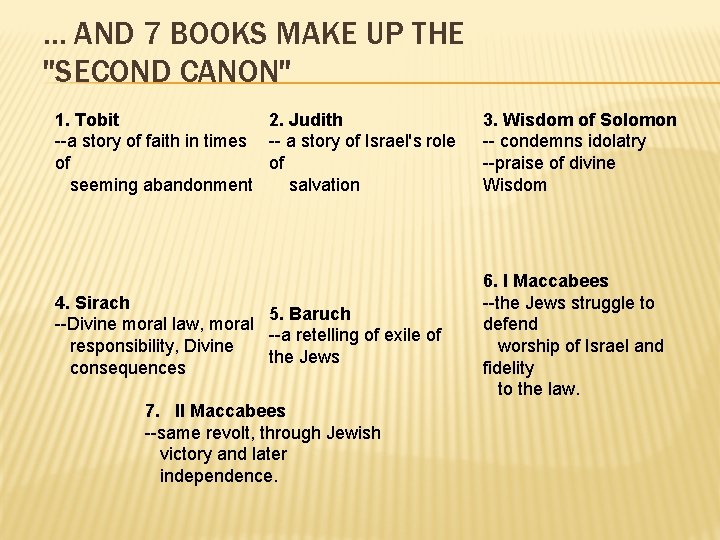
. . . AND 7 BOOKS MAKE UP THE "SECOND CANON" 1. Tobit 2. Judith --a story of faith in times -- a story of Israel's role of of seeming abandonment salvation 3. Wisdom of Solomon -- condemns idolatry --praise of divine Wisdom 4. Sirach 5. Baruch --Divine moral law, moral --a retelling of exile of responsibility, Divine the Jews consequences 6. I Maccabees --the Jews struggle to defend worship of Israel and fidelity to the law. 7. II Maccabees --same revolt, through Jewish victory and later independence.
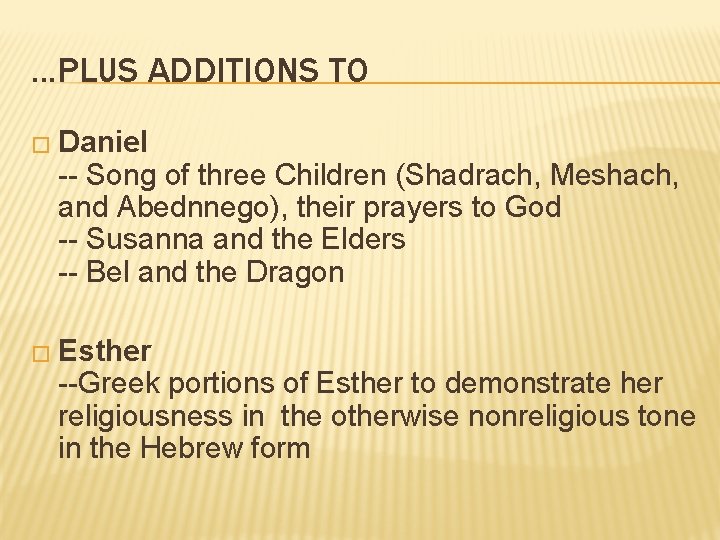
. . . PLUS ADDITIONS TO � Daniel -- Song of three Children (Shadrach, Meshach, and Abednnego), their prayers to God -- Susanna and the Elders -- Bel and the Dragon � Esther --Greek portions of Esther to demonstrate her religiousness in the otherwise nonreligious tone in the Hebrew form
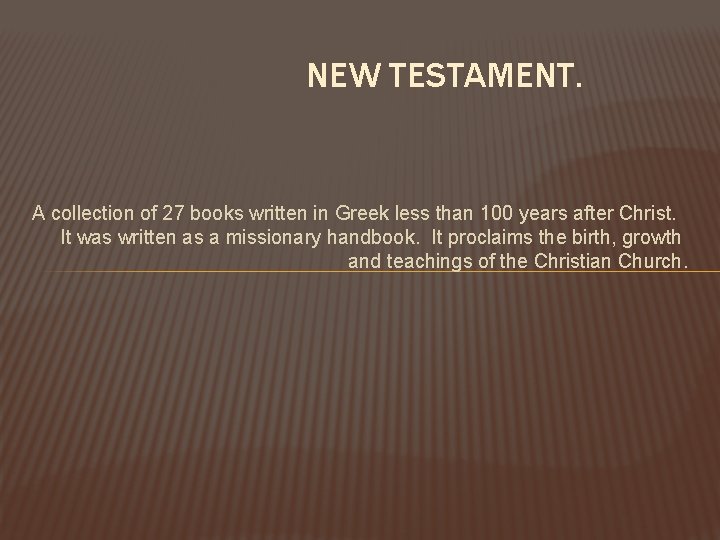
NEW TESTAMENT. A collection of 27 books written in Greek less than 100 years after Christ. It was written as a missionary handbook. It proclaims the birth, growth and teachings of the Christian Church.
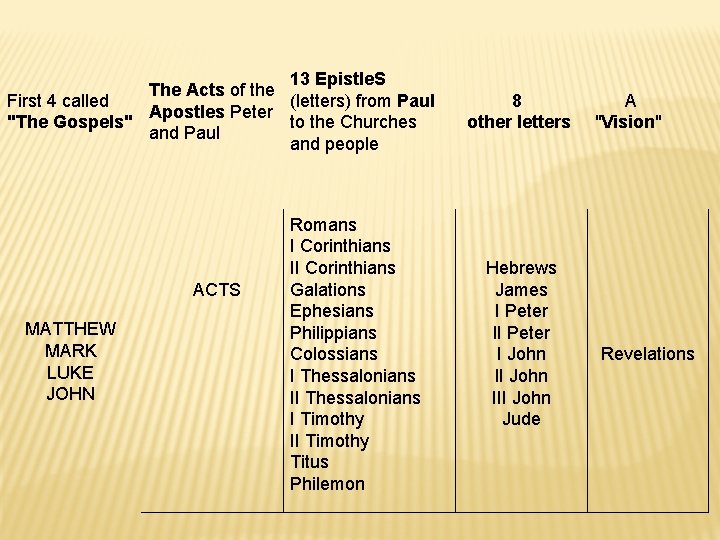
13 Epistle. S The Acts of the (letters) from Paul First 4 called Apostles Peter to the Churches "The Gospels" and Paul and people ACTS MATTHEW MARK LUKE JOHN Romans I Corinthians II Corinthians Galations Ephesians Philippians Colossians I Thessalonians I Timothy II Timothy Titus Philemon 8 other letters Hebrews James I Peter I John III John Jude A "Vision" Revelations
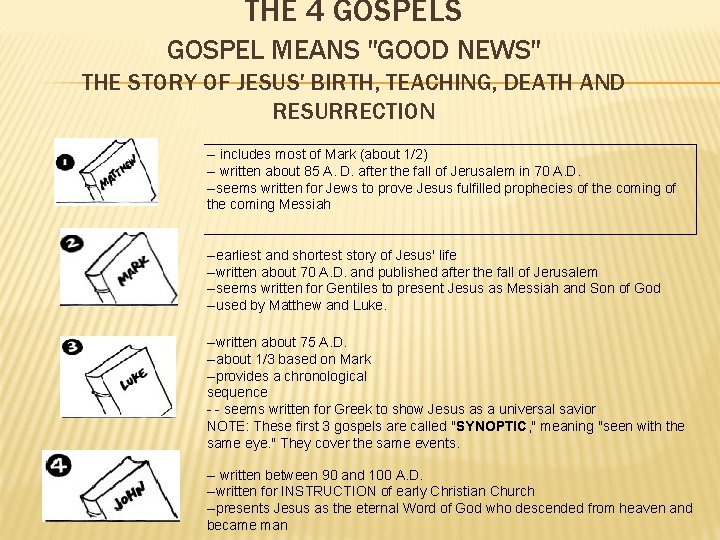
THE 4 GOSPELS GOSPEL MEANS "GOOD NEWS" THE STORY OF JESUS' BIRTH, TEACHING, DEATH AND RESURRECTION -- includes most of Mark (about 1/2) -- written about 85 A. D. after the fall of Jerusalem in 70 A. D. --seems written for Jews to prove Jesus fulfilled prophecies of the coming Messiah --earliest and shortest story of Jesus' life --written about 70 A. D. and published after the fall of Jerusalem --seems written for Gentiles to present Jesus as Messiah and Son of God --used by Matthew and Luke. --written about 75 A. D. --about 1/3 based on Mark --provides a chronological sequence - - seems written for Greek to show Jesus as a universal savior NOTE: These first 3 gospels are called "SYNOPTIC, " meaning "seen with the same eye. " They cover the same events. -- written between 90 and 100 A. D. --written for INSTRUCTION of early Christian Church --presents Jesus as the eternal Word of God who descended from heaven and became man
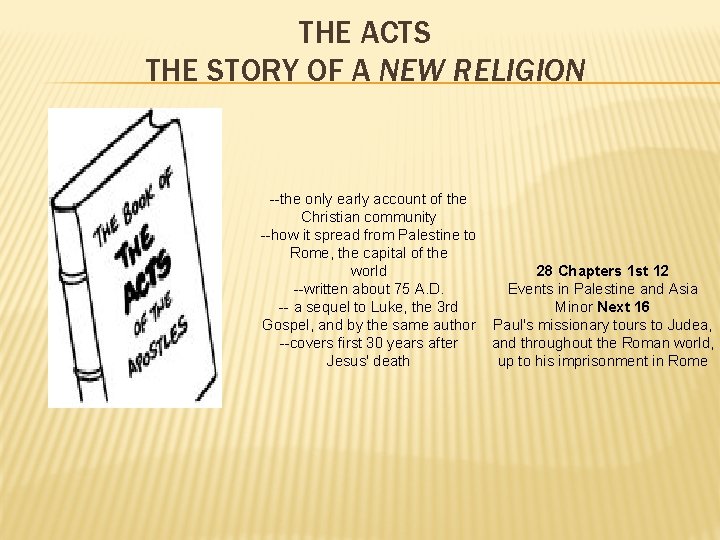
THE ACTS THE STORY OF A NEW RELIGION --the only early account of the Christian community --how it spread from Palestine to Rome, the capital of the world 28 Chapters 1 st 12 --written about 75 A. D. Events in Palestine and Asia -- a sequel to Luke, the 3 rd Minor Next 16 Gospel, and by the same author Paul's missionary tours to Judea, --covers first 30 years after and throughout the Roman world, Jesus' death up to his imprisonment in Rome
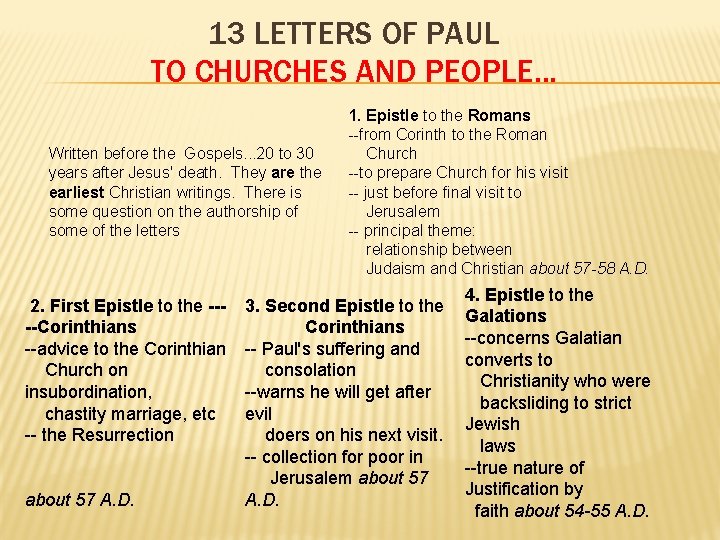
13 LETTERS OF PAUL TO CHURCHES AND PEOPLE. . . Written before the Gospels. . . 20 to 30 years after Jesus' death. They are the earliest Christian writings. There is some question on the authorship of some of the letters 2. First Epistle to the ----Corinthians --advice to the Corinthian Church on insubordination, chastity marriage, etc -- the Resurrection about 57 A. D. 1. Epistle to the Romans --from Corinth to the Roman Church --to prepare Church for his visit -- just before final visit to Jerusalem -- principal theme: relationship between Judaism and Christian about 57 -58 A. D. 3. Second Epistle to the Corinthians -- Paul's suffering and consolation --warns he will get after evil doers on his next visit. -- collection for poor in Jerusalem about 57 A. D. 4. Epistle to the Galations --concerns Galatian converts to Christianity who were backsliding to strict Jewish laws --true nature of Justification by faith about 54 -55 A. D.
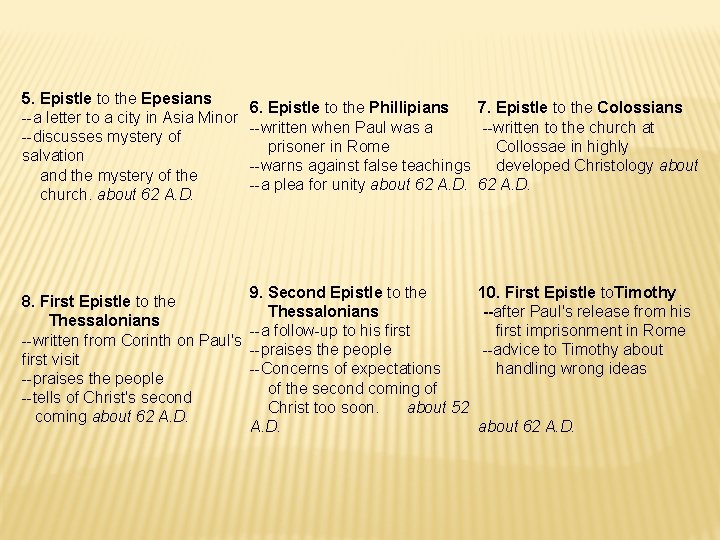
5. Epistle to the Epesians --a letter to a city in Asia Minor --discusses mystery of salvation and the mystery of the church. about 62 A. D. 6. Epistle to the Phillipians 7. Epistle to the Colossians --written when Paul was a --written to the church at prisoner in Rome Collossae in highly --warns against false teachings developed Christology about --a plea for unity about 62 A. D. 9. Second Epistle to the 8. First Epistle to the Thessalonians --a follow-up to his first --written from Corinth on Paul's --praises the people first visit --Concerns of expectations --praises the people of the second coming of --tells of Christ's second Christ too soon. about 52 coming about 62 A. D. 10. First Epistle to. Timothy --after Paul's release from his first imprisonment in Rome --advice to Timothy about handling wrong ideas about 62 A. D.
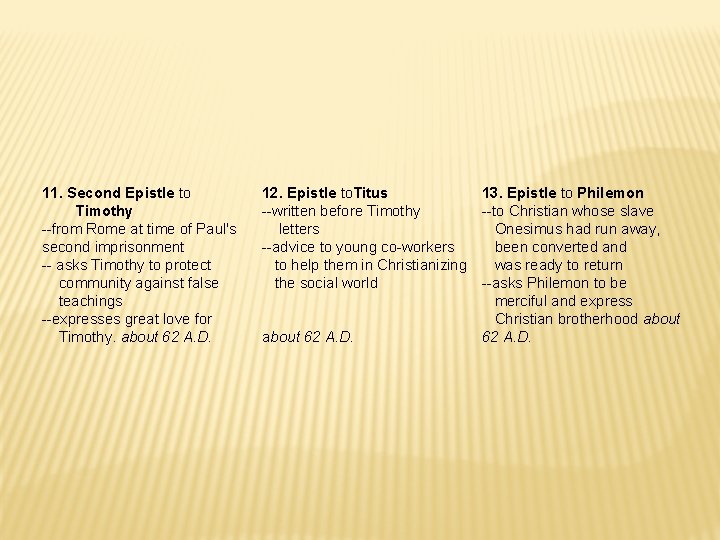
11. Second Epistle to Timothy --from Rome at time of Paul's second imprisonment -- asks Timothy to protect community against false teachings --expresses great love for Timothy. about 62 A. D. 12. Epistle to. Titus --written before Timothy letters --advice to young co-workers to help them in Christianizing the social world about 62 A. D. 13. Epistle to Philemon --to Christian whose slave Onesimus had run away, been converted and was ready to return --asks Philemon to be merciful and express Christian brotherhood about 62 A. D.
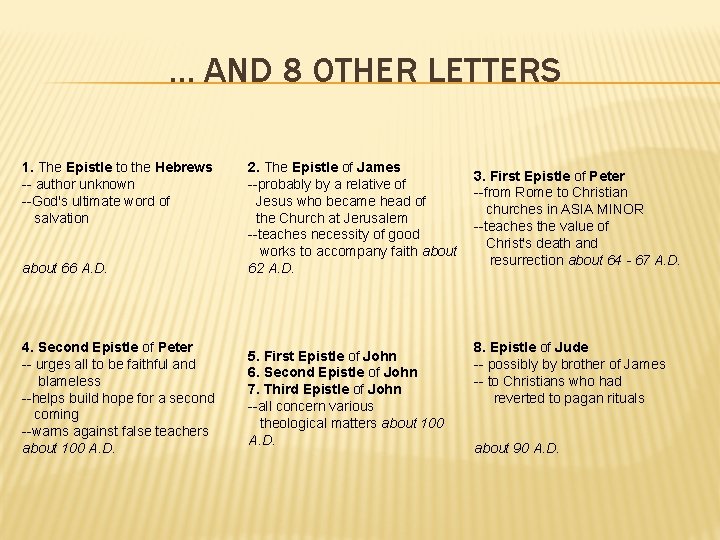
. . . AND 8 OTHER LETTERS 1. The Epistle to the Hebrews -- author unknown --God's ultimate word of salvation about 66 A. D. 4. Second Epistle of Peter -- urges all to be faithful and blameless --helps build hope for a second coming --warns against false teachers about 100 A. D. 2. The Epistle of James --probably by a relative of Jesus who became head of the Church at Jerusalem --teaches necessity of good works to accompany faith about 62 A. D. 5. First Epistle of John 6. Second Epistle of John 7. Third Epistle of John --all concern various theological matters about 100 A. D. 3. First Epistle of Peter --from Rome to Christian churches in ASIA MINOR --teaches the value of Christ's death and resurrection about 64 - 67 A. D. 8. Epistle of Jude -- possibly by brother of James -- to Christians who had reverted to pagan rituals about 90 A. D.
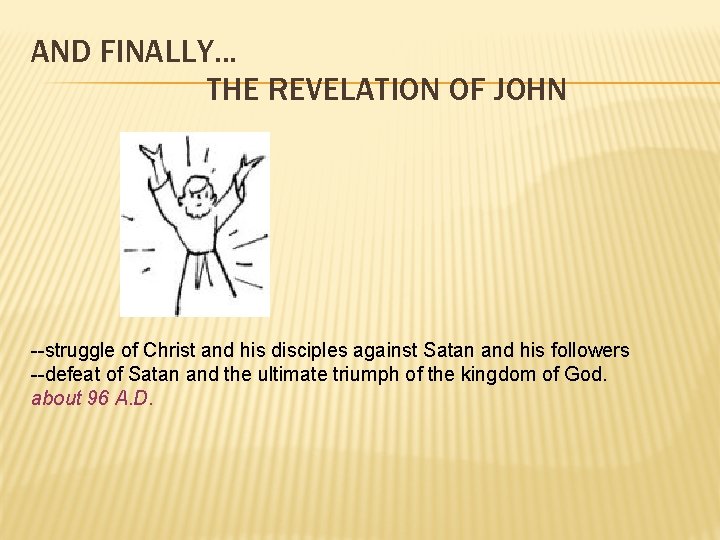
AND FINALLY. . . THE REVELATION OF JOHN --struggle of Christ and his disciples against Satan and his followers --defeat of Satan and the ultimate triumph of the kingdom of God. about 96 A. D.
IMPORTANT OLD TESTAMENT DATES The dates are given in round numbers, and only approximate, and somewhat uncertain. They are sufficiently accurate to show the historical sequence of events and persons
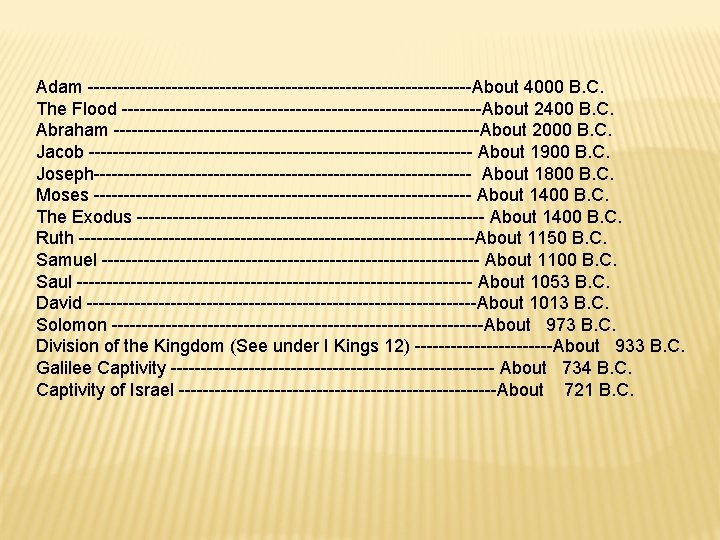
Adam --------------------------------About 4000 B. C. The Flood ------------------------------About 2400 B. C. Abraham -------------------------------About 2000 B. C. Jacob -------------------------------- About 1900 B. C. Joseph-------------------------------- About 1800 B. C. Moses -------------------------------- About 1400 B. C. The Exodus ----------------------------- About 1400 B. C. Ruth ---------------------------------About 1150 B. C. Samuel -------------------------------- About 1100 B. C. Saul --------------------------------- About 1053 B. C. David ---------------------------------About 1013 B. C. Solomon -------------------------------About 973 B. C. Division of the Kingdom (See under I Kings 12) ------------About 933 B. C. Galilee Captivity --------------------------- About 734 B. C. Captivity of Israel ---------------------------About 721 B. C.
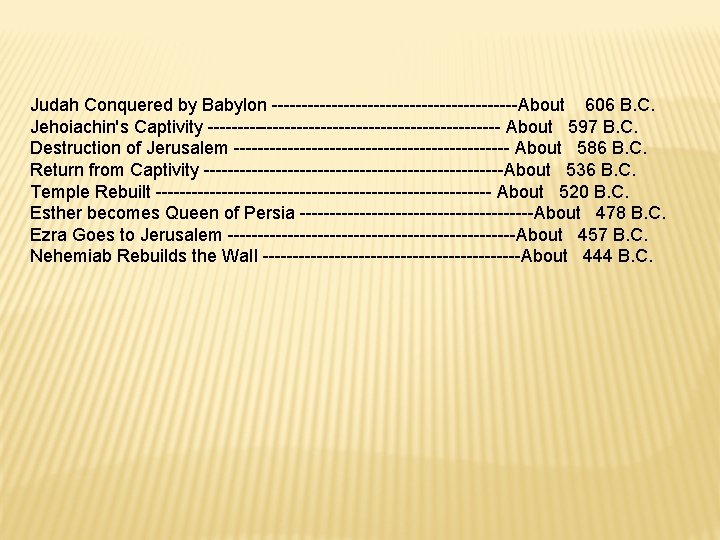
Judah Conquered by Babylon ---------------------About 606 B. C. Jehoiachin's Captivity ------------------------- About 597 B. C. Destruction of Jerusalem ----------------------- About 586 B. C. Return from Captivity -------------------------About 536 B. C. Temple Rebuilt ---------------------------- About 520 B. C. Esther becomes Queen of Persia --------------------About 478 B. C. Ezra Goes to Jerusalem ------------------------About 457 B. C. Nehemiab Rebuilds the Wa. Il ----------------------About 444 B. C.
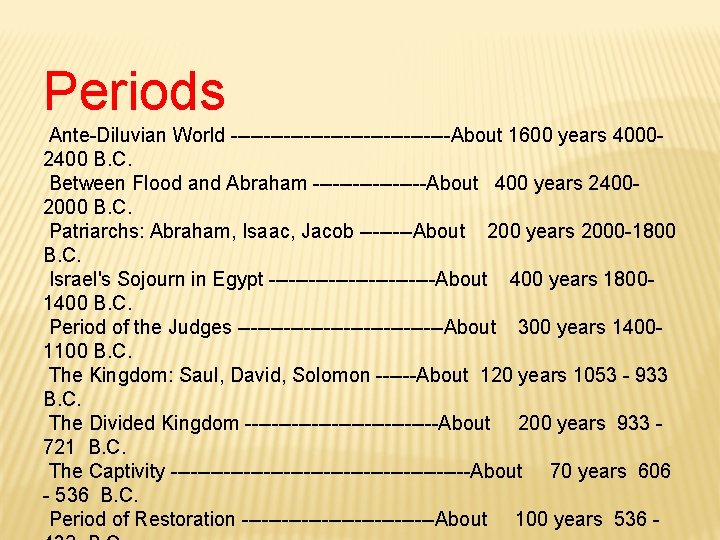
Periods Ante-Diluvian World -----------------About 1600 years 40002400 B. C. Between Flood and Abraham ---------About 400 years 24002000 B. C. Patriarchs: Abraham, Isaac, Jacob ----About 200 years 2000 -1800 B. C. Israel's Sojourn in Egypt -------------About 400 years 18001400 B. C. Period of the Judges ----------------About 300 years 14001100 B. C. The Kingdom: Saul, David, Solomon ------About 120 years 1053 - 933 B. C. The Divided Kingdom ---------------About 200 years 933 721 B. C. The Captivity -----------------------About 70 years 606 - 536 B. C. Period of Restoration ---------------About 100 years 536 -
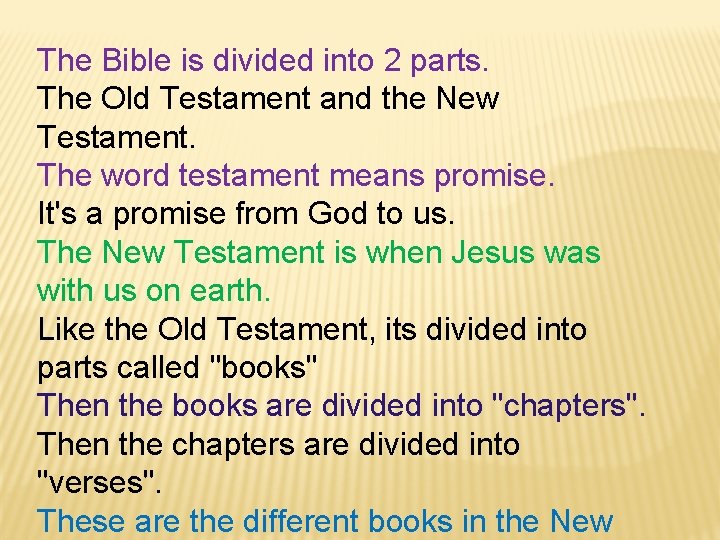
The Bible is divided into 2 parts. The Old Testament and the New Testament. The word testament means promise. It's a promise from God to us. The New Testament is when Jesus was with us on earth. Like the Old Testament, its divided into parts called "books" Then the books are divided into "chapters". Then the chapters are divided into "verses". These are the different books in the New
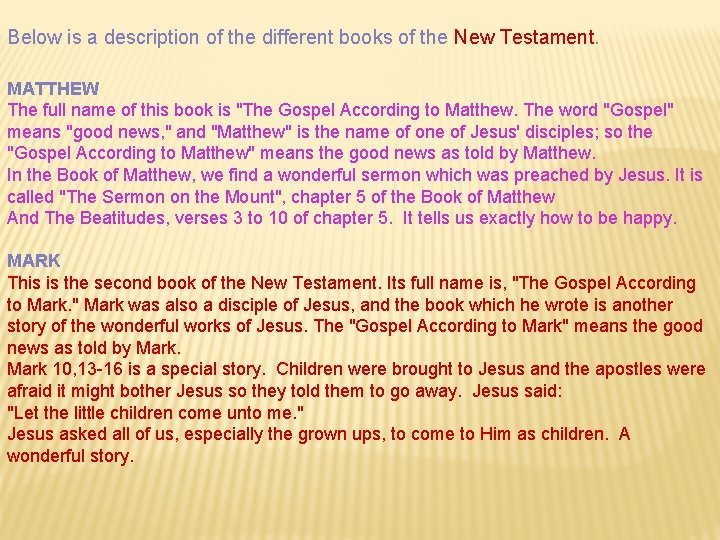
Below is a description of the different books of the New Testament. MATTHEW The full name of this book is "The Gospel According to Matthew. The word "Gospel" means "good news, " and "Matthew" is the name of one of Jesus' disciples; so the "Gospel According to Matthew" means the good news as told by Matthew. In the Book of Matthew, we find a wonderful sermon which was preached by Jesus. It is called "The Sermon on the Mount", chapter 5 of the Book of Matthew And The Beatitudes, verses 3 to 10 of chapter 5. It tells us exactly how to be happy. MARK This is the second book of the New Testament. Its full name is, "The Gospel According to Mark. " Mark was also a disciple of Jesus, and the book which he wrote is another story of the wonderful works of Jesus. The "Gospel According to Mark" means the good news as told by Mark 10, 13 -16 is a special story. Children were brought to Jesus and the apostles were afraid it might bother Jesus so they told them to go away. Jesus said: "Let the little children come unto me. " Jesus asked all of us, especially the grown ups, to come to Him as children. A wonderful story.
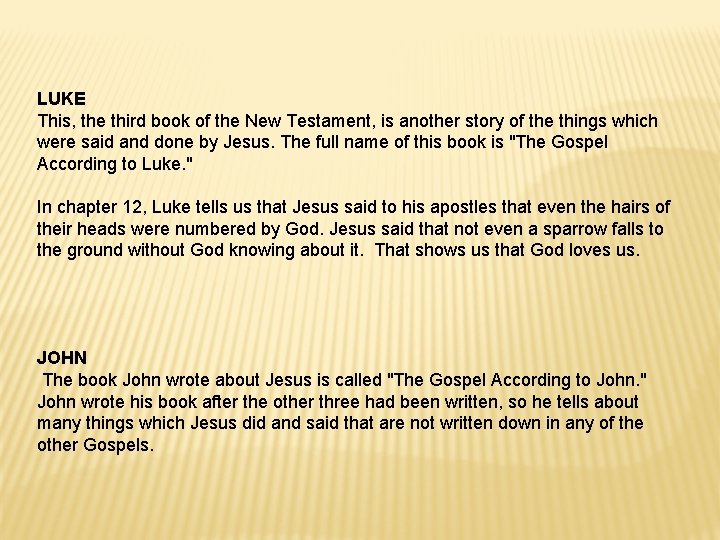
LUKE This, the third book of the New Testament, is another story of the things which were said and done by Jesus. The full name of this book is "The Gospel According to Luke. " In chapter 12, Luke tells us that Jesus said to his apostles that even the hairs of their heads were numbered by God. Jesus said that not even a sparrow falls to the ground without God knowing about it. That shows us that God loves us. JOHN The book John wrote about Jesus is called "The Gospel According to John. " John wrote his book after the other three had been written, so he tells about many things which Jesus did and said that are not written down in any of the other Gospels.
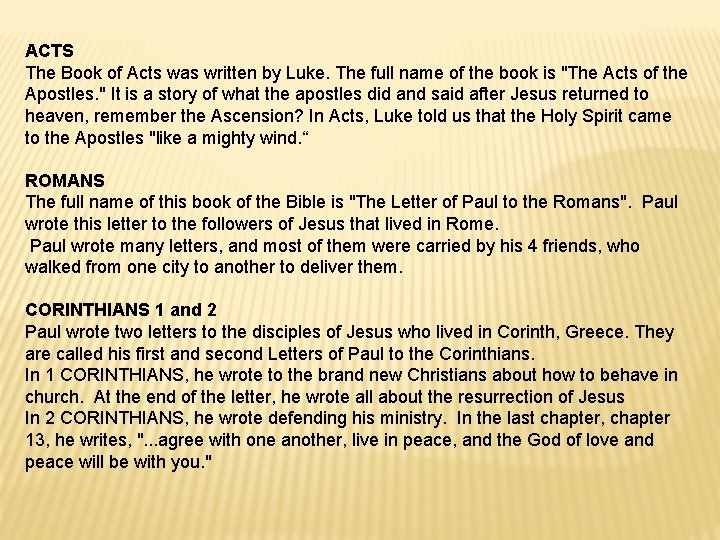
ACTS The Book of Acts was written by Luke. The full name of the book is "The Acts of the Apostles. " It is a story of what the apostles did and said after Jesus returned to heaven, remember the Ascension? In Acts, Luke told us that the Holy Spirit came to the Apostles "like a mighty wind. “ ROMANS The full name of this book of the Bible is "The Letter of Paul to the Romans". Paul wrote this letter to the followers of Jesus that lived in Rome. Paul wrote many letters, and most of them were carried by his 4 friends, who walked from one city to another to deliver them. CORINTHIANS 1 and 2 Paul wrote two letters to the disciples of Jesus who lived in Corinth, Greece. They are called his first and second Letters of Paul to the Corinthians. In 1 CORINTHIANS, he wrote to the brand new Christians about how to behave in church. At the end of the letter, he wrote all about the resurrection of Jesus In 2 CORINTHIANS, he wrote defending his ministry. In the last chapter, chapter 13, he writes, ". . . agree with one another, live in peace, and the God of love and peace will be with you. "
GALATIANS This book is another letter written by the Paul. It was written to the disciples of Jesus who lived in Galatia. In Galatia, there were several groups of disciples, and Paul sent this letter to all of them. Galatians is a book about the Grace of God. In those days, the Jews were so caught up in ritual and regulations, that means laws, and Paul was telling them that isn't what is important. The gifts of the Spirit and faith are what is important. EPHESIANS This book of the Bible is a letter which Paul wrote to the disciples of Jesus who lived in the city of Ephesus. People worshipped false gods in Ephesus. In this letter, Paul was explaining to the Ephesians about the Church and to be united with Jesus. PHILIPPIANS Paul wrote many letters, and this book of the Bible is another one of them. It was sent to the disciples of Jesus who lived in Philippi, which was a city in Macedonia. Paul was in prison when he wrote this letter. Although he could have been killed, in this letter he praised God and told the Filipinos to love God as well as each other.
COLOSSIANS Another of Paul's letters. It was sent to the disciples who lived in Colosse, which was a city in Asia Minor. In this letter, he talked about Jesus being our savior. That is the most important thing and everything else comes second. THESSALONIANS 1 and 2 The disciples of Jesus who were known as Thessalonians lived in a city called Thessalonica was in Macedonia. There are two books of the New Testament called Thessalonians, and both of them are letters which were written by the Paul. In these letters, Paul tells the new Christians of faith, love and hope. TIMOTHY 1 and 2 The first and second Books of Timothy are letters written by Paul to Timothy. Paul loved this young man very dearly, and called him his son. In the first letter, Paul reminded Timothy what to teach. To always teach the truth and how he should act to others Paul's second letter to Timothy was written while the Paul was a prisoner in Rome, and only a little while before he died. In this letter, he tells about his trial before the emperor of Rome, Nero. He says that Luke was with him and the Lord helped him
TITUS The Book of Titus is another letter written by the Paul. Titus traveled and worked with Paul for a long time. In this letter, Paul explains how to do the Lord's work. PHILEMON The Book of Philemon is a letter written by Paul to Philemon lived in Colosse, and the other Christians of this city met in his home to hold their meetings. Philemon was a business man, and had many slaves. The name of one of his slaves was Onesimus. The slave ran away from Philemon which was a very bad thing to do. Onesimus went to Rome and visited with Paul told Onesimus all about Jesus. Onesimus became a Christian. Onesimus knew that he must return to Philemon because running away was a bad thing. It was very hard for Onesimus to do but Paul helped him by writing a letter to Philemon. Paul told Philemon that Onesimus had become a Christian and was now returning to him. He asked Philemon to be kind to Onesimus. HEBREWS This is another letter written by Paul was a very wise man, and he knew there were some things that the Hebrews needed to learn, so that's why he wrote this letter to them.
JAMES The full name of this book is "The Letter of James, " which means the letter which James wrote to all the disciples of Jesus. James was one of Jesus' disciples who followed him before he was crucified. He lived in Jerusalem, and it was there that he wrote this letter. In it he writes many good things and tells us that prayer really works. PETER 1 and 2 Peter 1, the real name is "The First Letter of Peter" Peter 2, the real name is "The Second Letter of Peter" Peter was an Apostle of Jesus and knew him very well. Peter 1 is about how to behave when people are mean to you. Peter 2 is telling people not to teach wrong things and to always believe what God says.
JOHN 1, 2, and 3 John wrote "The Gospel According to John", which is his report of the life of Jesus. John also wrote three letters. John is the only one who wrote a Gospel and also wrote letters to the church. We are glad John wrote these three letters, because there are many things in them which are important for us to know. JUDE The full name of this book is "The Letter of Jude, " which means the letter that Jude wrote to all the disciples of Jesus. It is not a very long letter, but it has many important lessons in it. Jude tells us that we should do as God wants. REVELATION This is the last book of the Bible. It was written by John. Revelations is about Jesus being King of Heaven and earth.

- Slides: 38