
What is Technology Technology is defined as the



- Slides: 18
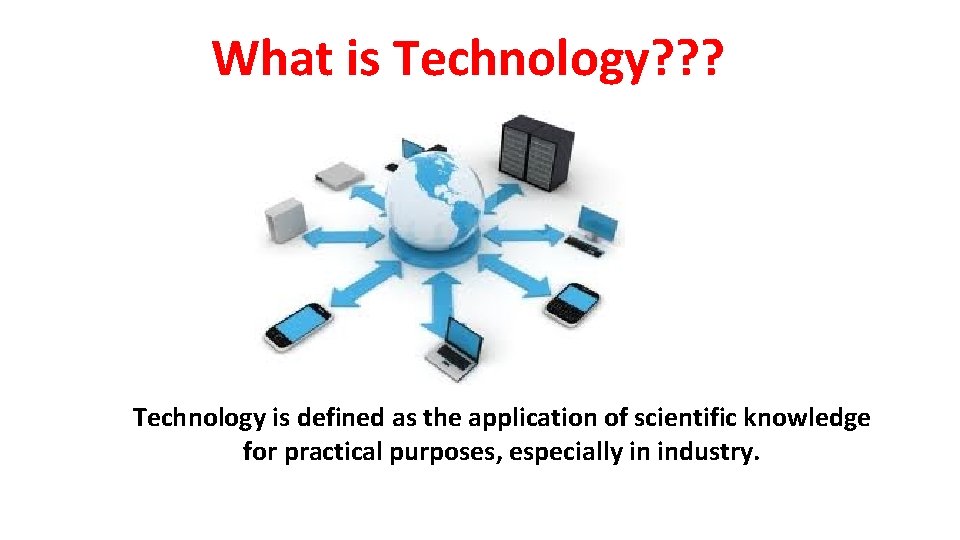
What is Technology? ? ? Technology is defined as the application of scientific knowledge for practical purposes, especially in industry.
Let’s go back in time !!!
Student Assignment/Homework Are you aware how much technology influences us? ? ? Do you take technology for granted? ? ? Do you know how pople managed daily chores when there was no internet? ? ? Using the worksheet provided, find someone who was an adult (at least 40 now) in the eighties or nineties and ask them the questions provided
Technology is used in every aspect of modern life. Countless technologies are used to carry out tasks formerly done by people, for example agricultural machinery, computers for communication, internet banking and self service checkouts in shops.
Technology Around Us The following are a list of areas of everyday life that involve technology: 1) in FOOD PRODUCTION 2) in TRANSPORT 3) in MEDICINE 4) in LEISURE 5) in COMMUNICATION 6) in NANOTECHNOLOGY
Technology in Food Production: • In Ireland agricultural crops are sown, fertilised and harvested by machines. • Meat is processed in factories • Refrigerated storage is used so that fruit and vegetables stay fresh • Development of convenience food such as ready-made meals and energy gels used by athletes
Technology in Transport: • Memory foam and high-tech engineering methods are used to make comfortable shoes • Cars are larger but easier to control using technologies such as power steering and sophisticated breaking systems • Technologies are being developed to make vehicles (incl. boats & aeroplanes) more energy efficient and to reduce the harmful emissions from engines • New materials are used to make shoes lightweight, breathable and waterproof
Technology in Medicine: • MRI is a machine used to take clear images of the inside of the body for diagnosis of injury or disease • Keyhole surgery allows doctors to treat patients in a less invasive way and so reduces recovery time • New and improved materials are used for stitches, dressings and burns treatment • Drips deliver a controlled dose of medication to patients
Technology in Leisure: • High definition TV’s, tablets, smartphones, and games consoles all provide new forms of entertainment • Televisions can be paused, rewound or fast forwarded • Smartphones can now act as handheld computers • MP 3 players etc. can be used to store and organise a large number of songs on a very small device
Technology in Communication: • Machines are used to sort post in postal sorting offices • The internet has become a very important tool for communication • Phone, television and internet signals use fibre optic cables (very fine cables of glass made from silicon, germanium and oxygen) and satellites to send information over long distances • Computers, tablets and smartphones use complex technologies to store, process and send information
Technology in Nanotechnology: Nanoscience and Nanotechnology is the study and use of matter at extremely small scales. Scientists have used nanoparticles to develop materials that are stronger and lighter than other materials. Products that use nanotechnology include: • Sunscreens that contain nanoparticles of zinc oxide or titanium oxide which are absorbed more easily into the skin than larger particles • Car paint and eyeglass lenses use nanoparticles of aluminum silicate to increase their scratch-resistance • Computers use nanoscale transistors, allowing computers to become smaller
Ireland is one of the leading locations for technology in Europe, and many companies with household names have operations and manufacturing bases here!!!
Accidental Discoveries Please read through this topic in your book page 539
Technology & Sustainability Science is looking to technology to help us to live sustainably on Earth. Here are some of the advances made so far: 1) The use of new technology to produce electricity using solar and wind energy 2) Production of more energy efficient cars, homes and appliances 3) Production of bio–plastics that break down in nature unlike non-biodegradable plastics
Technology The Negatives While there are many arguments for the advance of technology we must also consider the negatives impact: 1) Virtual friends – have we forgotten how to have a face-to-face conversation? 2) Loss of jobs – with the advancement of technology so too comes the loss of jobs as people are replaced by machines e. g. banks and post offices closing down and internet shopping reducing the need for local shops. 3) Globalisation – does the growth of giant multinational companies reduce competition and choice? 4) Exploitation – are people in poorer countries being used to manufacture technology, we use, at low prices?
Impacts of Technology on Science, Society & the Environment Technology & Science Technology is key to scientific research and development allowing the human race to learn more about the world around us Technology & Society Technology can effect large groups of people both positively and negatively e. g. development of electricity & internet, closure of banks/post offices leads to loss of jobs Technology & the Environmental impacts of technology can be both positive and negative e. g. the building of large hydroelectric dams provides sustainable energy but can lead to flooding of large areas of land
PW 4: Student Assignment Research and discuss a technological application of physics in terms of its impact on science, society and the environment. In your research you should address the following: a) reason you chose this technology b) history of its development c) current uses of the technology d) its impact on science, society and the environment e) future benefits f) sources of information ***Typed or handwritten report approx. 400 – 600 words (MAXIUM) excluding tables, graphs, reference list and research records
Report Format - Individual • Typed or handwritten report approx. 400 – 600 words excluding tables, graphs, reference list and research records • Poster Presentation incl. short written report • Powerpoint presentation