
What is Talk Boost KS 2 2 Evaluation


What is Talk Boost KS 2? 2
Evaluation of Talk Boost KS 2 • • Active and comparison groups Range of tests and checklists repeated before (Time 1) and immediately after (Time 2) Talk Boost KS 2 for both groups – SLC Progression Tools – Assessment of Comprehension and Expression (ACE) (subtests) – York Assessment of Reading for Comprehension (YARC) – Learning behaviour checklist – Staff training evaluation – Parent surveys for the active group • ACE and YARC were repeated for the active group one term after Talk Boost KS 2 (Time 3) 3
Evaluation key findings After eight weeks of running Talk Boost KS 2 the following key findings were made: From teacher and parent outcome measures • Children made significant progress in language and communication • 67% of children caught up with their peers in understanding language • 85% of parents saw their child’s language improve • Learning in the classroom was easier; children joined in more, took part in discussions more and listened more carefully From standardised assessments • Indications that Talk Boost KS 2 significantly improves children’s reading comprehension • Indications that Talk Boost KS 2 improves children’s language scores • Both of these findings need to be confirmed in further research 4
Today’s training Session 1: An introduction to speech, language and communication (SLC) in KS 2 Talk Boost KS 2 practitioner training Session 2: Selecting children for Talk Boost KS 2 & Overview of the materials Session 3: Talk Boost KS 2 content and activities Session 4: Planning your sessions 5
Learning outcomes • To have an awareness of speech, language and communication and typical language development in KS 2 • To understand how to run Talk Boost KS 2, including use of the Tracker and the resources • To understand the roles and responsibilities for staff • To understand how to support children to continue to apply their learning in class • To identify the necessary next steps in planning and preparation for delivering Talk Boost KS 2 6
Comment/question activity • • Work in groups of three or five Person 1 picks a Topic card and says something about the topic Person 2 picks up a Comment/question card and either makes a statement or asks a question about what the first person has said Person 3 then picks up a new Topic card Person 4 picks a Comment/question card, and so on. Continue until everyone has at least one turn to start a topic and comment/question on someone else’s Feedback: whole group 7
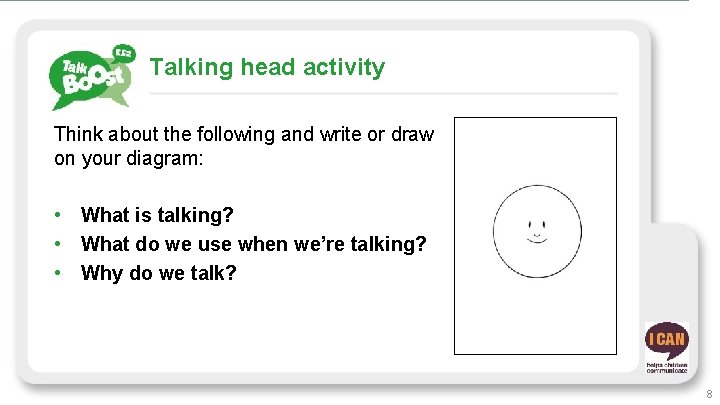
Talking head activity Think about the following and write or draw on your diagram: • What is talking? • What do we use when we’re talking? • Why do we talk? 8
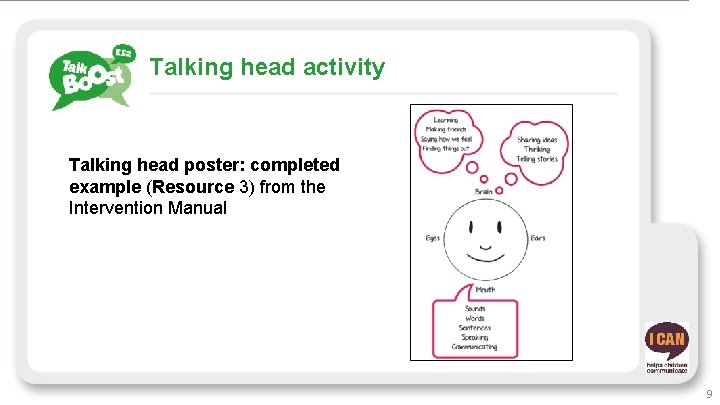
Talking head activity Talking head poster: completed example (Resource 3) from the Intervention Manual 9
Terminology Speech Language Communication Sounds and sound combinations System of sounds, signs and words that convey meaning; includes understanding and expression Sending and receiving of messages; includes non-verbal language, e. g. posture, eye contact and social communication skills, e. g. maintaining topics 10
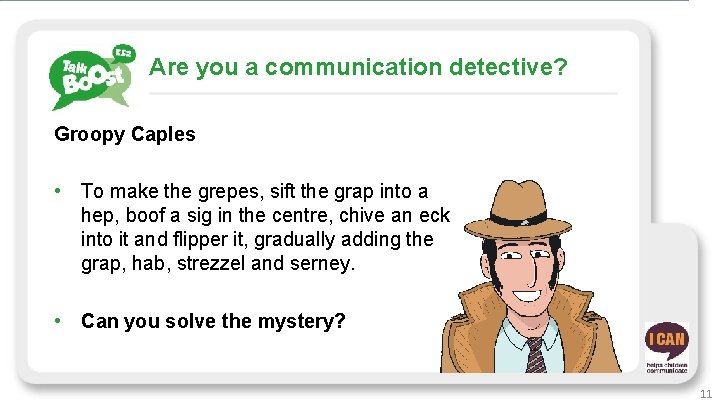
Are you a communication detective? Groopy Caples • To make the grepes, sift the grap into a hep, boof a sig in the centre, chive an eck into it and flipper it, gradually adding the grap, hab, strezzel and serney. • Can you solve the mystery? 11
Development of language skills Using the Language ability grid in your Participant Book, sort the Language ability cards into: • the correct area of language • the correct age group 12
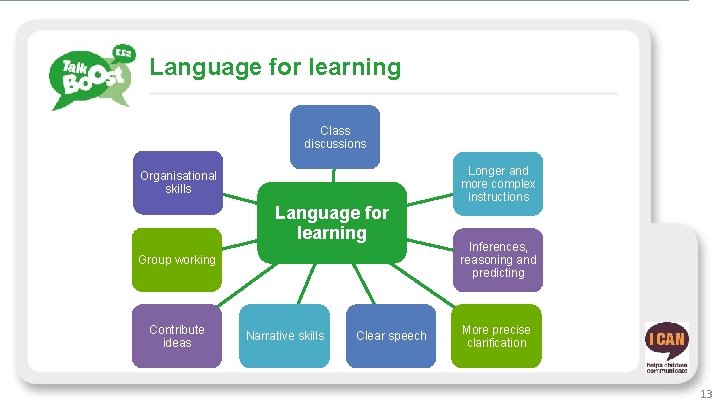
Language for learning Class discussions Organisational skills Language for learning Group working Contribute ideas Narrative skills Clear speech Longer and more complex instructions Inferences, reasoning and predicting More precise clarification 13
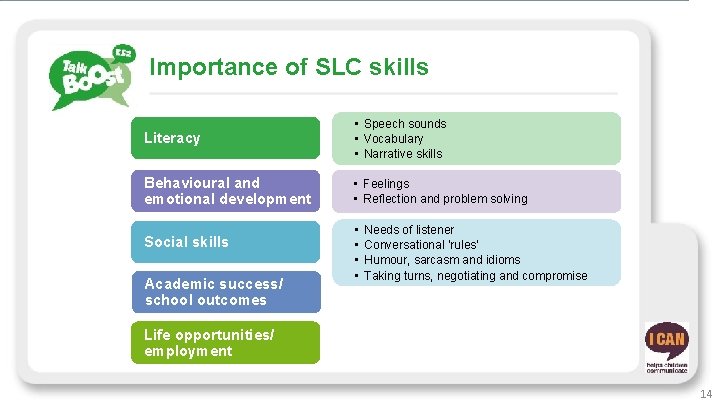
Importance of SLC skills Literacy • Speech sounds • Vocabulary • Narrative skills Behavioural and emotional development • Feelings • Reflection and problem solving Social skills Academic success/ school outcomes • • Needs of listener Conversational ‘rules’ Humour, sarcasm and idioms Taking turns, negotiating and compromise Life opportunities/ employment 14
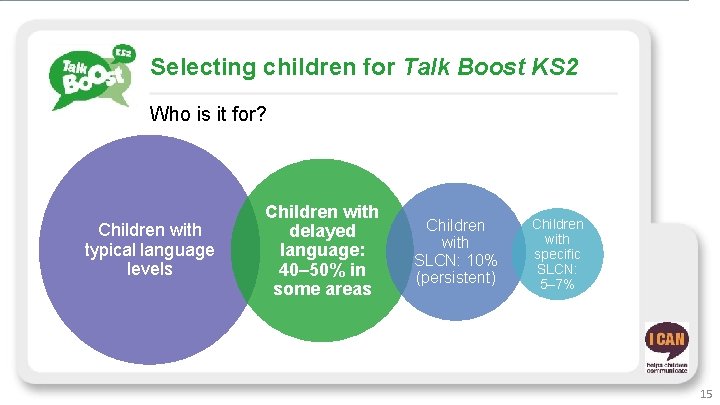
Selecting children for Talk Boost KS 2 Who is it for? Children with typical language levels Children with delayed language: 40– 50% in some areas Children with SLCN: 10% (persistent) Children with specific SLCN: 5– 7% 15
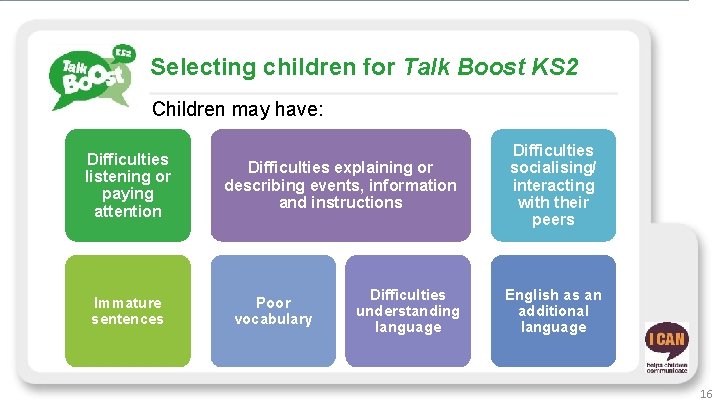
Selecting children for Talk Boost KS 2 Children may have: Difficulties listening or paying attention Immature sentences Difficulties explaining or describing events, information and instructions Poor vocabulary Difficulties understanding language Difficulties socialising/ interacting with their peers English as an additional language 16
English as an additional language (EAL) • Most children will learn another language easily from everyday exposure – it just takes time • Talk Boost KS 2 will support the acquisition of English language skills • It may help children who are behind in their home language as well as English – but these children may need further assessment and support 17
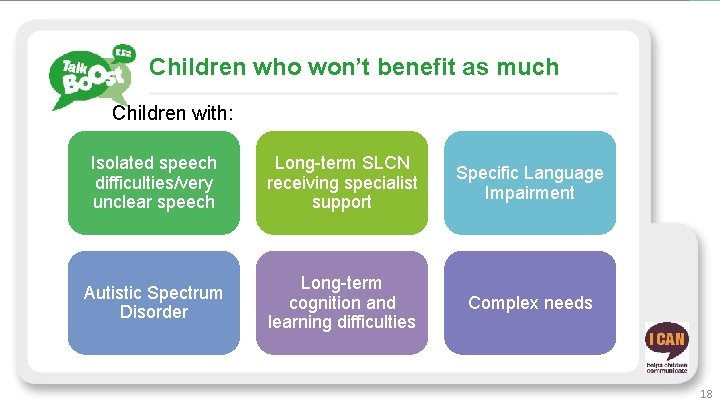
Children who won’t benefit as much Children with: Isolated speech difficulties/very unclear speech Long-term SLCN receiving specialist support Specific Language Impairment Autistic Spectrum Disorder Long-term cognition and learning difficulties Complex needs 18
Case studies Who would you select for Talk Boost KS 2 and why? Ollie? OR Lewis? 19
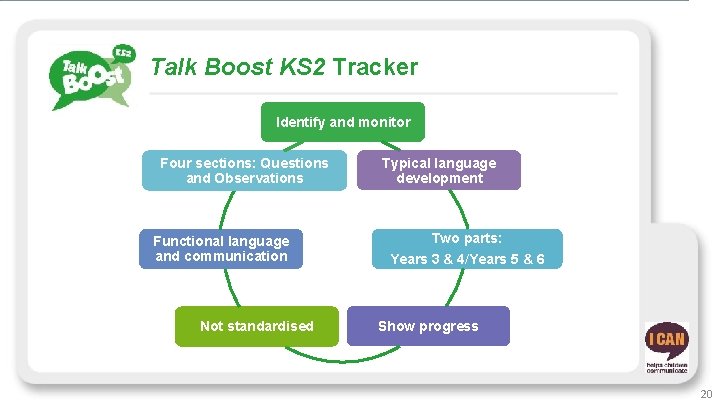
Talk Boost KS 2 Tracker Identify and monitor Four sections: Questions and Observations Functional language and communication Not standardised Typical language development Two parts: Years 3 & 4/Years 5 & 6 Show progress 20
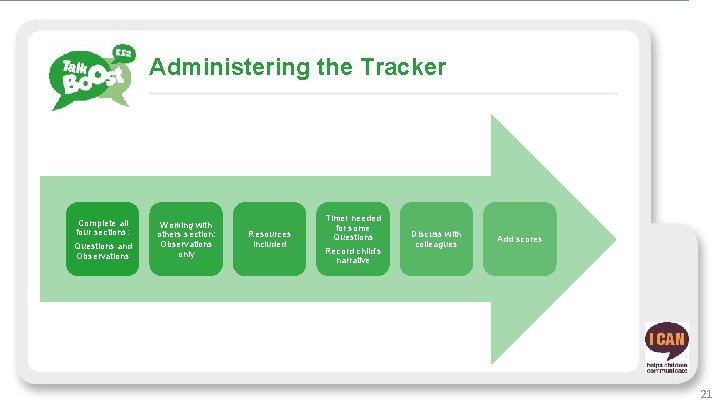
Administering the Tracker Complete all four sections: Questions and Observations Working with others section: Observations only Resources included Timer needed for some Questions Record child’s narrative Discuss with colleagues Add scores 21
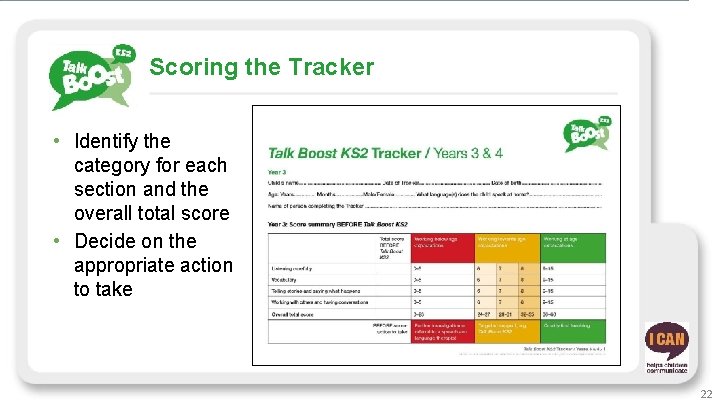
Scoring the Tracker • Identify the category for each section and the overall total score • Decide on the appropriate action to take 22
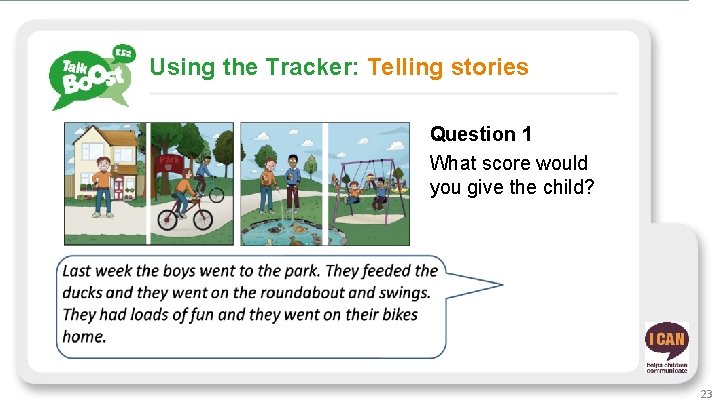
Using the Tracker: Telling stories Question 1 What score would you give the child? 23
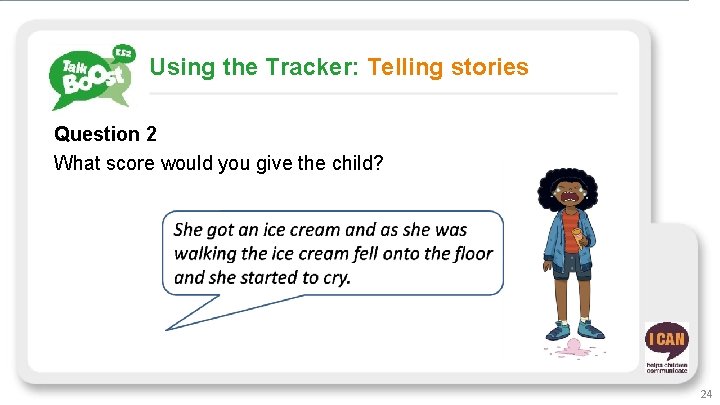
Using the Tracker: Telling stories Question 2 What score would you give the child? 24
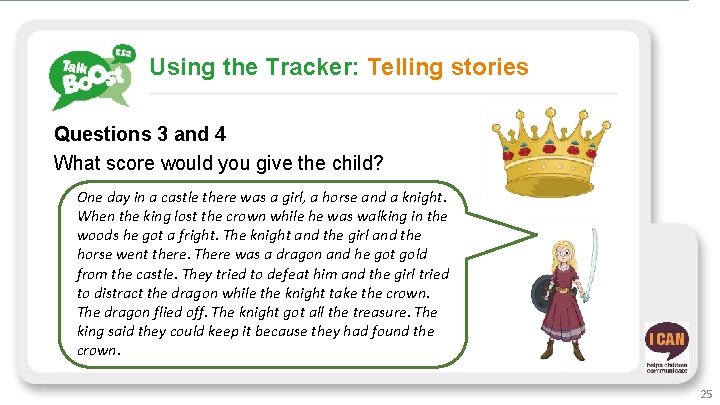
Using the Tracker: Telling stories Questions 3 and 4 What score would you give the child? One day in a castle there was a girl, a horse and a knight. When the king lost the crown while he was walking in the woods he got a fright. The knight and the girl and the horse went there. There was a dragon and he got gold from the castle. They tried to defeat him and the girl tried to distract the dragon while the knight take the crown. The dragon flied off. The knight got all the treasure. The king said they could keep it because they had found the crown. 25
Using the Tracker: Telling stories • Telling stories and saying what happens • This child is in Year 4 • Use the Tracker score summary to identify the category for this section Which children would you select from your class? 26
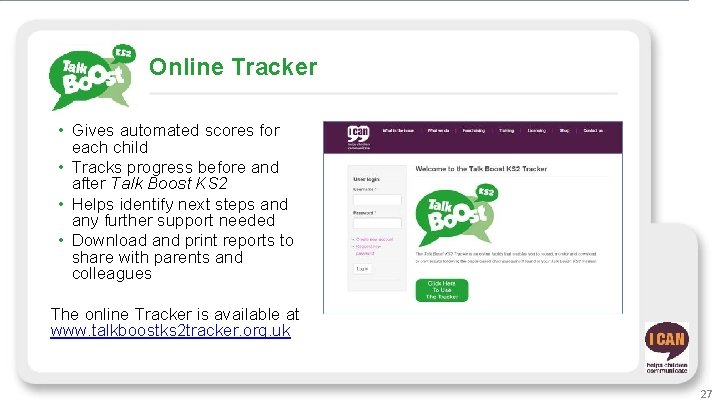
Online Tracker • Gives automated scores for each child • Tracks progress before and after Talk Boost KS 2 • Helps identify next steps and any further support needed • Download and print reports to share with parents and colleagues The online Tracker is available at www. talkboostks 2 tracker. org. uk 27
Child self-rating scale • The child completes the Child self-rating scale with a teacher or teaching assistant who knows them well • This sorting activity has 11 statements about communication in school • Using the five faces, the child selects the one that shows how they feel about each question • Complete the scale before and after Talk Boost KS 2, and use the online scoring tool to generate a report 28
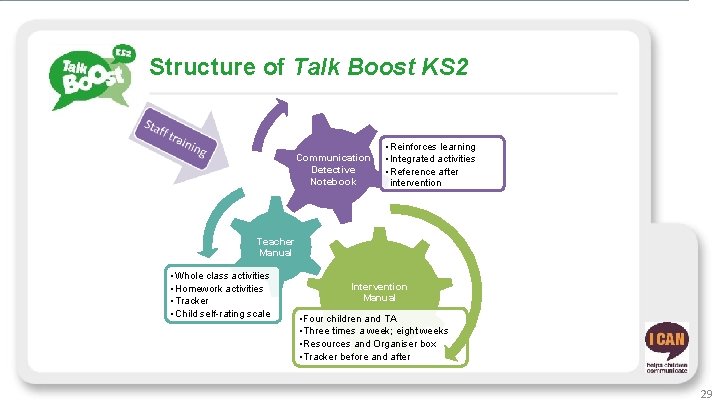
Structure of Talk Boost KS 2 Communication Detective Notebook • Reinforces learning • Integrated activities • Reference after intervention Teacher Manual • Whole class activities • Homework activities • Tracker • Child self-rating scale Intervention Manual • Four children and TA • Three times a week; eight weeks • Resources and Organiser box • Tracker before and after 29
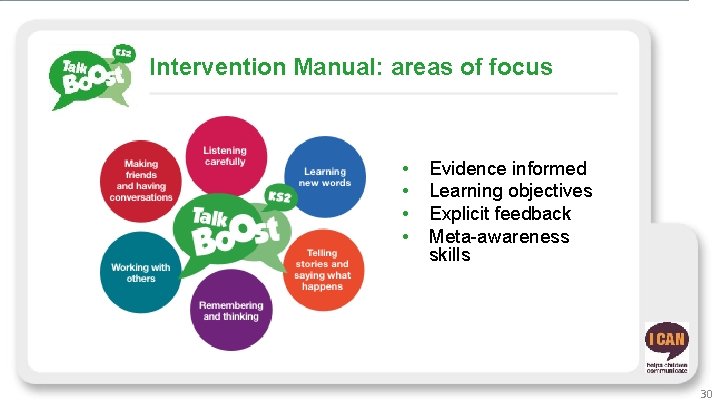
Intervention Manual: areas of focus • • Evidence informed Learning objectives Explicit feedback Meta-awareness skills 30
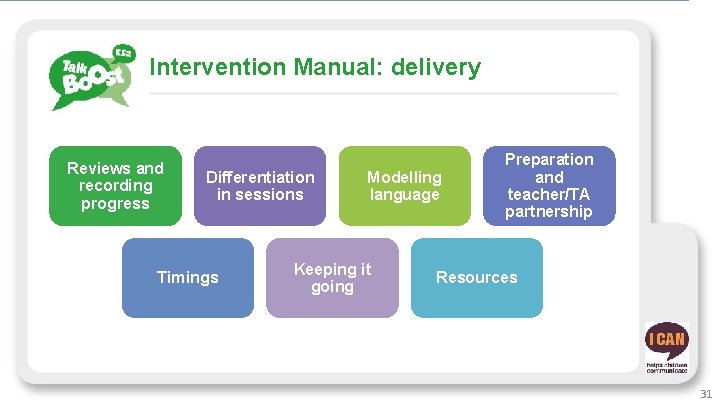
Intervention Manual: delivery Reviews and recording progress Differentiation in sessions Timings Modelling language Keeping it going Preparation and teacher/TA partnership Resources 31
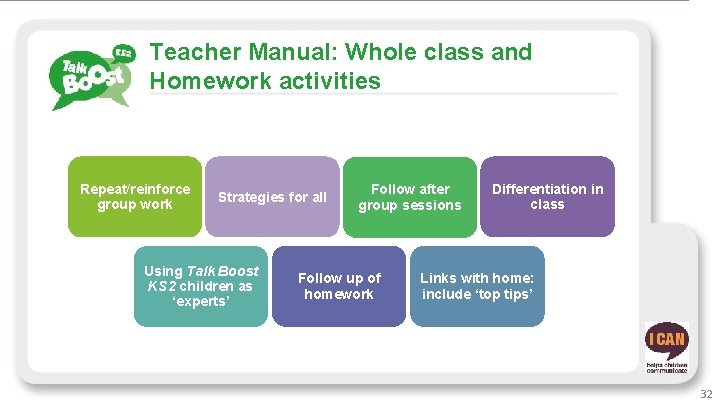
Teacher Manual: Whole class and Homework activities Repeat/reinforce group work Strategies for all Using Talk Boost KS 2 children as ‘experts’ Follow after group sessions Follow up of homework Differentiation in class Links with home: include ‘top tips’ 32
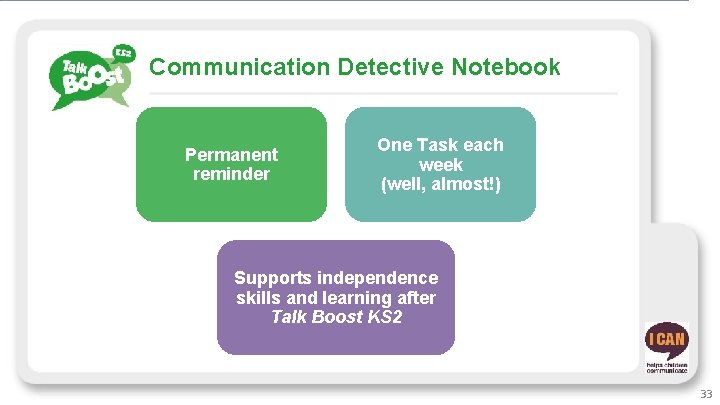
Communication Detective Notebook Permanent reminder One Task each week (well, almost!) Supports independence skills and learning after Talk Boost KS 2 33
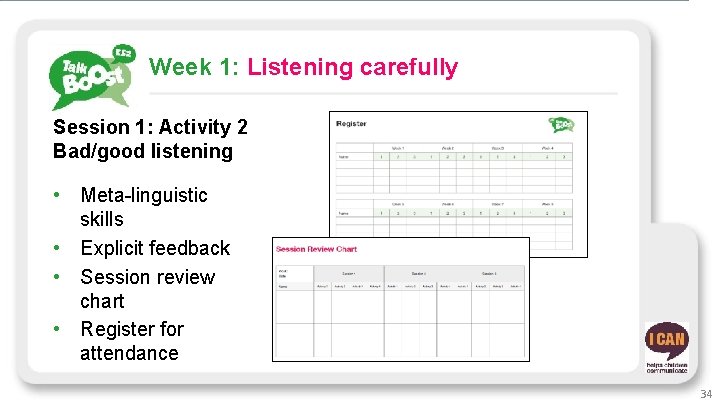
Week 1: Listening carefully Session 1: Activity 2 Bad/good listening • Meta-linguistic skills • Explicit feedback • Session review chart • Register for attendance 34
Week 1: Listening carefully Session 2: Activity 3 Barrier game • Listen to the description of how to colour the house • What sort of clarification did you ask for? 35
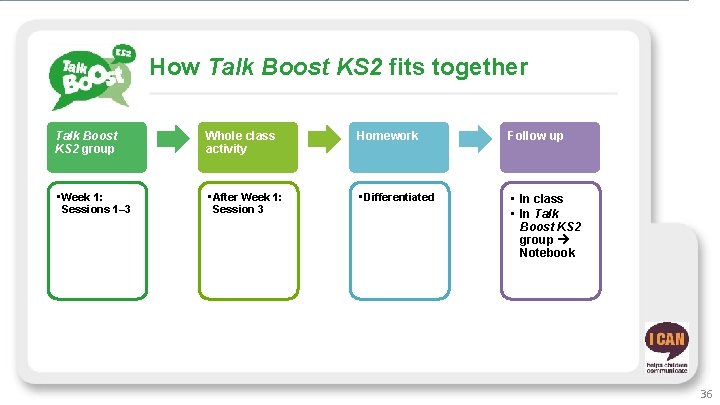
How Talk Boost KS 2 fits together Talk Boost KS 2 group Whole class activity Homework Follow up • Week 1: Sessions 1– 3 • After Week 1: Session 3 • Differentiated • In class • In Talk Boost KS 2 group Notebook 36
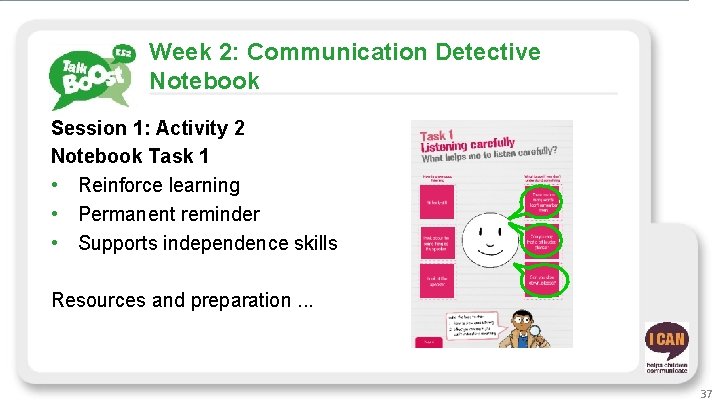
Week 2: Communication Detective Notebook Session 1: Activity 2 Notebook Task 1 • Reinforce learning • Permanent reminder • Supports independence skills Resources and preparation. . . 37
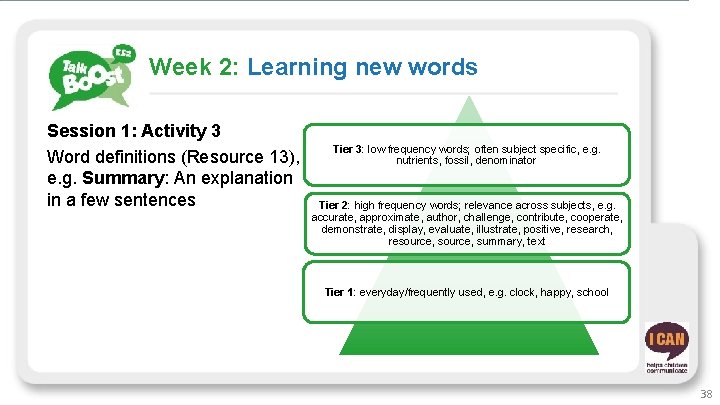
Week 2: Learning new words Session 1: Activity 3 Word definitions (Resource 13), e. g. Summary: An explanation in a few sentences Tier 3: low frequency words; often subject specific, e. g. nutrients, fossil, denominator Tier 2: high frequency words; relevance across subjects, e. g. accurate, approximate, author, challenge, contribute, cooperate, demonstrate, display, evaluate, illustrate, positive, research, resource, summary, text Tier 1: everyday/frequently used, e. g. clock, happy, school 38
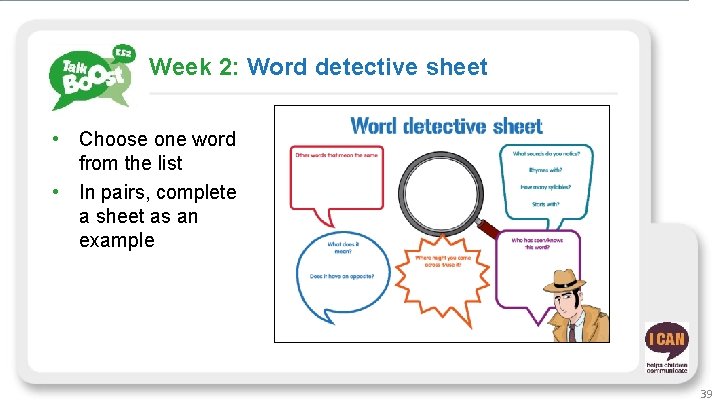
Week 2: Word detective sheet • Choose one word from the list • In pairs, complete a sheet as an example 39
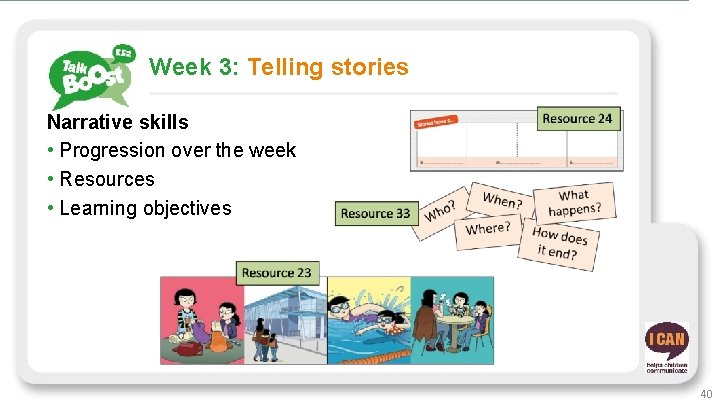
Week 3: Telling stories Narrative skills • Progression over the week • Resources • Learning objectives 40
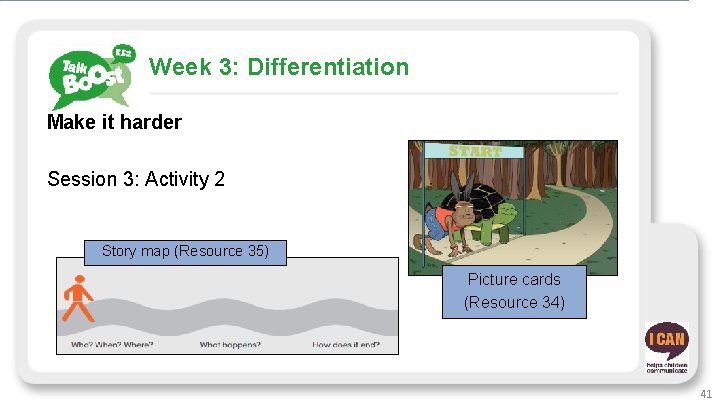
Week 3: Differentiation Make it harder Session 3: Activity 2 Story map (Resource 35) Picture cards (Resource 34) 41
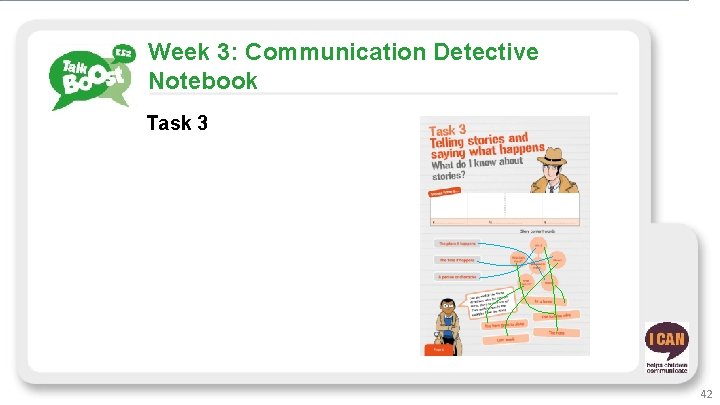
Week 3: Communication Detective Notebook Task 3 42
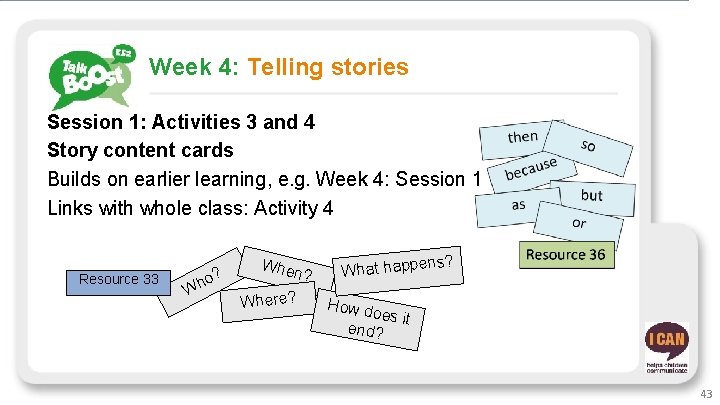
Week 4: Telling stories Session 1: Activities 3 and 4 Story content cards Builds on earlier learning, e. g. Week 4: Session 1 Links with whole class: Activity 4 Resource 33 o? Wh When ? Where? ns? What happe How d oes it end? 43
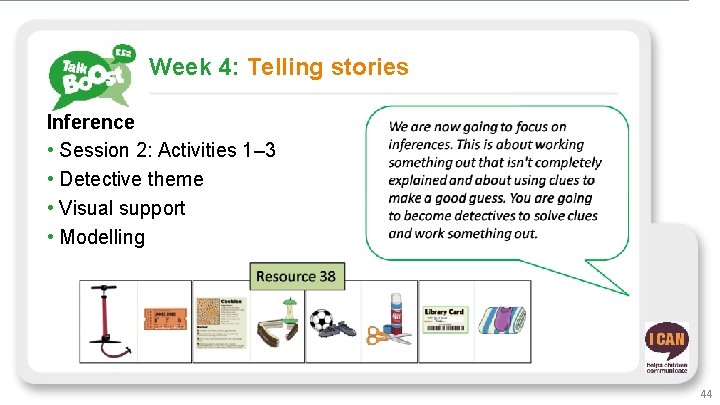
Week 4: Telling stories Inference • Session 2: Activities 1– 3 • Detective theme • Visual support • Modelling 44
Week 5: Communication Detective Notebook task: reviews Weeks 1– 4 Key learning: What if children haven’t understood/retained learning up to this point? 45
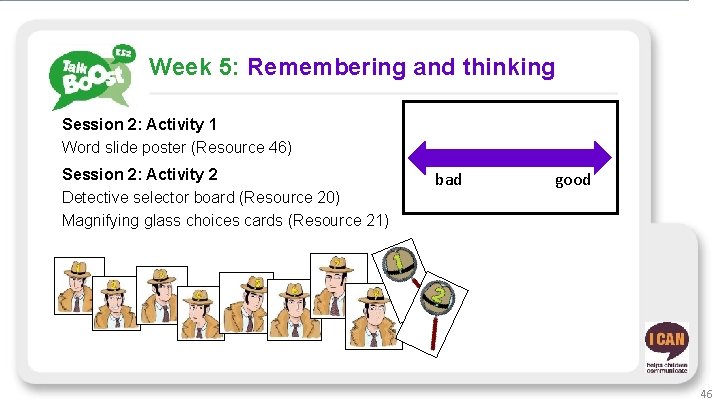
Week 5: Remembering and thinking Session 2: Activity 1 Word slide poster (Resource 46) Session 2: Activity 2 Detective selector board (Resource 20) Magnifying glass choices cards (Resource 21) bad good 46
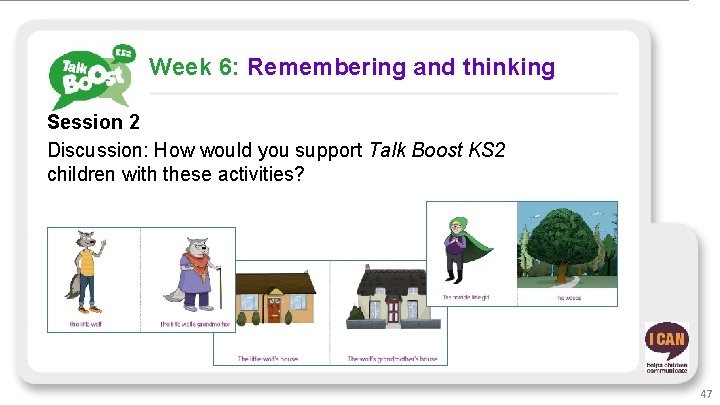
Week 6: Remembering and thinking Session 2 Discussion: How would you support Talk Boost KS 2 children with these activities? 47
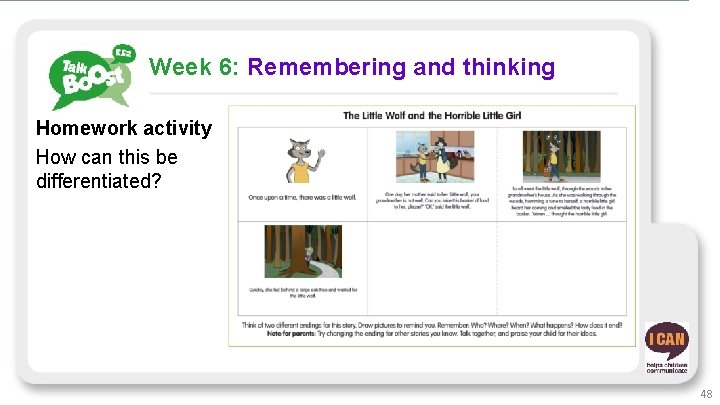
Week 6: Remembering and thinking Homework activity How can this be differentiated? 48
Week 6: Remembering and thinking Session 3 Making inferences and linking ideas together • Teacher/TA choose a text • Children think of Why? and How do you know? questions 49
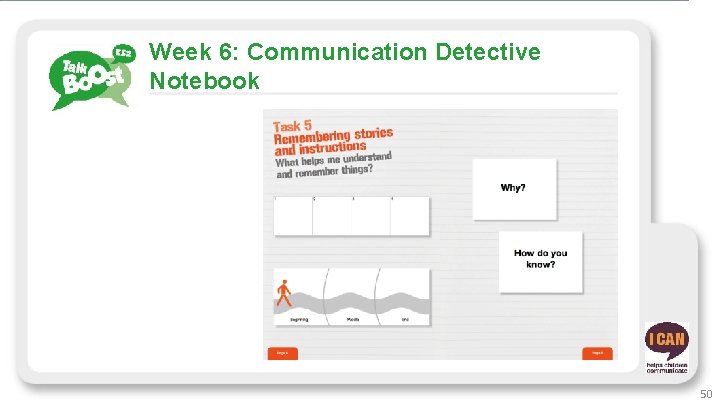
Week 6: Communication Detective Notebook 50
Week 7: Working with others Timings Week 7: Session 3: Activity 2 Whole class activity: Week 7 (Teacher Manual) • Read and discuss • Problems and solutions? 51
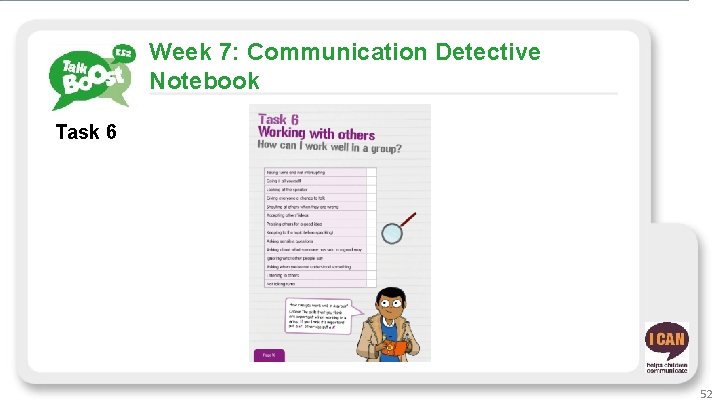
Week 7: Communication Detective Notebook Task 6 52
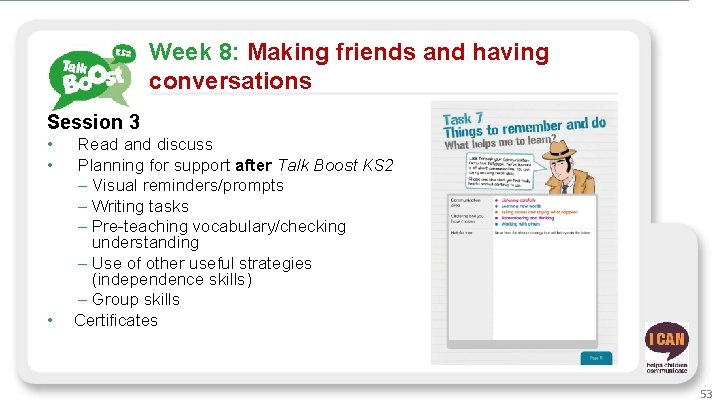
Week 8: Making friends and having conversations Session 3 • • • Read and discuss Planning for support after Talk Boost KS 2 – Visual reminders/prompts – Writing tasks – Pre-teaching vocabulary/checking understanding – Use of other useful strategies (independence skills) – Group skills Certificates 53
Outcomes, progress and evaluation • Talk Boost KS 2 Tracker • Child self-rating scale • www. talkboostks 2 tracker. org. uk
Next steps • What will you need to do next to start running Talk Boost KS 2? • What will you need to do once Talk Boost KS 2 is running? 55
Talk Boost KS 2 quiz 1. 2. 3. 4. 5. 6. Who is Talk Boost KS 2 for? How many sessions are there over how many weeks? When should the Whole class activities take place? Who does the homework and how/when is it followed up? Name three benefits of the Communication Detective Notebook Name three aspects of your respective roles as teacher/ teaching assistant 56
Any questions? 57
Course certificates and evaluation Please complete an evaluation of the Talk Boost KS 2 Practitioner Training course online at: www. icancharity. org. uk/validation When you do this you’ll be able to download a course certificate Tutor: Date: Email: 58
- Slides: 58