
What Is Strategy by Michael Porter What is
What Is Strategy? (by Michael Porter)
What is Strategy? Author : Michael Porter Professor, Harvard Business School - Director, Institute for Strategy and Competitiveness Key Contribution - 5 Forces, Value Chain, Generic Strategies, Positioning, Cluster of Competence Competitive Strategy Major Work - "How competitive forces shape strategy", (HBR, Mar/Apr 1979) Competitive Strategy (Free Press, 1980) Competitive Advantage (Free Press 1985) "From Competitive Advantage to Corporate Strategy", (HBR, May/June 1987) "What is Strategy", (HBR, Nov/Dec 1996) "Strategy and the Internet", (HBR, Mar 2001)
Table of Contents v Operational Effectiveness Is Not Strategy v Strategies Rests on Unique Activities v A Sustainable Strategic Position Requires Trade-offs v Fit Drives Both Competitive Advantage and Sustainability v Rediscover Strategy
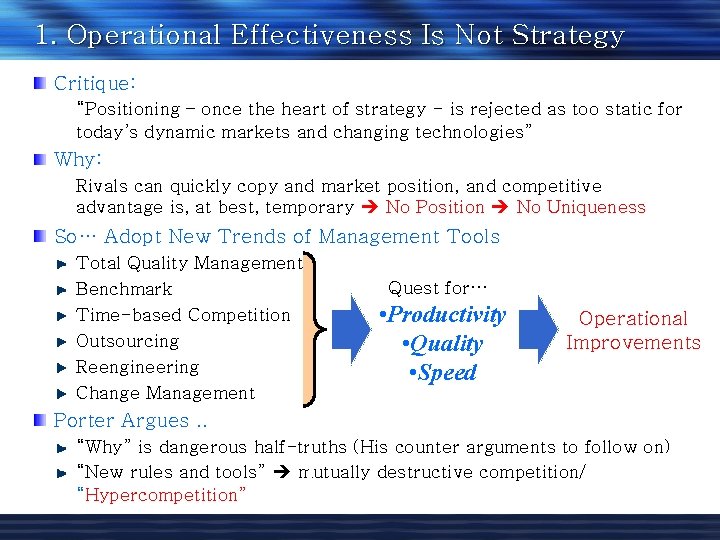
1. Operational Effectiveness Is Not Strategy Critique: “Positioning – once the heart of strategy - is rejected as too static for today’s dynamic markets and changing technologies” Why: Rivals can quickly copy and market position, and competitive advantage is, at best, temporary No Position No Uniqueness So… Adopt New Trends of Management Tools Total Quality Management Benchmark Time-based Competition Outsourcing Reengineering Change Management Porter Argues. . Quest for… • Productivity • Quality • Speed Operational Improvements “Why” is dangerous half-truths (His counter arguments to follow on) “New rules and tools” mutually destructive competition/ “Hypercompetition”
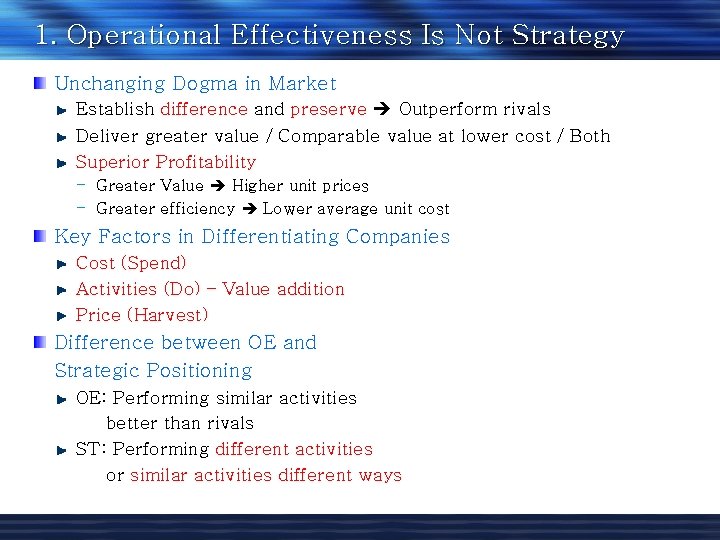
1. Operational Effectiveness Is Not Strategy Unchanging Dogma in Market Establish difference and preserve Outperform rivals Deliver greater value / Comparable value at lower cost / Both Superior Profitability - Greater Value Higher unit prices - Greater efficiency Lower average unit cost Key Factors in Differentiating Companies Cost (Spend) Activities (Do) – Value addition Price (Harvest) Difference between OE and Strategic Positioning OE: Performing similar activities better than rivals ST: Performing different activities or similar activities different ways
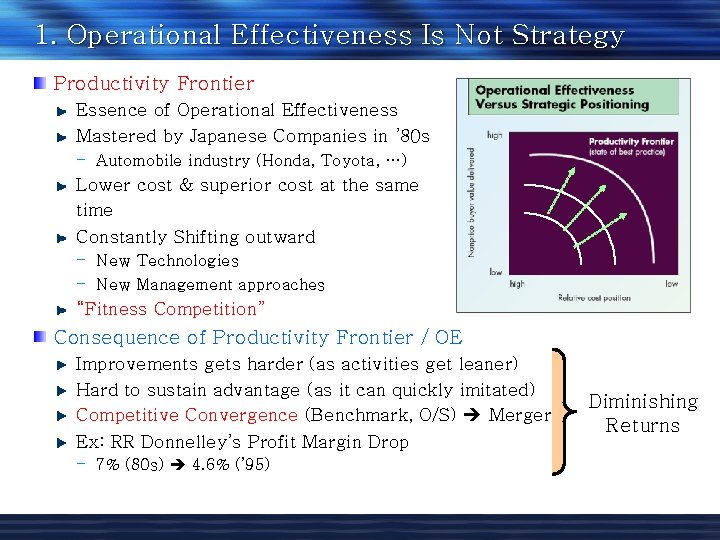
1. Operational Effectiveness Is Not Strategy Productivity Frontier Essence of Operational Effectiveness Mastered by Japanese Companies in ’ 80 s - Automobile industry (Honda, Toyota, …) Lower cost & superior cost at the same time Constantly Shifting outward - New Technologies - New Management approaches “Fitness Competition” Consequence of Productivity Frontier / OE Improvements gets harder (as activities get leaner) Hard to sustain advantage (as it can quickly imitated) Competitive Convergence (Benchmark, O/S) Merger Ex: RR Donnelley’s Profit Margin Drop - 7% (80 s) 4. 6% (’ 95) Diminishing Returns
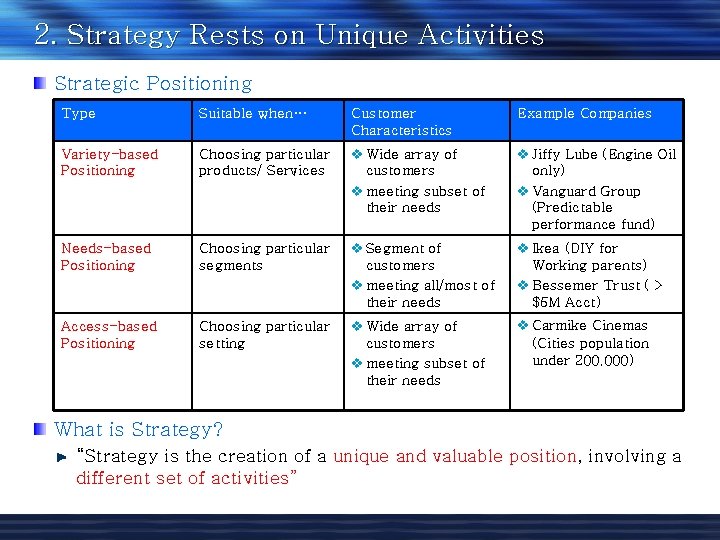
2. Strategy Rests on Unique Activities Strategic Positioning Type Suitable when… Customer Characteristics Example Companies Variety-based Positioning Choosing particular products/ Services v Wide array of customers v meeting subset of their needs v Jiffy Lube (Engine Oil only) v Vanguard Group (Predictable performance fund) Needs-based Positioning Choosing particular segments v Segment of customers v meeting all/most of their needs v Ikea (DIY for Working parents) v Bessemer Trust ( > $5 M Acct) Access-based Positioning Choosing particular setting v Wide array of customers v meeting subset of their needs v Carmike Cinemas (Cities population under 200, 000) What is Strategy? “Strategy is the creation of a unique and valuable position, involving a different set of activities”
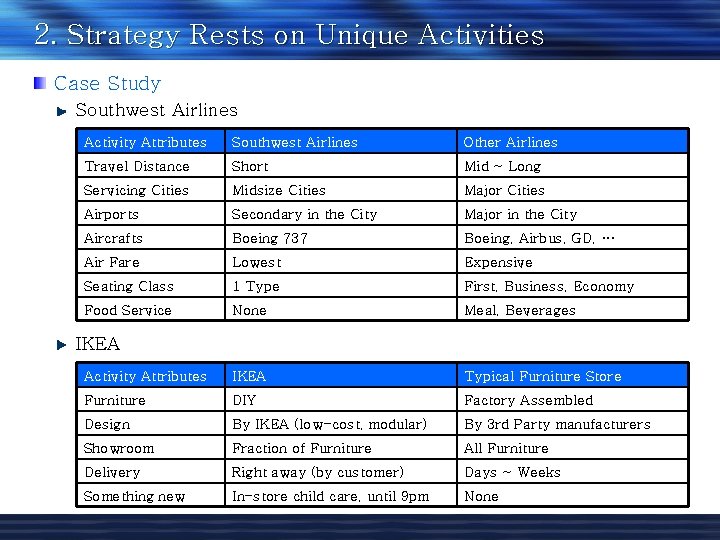
2. Strategy Rests on Unique Activities Case Study Southwest Airlines Activity Attributes Southwest Airlines Other Airlines Travel Distance Short Mid ~ Long Servicing Cities Midsize Cities Major Cities Airports Secondary in the City Major in the City Aircrafts Boeing 737 Boeing, Airbus, GD, … Air Fare Lowest Expensive Seating Class 1 Type First, Business, Economy Food Service None Meal, Beverages Activity Attributes IKEA Typical Furniture Store Furniture DIY Factory Assembled Design By IKEA (low-cost, modular) By 3 rd Party manufacturers Showroom Fraction of Furniture All Furniture Delivery Right away (by customer) Days ~ Weeks Something new In-store child care, until 9 pm None IKEA
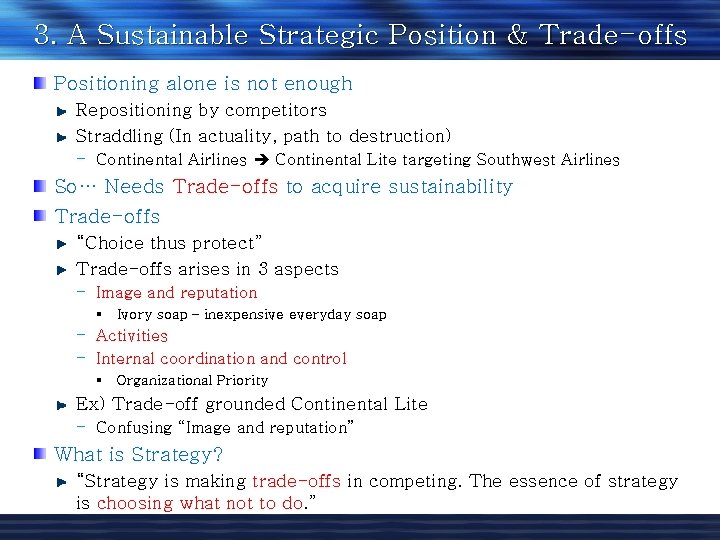
3. A Sustainable Strategic Position & Trade-offs Positioning alone is not enough Repositioning by competitors Straddling (In actuality, path to destruction) - Continental Airlines Continental Lite targeting Southwest Airlines So… Needs Trade-offs to acquire sustainability Trade-offs “Choice thus protect” Trade-offs arises in 3 aspects - Image and reputation § Ivory soap – inexpensive everyday soap - Activities - Internal coordination and control § Organizational Priority Ex) Trade-off grounded Continental Lite - Confusing “Image and reputation” What is Strategy? “Strategy is making trade-offs in competing. The essence of strategy is choosing what not to do. ”
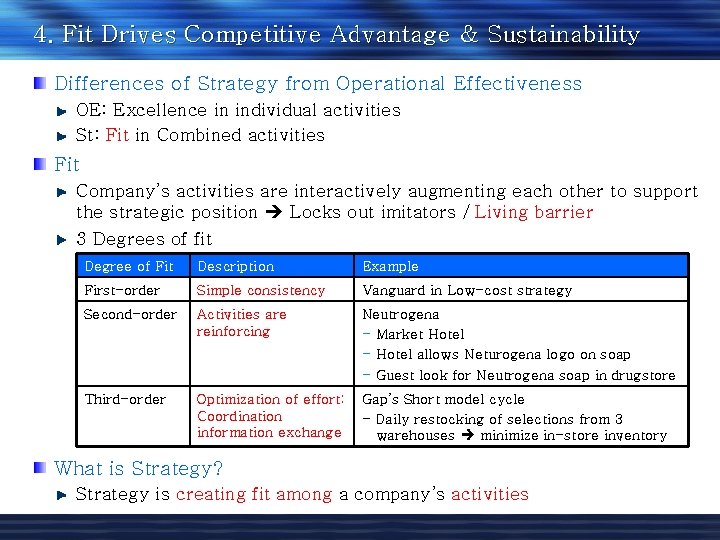
4. Fit Drives Competitive Advantage & Sustainability Differences of Strategy from Operational Effectiveness OE: Excellence in individual activities St: Fit in Combined activities Fit Company’s activities are interactively augmenting each other to support the strategic position Locks out imitators / Living barrier 3 Degrees of fit Degree of Fit Description Example First-order Simple consistency Vanguard in Low-cost strategy Second-order Activities are reinforcing Neutrogena - Market Hotel - Hotel allows Neturogena logo on soap - Guest look for Neutrogena soap in drugstore Third-order Optimization of effort: Coordination information exchange Gap’s Short model cycle - Daily restocking of selections from 3 warehouses minimize in-store inventory What is Strategy? Strategy is creating fit among a company’s activities
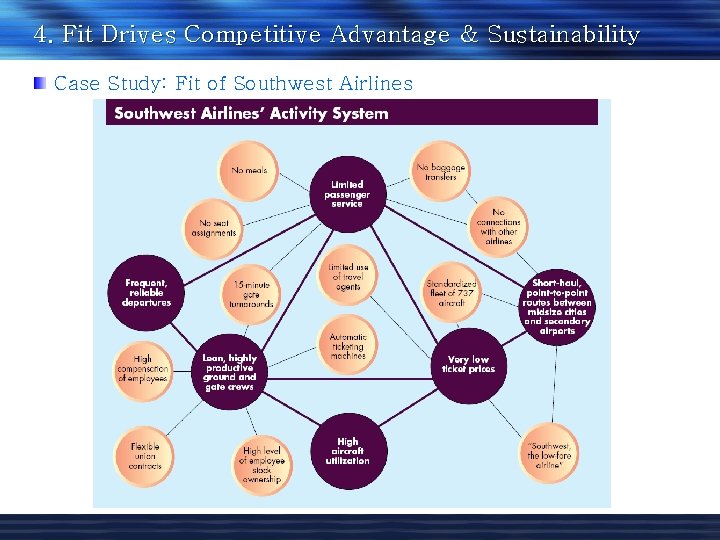
4. Fit Drives Competitive Advantage & Sustainability Case Study: Fit of Southwest Airlines
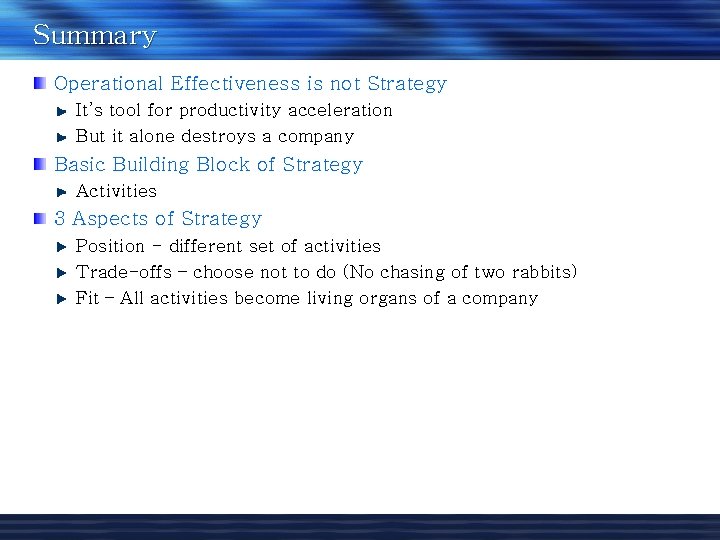
Summary Operational Effectiveness is not Strategy It’s tool for productivity acceleration But it alone destroys a company Basic Building Block of Strategy Activities 3 Aspects of Strategy Position - different set of activities Trade-offs – choose not to do (No chasing of two rabbits) Fit – All activities become living organs of a company
- Slides: 12