
WHAT IS SPRING Springs are elastic bodies generally
WHAT IS SPRING? • Springs are elastic bodies (generally metal) that can be twisted, pulled, or stretched by some external force. They can return to their original shape when the force is released. • Spring is a member which stores energy in form of mechanical energy. In other words it is also termed as a resilient member. • This stored energy can be regained with some losses known as hysteresis loss. 11/26/2020 V. S. Marwal, Reader, Deptt. of M. E. SKIT-Jaipur 1

CLASSIFICATION OF SPRINGS 1) Helical springs: a) Tension helical spring b) Compression helical spring c) Torsion spring d) Spiral spring • 2) Leaf springs 11/26/2020 V. S. Marwal, Reader, Deptt. of M. E. SKIT-Jaipur 2
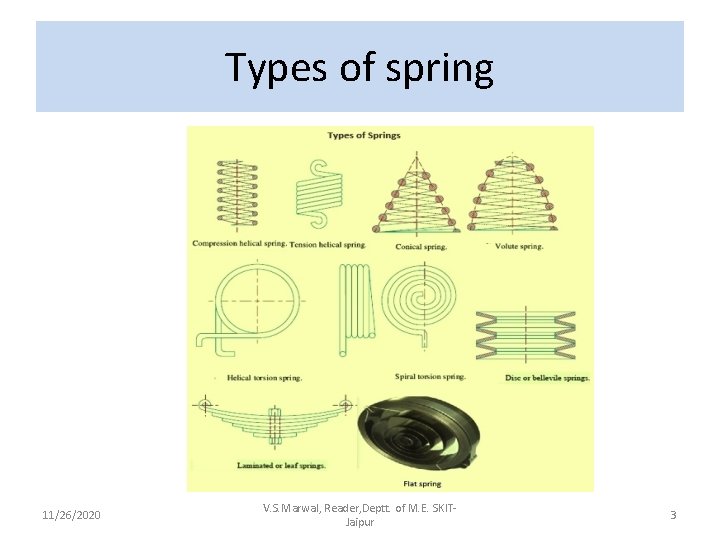
Types of spring 11/26/2020 V. S. Marwal, Reader, Deptt. of M. E. SKITJaipur 3

HELICAL SPRING CLASSIFICATION 1) Open coil helical spring 2) Closed coil helical spring 3) Torsion spring 4) Spiral spring 11/26/2020 V. S. Marwal, Reader, Deptt. of M. E. SKIT-Jaipur 4
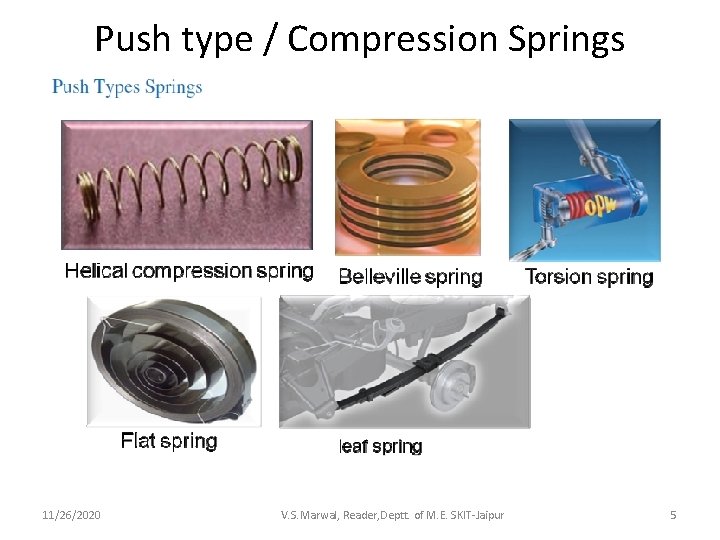
Push type / Compression Springs 11/26/2020 V. S. Marwal, Reader, Deptt. of M. E. SKIT-Jaipur 5
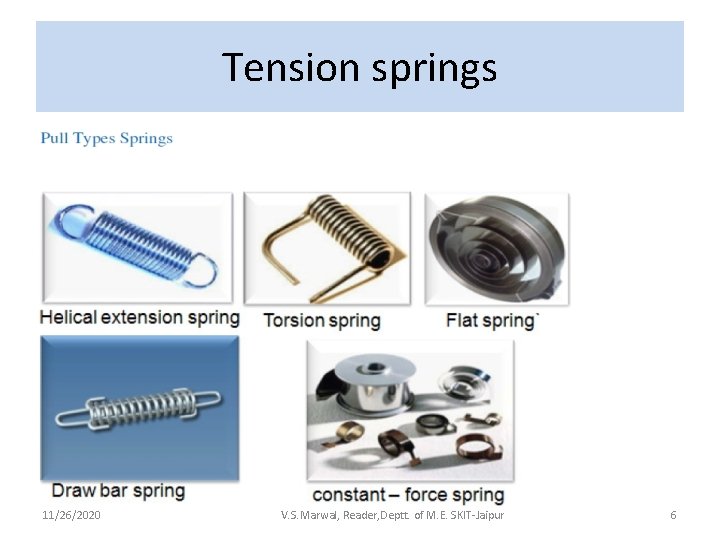
Tension springs 11/26/2020 V. S. Marwal, Reader, Deptt. of M. E. SKIT-Jaipur 6
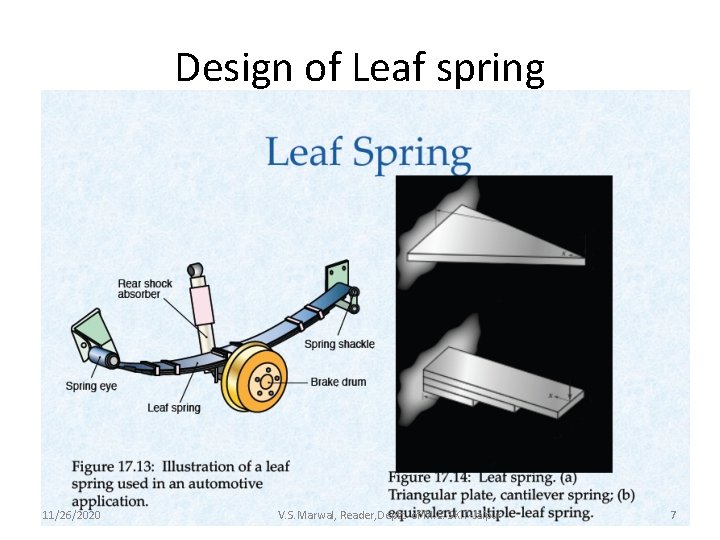
Design of Leaf spring 11/26/2020 V. S. Marwal, Reader, Deptt. of M. E. SKIT-Jaipur 7
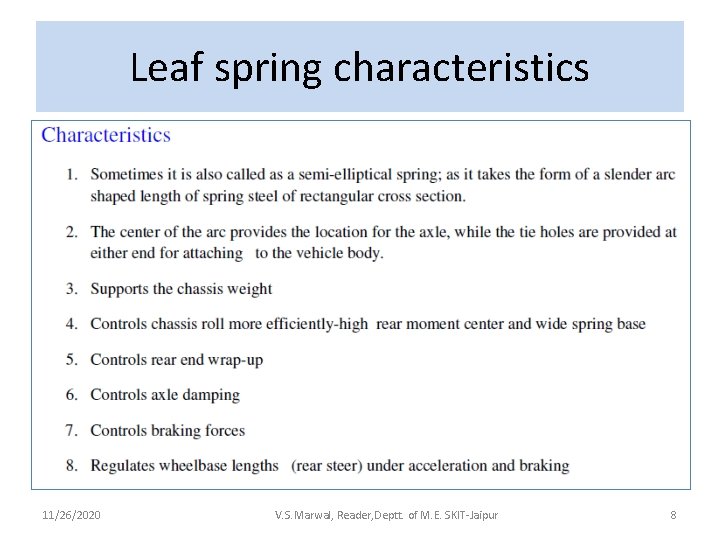
Leaf spring characteristics 11/26/2020 V. S. Marwal, Reader, Deptt. of M. E. SKIT-Jaipur 8
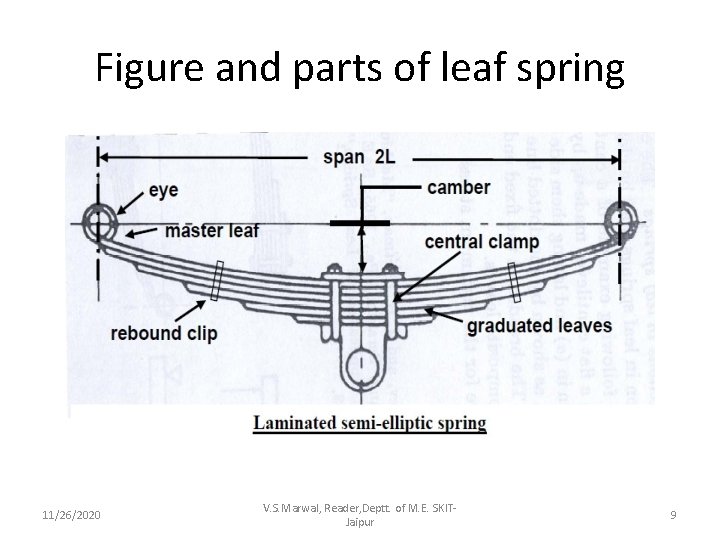
Figure and parts of leaf spring 11/26/2020 V. S. Marwal, Reader, Deptt. of M. E. SKITJaipur 9
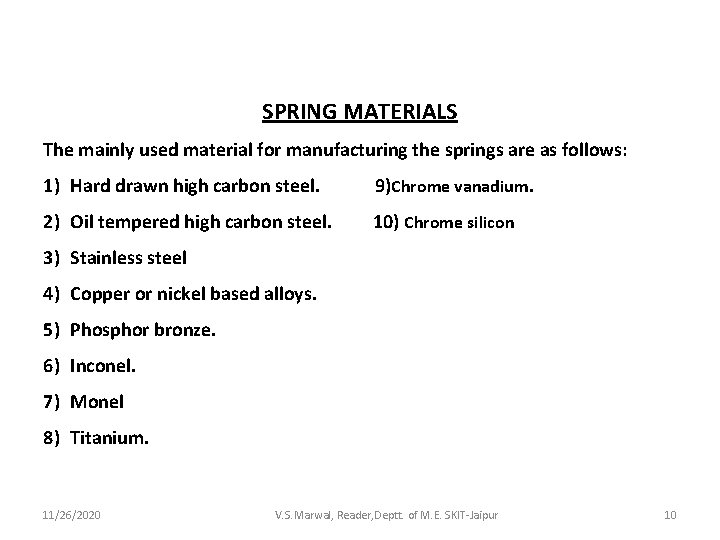
SPRING MATERIALS The mainly used material for manufacturing the springs are as follows: 1) Hard drawn high carbon steel. 9)Chrome vanadium. 2) Oil tempered high carbon steel. 10) Chrome silicon 3) Stainless steel 4) Copper or nickel based alloys. 5) Phosphor bronze. 6) Inconel. 7) Monel 8) Titanium. 11/26/2020 V. S. Marwal, Reader, Deptt. of M. E. SKIT-Jaipur 10
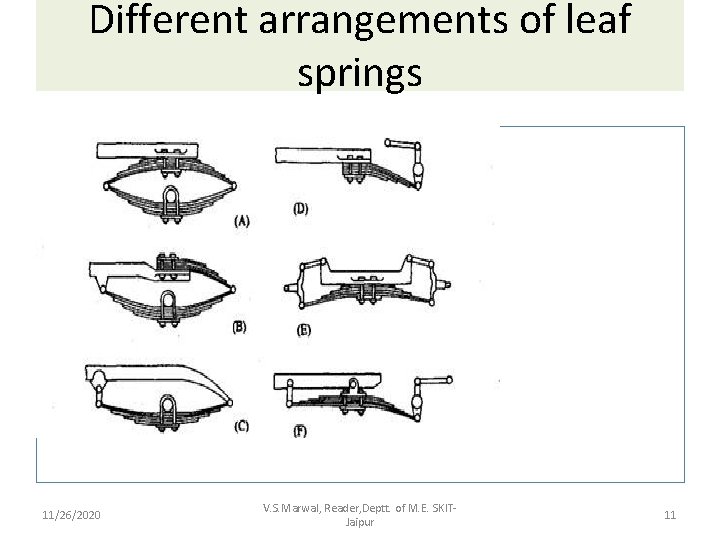
Different arrangements of leaf springs 11/26/2020 V. S. Marwal, Reader, Deptt. of M. E. SKITJaipur 11

LEAF SPRINGS Leaf springs are constructed of one or more strips of long, narrow spring steel. These metal strips, called leaves, are assembled with plastic or synthetic rubber insulators between the leaves, allowing freedom of movement during spring operation. 11/26/2020 V. S. Marwal, Reader, Deptt. of M. E. SKIT-Jaipur 12
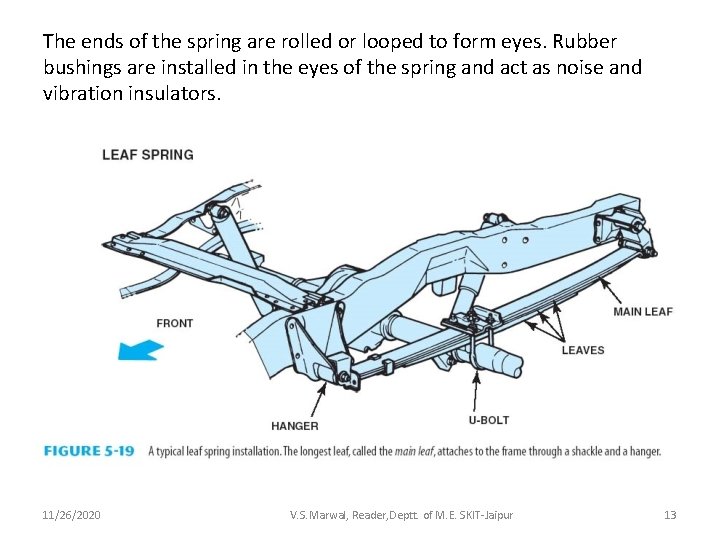
The ends of the spring are rolled or looped to form eyes. Rubber bushings are installed in the eyes of the spring and act as noise and vibration insulators. 11/26/2020 V. S. Marwal, Reader, Deptt. of M. E. SKIT-Jaipur 13
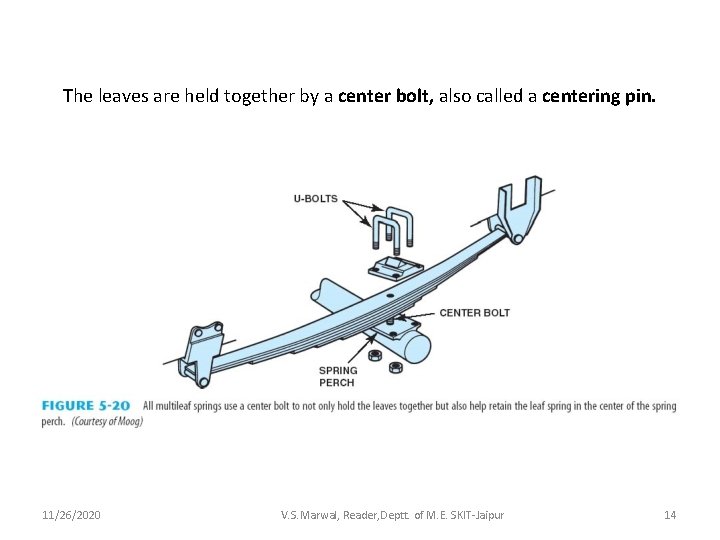
The leaves are held together by a center bolt, also called a centering pin. 11/26/2020 V. S. Marwal, Reader, Deptt. of M. E. SKIT-Jaipur 14
11/26/2020 V. S. Marwal, Reader, Deptt. of M. E. SKITJaipur 15
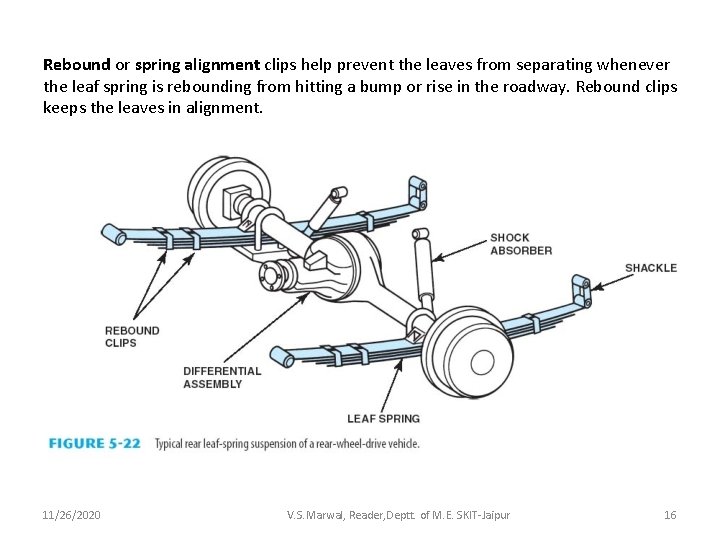
Rebound or spring alignment clips help prevent the leaves from separating whenever the leaf spring is rebounding from hitting a bump or rise in the roadway. Rebound clips keeps the leaves in alignment. 11/26/2020 V. S. Marwal, Reader, Deptt. of M. E. SKIT-Jaipur 16
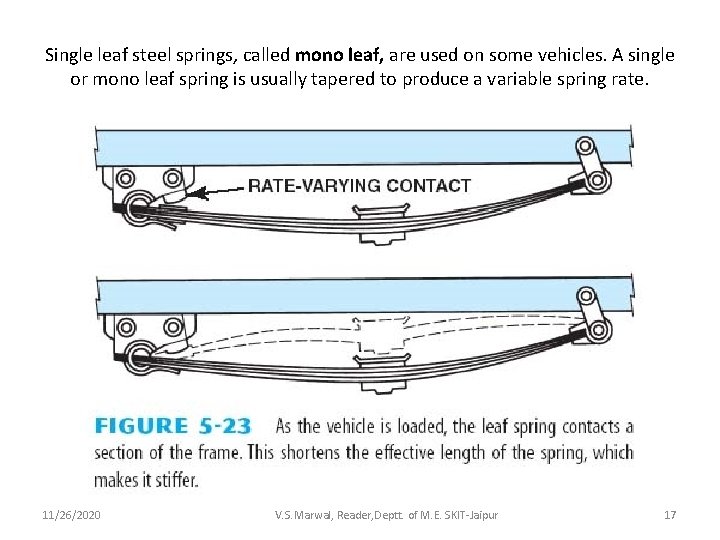
Single leaf steel springs, called mono leaf, are used on some vehicles. A single or mono leaf spring is usually tapered to produce a variable spring rate. 11/26/2020 V. S. Marwal, Reader, Deptt. of M. E. SKIT-Jaipur 17
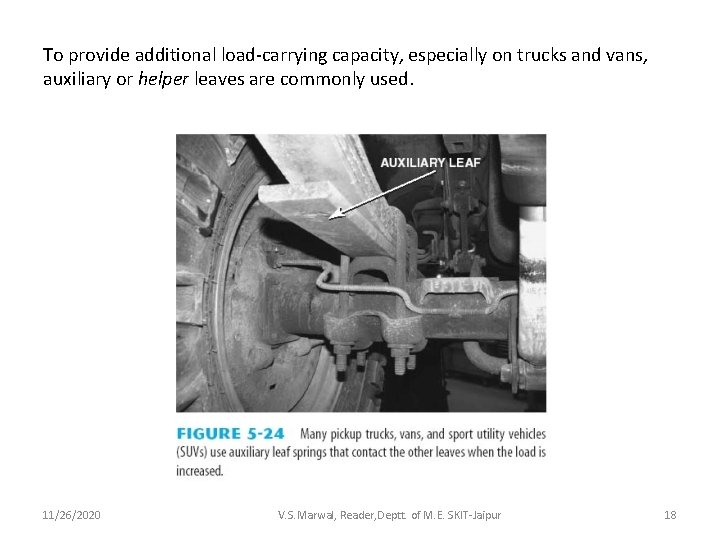
To provide additional load-carrying capacity, especially on trucks and vans, auxiliary or helper leaves are commonly used. 11/26/2020 V. S. Marwal, Reader, Deptt. of M. E. SKIT-Jaipur 18
Composite Leaf Springs • Fiberglass-reinforced epoxy plastic leaf springs have been used on production vehicles. Using 70% fiberglass with 30% epoxy composite. 11/26/2020 V. S. Marwal, Reader, Deptt. of M. E. SKIT-Jaipur 19

Composite Springs 11/26/2020 V. S. Marwal, Reader, Deptt. of M. E. SKIT-Jaipur 20
ANALYSIS OF LEAF SPRINGS • • LEAF SPRING AS CANTILEVER A) UNIFORM WIDTH LEAF B) UNIFORMLY VARYING WIDTH LEAF C) GRADUATED LEAF SPRING AS SIMPLY SUPPORTED A) UNIFORM WIDTH LEAF B) UNIFORMLY VARYING WIDTH LEAF C) GRADUATED LEAF 11/26/2020 V. S. Marwal, Reader, Deptt. of M. E. SKIT-Jaipur 21
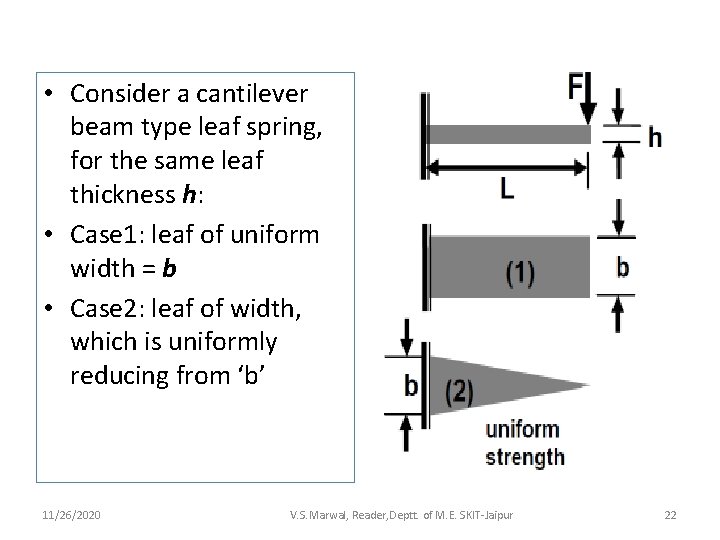
• Consider a cantilever beam type leaf spring, for the same leaf thickness h: • Case 1: leaf of uniform width = b • Case 2: leaf of width, which is uniformly reducing from ‘b’ 11/26/2020 V. S. Marwal, Reader, Deptt. of M. E. SKIT-Jaipur 22
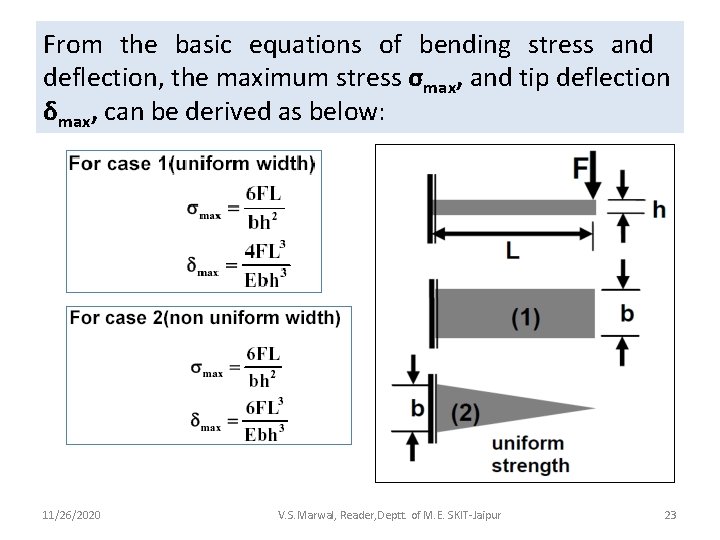
From the basic equations of bending stress and deflection, the maximum stress σmax, and tip deflection δmax, can be derived as below: 11/26/2020 V. S. Marwal, Reader, Deptt. of M. E. SKIT-Jaipur 23
Results of study: • It is observed that instead of uniform width leaf, if a leaf of varying width is used, the bending stress at any cross section is same and equal to maximum stress σmax. • This is called as leaf of a uniform strength. 11/26/2020 • Moreover, the tip deflection being more, comparatively it has greater resilience than its uniform width counterpart. [i. e. stores more energy] V. S. Marwal, Reader, Deptt. of M. E. SKIT-Jaipur 24
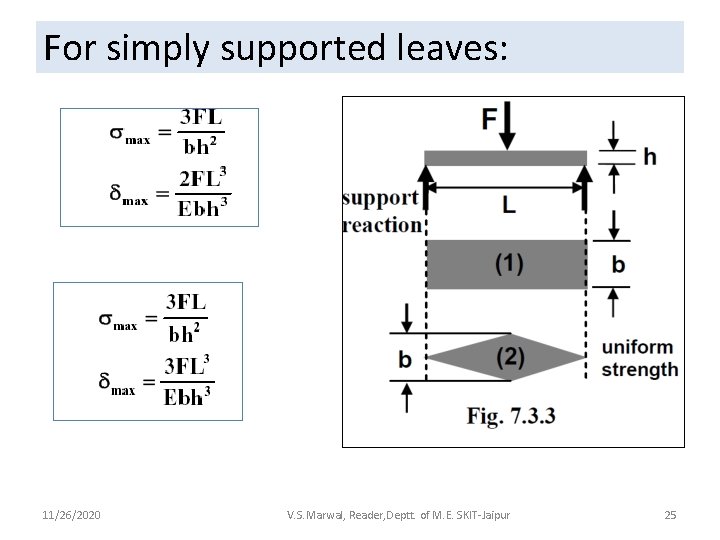
For simply supported leaves: 11/26/2020 V. S. Marwal, Reader, Deptt. of M. E. SKIT-Jaipur 25
Applications of leaf springs • One of the applications of leaf spring of simply supported beam type is seen in automobiles, where, the central location of the spring is fixed to the wheel axle. • The wheel exerts the force F on the spring and support reactions at the two ends of the spring come from the carriage. 11/26/2020 V. S. Marwal, Reader, Deptt. of M. E. SKIT-Jaipur 26
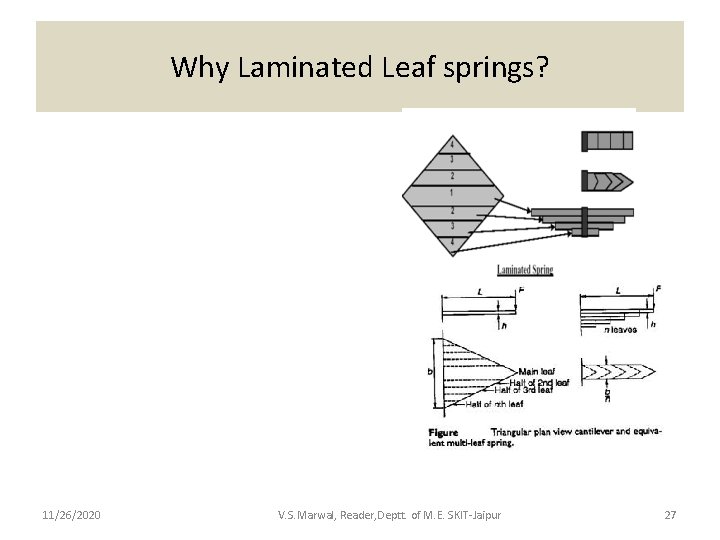
Why Laminated Leaf springs? 11/26/2020 V. S. Marwal, Reader, Deptt. of M. E. SKIT-Jaipur 27

Laminated leaf • Here width of each strip, b’ or b. N is given as ===========> • The stress and deflection equations for a laminated spring is given by: 11/26/2020 V. S. Marwal, Reader, Deptt. of M. E. SKIT-Jaipur 28
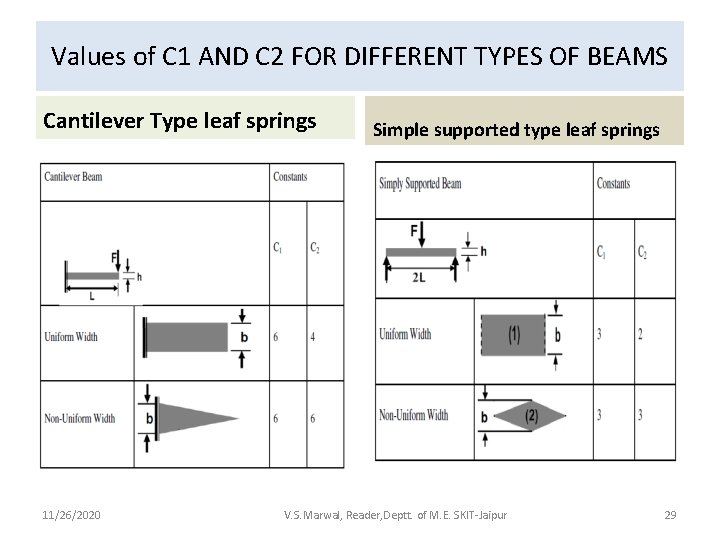
Values of C 1 AND C 2 FOR DIFFERENT TYPES OF BEAMS Cantilever Type leaf springs 11/26/2020 Simple supported type leaf springs V. S. Marwal, Reader, Deptt. of M. E. SKIT-Jaipur 29

Laminated semi-elliptic spring 11/26/2020 V. S. Marwal, Reader, Deptt. of M. E. SKIT-Jaipur 30
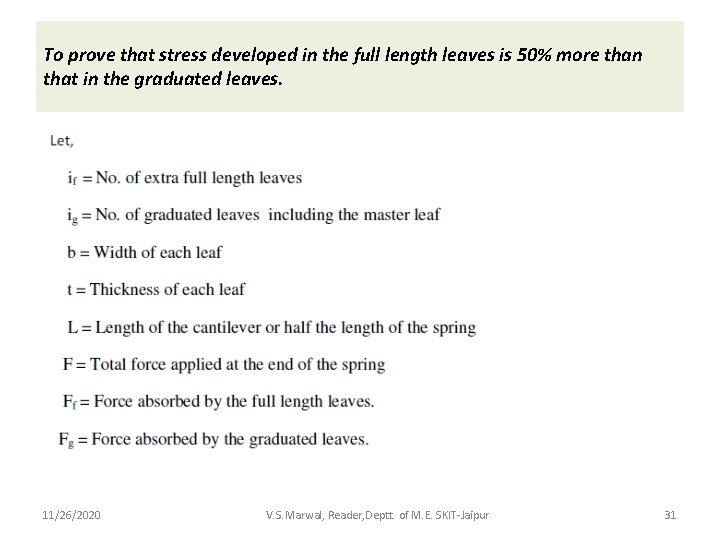
To prove that stress developed in the full length leaves is 50% more than that in the graduated leaves. 11/26/2020 V. S. Marwal, Reader, Deptt. of M. E. SKIT-Jaipur 31
Use of Full length leaves • Two or more Full length leaves are provides just below master leaf to take extra transverse shear loads. • Full length leaves have greater ability to take shear stress during bending. 11/26/2020 V. S. Marwal, Reader, Deptt. of M. E. SKITJaipur 32
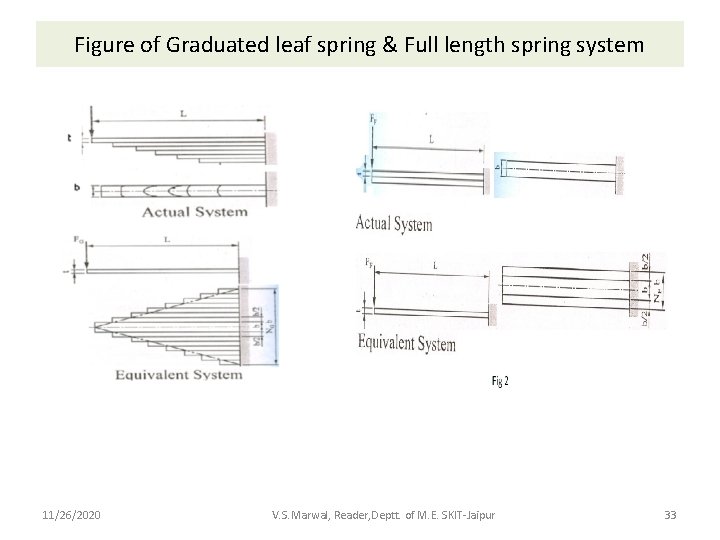
Figure of Graduated leaf spring & Full length spring system 11/26/2020 V. S. Marwal, Reader, Deptt. of M. E. SKIT-Jaipur 33
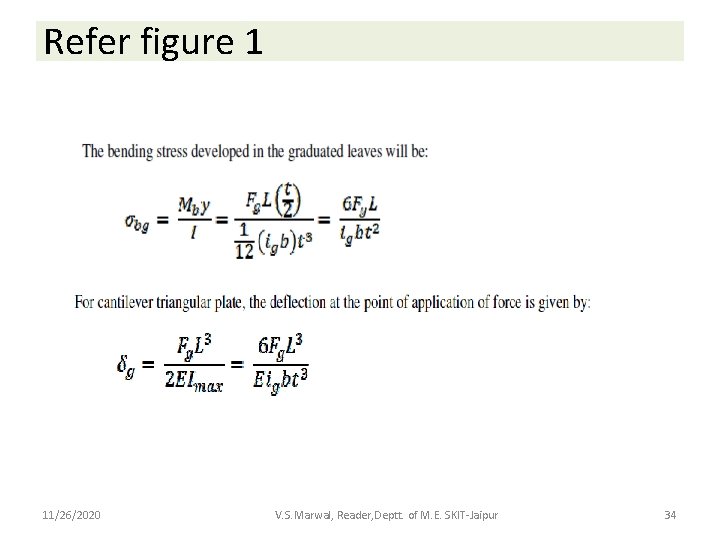
Refer figure 1 11/26/2020 V. S. Marwal, Reader, Deptt. of M. E. SKIT-Jaipur 34

Refer figure 2 11/26/2020 V. S. Marwal, Reader, Deptt. of M. E. SKIT-Jaipur 35
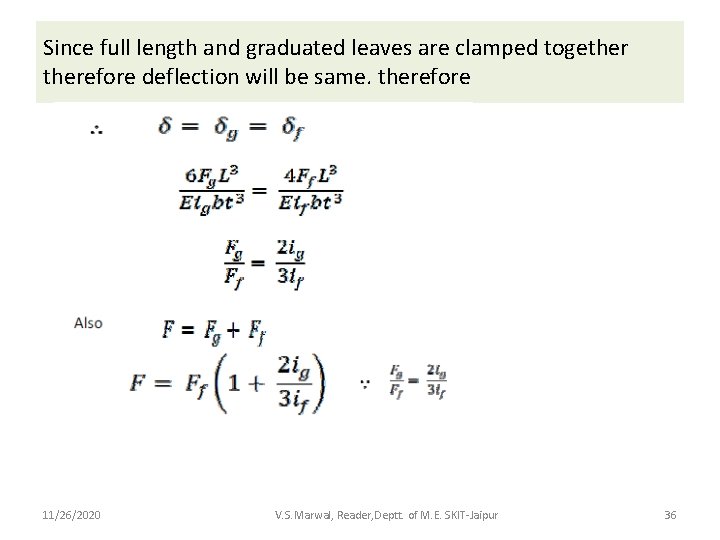
Since full length and graduated leaves are clamped togetherefore deflection will be same. therefore 11/26/2020 V. S. Marwal, Reader, Deptt. of M. E. SKIT-Jaipur 36

Solving further we get: 11/26/2020 V. S. Marwal, Reader, Deptt. of M. E. SKIT-Jaipur 37
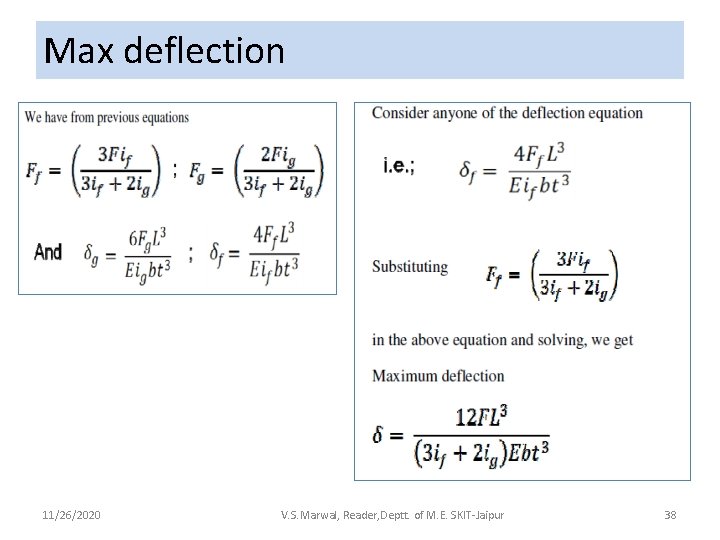
Max deflection 11/26/2020 V. S. Marwal, Reader, Deptt. of M. E. SKIT-Jaipur 38
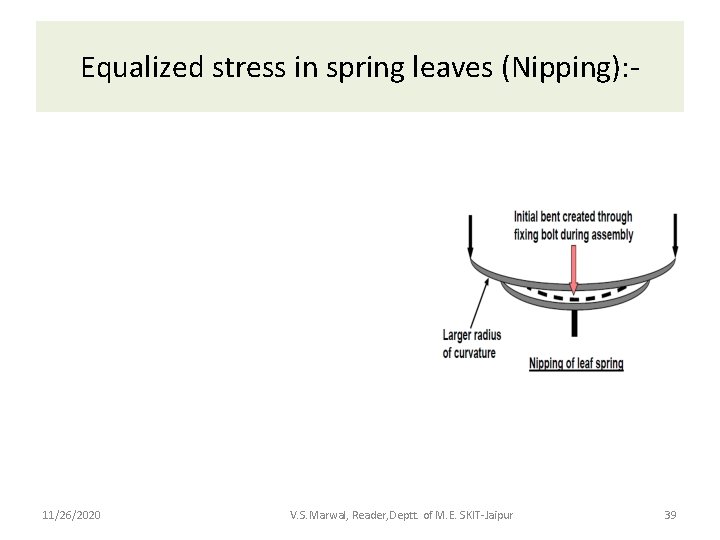
Equalized stress in spring leaves (Nipping): - 11/26/2020 V. S. Marwal, Reader, Deptt. of M. E. SKIT-Jaipur 39

Nipping contd. . • The nip eliminated by tightening of the center bolt due to these pre-stresses is induced in the leaves. This method of pre -stressing by giving different radii of curvature is called as nipping. • By giving a greater radius of curvature to the full length leaves than graduated leaves before the leaves are assembled to form a spring. • Nip: C The value of the INITIAL GAP or Nip C is nothing but the difference in deflection between the full length and the graduated leaves 11/26/2020 V. S. Marwal, Reader, Deptt. of M. E. SKIT-Jaipur 40
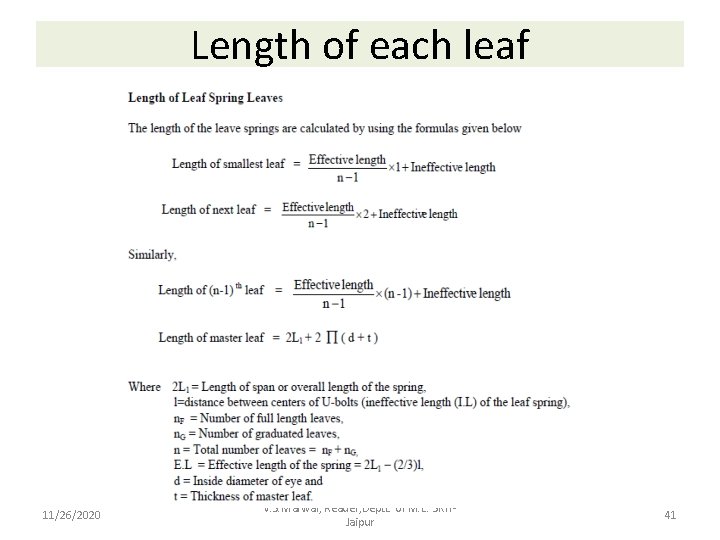
Length of each leaf 11/26/2020 V. S. Marwal, Reader, Deptt. of M. E. SKITJaipur 41
Problem 1. Determine the width and thickness of a flat spring carrying a central load of 5000 N. The deflection is limited to 100 mm. The spring is supported at both ends at a distance of 800 mm. The allowable stress is 300 N/mm 2 and modulus of elasticity 221 GPa. The spring is of constant thickness and varying width. 11/26/2020 V. S. Marwal, Reader, Deptt. of M. E. SKIT-Jaipur 42
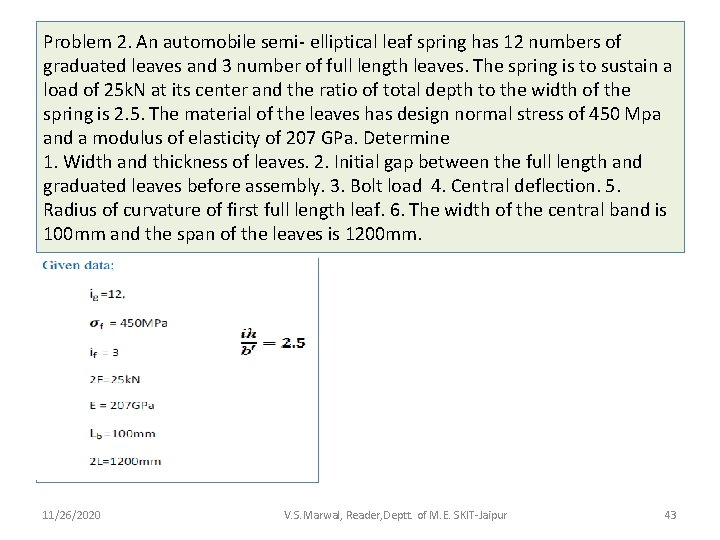
Problem 2. An automobile semi- elliptical leaf spring has 12 numbers of graduated leaves and 3 number of full length leaves. The spring is to sustain a load of 25 k. N at its center and the ratio of total depth to the width of the spring is 2. 5. The material of the leaves has design normal stress of 450 Mpa and a modulus of elasticity of 207 GPa. Determine 1. Width and thickness of leaves. 2. Initial gap between the full length and graduated leaves before assembly. 3. Bolt load 4. Central deflection. 5. Radius of curvature of first full length leaf. 6. The width of the central band is 100 mm and the span of the leaves is 1200 mm. • 11/26/2020 V. S. Marwal, Reader, Deptt. of M. E. SKIT-Jaipur 43
BIBLIOGRAPHY 1) www. webs 1. vidaho. edu 2) www. springer. com 3) www. indialeaf. com 4) www. engineersedge. com/spring_terms. html 5) www. sprind. com/springterm. html 6) http: //nptel. iitm. ac. in 7) www. instructables. com 8) www. tpub. com/content/engine/4037/css/14037_77. html 9) www. physicsbrown. edu 10) www. csun. edu 11) Design of machine elements by Bhandari V. B. TMGH 12) Machine Design – Khurmi – S. Chand 13. Automobile Engineering – Joshep Hetner – East West Publisher 11/26/2020 V. S. Marwal, Reader, Deptt. of M. E. SKIT-Jaipur 44
- Slides: 44