
WHAT IS SOLAR WIND AND HOW DOES IT
- Slides: 8
WHAT IS SOLAR WIND AND HOW DOES IT AFFECT THE EARTH? By Annabell
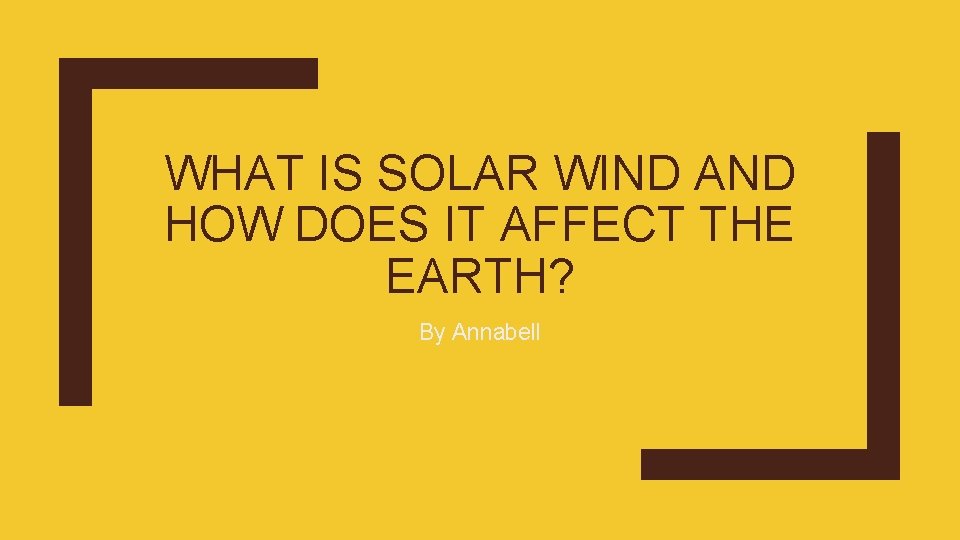
How is Solar Wind made? First off before we can understand what solar wind is we must first how and what it is made of. It is created within the suns core by photons as they reach the surface photons heat up the outer layers of the sun. Which then sends it hurtling around the sun, this causes very intense turbulence and shock waves. The gasses create giant magnetic loops, they can become so large that the earth could fit through with thousands of mile to spare. They blast a stream of electrical particles deep into space also known as Solar Wind.
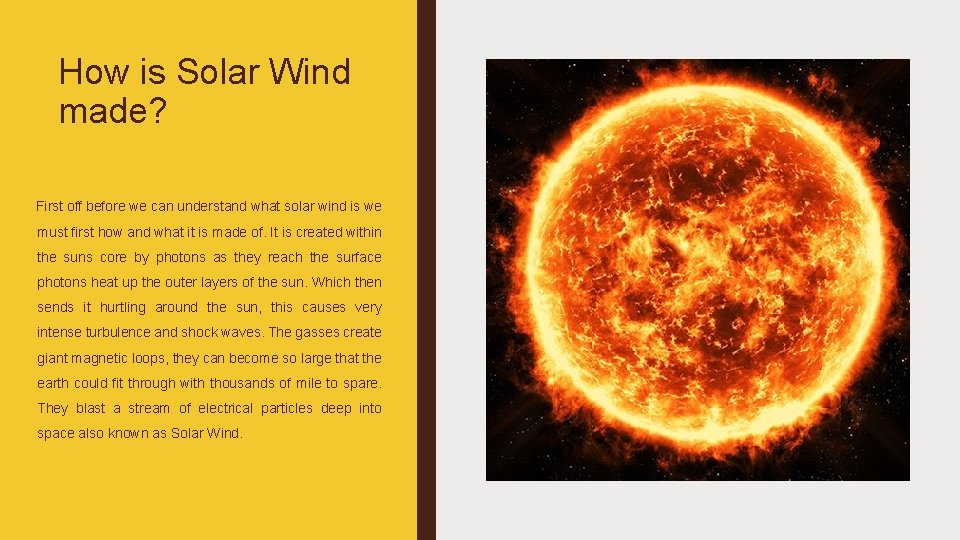
What is Solar Wind? Solar wind is created by streams of electrically charged particles that are constantly flowing out from the sun in all directions. It takes less than 10 days for the particles to make the journey from the earth to the sun. Eventually when the wind reaches the earth and turn into a storm it interacts with the earths magnetic fields to create the aurora-borealis (aka northern lights).
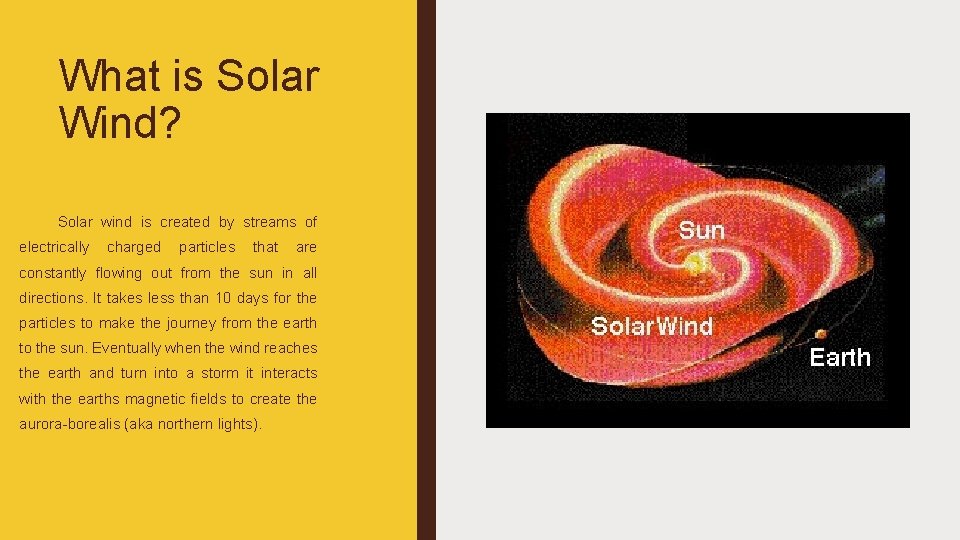
Why does the interaction of the solar wind and the magnetic field cause lights in the sky? After learning that it is the interaction of the solar wind and earths magnetic field was the cause of the beautiful phenomenon known as the northern lights I had a follow up question: What causes the light from this interaction? I learned that when the charged particles known as solar wind react with the atom and molecules in the earth’s atmosphere. Once the atoms and molecules have been struck by the solar wind the atoms become excited. The atoms being excited causes them to light up.
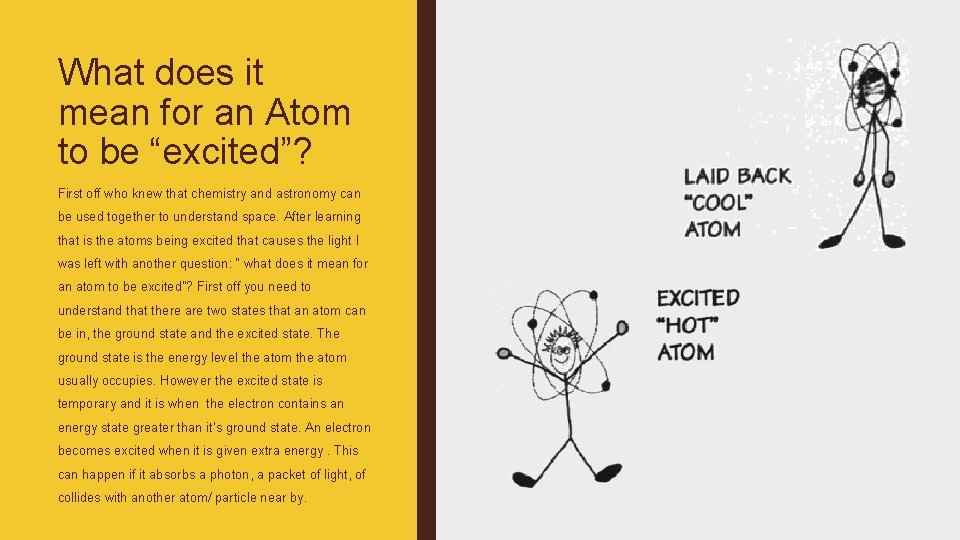
What does it mean for an Atom to be “excited”? First off who knew that chemistry and astronomy can be used together to understand space. After learning that is the atoms being excited that causes the light I was left with another question: “ what does it mean for an atom to be excited”? First off you need to understand that there are two states that an atom can be in, the ground state and the excited state. The ground state is the energy level the atom usually occupies. However the excited state is temporary and it is when the electron contains an energy state greater than it’s ground state. An electron becomes excited when it is given extra energy. This can happen if it absorbs a photon, a packet of light, of collides with another atom/ particle near by.
Are there any negative affects of Solar winds? Besides helping to create the beautiful lights that make the northern light so beautiful I had to wonder: Are there any negative affects of Solar winds? Luckily watching the northern lights is not harmful but the but up in space is where the negative effects take place. First off they can distort or even destroy the functioning of communication satellite. Astronauts can suffer serious radiation related health conditions if they are caught in any paths of solar winds. The tradition cause damage to chromosomes and cancer.
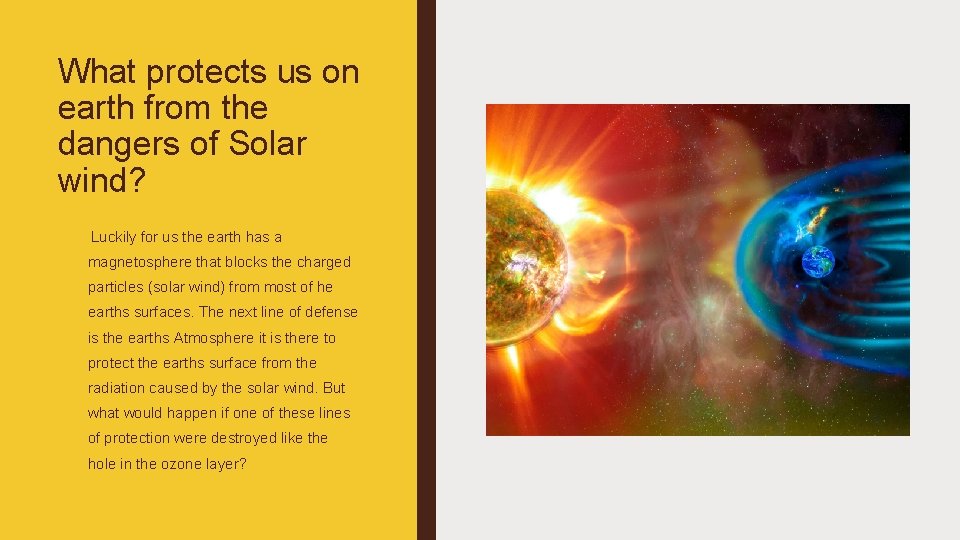
What protects us on earth from the dangers of Solar wind? Luckily for us the earth has a magnetosphere that blocks the charged particles (solar wind) from most of he earths surfaces. The next line of defense is the earths Atmosphere it is there to protect the earths surface from the radiation caused by the solar wind. But what would happen if one of these lines of protection were destroyed like the hole in the ozone layer?
Conclusion As I did more research I was left with so many more questions. It felt with every new discovery I ended up having so many more questions. For example before doing this project I had no ide what caused the beautiful phenomenon known as the northern lights. This project and question gave me so much insight and made me start thinking about the hole in the ozone layer. For example will pollution one day destroy the magnetosphere and if the destroying of the ozone layers makes the earth more vulnerable to the dangerous radiation that comes from the solar winds. To answer the rest of my questions there s a lot more research that needs to be done but for now what I have discovered has been plenty.