
What is Sociology Chapter 1 Introduction to Sociology




- Slides: 30
What is Sociology Chapter 1
Introduction to Sociology • Sociological Perspective • Sociology is the systematic study of human society. • Sociology teaches that social world guides out life choices in much the same way as the seasons influence our choice of clothing. Sociological Perspective is seeing the general in the particular (Berger, 1963) looking for general patterns in the behavior of particular people. Society shapes particular life experiences depending on the category we belong to: gender, education, age, rich, poor, race and the particular society you are in at the time.
Seeing Society in Everyday Life • “ You fit all the right categories, which means you would make a wonderful spouse!” Society influences our everyday choices: food, clothing, music, jobs, selection of mate, number of children. Society shapes individual lives best seen in situations of marginalization and crisis being minority racial minority, women, elderly, disabled, LGBTQ or different.
Applying Sociological Perspective 1. Sociology provides guidelines for laws and policies 1. Recial desegregation 2. Laws regulating divorce (obligation to provide support for woman raising children) 2. Applying Sociological Perspective is important for personal growth and critical thinking. 1. Common beliefs (are they really true) and research data encourages to ask questions: is it true, why we still hold on to common beliefs? 2. Seeing opportunities and constrains in our lives -- helps to see what is this game of life and how to play it. 3. The Sociological Perspective empowers us to be active participants in our society: private problem – being out of work -—turn into social issue –lack of good jobs. do we support society as it is or work to change it. 4. The Sociological Perspective helps us to live in a diverse world: is our way of life the only “right”, “natural”, “better”?
Origins of Sociology Changes in Europe in 18 th and 19 th century 1. New Industrial Economy: change in production system->factories, urban labor force change in traditional communal support system 2. Growth of cities: urban migration=>social problems: pollution, crime, homelessness, poverty 3. Political change: change in thinking from focus on moral duties to God and King to the pursuit of self-interest (T. Hobbes, 1588 -1679; John Locke, 1632 -1704; Adam Smith, 17231790). (Life, liberty and pursuit of happiness) 4. Awareness of Societ: factories, cities, individualism – growing awareness of surroudings – England, Germany, France – birthplace of the discipline of sociology
Science and Sociology • • Interest in the nature of the society: *Kung Fu-tzu 551 -479 China *Plato 427 -347 bce Greece *Aristotle 384 -322 bce Greece *Marcus Aurelius 121 -180 Roman Imperor *St. Thomas Aquinas 1225 -1274 *William Shakespeare 1564 -1616 *All of them wrote about the working of society, with the focus on the ideal society *Sociologists before the title existed.
Modern Sociology • Auguste Comte (1798 -1857) France created term sociology and saw it as a product of 3 stages of historical development: • 00— 1350 Early Middle ages: Theological stage: people adhered to the religious view that society expressed God’s will • 15 cent Renaissance: Metaphysical stage: people saw society as a natural rather then supernatural phenomenon. Hobbes: society reflects less perfection of God but the fallibility of selfish human nature. • Scientific Stage: Early science development (Copernicus 1543, Galileo 1642, Newton 1727) Comte– applying scientific approach to the study of society • Comte’s approach=POSITIVISM: a scientific approach to knowledge based on “positive: facts as opposed to mere speculations. • Comte: society operates according to specific laws like in physics or astronomy.
Sociological Theory • • THEORY: is a statement of how and why specific facts are related Purpose: explain social behavior in the real world Theoretical approach= a basic road map to guide our thinking and research In order to decide which theory to use ask 2 basic questions: • 1. What issues should we study? • 2. How should we connect the facts? Three major theoretical approaches: The Structural-Functional Approach The Social Conflict Appraoch The Symbolic-Interaction Approach
The Structural-Functional Approach • The Structural-Functional Approach = a framework for building theory that sees society as a complex system whose parts work together to promote solidarity and stability. • Focus on • social structure and relatively stable patterns of social behavior, • each structure has social function – the consequences of a social pattern for the operation of the society as a whole. • All social patterns (Handshake, rituals) function to tie people together and to keep society going in its present form – preserve society • Task • Identify different structures of society and investigate their functions • Robert Merton (1910 -2003, US): • Manifest Functions –recognized and intended consequences of any social pattern (school-education_ • Latent Functions- unrecognized, unitended consequencs of any social pattern (school-place to meet marriage partners, occupy nad keep out of labor market) • Social Dysfunction: any social pattern that may disrupt the operation of society (increasing inequality)
The Structural-Functional Approach • Limitations • By focusing on stability and unity, The Structural. Functionalism is not critical of inequalities based on social class, race, ethnicity, gender which cause tension and conflict.
The Social Conflict Approach • The Social Conflict Approach=a framework for building theory that sees society as an arena of inequality that generates conflict and change. • Focus • How factors as class, race, gender, age are linked to inequality in terms of money, power, education, social prestige. • How any social pattern benefits some people while hurting others. • On ongoing conflict between dominant and disadvantageous categories: rich to poor, men to women, white to people of color. . Those on top try to protect their privileges, while the disadvantaged try to gain more for themselves. • Apply this theory not only to understand society but also as an effort to reduce inequality
The Social Conflict Approach • Feminism and Gender Conflict • Study of society that focuses on inequality and conflict between men and women. • Feminism=support of social equality for women and men. • Raising awareness of many ways that society place men in the position of power over women (head of the household, at work – wage gap, and positions of power. • Raising awareness of importance of women in the development of sociology • Harriet Martineau (1802 -1876) – education for women, workers rights, antislavery. • JAne Adams (1860 -1935) – Hull House – assistance for immigrants, inequality, immigration, pursuit of peace, Nobel Prize 1931.
Race-Conflict Theory • Race-Conflict Theory Study of society that focuses on inequality and conflict between people of different racial and ethnic categories: social advantages -higher income, more schooling, better health, longer life expectancy. • Ida Wells Barnett (1862 -1931) – teacher, journalist, publisher: campaign for racial equality, to end lynching. • William E. B. Du Bois (1868 -1963) : “sociologist need not only to learn about societies problems but also try to solve them”! • Limitations/Critique: because of the focus on inequality, SC ignores how shared values and interdependence can unify members of the society. Can not be scientifically objective because it pursues political goals. • Contra argument: all sociological theories have political consequences.
The Symbolic-Interaction Approach • Previous theories share macro-level orientation: a broad focus on social structures that shape society as a whole – big picture – helicopter view • Micro-level orientation – a close up focus on social interaction in specific situations – street view (plays kids invent on the playground) • The Symbolic Interaction approach is a framework for building a theory that sees society as the product of the everyday interactions of individuals. • We create reality in our language—define , identify, shape our identities, experiences, behaviors and thoughts about others. • Roots: Max Weber (1864 -1920) German sociologist: understanding of a particular setting from the point of view of the people who are in it. • Peter Blau: social exchange analysis, the idea that interaction is guided by what each person stands to gain and lose from others (marriage: seek mates who offer at least as much in terms of attractiveness, intelligence, social background) • Limitation: overlooking the widespread influence of culture, class, gender, race.
Sociological Research • Positivist Sociology: study of society based on scientific, direct, systematic observation of social behavior – based on empirical evidence (we can verufy it with our senses). • 1. Differences between male and female are human nature. Not true: gender (what is masculine and feminine) is construct that is different in different times and cultures. • 2. People marry because they are in love. Not true: most societies practice arranged marriages.
Concepts, Variables, Measurements • Basic elements of science: • Concepts: mental construct that represents some part of the world in a simplified form, to label aspects of social life: “the family”, ” the economy”, “gender”, “social class”. • Variable: is a concept whose value changes from case to case. “hight” – different for each, Social cass: middle, upper, lower, working. • The use of variables depend on measurement: a procedure for determining the valu of variable in a specific case: how to measure social class? – looking at the clothing people wear, listening to how they speak, where they live, income, occupation, education.
Statistics • Using descriptive statistics to state what is “average” for a large population. Most commonly used statistics are the mean – average of all. Median – half way point Mode – score that happens the most often Reliability and Validity Correlation and Cause Reliability refers to consistency in measurement Validity – measuring exactly what you intend to measure. Can you measure religiosity by the attendance of the church? What about people who are spiritual but not religious?
Causal Relationships Correlation and Cause - Correlation means relationship finding out which variables change the other. Ideal is finding cause and effect – relationships in which change in one varable changes the other variable. It allows to predict how one pattern of behavior will produce another. There is not always cause and effect correlation between variables. To be sure of real cause and effect relationship make sure: 1. variables are correlated 2. independent variable occurs before the dependent variable 3. there is no evidence that a third variable has been overlooked, causing a spurious (false) correlation.
Ideal objectivity • Reality: total objectivity is impossible. • We can only strive for maximized objectivity. • Being aware of our values and biases, being open-minded
Interpretive Sociology • Humans are more complex than physical objects • WE attach meaning to actions – that can not be observed directly and easily measured. • Second research orientation: Interpretive sociology: the study of society that focuses on discovering the meanings people attach to their social world. (Max Weber: proper focus of sociology is interpretation or understanding of the meaning people create in their everyday lives: what people mean by what they do.
. • • Comparison: 1. POSITIVISTS-focus on What people do Interpretive Soc. – focus on the meaning of that action 2. Positivists: reality exsists out there – ca be measured • Interpretive Soc. : reality is subjective, meaning is constructed in everyday life • 3. Positivists: quantitative date • Interpretive soc: qualitative date – how people understand the world. • Summary: • Positivist- laboratory • Interpretive – natural setting
Critical Sociology • Created as a reaction to positivist approach on grounds of objectivity. • Developer of critical orientation, Karl Marx, rejected notion that society is “natural”, “fixed” and therefore status quo preserving system. • Critical sociology is a study of society that focuses on the need for social change. • Positivist research question: how much inequality is out there? • Critical research question: should we have this much inequality? • Should society exist in its present form? • Sociologists should be social activists in pursuit of greater social equality. • Researchers and their subjects use their findings to provide a voice for less powerful and to advance the political goal of a more equal society (Hess, 1999, Feagin, Hernan, 2001, Perucci, 2001)
Theory and Research • Positivist orientation is linked to the Structural –Functional Approach – understanding of the society as it is • The Interpretive orientation – linked to symbolic interaction approach – both focus on the meaning, understanding • Critical orientation is connected to the social –conflict approach because both are focused on the goal of reducing social inequality.
Gender and research • 1. Androcentricity – approaching issue form male perspective • 2. Overgeneralizing – data from only man conclusions about all • 3. Gender blindness – not seeing gender (most elderly men live with spouses, women – alone) • 4. Double standards • 5. Interference – subject reacts to the gender of the researcher (ex. no access to female researcher)
Research Ethics • • Be aware of harm to to subjects and communities. Informed consent - -responsibilities and risk Conflict of interest – funding Sensitivity to cultural diversity
Research Methods • Research Methods= a systematic plan for doing research • 4 common methods: • • Experiments Surveys Participant observation Interviews or Focus Groups
Survey • Survey=research method in which subjects respond to a series of statements or questions on a questionnaire or an interview. • Targets some population • Need to select sample • Specific plan for asking and recording questions.
In the field: Participant Observation • Participant Observation= research method in which investigators systematically observe people while joinig them in their daily activities. (nightclubs, religious seminaries) – fieldwork. • • Don’t start with specific hypothesis in mind Exploratory, descriptive Interpretive sociology, producing qualitative data. Try not to disturb natural setting • Limits and strength: researcher is immersed in lives of research participants-- can gain profound insights in the behaviors.
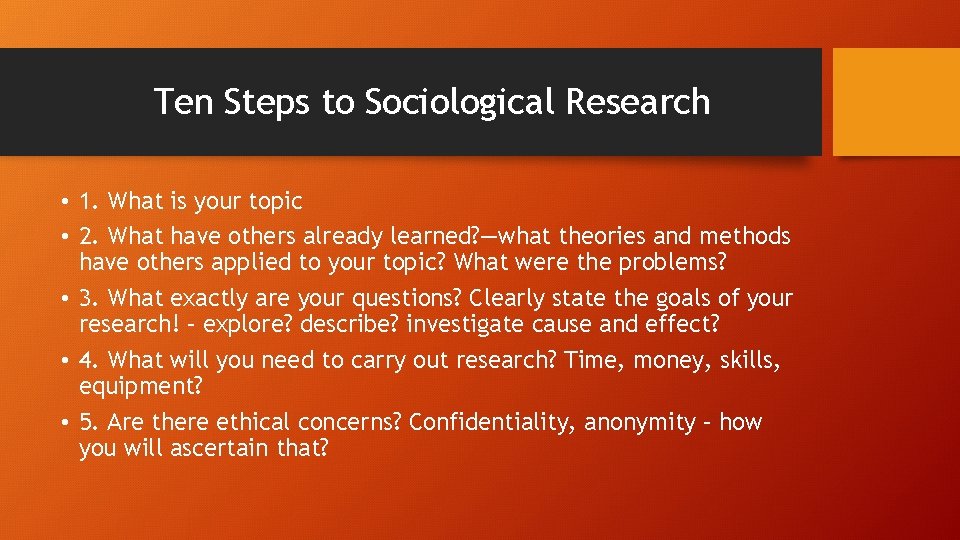
Ten Steps to Sociological Research • 1. What is your topic • 2. What have others already learned? —what theories and methods have others applied to your topic? What were the problems? • 3. What exactly are your questions? Clearly state the goals of your research! – explore? describe? investigate cause and effect? • 4. What will you need to carry out research? Time, money, skills, equipment? • 5. Are there ethical concerns? Confidentiality, anonymity – how you will ascertain that?
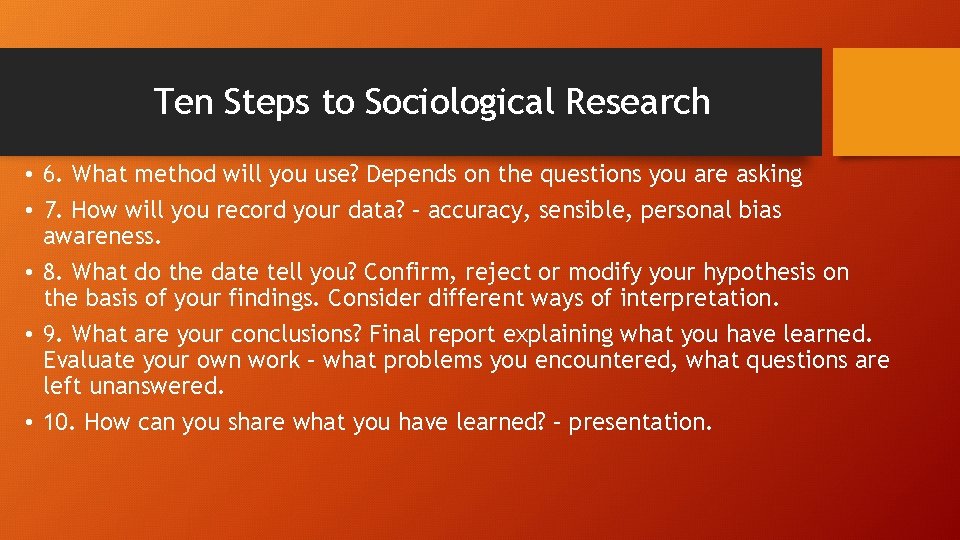
Ten Steps to Sociological Research • 6. What method will you use? Depends on the questions you are asking • 7. How will you record your data? – accuracy, sensible, personal bias awareness. • 8. What do the date tell you? Confirm, reject or modify your hypothesis on the basis of your findings. Consider different ways of interpretation. • 9. What are your conclusions? Final report explaining what you have learned. Evaluate your own work – what problems you encountered, what questions are left unanswered. • 10. How can you share what you have learned? – presentation.