
What is Science Section 1 1 What Science
- Slides: 41
What is Science? Section 1. 1
What Science Is and Is Not ► Science ► Organized way of using evidence to learn about the natural world
What Science Is and Is Not Cont’d ► Goal of Science: ► Investigate and understand the natural world ► Explain events ► Use explanations to make predictions that could be beneficial
Thinking Like A Scientist ► Step 1 ► Observation: ► Process of gathering info. about events or processes in a careful, orderly way
Thinking Like A Scientist Cont’d ► Step 2 ► Gathering info. from observations (data) ► 2 Types of Data ► 1. Quantitative: expressed as numbers ► 2. Qualitative: descriptive and involve characteristics that can’t easily be measured
Thinking Like A Scientist Cont’d ► Step 3 ► Make inferences based on data ► Inference ► Logical interpretation based on prior knowledge or experience
Thinking Like A Scientist Cont’d ► Step 4 ► Explain and interpret your evidence which leads to a… ► Hypothesis ► Proposed scientific explanation for a set of observations that can be tested
Hypothesis ► Must be proposed in a way that can be tested ► Tested by performing controlled experiments or by gathering new data
Explaining and Interpreting Evidence ► Do not copy ► Researchers often work in teams to analyze, review, and critique each other’s data and hypotheses. ► A review process helps ensure conclusions are valid. ► To be valid, a conclusion must be based on logical interpretation of reliable data.
What does science involve? 1. Asking questions 2. Observing 3. Making inferences 4. Testing hypotheses
Science as a Way of Knowing ► Scientific knowledge is always changing ► Good scientists are skeptics
Science and Human Values ► Decisions in science depend on: ► Society ► Economy ► Laws ► Moral principles ► We decide what and how things get done when we vote
Section 1 -2
The Scientific Method Section 1 -2 ► How do scientists test hypotheses? ► Controlled Experiments ► Must change only 1 variable at a time ► Why? ? ? ? ?
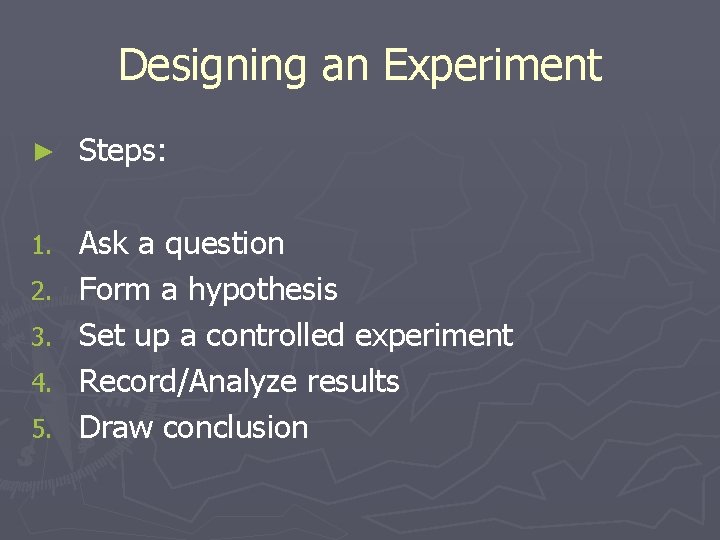
Designing an Experiment ► Steps: 1. Ask a question Form a hypothesis Set up a controlled experiment Record/Analyze results Draw conclusion 2. 3. 4. 5.
Designing an Experiment Cont’d ► Step 1: Asking a question ► Ex. ) ► How do organisms come into being?
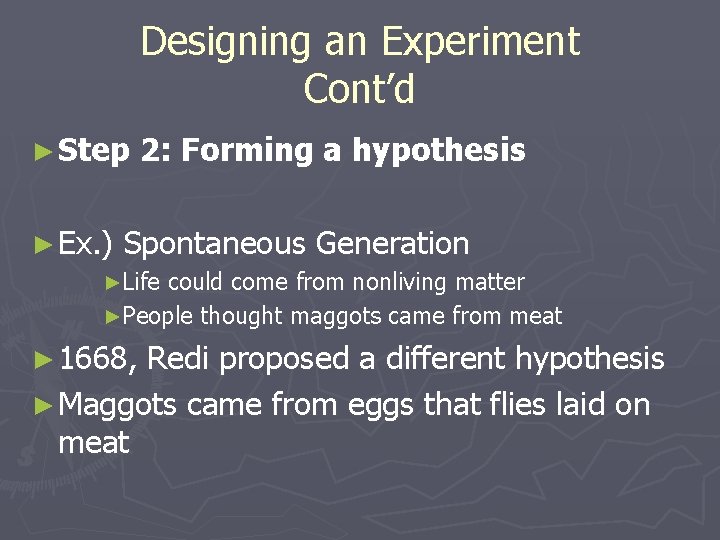
Designing an Experiment Cont’d ► Step 2: Forming a hypothesis ► Ex. ) Spontaneous Generation ►Life could come from nonliving matter ►People thought maggots came from meat ► 1668, Redi proposed a different hypothesis ► Maggots came from eggs that flies laid on meat
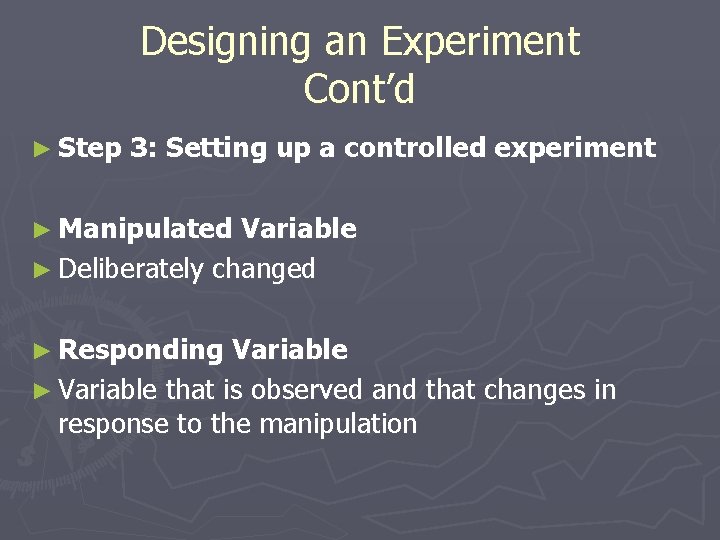
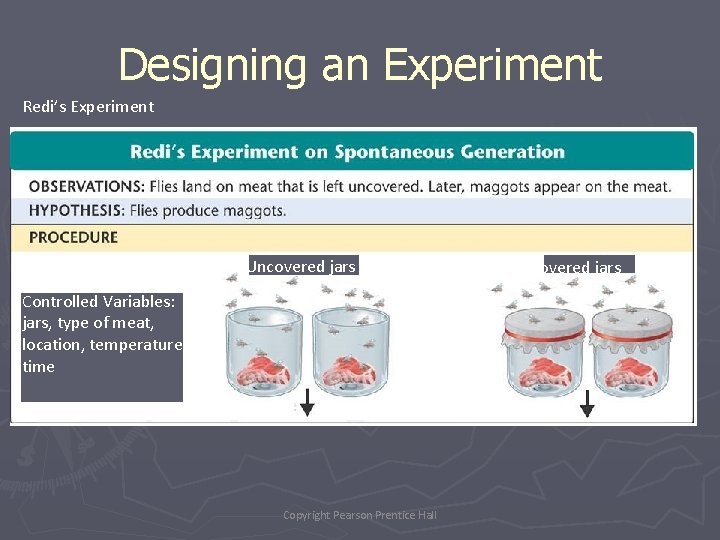
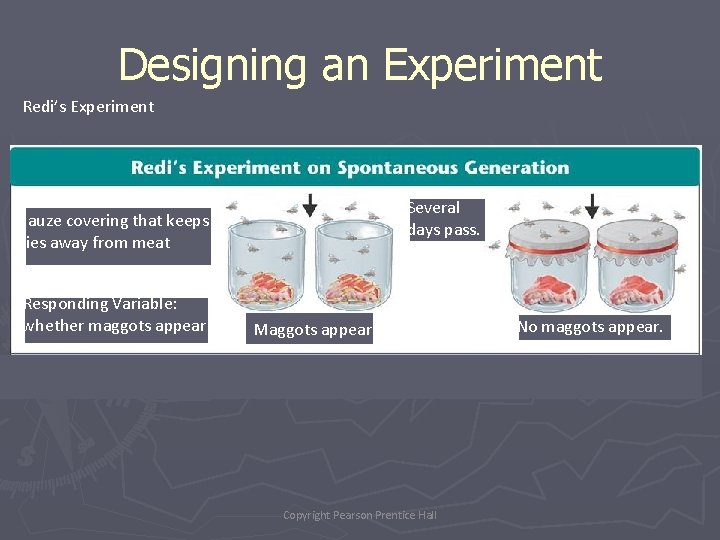
Designing an Experiment Cont’d ► Step 3: Setting up a controlled experiment ► Manipulated Variable ► Deliberately changed ► Responding Variable ► Variable that is observed and that changes in response to the manipulation
Designing an Experiment Redi’s Experiment Uncovered jars Controlled Variables: jars, type of meat, location, temperature, time Copyright Pearson Prentice Hall Covered jars
Designing an Experiment Redi’s Experiment Manipulated Variable: Gauze covering that keeps flies away from meat Responding Variable: whether maggots appear Several days pass. Maggots appear. Copyright Pearson Prentice Hall No maggots appear.
Designing an Experiment Cont’d ► Step 4: Recording and analyze results ► Use written records of observations/data ► Use drawings when needed ► Use computers to analyze data ► Store data online for others to view
Designing an Experiment Cont’d ► Step 5: Draw a conclusion ► Use data to evaluate hypothesis and draw a conclusion ► Ex. ) Redi’s results supported his hypothesis
Designing an Experiment Cont’d ► Finally Step 6: ► Investigations must be repeated ► Why? ? ► To make sure results are correct
Repeating Investigations ► Needham ► Challenged Redi’s results ► Said that spontaneous generation could occur when conditions were right
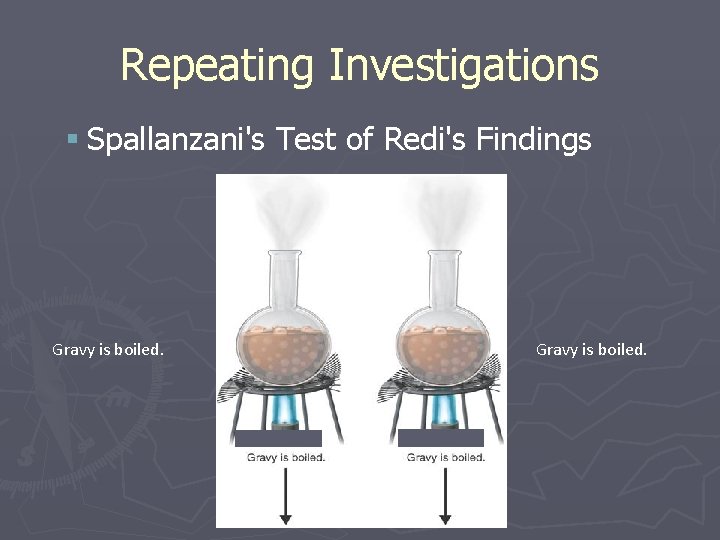
Repeating Investigations § Spallanzani's Test of Redi's Findings Gravy is boiled. Copyright Pearson Prentice Hall
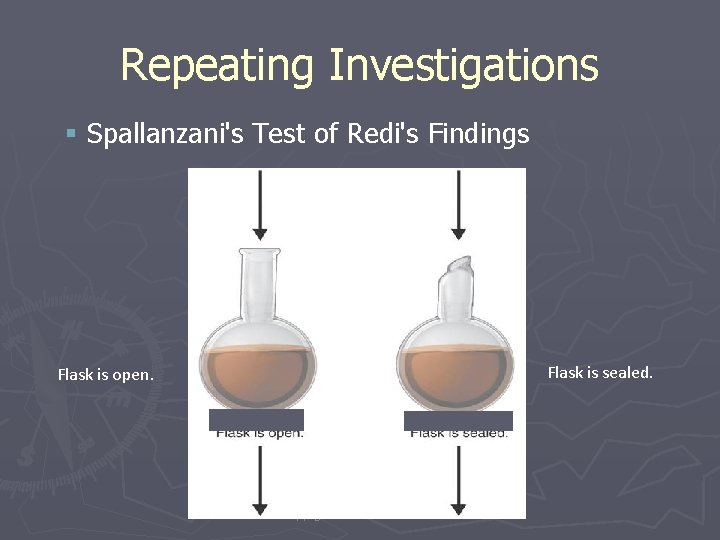
Repeating Investigations § Spallanzani's Test of Redi's Findings Flask is sealed. Flask is open. Copyright Pearson Prentice Hall
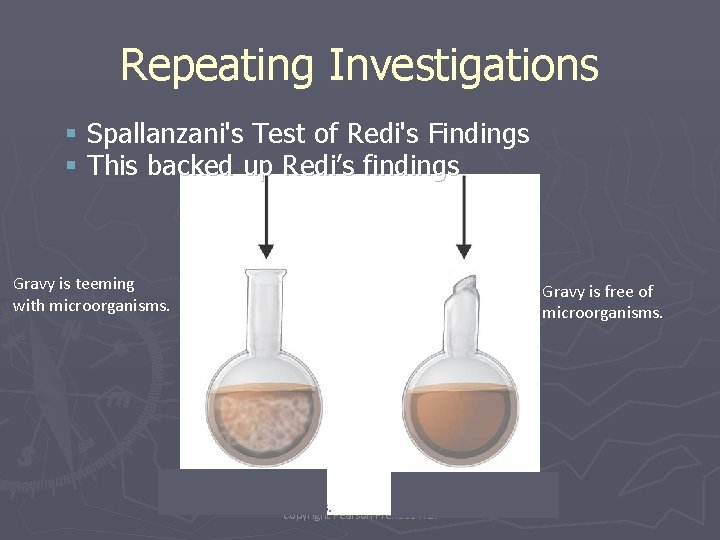
Repeating Investigations § Spallanzani's Test of Redi's Findings § This backed up Redi’s findings Gravy is teeming with microorganisms. Gravy is free of microorganisms. Copyright Pearson Prentice Hall
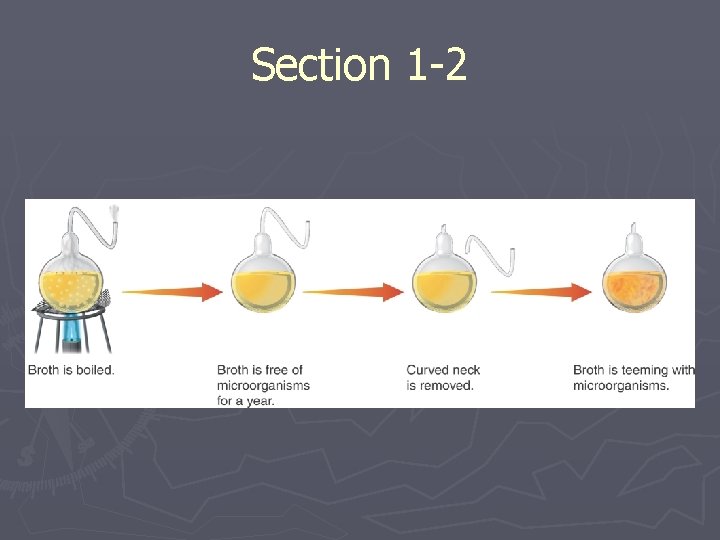
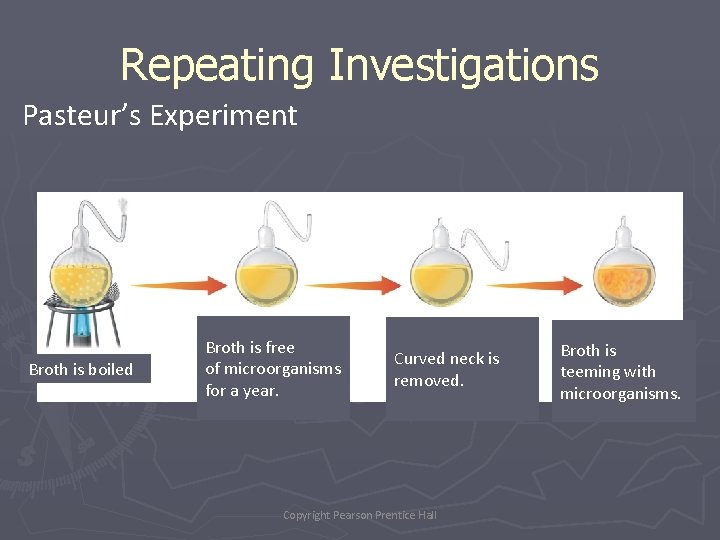
Repeating Investigations ► Louis Pasteur ► Disproved the hypothesis of spontaneous generation for sure ► Showed all living things come from other living things
Repeating Investigations Pasteur’s Experiment Broth is boiled Broth is free of microorganisms for a year. Curved neck is removed. Copyright Pearson Prentice Hall Broth is teeming with microorganisms.
Impact of Pasteur’s Work ► Saved the French wine industry b/c it gave them a way to preserve wine to keep it from souring ► Saved silk industry b/c it was becoming endangered by a silkworm disease ► Began to uncover the nature of infectious diseases, showing they came from organisms
Question ? ? ► How does a scientific theory develop?
How A Theory Develops ► Evidence builds over time ► Hypothesis that is supported by it becomes so well supported ► It must then be considered a theory ► Theory ► Well-tested explanation that unifies a broad range of observations ► These can be changed; they are not concrete
What is Biology ► Bio/logy- ► Science that employs the scientific method to study living things
Characteristics of Life Fig. 1 -15 p. 16 -17 ► Made of cells ► Reproduce ► Based on a universal genetic code ► Grow and develop ► Obtain and use materials and energy ► Respond to environment ► Maintain a stable enviro. ► Change over time as a group
Big Ideas ► What do you think this means? ► All biological sciences are tied together they overlap each other p. 18 -19 ►Go over pg. 18 -20 with class
Branches of Biology ► Zoology ► Botany ► Paleontology
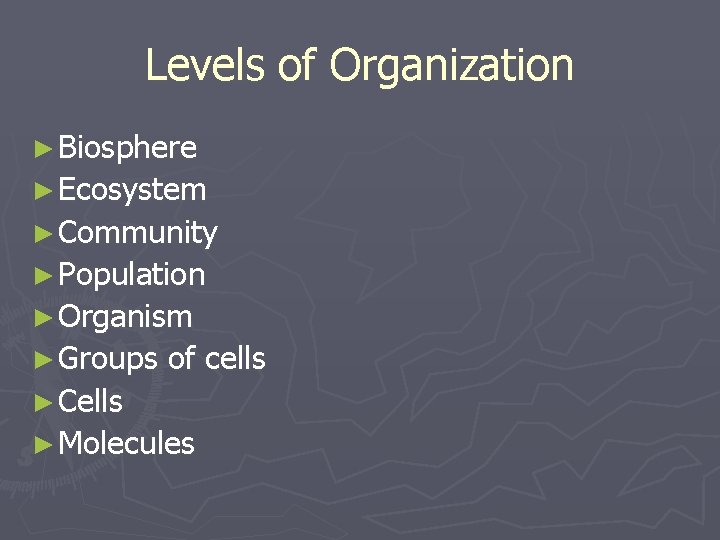
Levels of Organization ► Biosphere ► Ecosystem ► Community ► Population ► Organism ► Groups of cells ► Cells ► Molecules
Tools and Procedures ► What units are used to measure things? ► Metric System ► How do scientists analyze data? ► Use graphs
Tools and Procedures Cont’d ► Lab Techniques ► Cell Cultures- ► Group of cells grown in a nutrient solution from a single original cell ► Cell Fractionation- ► Solution is put into a centrifuge and spun to separate materials out by densities
Microscopes ► 2 Types ► 1. Light- produce images by focusing light rays ► 2. Electron- produce images by focusing beams of electrons
History of Microscope ► Use notes from West Greene here