
What is Science Science is a body of
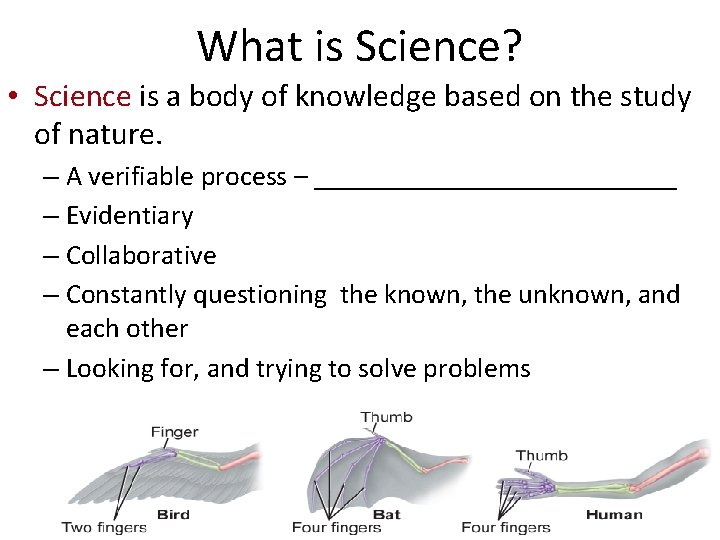
What is Science? • Science is a body of knowledge based on the study of nature. – A verifiable process – _____________ – Evidentiary – Collaborative – Constantly questioning the known, the unknown, and each other – Looking for, and trying to solve problems
Science is Ethical issues must be addressed by society based on the values it holds important. Scientific Inquiry • the foundation of science • a __________ process • a process based on _________ observations and experimentation.
1. 1 The Scientific Method 1. Make Observations/Ask a Question 2. Research (get background info) to generate a hypothesis (_______ explanation of why something happens) 3. Design Experiment/Conduct Experiment/Collect Data 4. Analyze data and hypothesis • Use tables, graphs and statistics 5. Draw a conclusion (support or reject) and Report conclusion for peer review…retest or revise hypothesis • Peer review = process where experimental procedures and the results are evaluated by others *Be safe and ethical in the process!
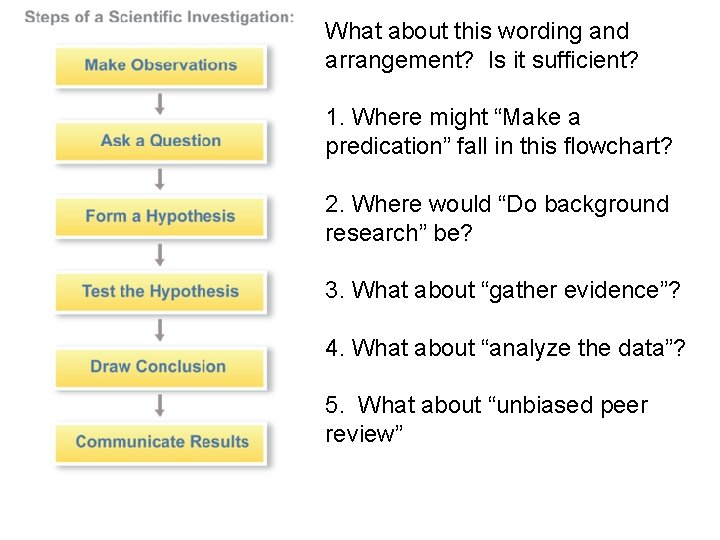
What about this wording and arrangement? Is it sufficient? 1. Where might “Make a predication” fall in this flowchart? 2. Where would “Do background research” be? 3. What about “gather evidence”? 4. What about “analyze the data”? 5. What about “unbiased peer review”
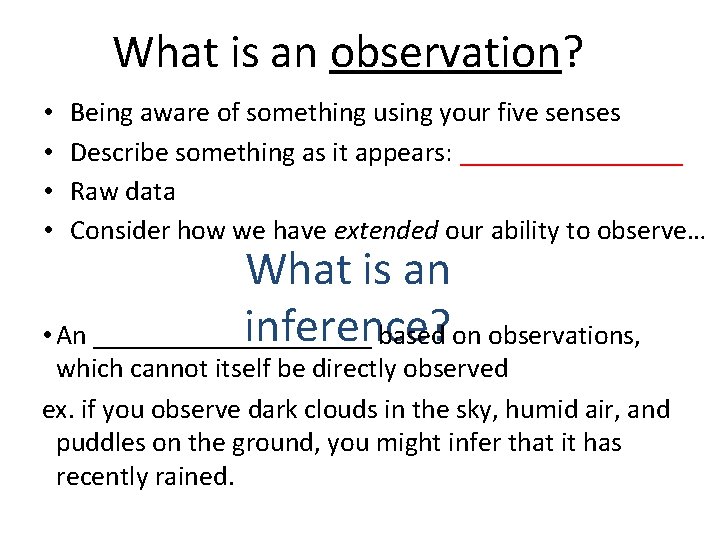
What is an observation? • • Being aware of something using your five senses Describe something as it appears: ________ Raw data Consider how we have extended our ability to observe… What is an inference? • An __________ based on observations, which cannot itself be directly observed ex. if you observe dark clouds in the sky, humid air, and puddles on the ground, you might infer that it has recently rained.
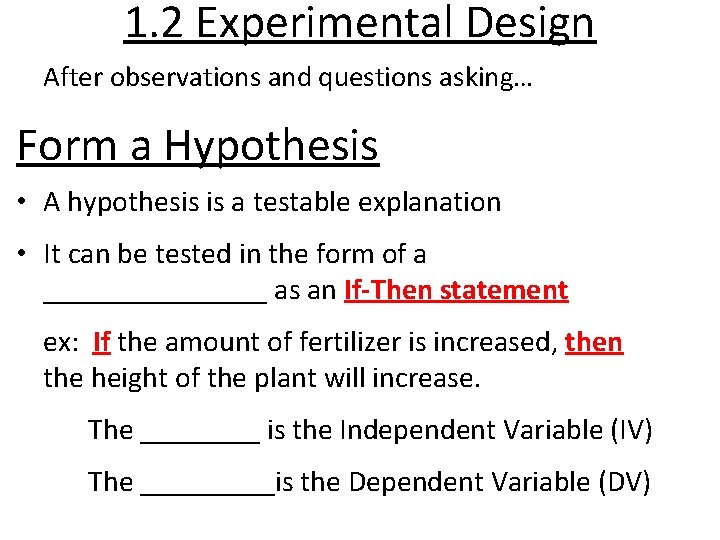
1. 2 Experimental Design After observations and questions asking… Form a Hypothesis • A hypothesis is a testable explanation • It can be tested in the form of a ________ as an If-Then statement ex: If the amount of fertilizer is increased, then the height of the plant will increase. The ____ is the Independent Variable (IV) The _____is the Dependent Variable (DV)
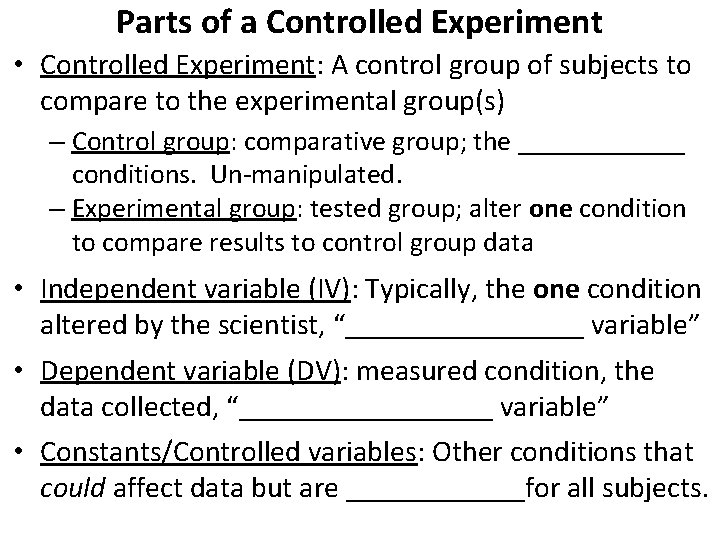
Parts of a Controlled Experiment • Controlled Experiment: A control group of subjects to compare to the experimental group(s) – Control group: comparative group; the ______ conditions. Un-manipulated. – Experimental group: tested group; alter one condition to compare results to control group data • Independent variable (IV): Typically, the one condition altered by the scientist, “________ variable” • Dependent variable (DV): measured condition, the data collected, “_________ variable” • Constants/Controlled variables: Other conditions that could affect data but are ______for all subjects.
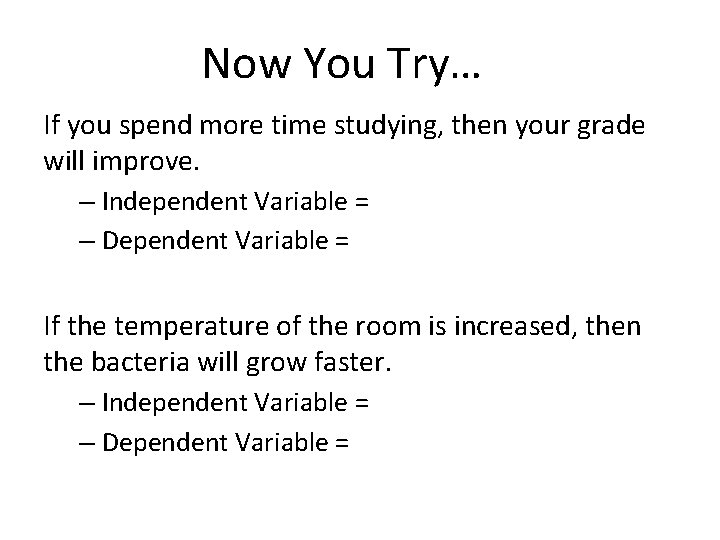
Now You Try… If you spend more time studying, then your grade will improve. – Independent Variable = – Dependent Variable = If the temperature of the room is increased, then the bacteria will grow faster. – Independent Variable = – Dependent Variable =
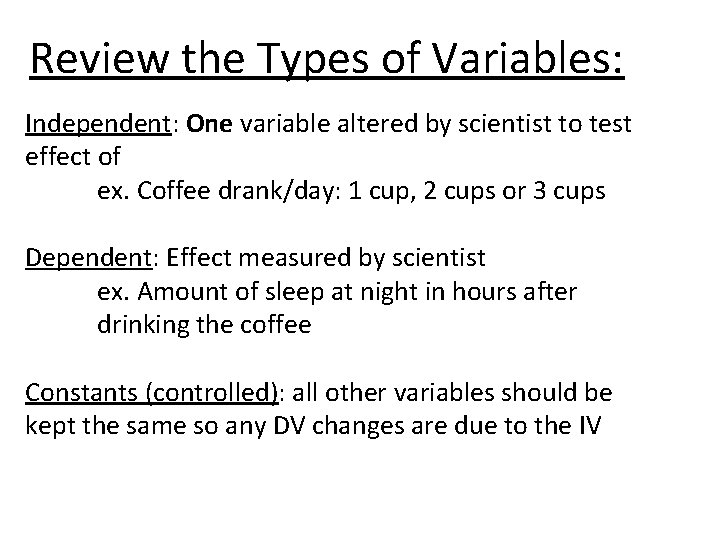
Review the Types of Variables: Independent: One variable altered by scientist to test effect of ex. Coffee drank/day: 1 cup, 2 cups or 3 cups Dependent: Effect measured by scientist ex. Amount of sleep at night in hours after drinking the coffee Constants (controlled): all other variables should be kept the same so any DV changes are due to the IV
Collect Valid Data • Data can be numeric = ______________ • Data can be descriptive = _____________ – Quantitative data is best to remove bias • ex. bubbles created are large or small (qualitative) vs. measure bubble size in centimeters (quantitative) • Sample size: the _______ the sample (more subjects), the ______ the conclusion • Repetition: the ________ tested with the same results, the ________ the data
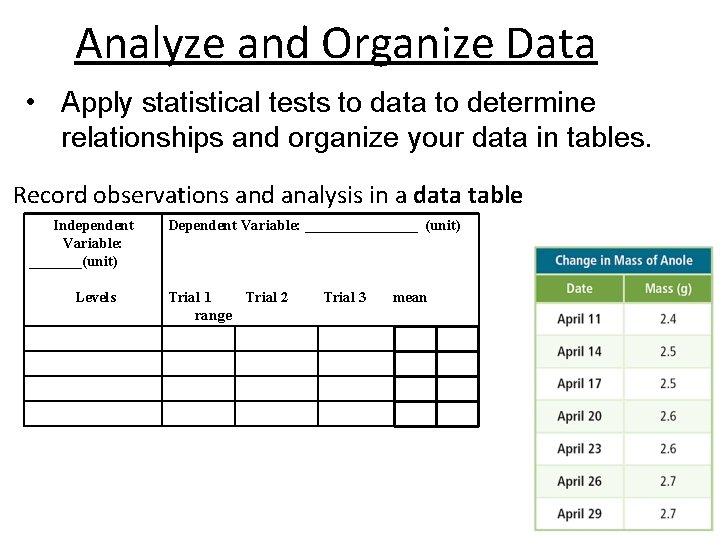
Analyze and Organize Data • Apply statistical tests to data to determine relationships and organize your data in tables. Record observations and analysis in a data table Independent Variable: _______(unit) Levels Dependent Variable: ________ (unit) Trial 1 Trial 2 range Trial 3 mean
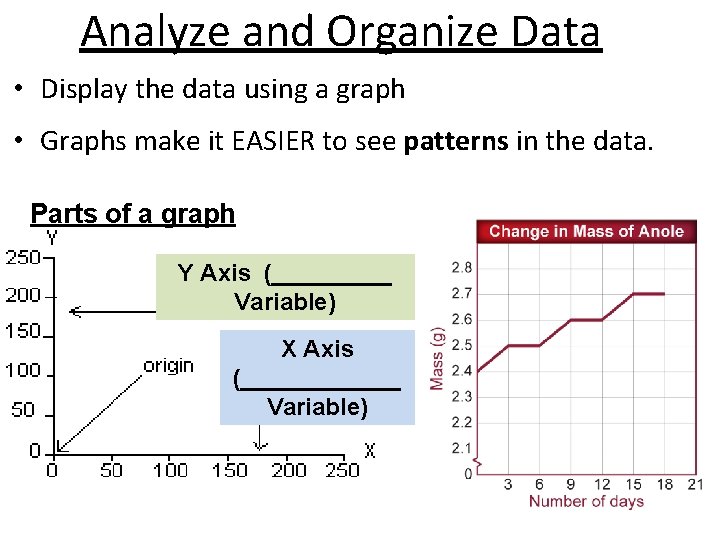
Analyze and Organize Data • Display the data using a graph • Graphs make it EASIER to see patterns in the data. Parts of a graph Y Axis (_____ Variable) X Axis (______ Variable)
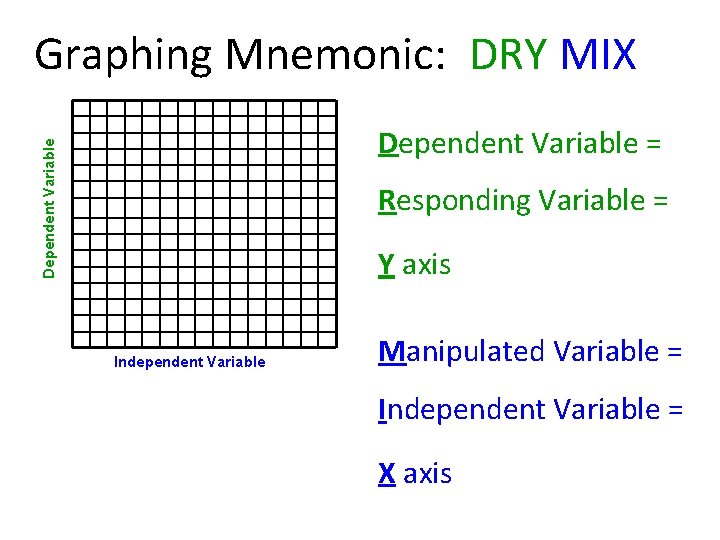
Graphing Mnemonic: DRY MIX Dependent Variable = Responding Variable = Y axis Independent Variable Manipulated Variable = Independent Variable = X axis
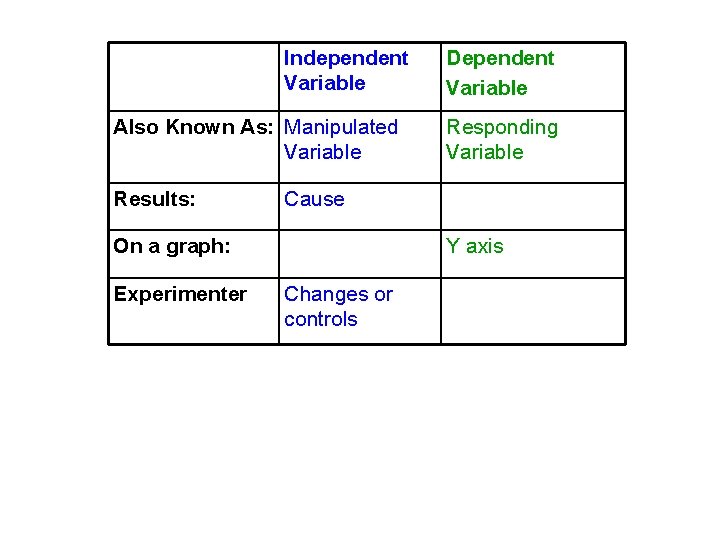
Independent Variable Also Known As: Manipulated Variable Results: Responding Variable Cause On a graph: Experimenter Dependent Variable Y axis Changes or controls
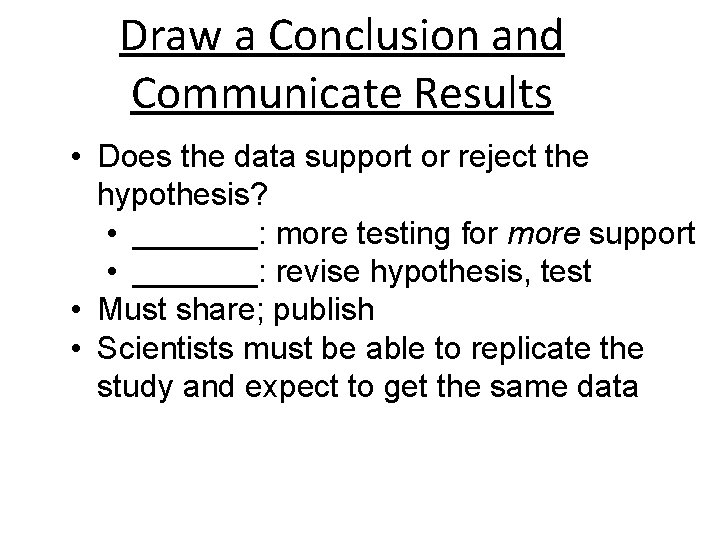
Draw a Conclusion and Communicate Results • Does the data support or reject the hypothesis? • _______: more testing for more support • _______: revise hypothesis, test • Must share; publish • Scientists must be able to replicate the study and expect to get the same data
Peer Review is necessary! • Process where experimental procedures and the results are evaluated by others in the same field or conducting similar research. -Is a researcher involved in a particular study an appropriate “peer” to do review of that study?
1. 3
The Study of Life Challenging Accepted Theories § Scientists welcome debate about one another’s ideas. § Sciences advance by accommodating new information as it is discovered. §Observations or data that are inconsistent with current scientific understanding are of interest to scientists. §These inconsistencies often lead to further investigations and understanding.
Biology: Science of Life • Study past, present and future life – Interactions – Structures – Functions • Solve biological problems – Agriculture – Disease – Conservation/Remediation
What is life? We decide: • 1+ cells • Organized/Complex • Grow/develop • Homeostasis • • Reproduce Respond to Stimuli Use Energy Adaptations/Evolution
• 1+ cells • Organized/Complex – Chemical complexity for structure and function – Atoms->molecules->cells->tissues->organ systems>organism • Grow/develop • Homeostasis – Regulate internal conditions
• Reproduce – Species = • Respond to Stimuli – Individuals are able to process and react to internal/external environ. • Use Energy – Get/make food (_____ energy) to fuel metabolism, convert the chemical energy in food into another form of chemical energy (______) that ALL living things use to power processes • There are 4 groupings for how energy is obtained: – Autotroph – Heterotroph
• Adaptations/Evolution – Change in inherited traits (genetics) over time (generations) – Genetic variation is a generally good thing for species survival
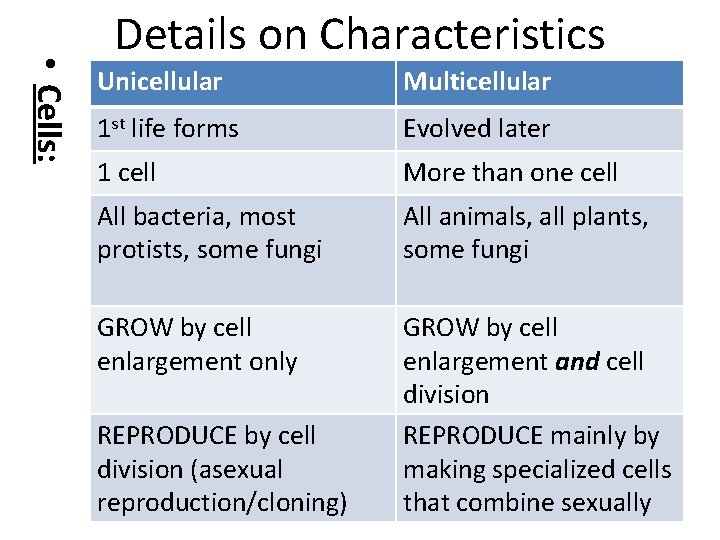
• Cells: Details on Characteristics Unicellular Multicellular 1 st life forms Evolved later 1 cell More than one cell All bacteria, most protists, some fungi All animals, all plants, some fungi GROW by cell enlargement only GROW by cell enlargement and cell division REPRODUCE mainly by making specialized cells that combine sexually REPRODUCE by cell division (asexual reproduction/cloning)
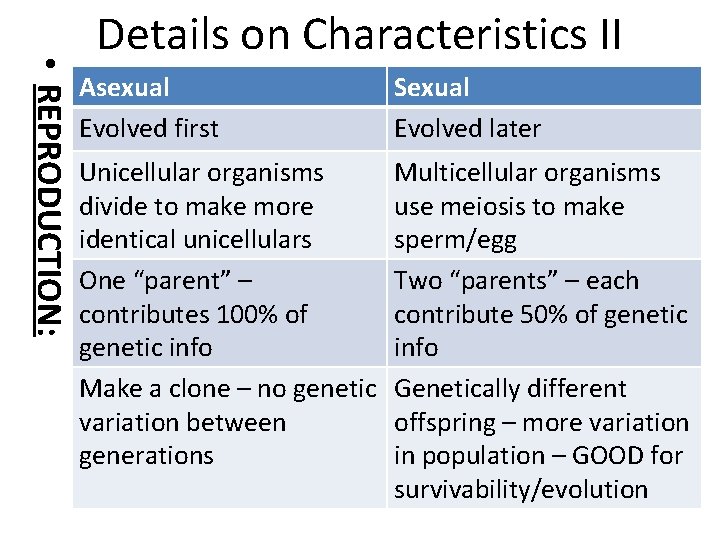
• REPRODUCTION: Details on Characteristics II Asexual Evolved first Sexual Evolved later Unicellular organisms divide to make more identical unicellulars One “parent” – contributes 100% of genetic info Make a clone – no genetic variation between generations Multicellular organisms use meiosis to make sperm/egg Two “parents” – each contribute 50% of genetic info Genetically different offspring – more variation in population – GOOD for survivability/evolution
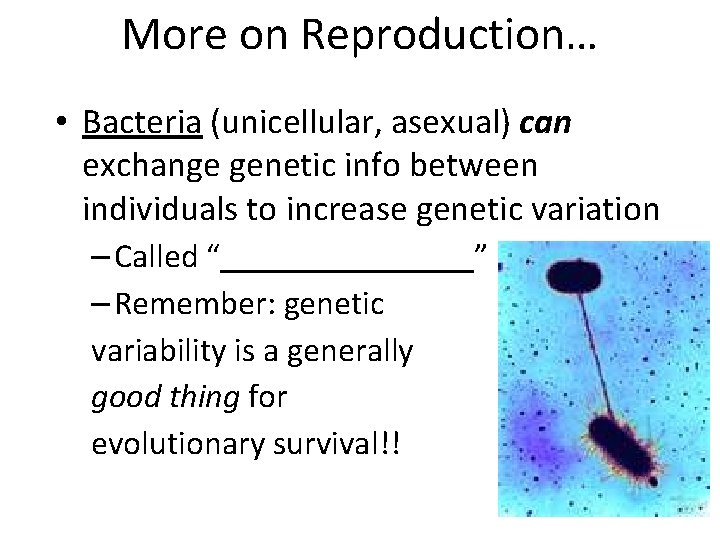
More on Reproduction… • Bacteria (unicellular, asexual) can exchange genetic info between individuals to increase genetic variation – Called “________” – Remember: genetic variability is a generally good thing for evolutionary survival!!
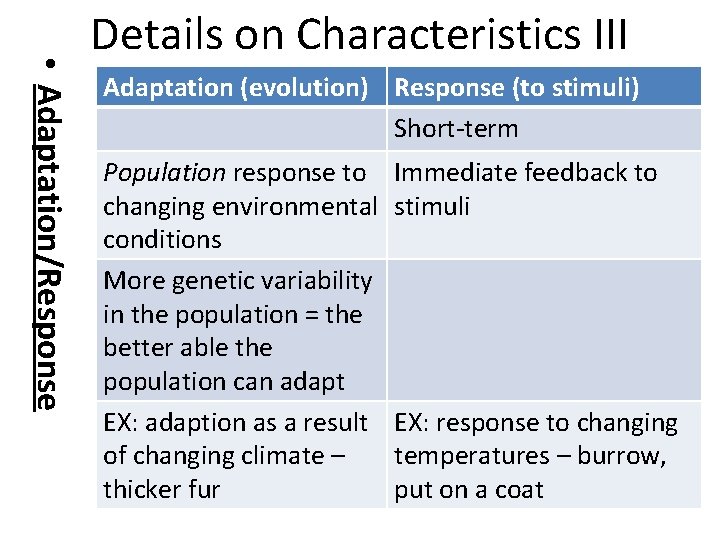
• Adaptation/Response Details on Characteristics III Adaptation (evolution) Response (to stimuli) Short-term Population response to changing environmental conditions More genetic variability in the population = the better able the population can adapt EX: adaption as a result of changing climate – thicker fur Immediate feedback to stimuli EX: response to changing temperatures – burrow, put on a coat
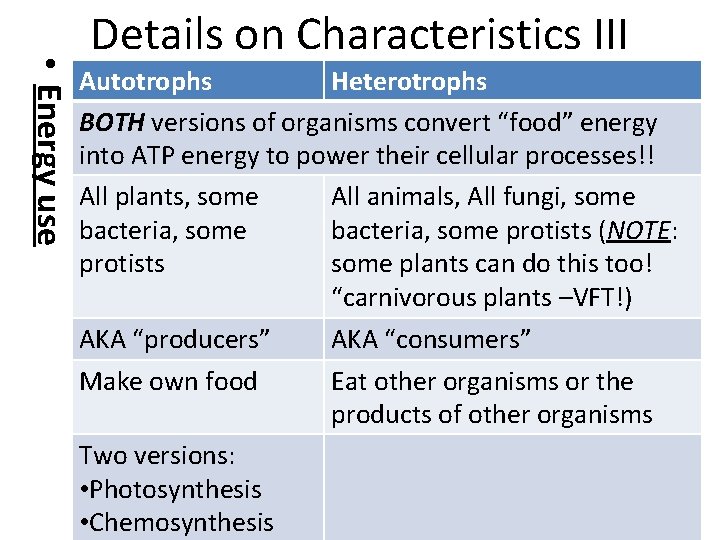
• Energy use Details on Characteristics III Autotrophs Heterotrophs BOTH versions of organisms convert “food” energy into ATP energy to power their cellular processes!! All plants, some All animals, All fungi, some bacteria, some protists (NOTE: protists some plants can do this too! “carnivorous plants –VFT!) AKA “producers” AKA “consumers” Make own food Eat other organisms or the products of other organisms Two versions: • Photosynthesis • Chemosynthesis
Life vs. Viruses • Bacteria, protists, fungi, plants and animals are living; viruses are NOT • living things have ALL characteristics of life, viruses do not exhibit all • NOTE: anything you need a microscope to see is called a “microbe”, anything that causes disease is called a “pathogen”. – MOST bacteria do not cause human illness!! Viruses: § are acellular § do not (generally) reproduce themselves § do not use energy/ have a metabolism
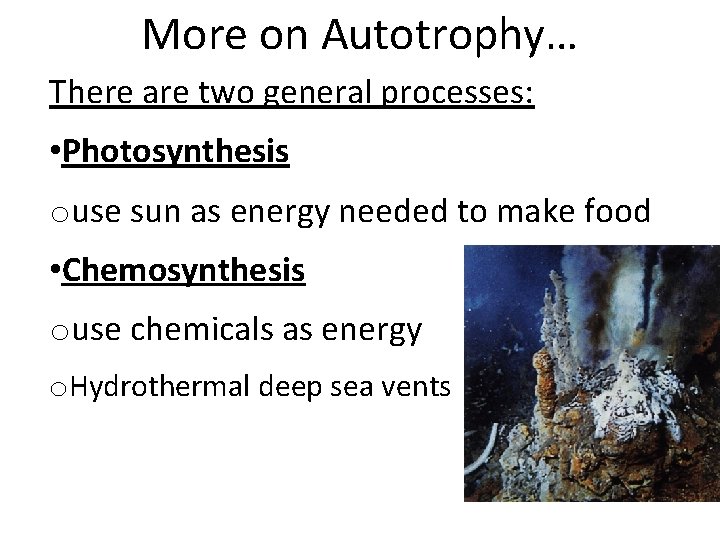
More on Autotrophy… There are two general processes: • Photosynthesis ouse sun as energy needed to make food • Chemosynthesis ouse chemicals as energy o. Hydrothermal deep sea vents
Chapter 1 The Study of Life 1. 1 Formative Questions Some species of plants begin opening their flowers in the morning when they are exposed to sunlight. What characteristic of living things does this represent? A. acquiring energy B. adapting to the environment C. displaying organization D. responding to stimuli 1. A 2. B 3. C 4. D
Chapter 1 The Study of Life 1. 1 Formative Questions What process regulates an organism’s internal conditions and keeps them stable? A. adaptation B. equilibrium C. homeostas is D. metabolis m 1. A 2. B 3. C 4. D
Chapter 1 The Study of Life 1. 1 Formative Questions What is the process of change that takes place during the life of an organism? A. adaptation B. development C. growth D. maturation 1. A 2. B 3. C 4. D
Chapter 1 The Study of Life 1. 2 Formative Questions What is a theory? A. a body of knowledge about a natural phenomenon B. a creative tool for designing investigations C. a scientific inquiry that seeks to provide an explanation D. an explanation supported by observations and experiments 1. A 2. B 3. C 4. D
Chapter 1 The Study of Life 1. 2 Formative Questions Scientists discard observations and data that are not consistent with current scientific understanding. A. true B. false 1. A 2. B
Chapter 1 The Study of Life 1. 2 Formative Questions A scientist wants to report the findings from her investigations. Before her information can be published, what must it go through? A. forensics B. peer review C. scientific methods D. the metric system 1. A 2. B 3. C 4. D
Scientific Theory • Explains natural phenomenon • Supported by observations/experiments • Always same results – Not a hypothesis – Can be modified or discarded by NEW info – Ex. Gravity, cells, tectonic plates
Chapter 1 The Study of Life 1. 3 Formative Questions When you form a logical conclusion based on your observations and what you already know, what are you making? A. a conjecture B. an inference C. a speculation D. a theory 1. A 2. B 3. C 4. D
Chapter 1 The Study of Life 1. 3 Formative Questions What is a hypothesis? A. a defined question B. a curious assumption C. a tested inference D. a testable explanation 1. A 2. B 3. C 4. D
Chapter 1 The Study of Life 1. 3 Formative Questions What type of discovery is a serendipitous discovery? A. accidental B. anticipated C. ingenious D. whimsical 1. A 2. B 3. C 4. D
Chapter 1 The Study of Life Chapter Diagnostic Questions Why is the metric system preferred by scientists? Answer: Using the same system of measurements allows a scientist to repeat another’s work knowing that he or she is performing the experiments exactly the same.
Chapter 1 The Study of Life Chapter Diagnostic Questions What is a testable explanation? A. observation B. hypothesis C. experiment D. constant 1. A 2. B 3. C 4. D
Chapter 1 The Study of Life Chapter Diagnostic Questions Which is not a characteristic of all organisms? A. made of one or more cells B. grows and develops C. capable of rational thought D. maintains homeostasis 1. A 2. B 3. C 4. D
Chapter 1 The Study of Life Chapter Assessment Questions Identify the term used to describe an explanation of a natural phenomenon supported by observation and experimentation. A. forensics B. natural law C. theory D. physics 1. A 2. B 3. C 4. D
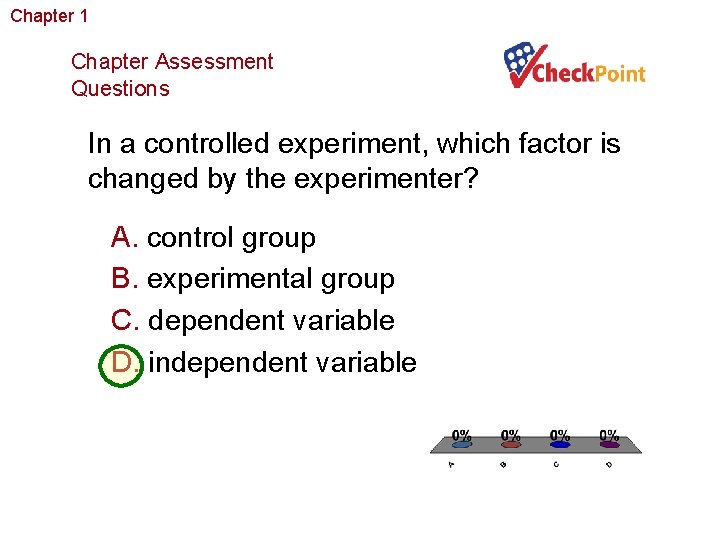
Chapter 1 The Study of Life Chapter Assessment Questions In a controlled experiment, which factor is changed by the experimenter? A. control group B. experimental group C. dependent variable D. independent variable 1. A 2. B 3. C 4. D
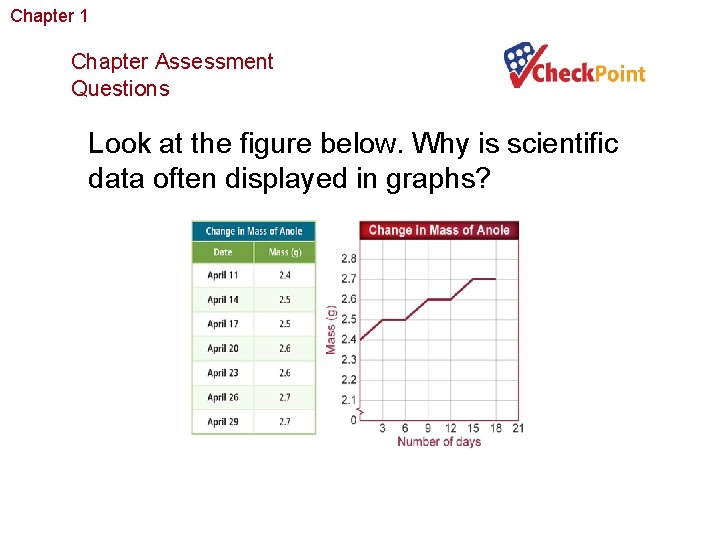
Chapter 1 The Study of Life Chapter Assessment Questions Look at the figure below. Why is scientific data often displayed in graphs?
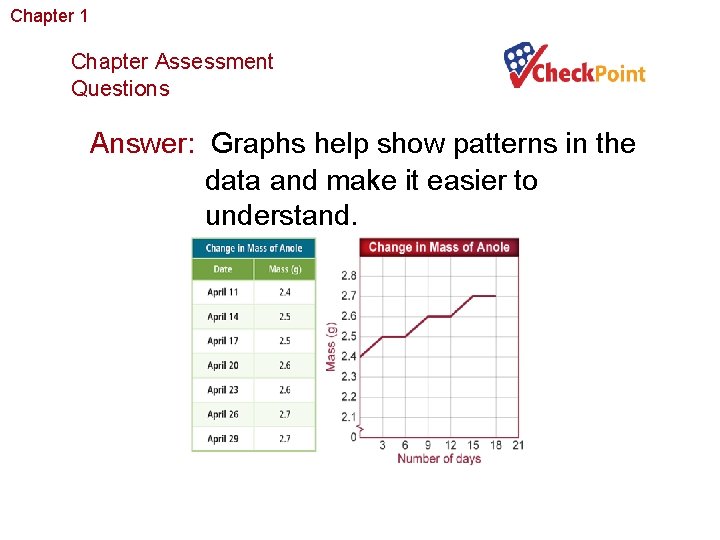
Chapter 1 The Study of Life Chapter Assessment Questions Answer: Graphs help show patterns in the data and make it easier to understand.
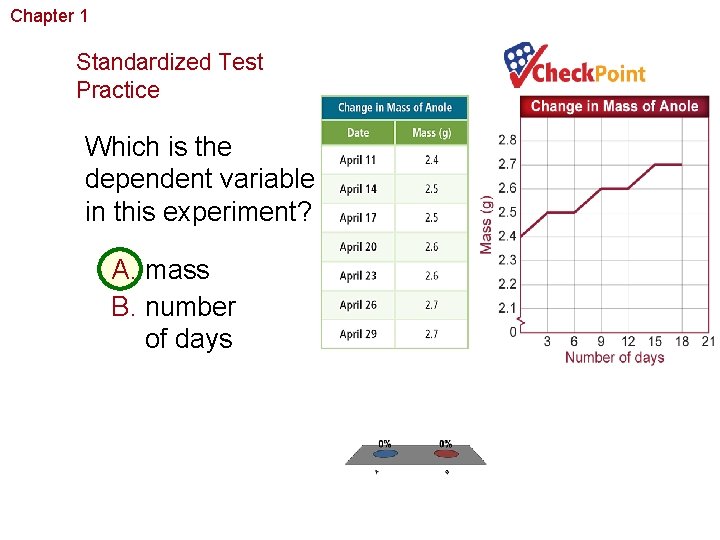
Chapter 1 The Study of Life Standardized Test Practice Which is the dependent variable in this experiment? A. mass B. number of days 1. A 2. B
Chapter 1 The Study of Life Standardized Test Practice Which biological science was Jane Goodall studying when she observed chimpanzees? A. ecology B. genetics C. animal behavior D. biotechnology 1. A 2. B 3. C 4. D
Chapter 1 The Study of Life Standardized Test Practice In which activity would an environmental biologist most likely be involved? A. genetically engineering plants B. finding ways to protect species C. preventing the spread of disease D. developing new medicines and vaccines 1. A 2. B 3. C 4. D
Chapter 1 The Study of Life Standardized Test Practice Which is an indication that an idea is based on pseudoscience? A. It brings up more questions. B. It causes disagreement and debate. C. It does not welcome scientific investigation. D. It does not receive acceptance by scientists. 1. A 2. B 3. C 4. D
Chapter 1 The Study of Life Standardized Test Practice Scientists use laboratory rats to test the effects of a new drug, Razatrin. What do rats in the control group receive? A. food containing Razatrin B. food without Razatrin C. food containing another drug D. food containing a variety of drugs E. No food 1. A 2. B 3. C 4. D
- Slides: 52