
What is Science Plant Biology 006 Summer 2014
What is Science? Plant Biology 006, Summer 2014
Science is a way of knowing. It is a formal process of asking questions about the world and seeking explanations.
The key element of the scientific method is hypothetico-deductive reasoning. So what is that?
Hypothetico refers to hypothesis. A hypothesis is a provisional explanation of some phenomenon. Scientific hypotheses are never proven to be true. Rather, they are subject to testing and if they are not established to be false, they continue to be accepted.
Science proceeds by the testing of hypotheses, with the goal of falsifying them (shooting them down). A hypothesis that has not been falsified is allowed to stand as the provisional truth.

Hypothetico-deductive: What does deductive mean? Deductive reasoning is the process of beginning with a general theory and then testing it by examining specific cases.
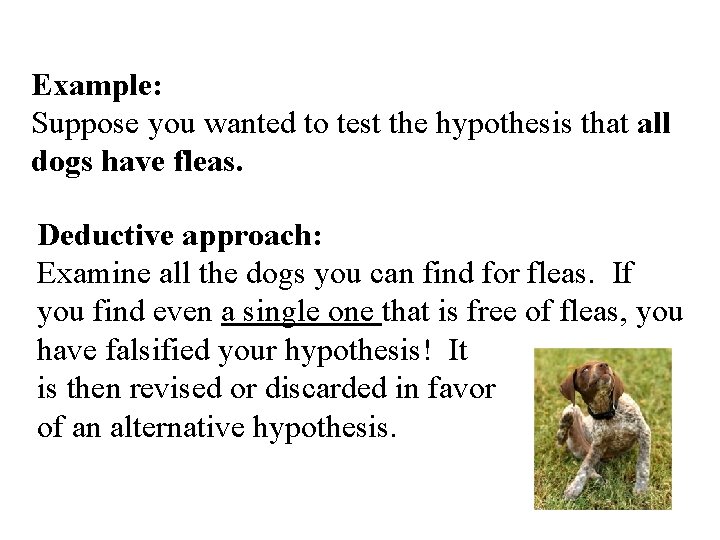
Example: Suppose you wanted to test the hypothesis that all dogs have fleas. Deductive approach: Examine all the dogs you can find for fleas. If you find even a single one that is free of fleas, you have falsified your hypothesis! It is then revised or discarded in favor of an alternative hypothesis.
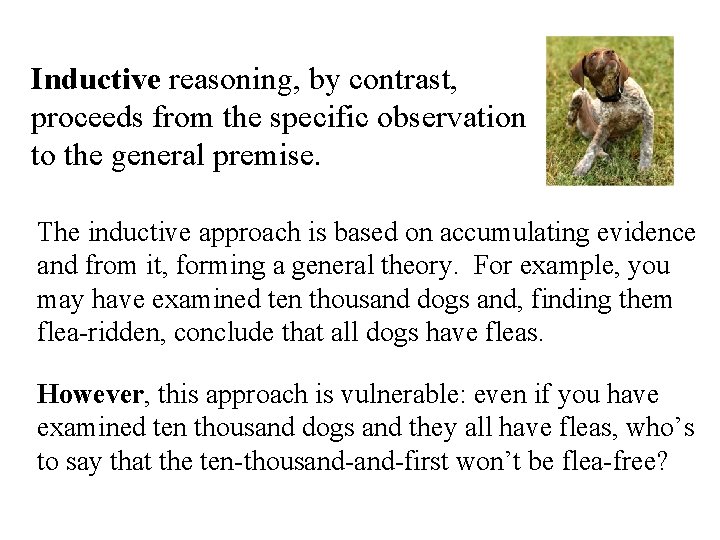
Inductive reasoning, by contrast, proceeds from the specific observation to the general premise. The inductive approach is based on accumulating evidence and from it, forming a general theory. For example, you may have examined ten thousand dogs and, finding them flea-ridden, conclude that all dogs have fleas. However, this approach is vulnerable: even if you have examined ten thousand dogs and they all have fleas, who’s to say that the ten-thousand-first won’t be flea-free?
The Scientific Method • • • Observation Question Hypothesis Prediction Test If hypothesis is falsified, formulate a new one.

Figure 1. 20 Applying hypothetico-deductive reasoning to a campground problem

Jan Baptista van Helmont ca. 1577 -1644
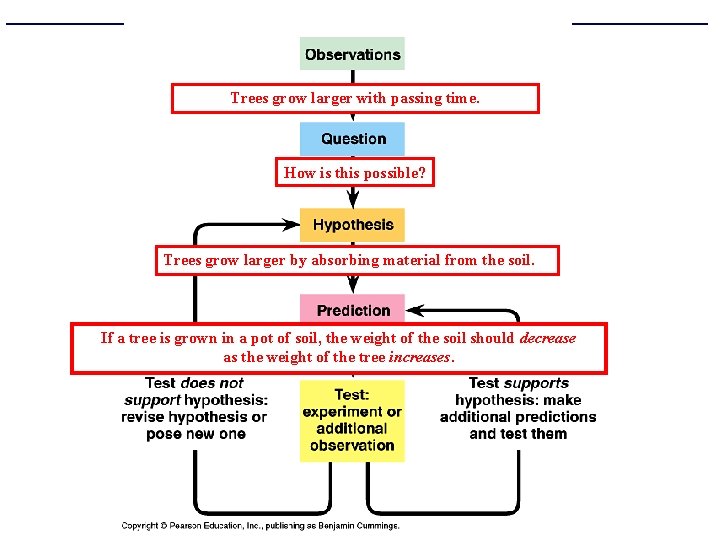
Figure 1. 19 Idealized version of the scientific method Trees grow larger with passing time. How is this possible? Trees grow larger by absorbing material from the soil. If a tree is grown in a pot of soil, the weight of the soil should decrease as the weight of the tree increases.
What happened? At the end of five years, the willow tree had increased in weight by 74. 4 kilograms. The soil had decreased in weight by only 57 grams!
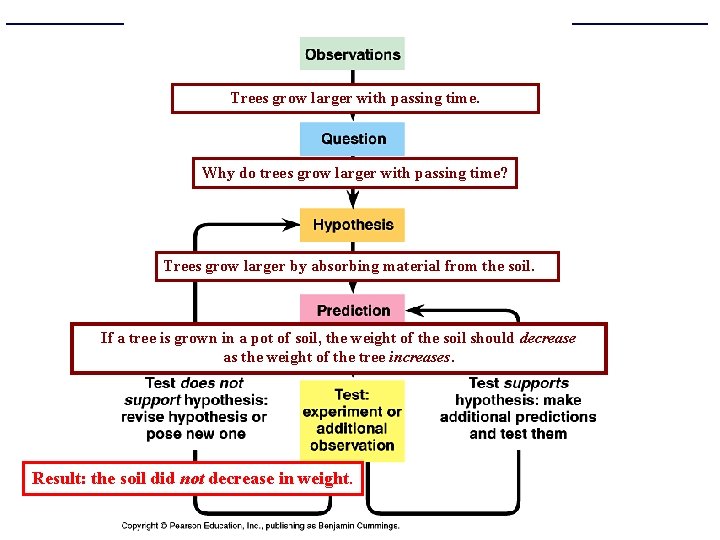
Figure 1. 19 Idealized version of the scientific method Trees grow larger with passing time. Why do trees grow larger with passing time? Trees grow larger by absorbing material from the soil. If a tree is grown in a pot of soil, the weight of the soil should decrease as the weight of the tree increases. Result: the soil did not decrease in weight.
Conclusion: The hypothesis had been falsified: it was demonstrated that plants do not increase in size by absorbing material from the soil.
Q. Which of the following best represents an application of the Scientific Method? A. A student memorizes the Periodic Table of the Elements B. A homeowner checks his fuel tank to see if that’s why his furnace won’t come on C. An anthropologists finds a fossil hominid older than any yet known D. Geneticists completely sequence the human genome
Lecture Review, Chapter 1 • Define science in your own words. • What is a hypothesis? • Describe how van Helmont’s 5 -year tree experiment followed the scientific method.
- Slides: 17