
What is science Knowledge Science comes from a

- Slides: 17
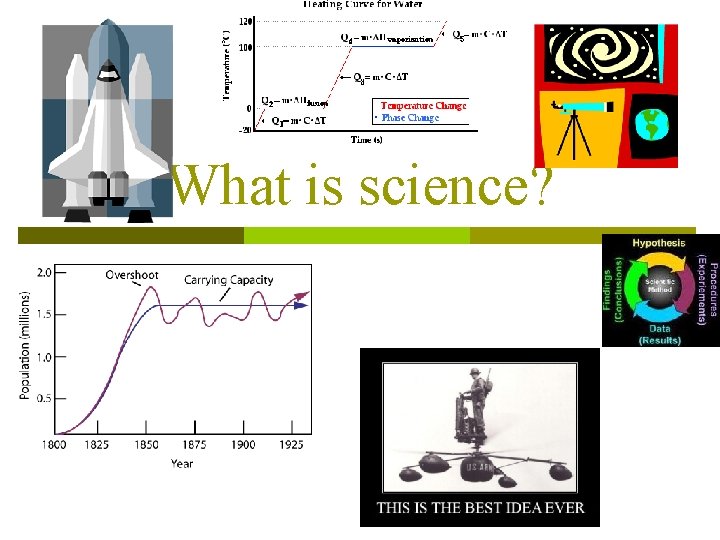
What is science?
Knowledge! “Science” comes from a latin root word that means Knowledge! p It’s a system that builds and organizes knowledge about the universe in the form of testable explanations and predictions about the universe. p
Science p Scientific thought involves making observations, using evidence to draw conclusions, being skeptical about ideas and being open to changing them when new discoveries are made.
Universal Laws Science helps to discover truths that apply to everything. p These truths are called universal laws. p
Why do I have to study science? Understanding science can help you stay healthy. p It can help you to be a wiser consumer (not get ripped off). p It can help you be a better-informed citizen. p
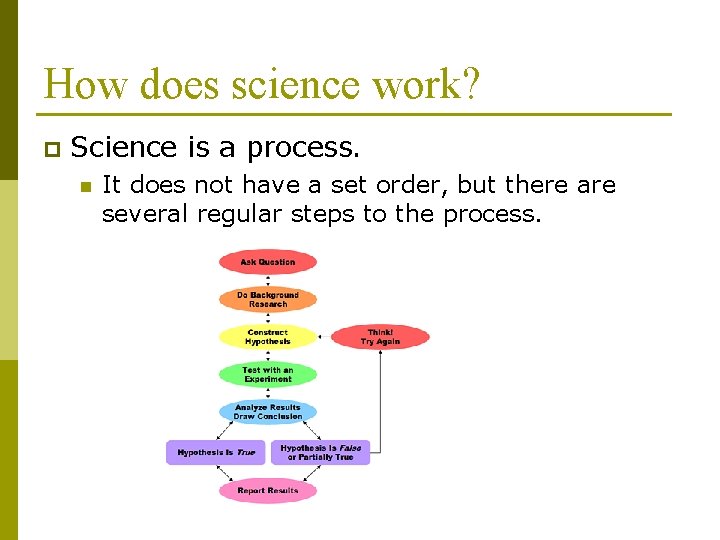
How does science work? p Science is a process. n It does not have a set order, but there are several regular steps to the process.
Observe p Almost all scientific investigations occur with an observation. n The easiest observations are made about things that can be seen, or counted. p n “One of my posters has fallen off the wall” is an easy observation to make. But how do we observe things like bacteria, cells, or even atoms and electrons?
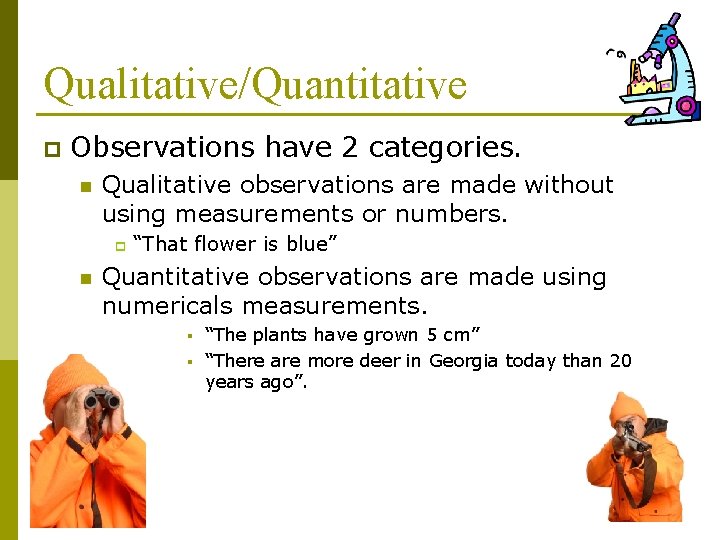
Qualitative/Quantitative p Observations have 2 categories. n Qualitative observations are made without using measurements or numbers. p n “That flower is blue” Quantitative observations are made using numericals measurements. “The plants have grown 5 cm” § “There are more deer in Georgia today than 20 years ago”. §
Hypothesis p A hypothesis is a possible explanation for an observation. They can be tested by experimentation. n n They are not guesses. A hypothesis needs to be based on fact or stem from prior knowledge or observations. “My poster has fallen because there wasn’t enough tape on it!”
Experiment p An experiment is a procedure that is carried out under controlled conditions to test a hypothesis. n n Control group: Receives no treatment and serves as a standard of comparison. Experimental group: Identical to the control except for a single variable.
Variables p Variables are things that change during an experiment. n n Independent variables are changed by the scientist. Dependent variables are measured over the course of the experiment.
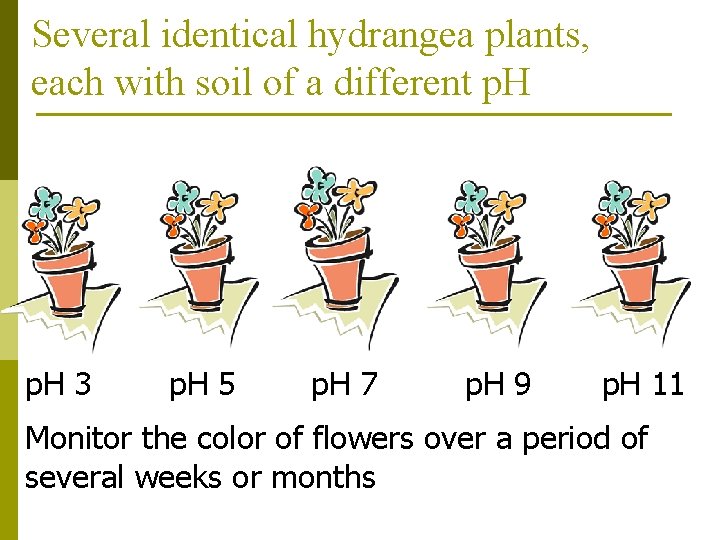
Several identical hydrangea plants, each with soil of a different p. H 3 p. H 5 p. H 7 p. H 9 p. H 11 Monitor the color of flowers over a period of several weeks or months
Sci. method steps continued Analyze data p Publish results (results should be repeatable) p Form a theory (possibly) A theory is a generally accepted scientific principle p
a) b) c) d) e) f) g) An experiment was performed to determine the effect of music on ivy plants. Two groups of plants were set up. One received music 24 hours/day, and the other was left in silence. All plants were given equal light, water and minerals. Independent variable? Dependent variable? Constant factors? Control group? Experimental group? Qualitative observations? Quantitative observations?
a) b) c) d) e) f) Radon is a radioactive gas that seeps into homes from the soil. It is thought to be one of the leading causes of lung cancer. A research team investigated this problem by collecting data from 50 homes. They measured basement radon levels, and noted how many people living in the homes had lung cancer. Independent variable? Dependent variable? Control group? Experimental group? Is a placebo needed? Possible problems with the study?
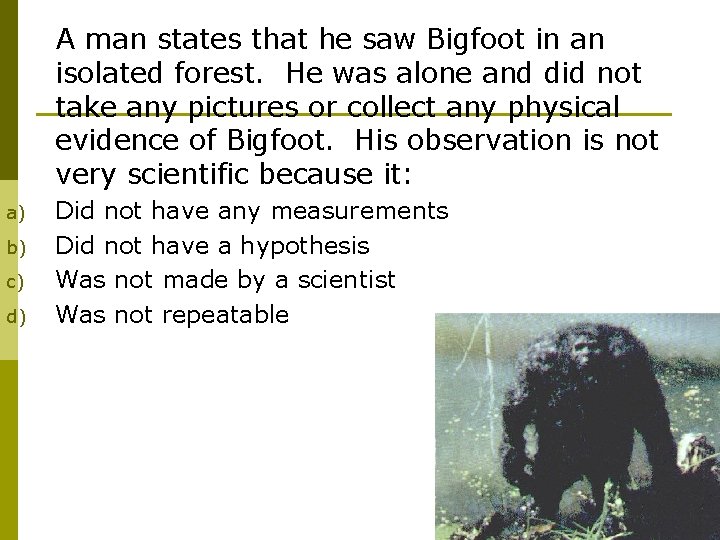
A man states that he saw Bigfoot in an isolated forest. He was alone and did not take any pictures or collect any physical evidence of Bigfoot. His observation is not very scientific because it: a) b) c) d) Did not have any measurements Did not have a hypothesis Was not made by a scientist Was not repeatable