
What is SCIENCE Introduction to science as a
- Slides: 42
What is SCIENCE? Introduction to science as a field of study
What is Science? Science is what scientists do n Science is trying to explain the world around us n Science is a way of thinking n “Science is a system of knowledge based on facts or principles n Book talks about “social science” n We prefer social studies n
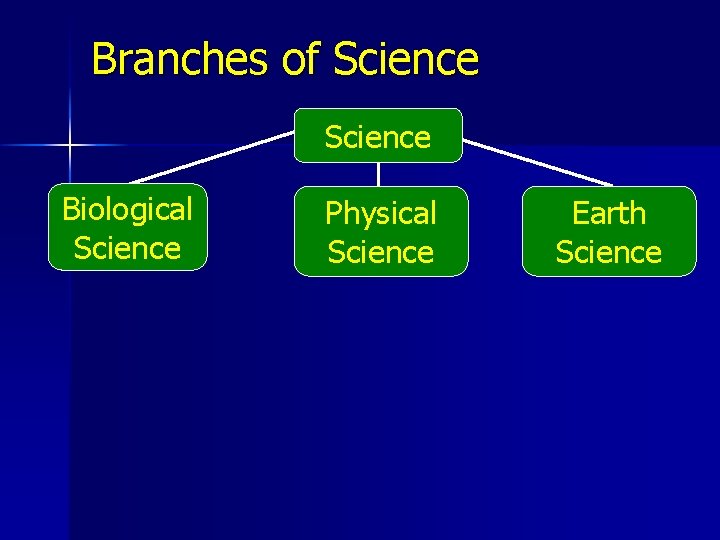
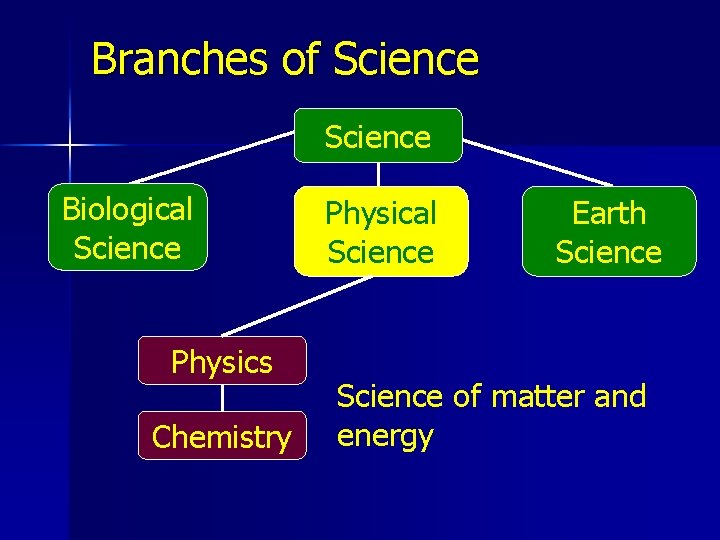
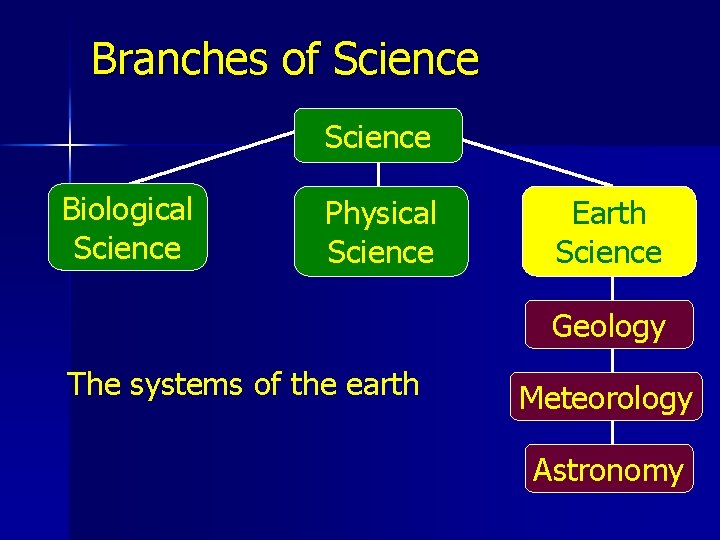
Branches of Science Biological Science Physical Science Earth Science
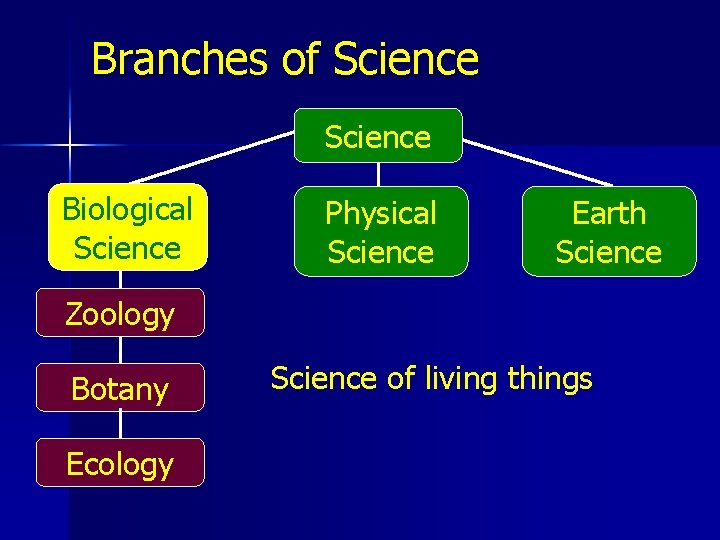
Branches of Science Biological Science Physical Science Earth Science Zoology Botany Ecology Science of living things
Branches of Science Biological Science Physics Chemistry Physical Science Earth Science of matter and energy
Branches of Science Biological Science Physical Science Earth Science Geology The systems of the earth Meteorology Astronomy
Branches of Science There are many more branches to biological and earth sciences n The three categories overlap n Biochemistry n Astrobiology n Geophysics n
Science and Technology Pure Science - search for scientific knowledge n Technology – application of science n Two are interrelated n Technology develops new tools for investigating nature n New science leads to new applications n
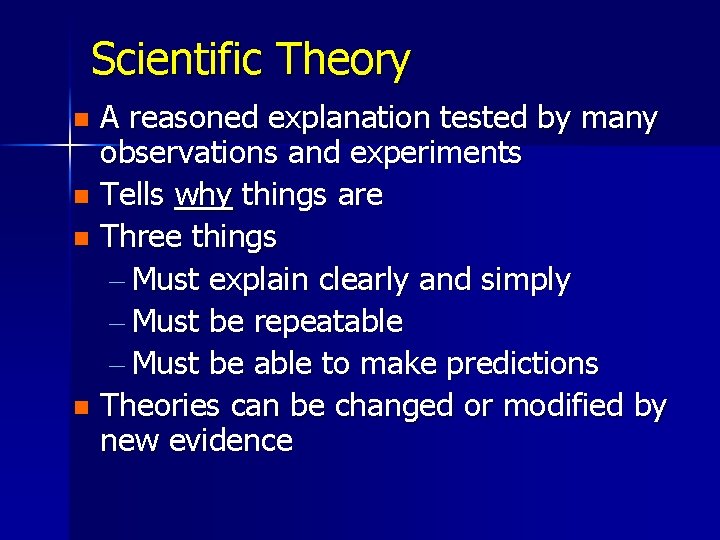
Scientific Theory A reasoned explanation tested by many observations and experiments n Tells why things are n Three things – Must explain clearly and simply – Must be repeatable – Must be able to make predictions n Theories can be changed or modified by new evidence n
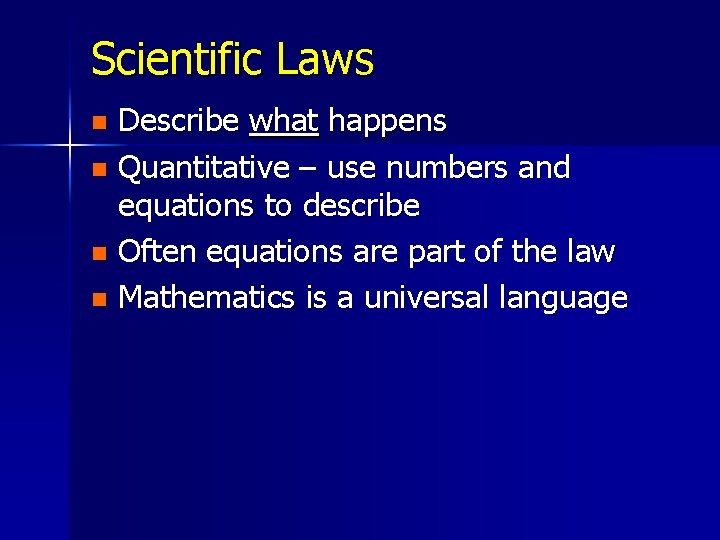
Scientific Laws Describe what happens n Quantitative – use numbers and equations to describe n Often equations are part of the law n Mathematics is a universal language n
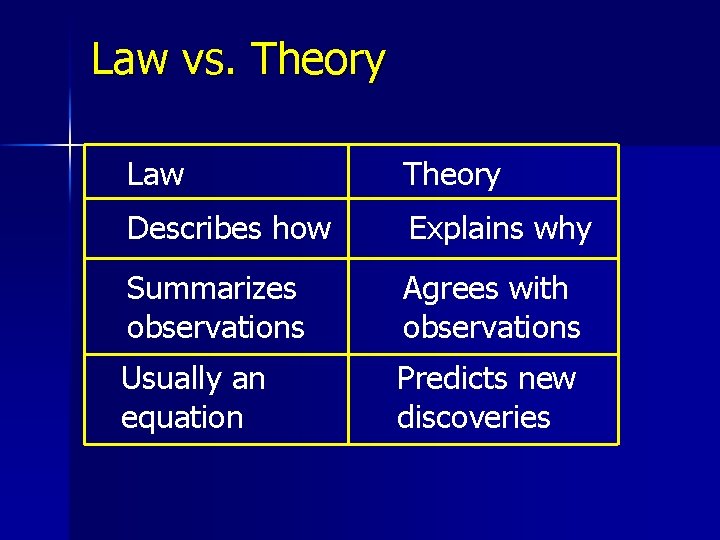
Law vs. Theory Law Theory Describes how Explains why Summarizes observations Agrees with observations Usually an equation Predicts new discoveries
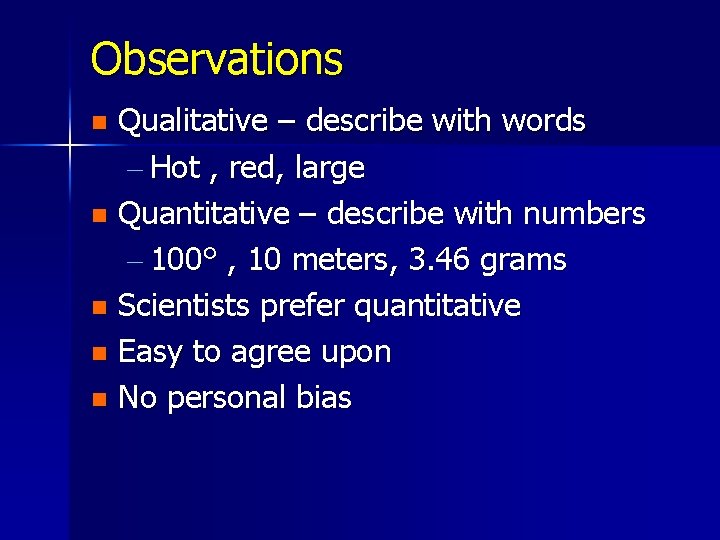
Observations Qualitative – describe with words – Hot , red, large n Quantitative – describe with numbers – 100° , 10 meters, 3. 46 grams n Scientists prefer quantitative n Easy to agree upon n No personal bias n
Models A representation of some object or event n Made to better understand it n Often used if real thing is too big, small or complex. n Come in a variety of forms – Physical models – Diagrams – Computer models n
The Scientific Method A way of thinking about and solving problems n It is a logical method n You do it all the time n
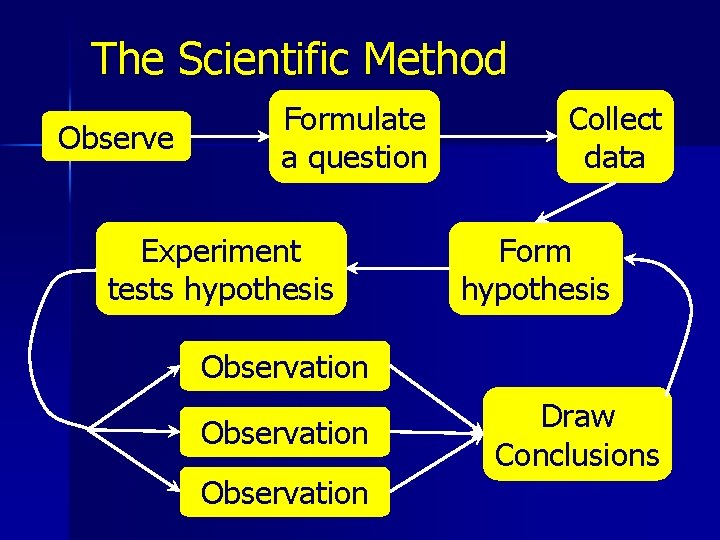
The Scientific Method Starts with observation- can be anything n Question – what do you want to know? n Gather data- what is already known n Form hypothesis- a possible explanation based on observations n Design experiment to test hypothesis – This is the hard part n
The Scientific Method Experiments generate more observations n Allow us to draw conclusions about hypothesis – Support the hypothesis or not – If not modify hypothesis n
The Scientific Method Observe Formulate a question Experiment tests hypothesis Collect data Form hypothesis Observation Draw Conclusions
The Scientific Method Does not always work this way, but gives a way of guiding our thinking n Hard part is testing only one variable at a time n Changing only one thing at a time allows scientists to see the effects clearly n If you change more than one, you don’t know which one is the cause n
Experimental Design When experimenting, scientist focus on one factor to test two variables: n Dependent- the variable that responds as an effect of tested factors; usually on the y-axis n Independent- the variable that is manipulated or monitored to get a measurable outcome; usually on the xaxis n
Experimental Design Experiments involve two major groups n Experimental Group- manipulating variables in the group to see the effect on the test subject n Control Group- group is treated with similar conditions as the experimental group, but tested factors are left out to use as a comparison to what was being tested n
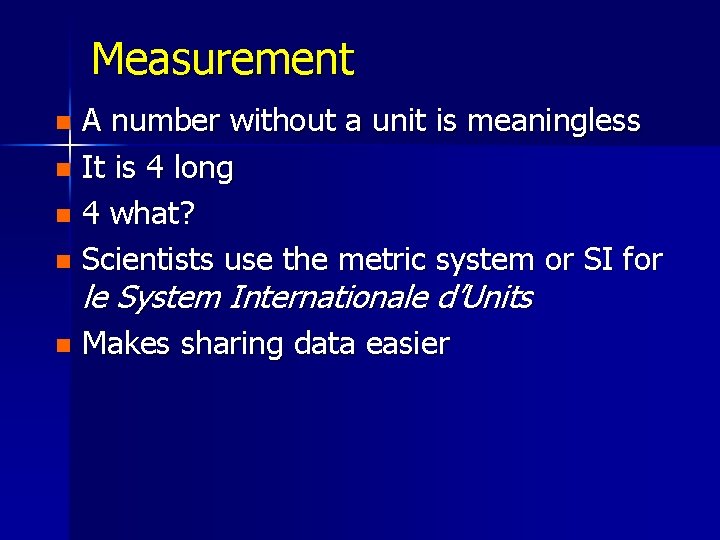
Measurement A number without a unit is meaningless n It is 4 long n 4 what? n Scientists use the metric system or SI for n le System Internationale d’Units n Makes sharing data easier
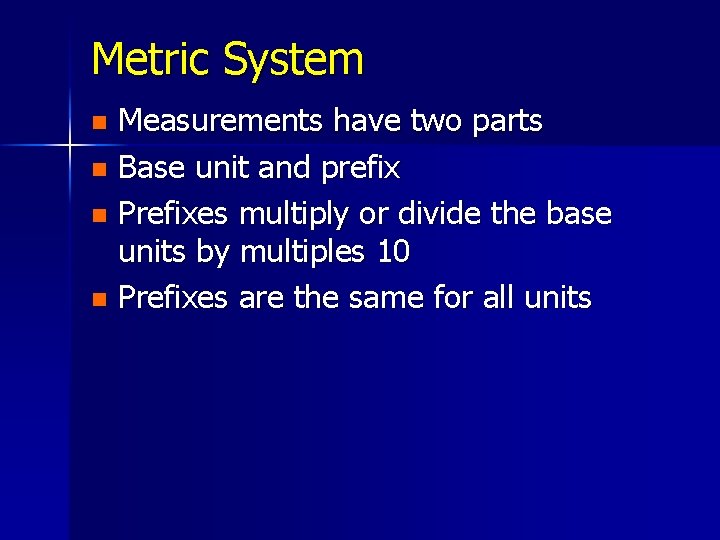
Metric System Measurements have two parts n Base unit and prefix n Prefixes multiply or divide the base units by multiples 10 n Prefixes are the same for all units n
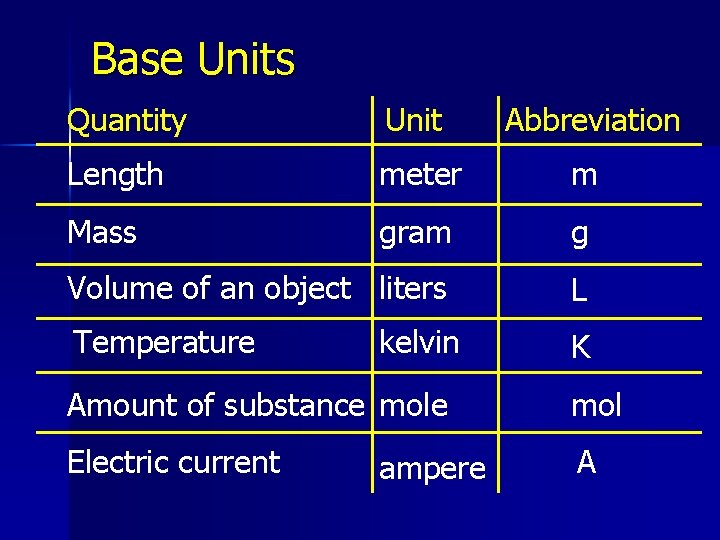
Base Units Quantity Unit Abbreviation Length meter m Mass gram g Volume of an object liters L Temperature K kelvin Amount of substance mol Electric current A ampere
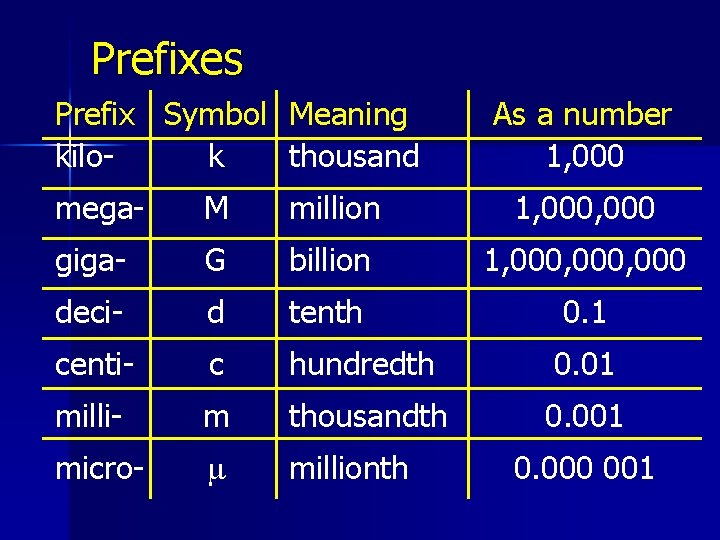
Prefixes Prefix Symbol Meaning kilok thousand As a number 1, 000 mega- M million 1, 000 giga- G billion 1, 000, 000 deci- d tenth 0. 1 centi- c hundredth 0. 01 milli- m thousandth 0. 001 micro- m millionth 0. 000 001
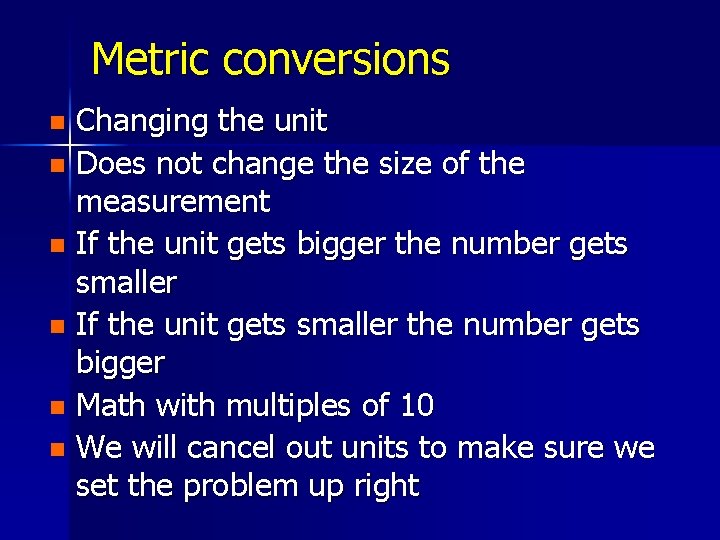
Metric conversions Changing the unit n Does not change the size of the measurement n If the unit gets bigger the number gets smaller n If the unit gets smaller the number gets bigger n Math with multiples of 10 n We will cancel out units to make sure we set the problem up right n
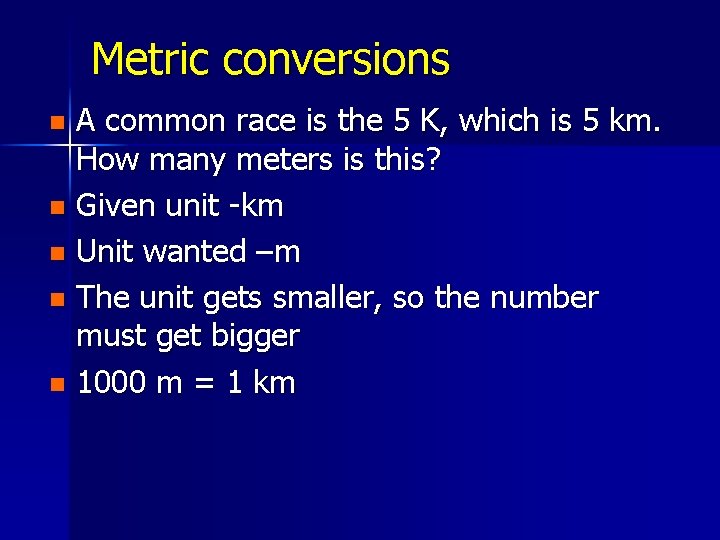
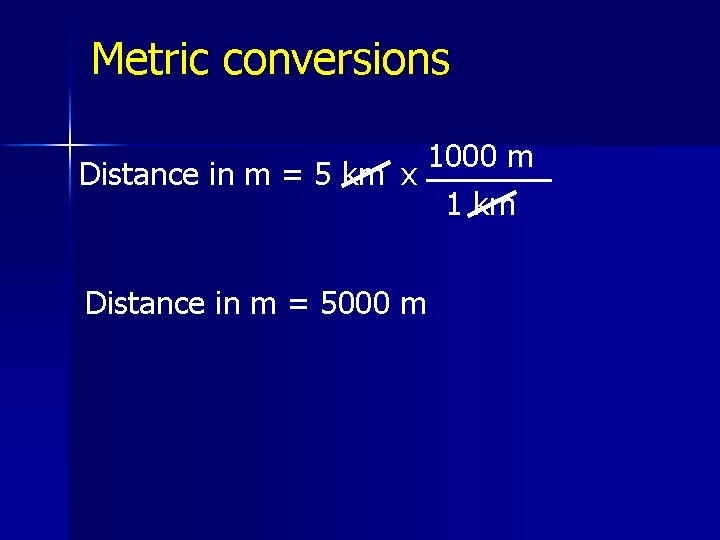
Metric conversions A common race is the 5 K, which is 5 km. How many meters is this? n Given unit -km n Unit wanted –m n The unit gets smaller, so the number must get bigger n 1000 m = 1 km n
Metric conversions 1000 m Distance in m = 5 km x 1 km Distance in m = 5000 m
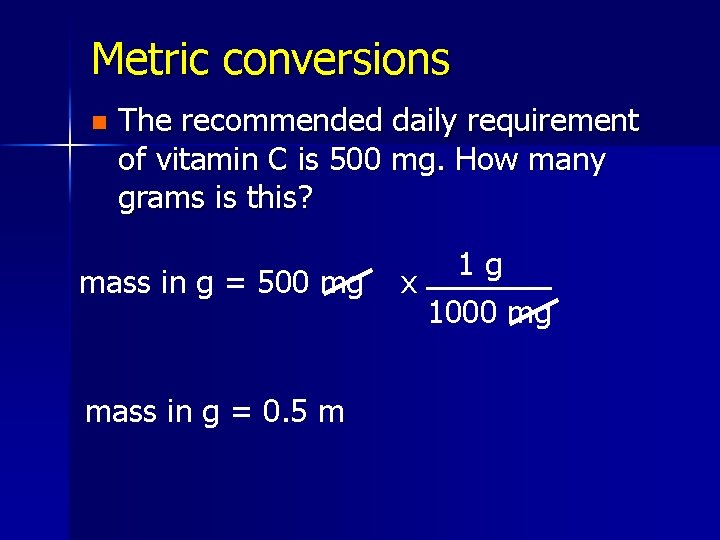
Metric conversions n The recommended daily requirement of vitamin C is 500 mg. How many grams is this? mass in g = 500 mg mass in g = 0. 5 m 1 g x 1000 mg
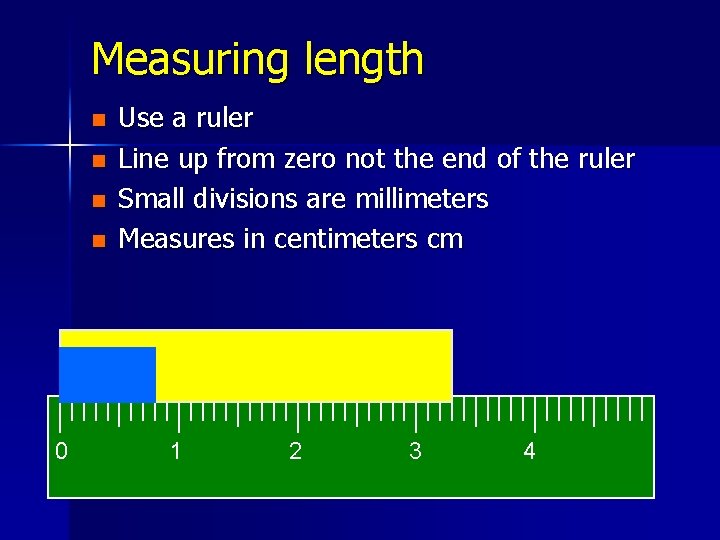
Measuring length n n 0 Use a ruler Line up from zero not the end of the ruler Small divisions are millimeters Measures in centimeters cm 1 2 3 4
Volume Liter a common unit n 1 L about 1/4 of a gallon - a quart n 1 m. L is about 20 drops of water or 1 sugar cube n
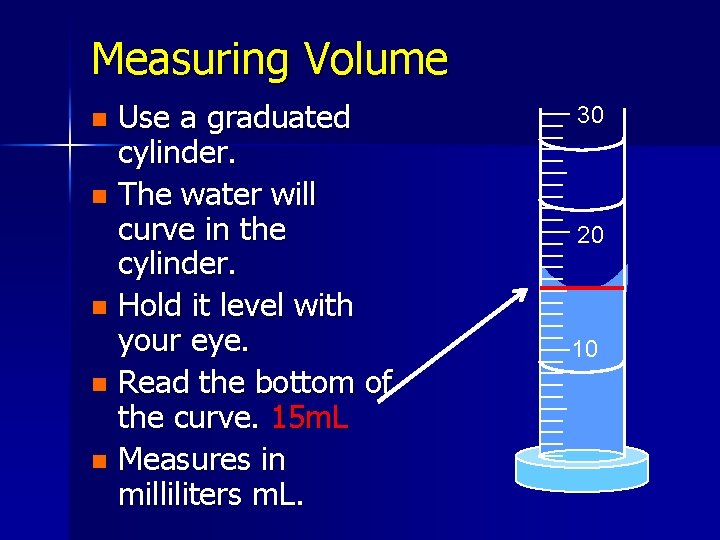
Measuring Volume Use a graduated cylinder. n The water will curve in the cylinder. n Hold it level with your eye. n Read the bottom of the curve. 15 m. L n Measures in milliliters m. L. n 30 20 10
Mass n weight is a force, mass is the amount of matter an object is made of. 3 n 1 gram is defined as the mass of 1 cm of water at 4 ºC. n 1 kg = 1 L of water n 1 kg = 2. 2 lbs n 1 g = 1 paper clip n 1 mg = 10 grains of salt or 2 drops of water.
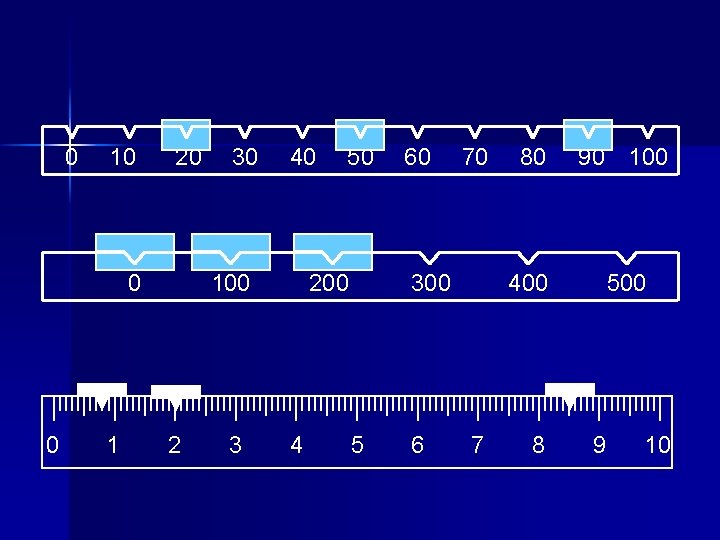
Measuring Mass Use a triple beam balance n First balance it at zero. n Then put item on n Then move one weight at a time n When balanced, add up the weights n
0 10 20 0 0 1 30 40 100 2 3 50 200 4 60 70 300 5 6 7 80 90 100 400 500 8 9 10
Graphs Give a visual representation of data n Summarizes data. n Two types of variables – Independent variable thing you have control over – Dependent variable thing that you don’t have control over. n Three types of graphs line, bar, and circle n
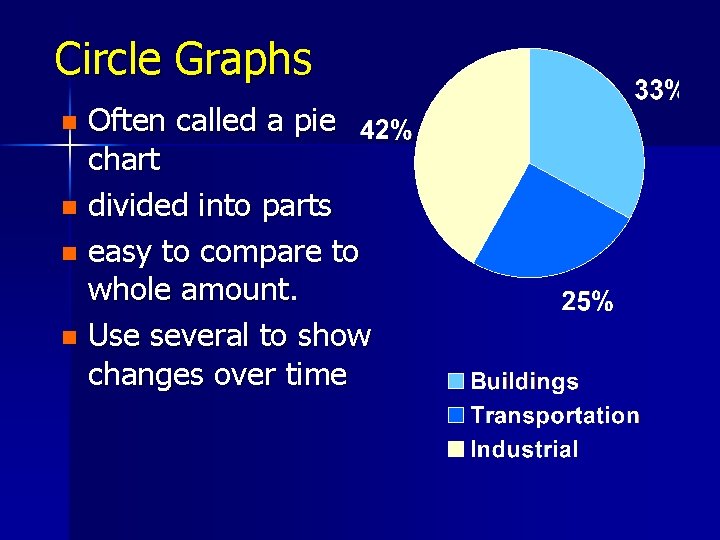
Circle Graphs Often called a pie chart n divided into parts n easy to compare to whole amount. n Use several to show changes over time n
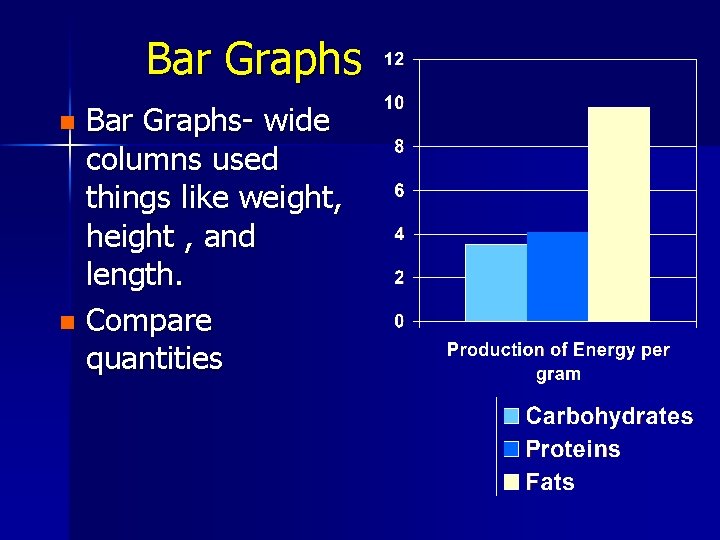
Bar Graphs- wide columns used things like weight, height , and length. n Compare quantities n
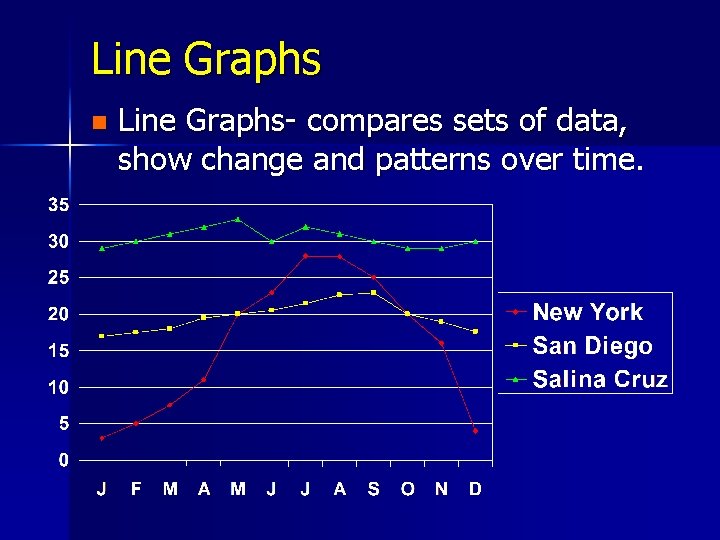
Line Graphs n Line Graphs- compares sets of data, show change and patterns over time.
Graphs include A title n Labeled axes n A consistent scale. n
Scientific Reasoning You have been a scientist your entire life! n If you have ever figured out how something works, fixed something that was broken without instructions, or solved a problem using your mind then you have used scientific reasoning. n Think like a scientist to have success in this class and in life. n
Review Quiz What is science? n Describe the 3 branches of science? n Compare the difference between a scientific law and scientific theory? n Which type of observation relies on measurable units? n Why do scientists use models? n List the steps of the scientific method? n Why is the metric system used by scientists? n
Review Quiz Which tools are used to measure distance, volume, and mass? n Which units are used to measure distance, volume, and mass? n List the 3 types of graphs and tell a scenario for how you would use each? n