
What is resistivity Which of the four examples
- Slides: 9
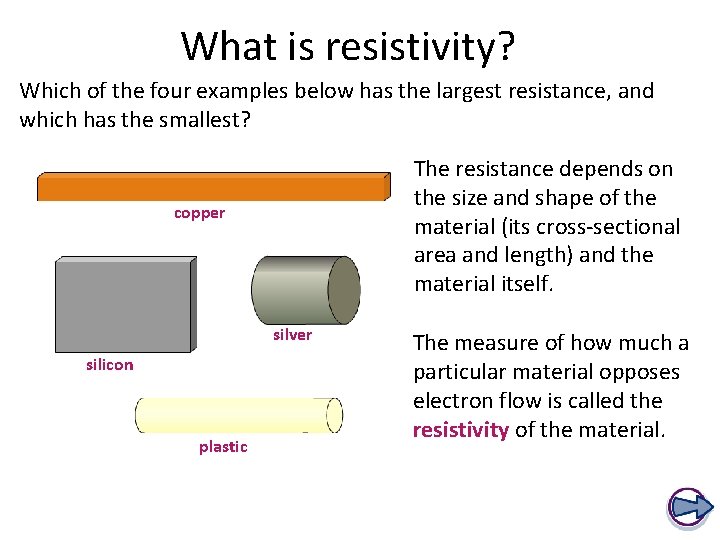
What is resistivity? Which of the four examples below has the largest resistance, and which has the smallest? The resistance depends on the size and shape of the material (its cross-sectional area and length) and the material itself. copper silver silicon plastic The measure of how much a particular material opposes electron flow is called the resistivity of the material.
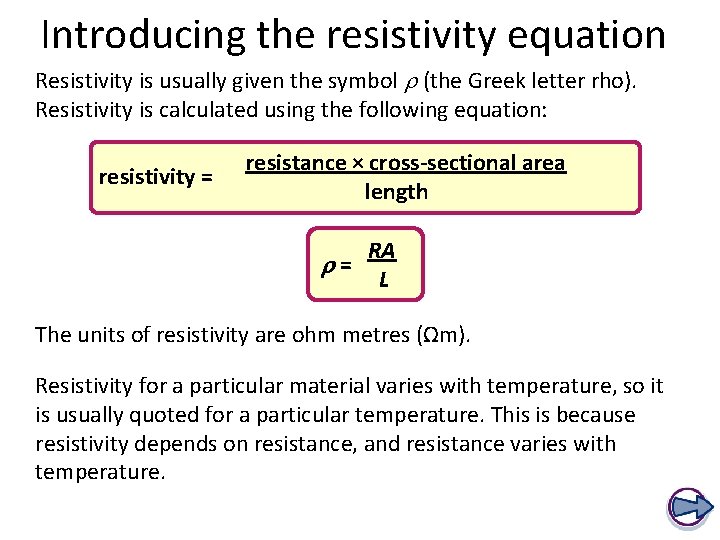
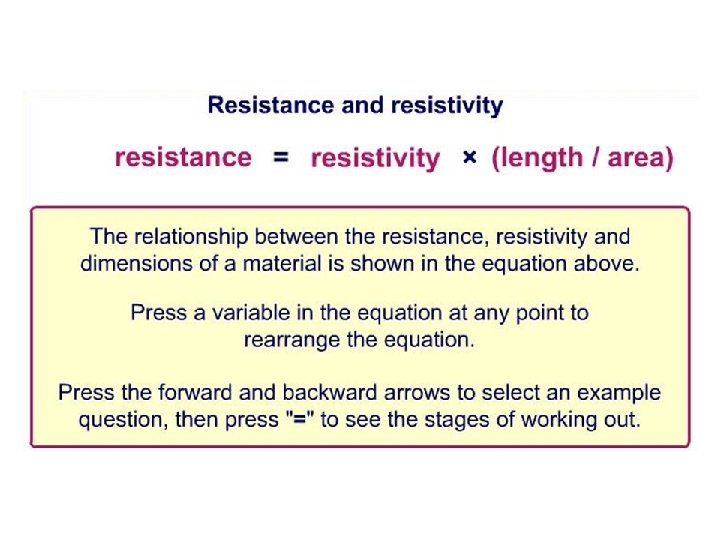
Introducing the resistivity equation Resistivity is usually given the symbol r (the Greek letter rho). Resistivity is calculated using the following equation: resistivity = resistance × cross-sectional area length RA r= L The units of resistivity are ohm metres (Ωm). Resistivity for a particular material varies with temperature, so it is usually quoted for a particular temperature. This is because resistivity depends on resistance, and resistance varies with temperature.
Electromotive force or EMF is the term given to the energy per unit charge by a source of emf such as a voltaic cell or electrical generator. It is basically the potential difference across a cell or other power supply.
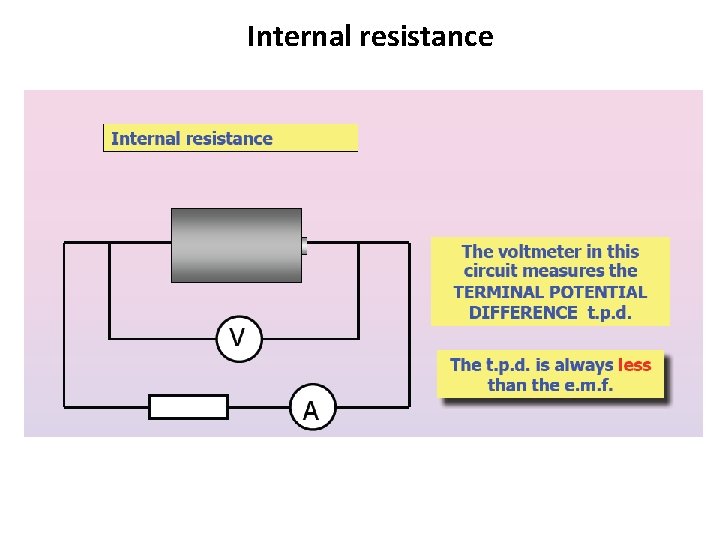
Internal resistance
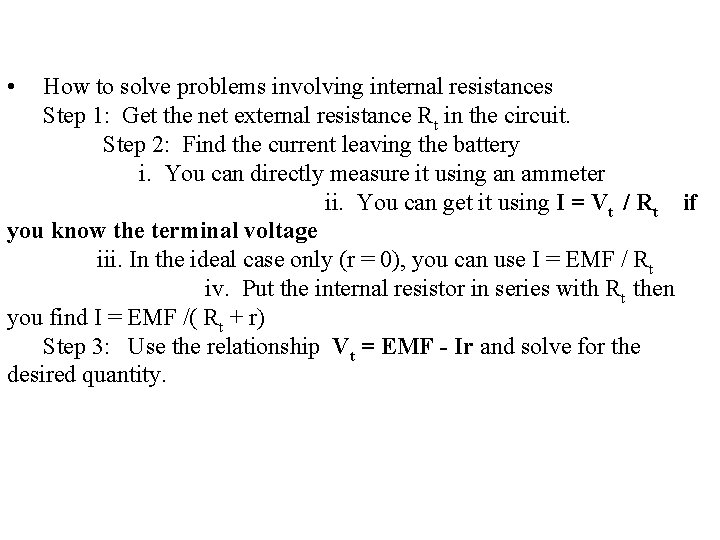
• How to solve problems involving internal resistances Step 1: Get the net external resistance Rt in the circuit. Step 2: Find the current leaving the battery i. You can directly measure it using an ammeter ii. You can get it using I = Vt / Rt if you know the terminal voltage iii. In the ideal case only (r = 0), you can use I = EMF / Rt iv. Put the internal resistor in series with Rt then you find I = EMF /( Rt + r) Step 3: Use the relationship Vt = EMF - Ir and solve for the desired quantity.
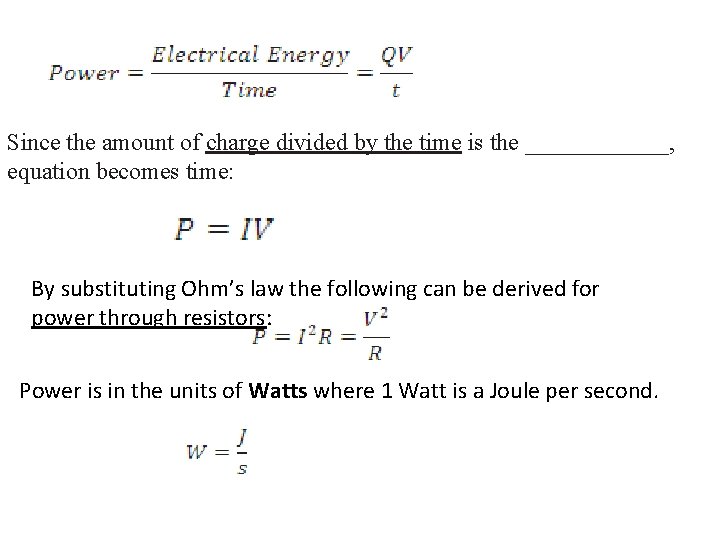
Electrical Power • When current flows through a circuit, electrical potential energy changes form as it passes through the different components. • As it passes through a light bulb the potential energy is changed into light and into _______. • The rate at which electrical energy changes form is called the electrical power.
Since the amount of charge divided by the time is the ______, equation becomes time: By substituting Ohm’s law the following can be derived for power through resistors: Power is in the units of Watts where 1 Watt is a Joule per second.