
What is Range Management Integrated Rangeland Management REM





- Slides: 26
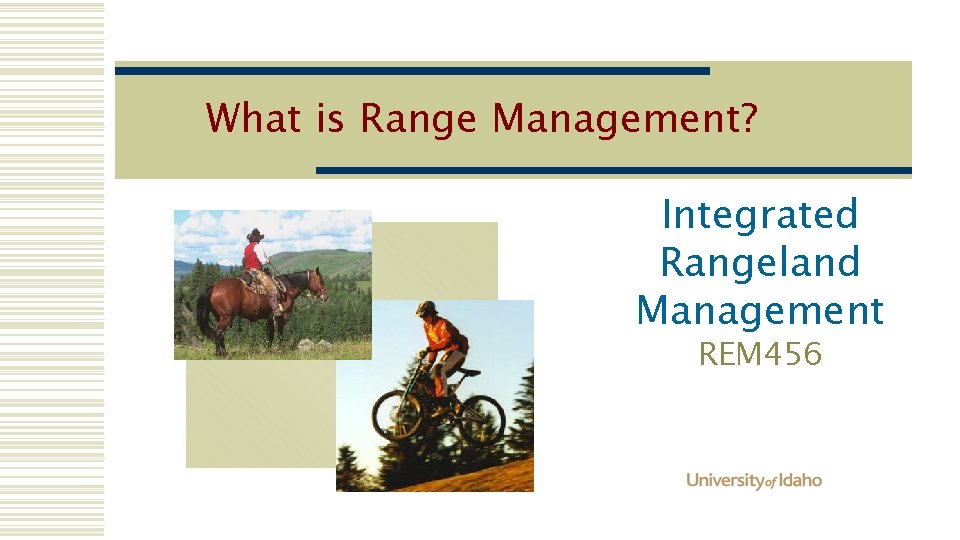
What is Range Management? Integrated Rangeland Management REM 456
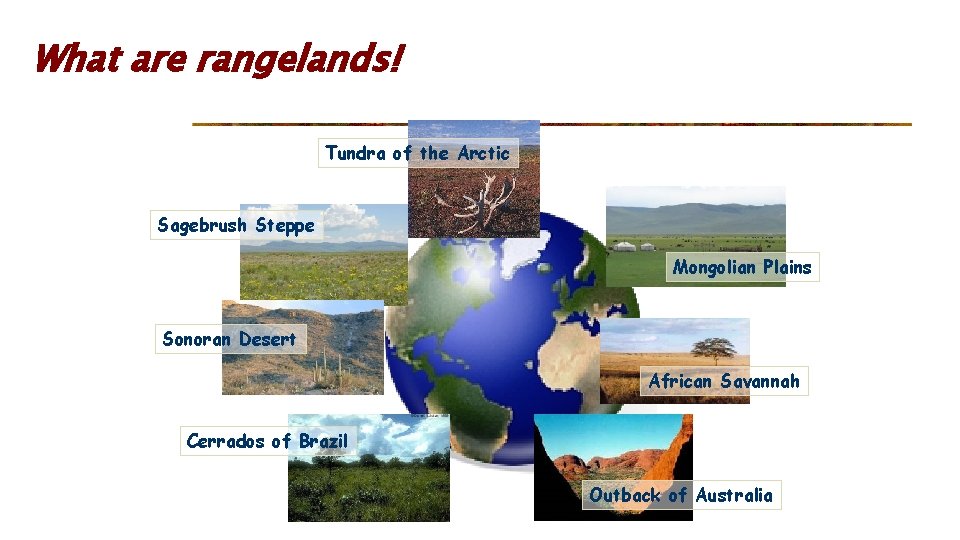
What are rangelands! Tundra of the Arctic Sagebrush Steppe Mongolian Plains Sonoran Desert African Savannah Cerrados of Brazil Outback of Australia
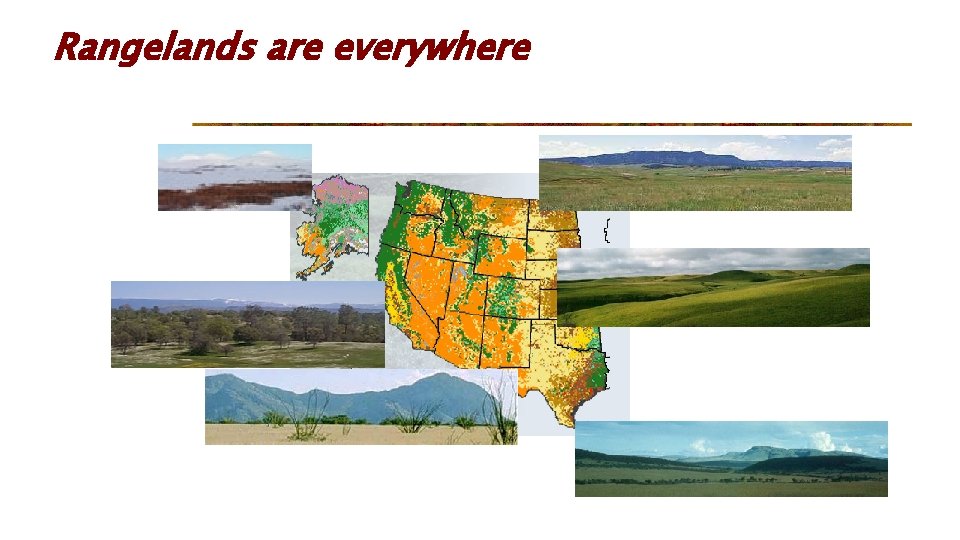
Rangelands are everywhere
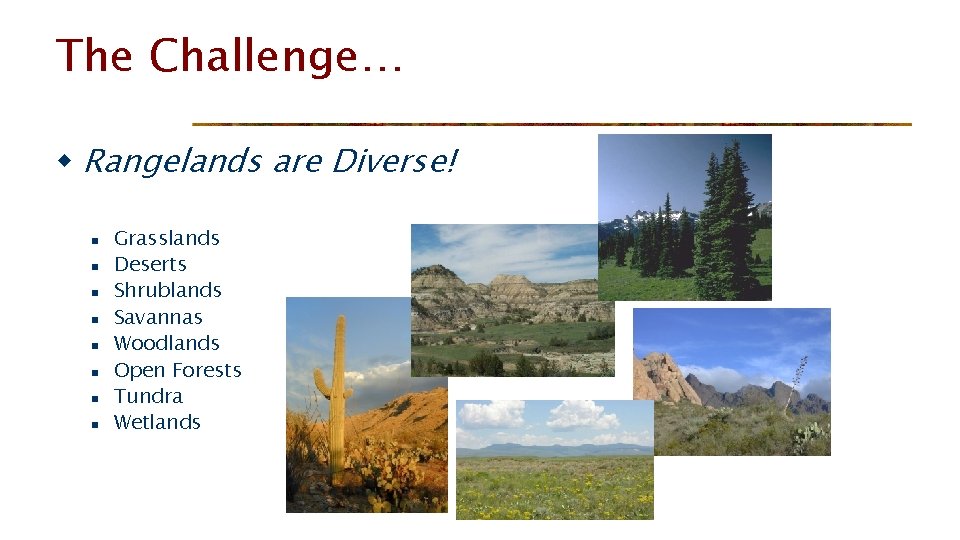
The Challenge… w Rangelands are Diverse! n n n n Grasslands Deserts Shrublands Savannas Woodlands Open Forests Tundra Wetlands
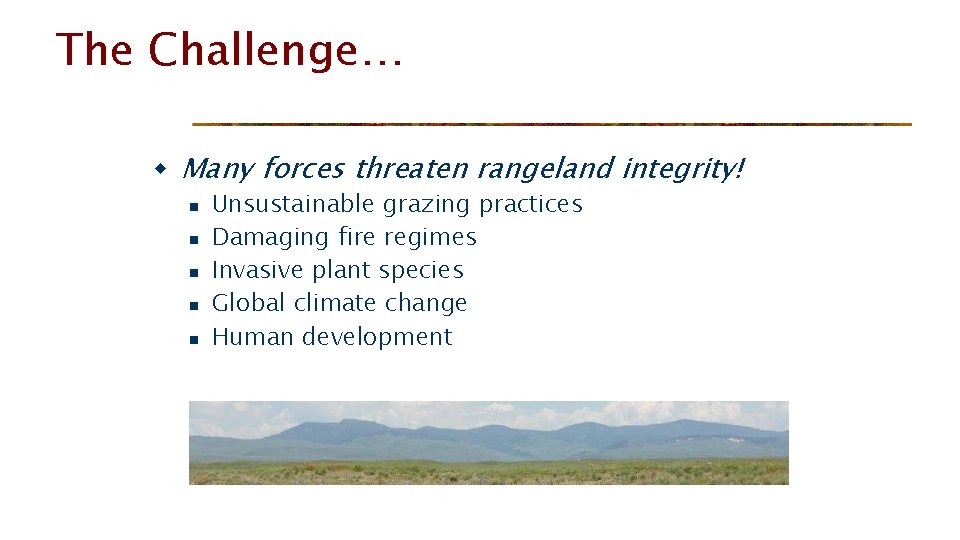
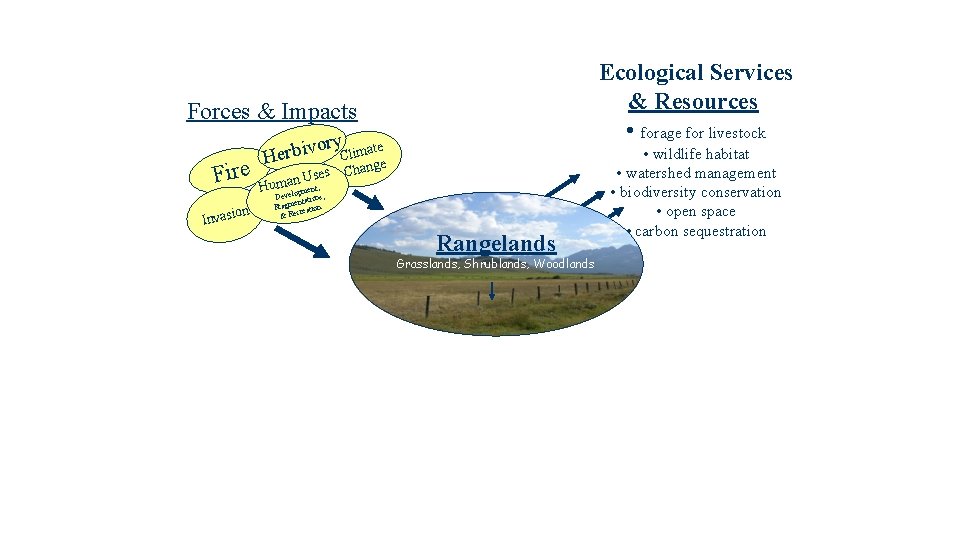
The Challenge… w Many forces threaten rangeland integrity! n n n Unsustainable grazing practices Damaging fire regimes Invasive plant species Global climate change Human development
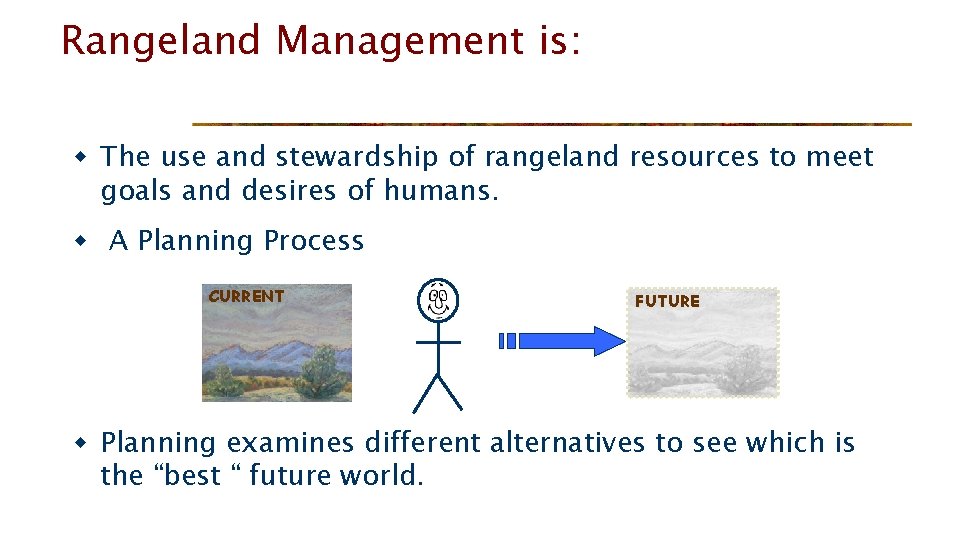
Rangeland Management is: w The use and stewardship of rangeland resources to meet goals and desires of humans. w A Planning Process CURRENT FUTURE w Planning examines different alternatives to see which is the “best “ future world.
What is “Best” w It depends on your point of view. n n n Preservationists Conservationists Utilitarianists Pragmatists Etc. etc.
What is “Best” w Preservationists - Emphasize protecting large areas of land from mining, timber, grazing and development so they can be enjoyed by present and future generations. Founders of the preservation movement were John Muir and Aldo Leopold. w Conservationists - View land as a resource to be used now to enhance economic growth. But, land must be protected from degradation by efficient management, based on scientific principles, for sustained yield and multiple use. Early conservationists were T. R. Roosevelt, Gifford Pinchot, and John Wesley Powell. w Utilitarianists - View land as a substrate for saleable products. Management is based on land manipulation and exogenous inputs (e. g. , fertilizer or herbicides) are usually required to keep production at an optimum level.
Rangeland Management Source of Decision? ? ? CURRENT ? ? FUTURE
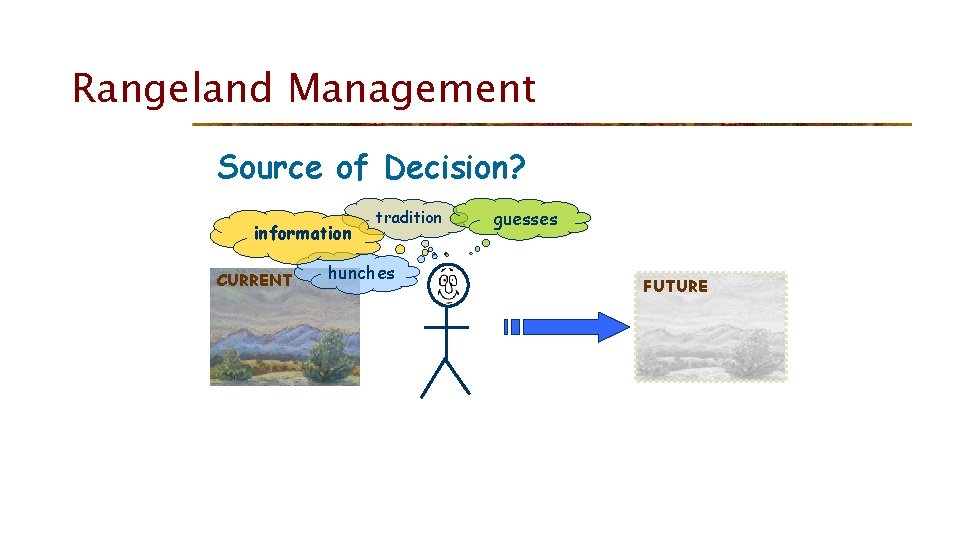
Rangeland Management Source of Decision? information CURRENT tradition hunches guesses FUTURE
Why do we need science? w Mangers must integrate scientific knowledge with idea, hunches, traditions, etc. , to make wise decisions. w To understand the physical, biological, and social processes that affect rangelands. w To discover principles up which to base the wise use of rangelands. w Others?
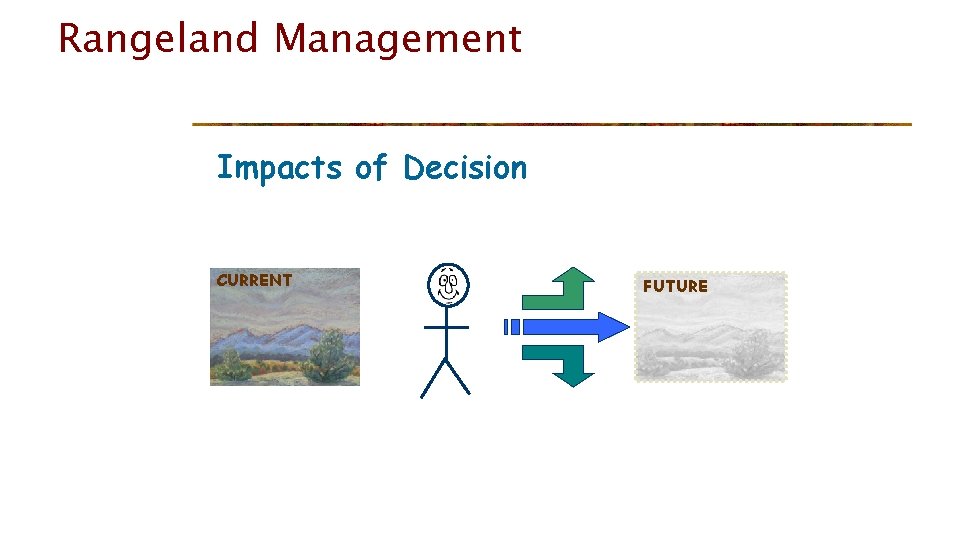
Rangeland Management Impacts of Decision CURRENT FUTURE
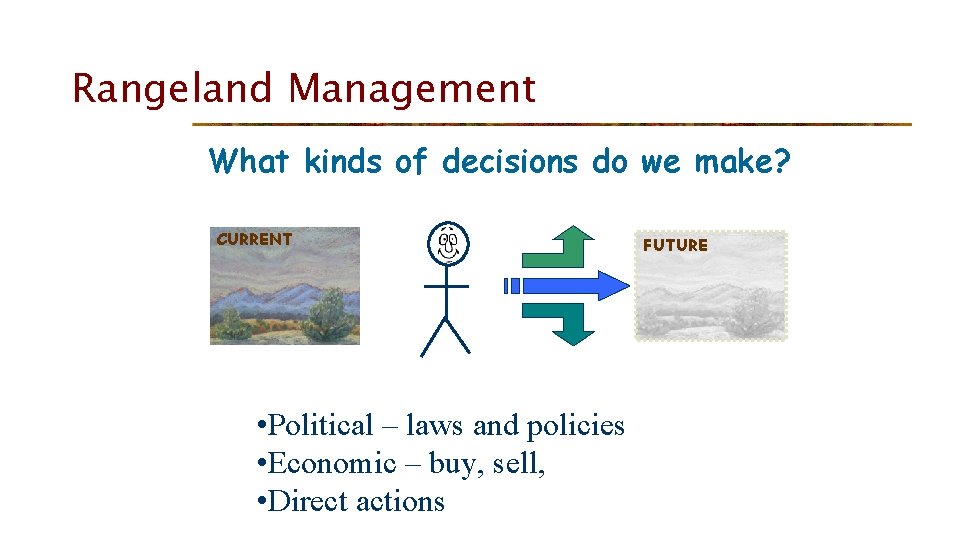
Rangeland Management What kinds of decisions do we make? CURRENT FUTURE
Rangeland Management What kinds of decisions do we make? CURRENT • Political – laws and policies • Economic – buy, sell, • Direct actions FUTURE
What is the role of education?
What is the role of education? w Convey what is known to society w Stop non-objective views w Lead to wise land use discussion and support for management actions.
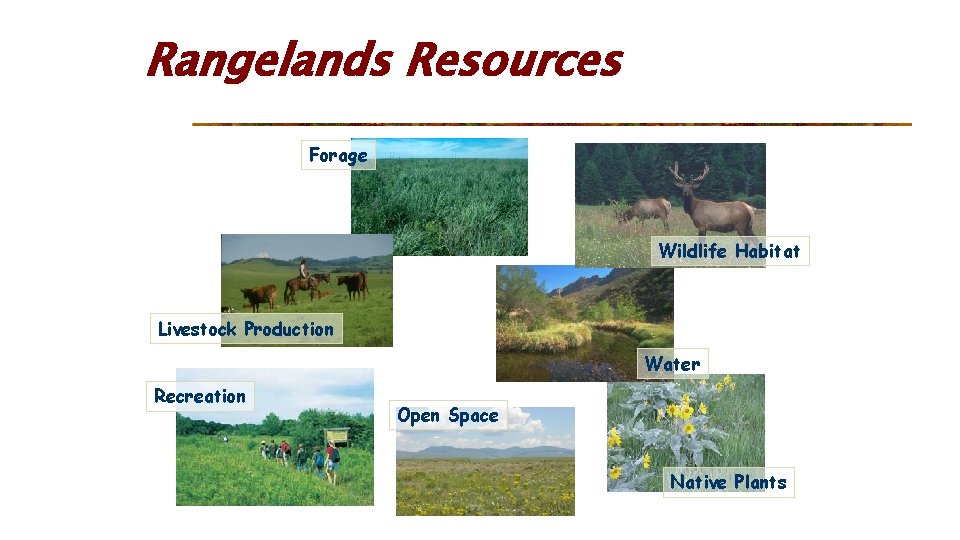
Rangeland Management is: w The use and stewardship of rangeland resources to meet goals and desires of humans. w What do people want from rangelands?
Rangelands Resources Forage Wildlife Habitat Livestock Production Water Recreation Open Space Native Plants
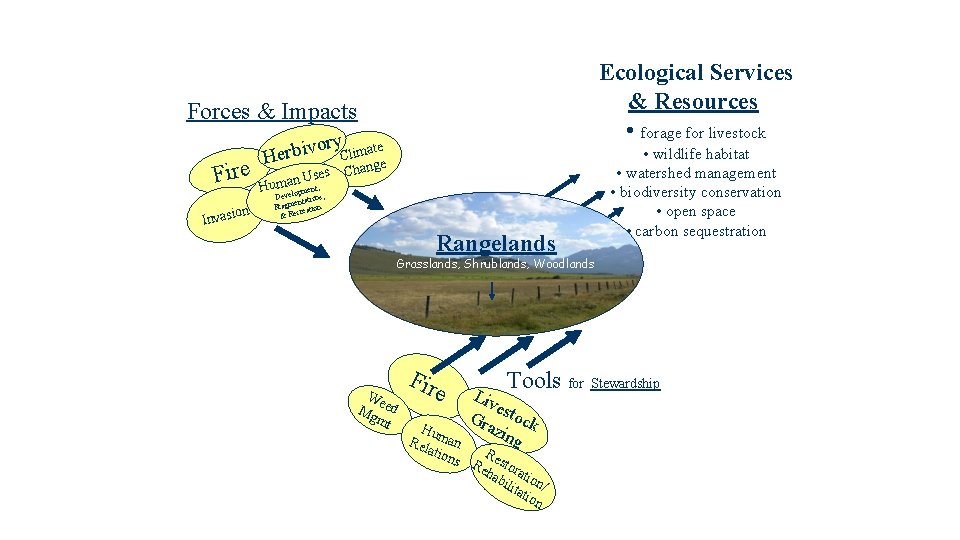
Rangeland Management is: w The use and stewardship of rangeland resources to meet goals and desires of humans. w What tools do we have for Range Management?
Ecological Services & Resources • forage for livestock Forces & Impacts Fire on Invasi vor i b r e H y te Clima e s Chang e s U n Humevaelopment, , D ons entati Fragm reation & Rec Rangelands Grasslands, Shrublands, Woodlands • wildlife habitat • watershed management • biodiversity conservation • open space • carbon sequestration
Ecological Services & Resources • forage for livestock Forces & Impacts Fire on Invasi vor i b r e H y te Clima e s Chang e s U n Humevaelopment, , D ons entati Fragm reation & Rec Rangelands • wildlife habitat • watershed management • biodiversity conservation • open space • carbon sequestration Grasslands, Shrublands, Woodlands We Mg ed mt Fir e Tools for Stewardship Liv e Gra stock zin g Hu Rel man atio ns R Rest eha orat bil ion ita / tio n
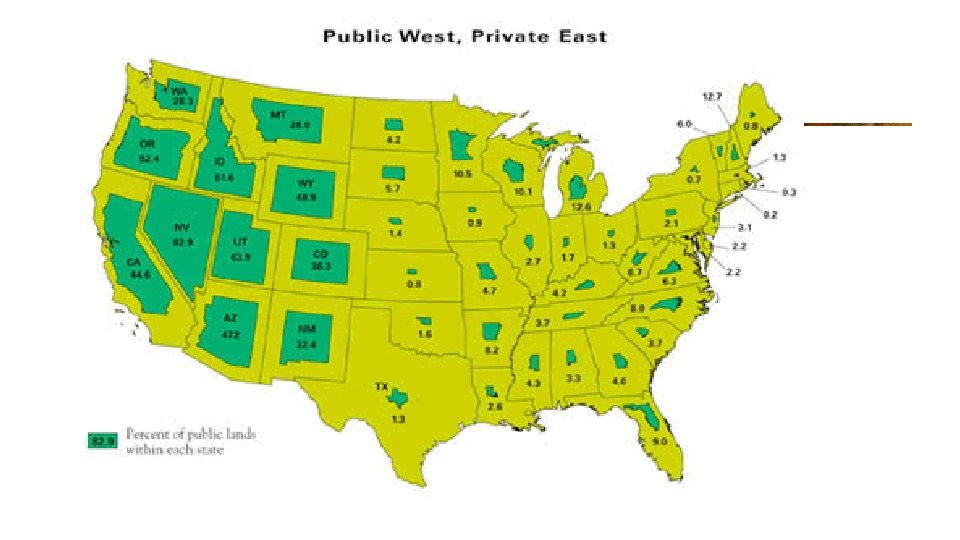
Rangeland Management – Basic Concepts w Rangelands are renewable resources; they can produce on a sustained yield basis if properly managed. w Rangeland must be managed to maintain soil and water quality and health and basic biogeochemical cycles. w Rangelands are managed by extensive and ecological principles, not intensive and agronomic principles.
Rangeland Management – 6 Basic Concepts w Rangelands produce a variety of products (e. g. , forage, recreation, water) therefore principles of multiple use are important in range management. w Many important public concerns on rangeland happen across multiple ownerships (i. e. , fire, water quality, weeds, open space) w You can’t please all the people all the time. What one person wants may not meet the desires or plans of another.
Principles of Rangeland Management w Rangelands change through succession and disturbance. All we can really do as managers is apply, control, or respond to disturbance based on our knowledge of succession. w The only constant on rangeland is CHANGE. Conditions change from place to place (spatially) and time to time (temporally). We need to understand accept change. w If you do nothing the land will probably not return to some pre-European paradise.
What is Range Management? Integrated Rangeland Management REM 456