
What is Raman spectroscopy When and Who In

- Slides: 7
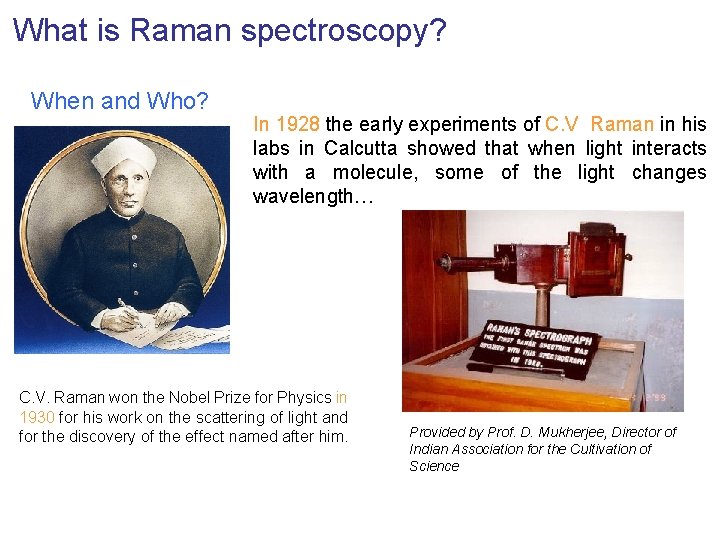
What is Raman spectroscopy? When and Who? In 1928 the early experiments of C. V Raman in his labs in Calcutta showed that when light interacts with a molecule, some of the light changes wavelength… C. V. Raman won the Nobel Prize for Physics in 1930 for his work on the scattering of light and for the discovery of the effect named after him. Provided by Prof. D. Mukherjee, Director of Indian Association for the Cultivation of Science
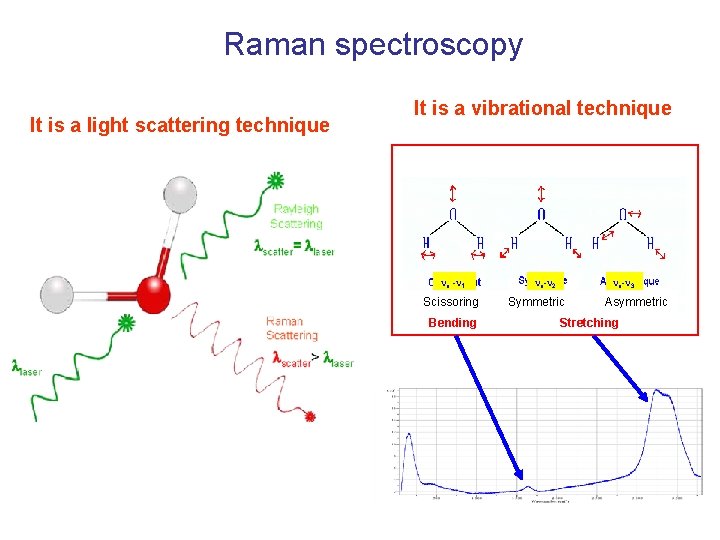
Raman spectroscopy It is a light scattering technique It is a vibrational technique o - 1 Scissoring Bending o- 2 o- 3 Symmetric Asymmetric Stretching
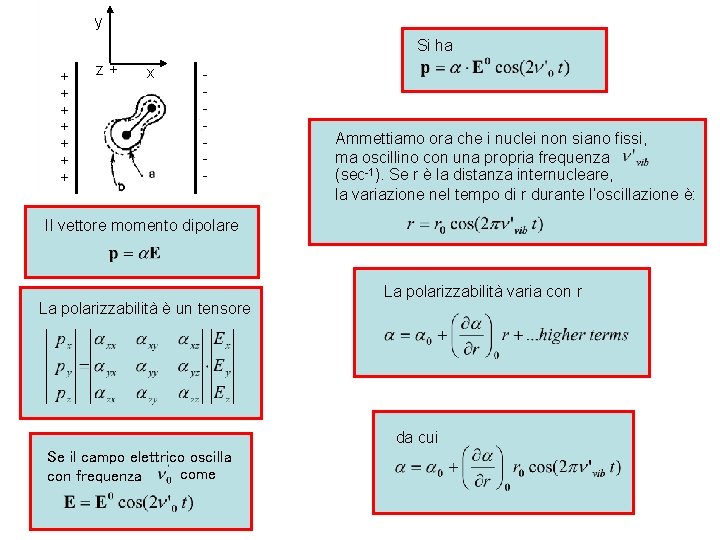
y Si ha + + + + z+ x - Ammettiamo ora che i nuclei non siano fissi, ma oscillino con una propria frequenza (sec-1). Se r è la distanza internucleare, la variazione nel tempo di r durante l’oscillazione è: Il vettore momento dipolare La polarizzabilità è un tensore La polarizzabilità varia con r da cui Se il campo elettrico oscilla come con frequenza
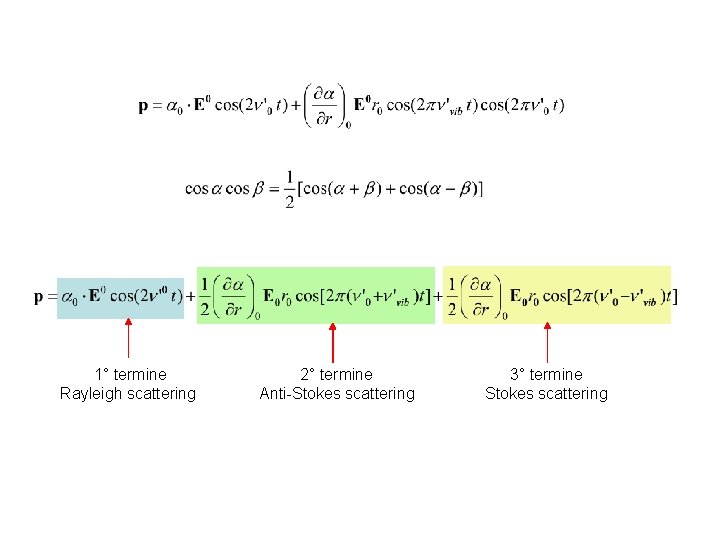
1° termine Rayleigh scattering 2° termine Anti-Stokes scattering 3° termine Stokes scattering
Raman spectroscopy Infrared spectroscopy E = h ’ Absorption =1 =0 (a) Inelastic collision (b) Elastic collision =1 =0 (c) Inelastic collision =1 =0
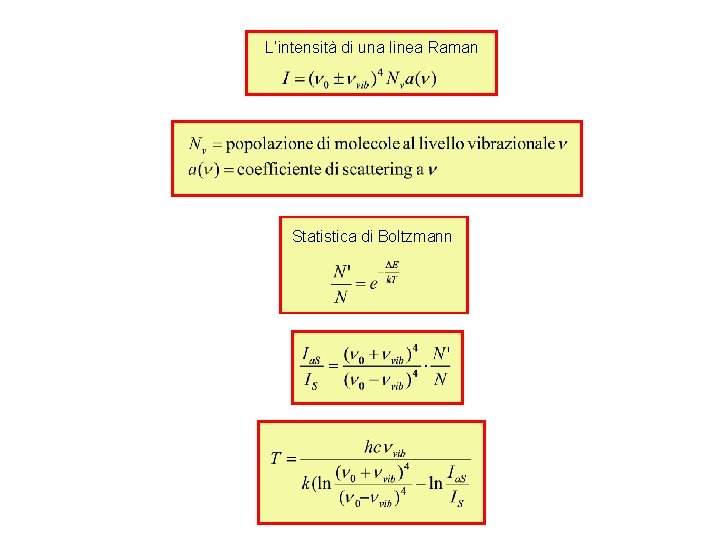
L’intensità di una linea Raman Statistica di Boltzmann