
What is Quality Improvement How can Key Principles

- Slides: 42
What is Quality Improvement? How can Key Principles be Applied in HIV Care? The Quality Academy Tutorial 2 2
Learning Objectives: You Will Learn About… • • • 2 Learning Objectives Defining quality in terms of client needs Focus on processes, rather than on people Quality of HIV care in the U. S. Why we seek to improve it Examples of improvements in HIV care quality
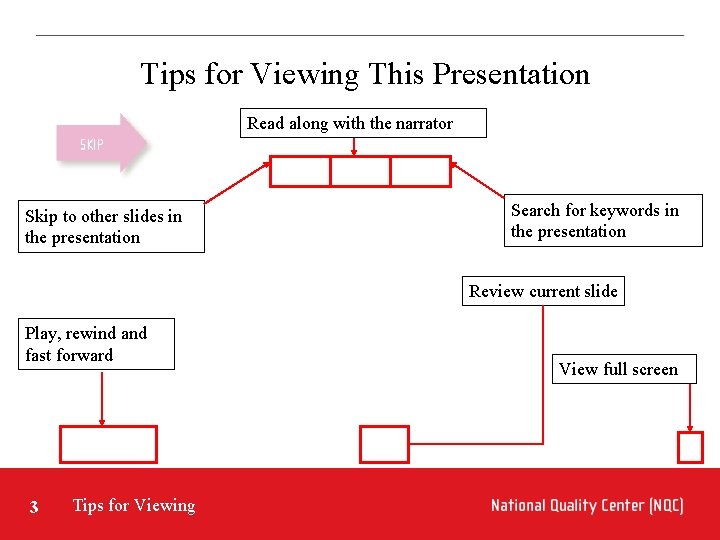
Tips for Viewing This Presentation Read along with the narrator Skip to other slides in the presentation Search for keywords in the presentation Review current slide Play, rewind and fast forward 3 Tips for Viewing View full screen
Key Question What do we mean by quality, and how does this definition relate to the provision of HIV care and services? 4 Defining Quality
How the Institute of Medicine Defines Quality: “Quality of care is the degree to which health services for individuals and populations increase the likelihood of desired health outcomes and are consistent with current professional knowledge. ” Institute of Medicine. Medicare: A Strategy for Quality Assurance. Vol. 1. (1990) 5 Defining Quality
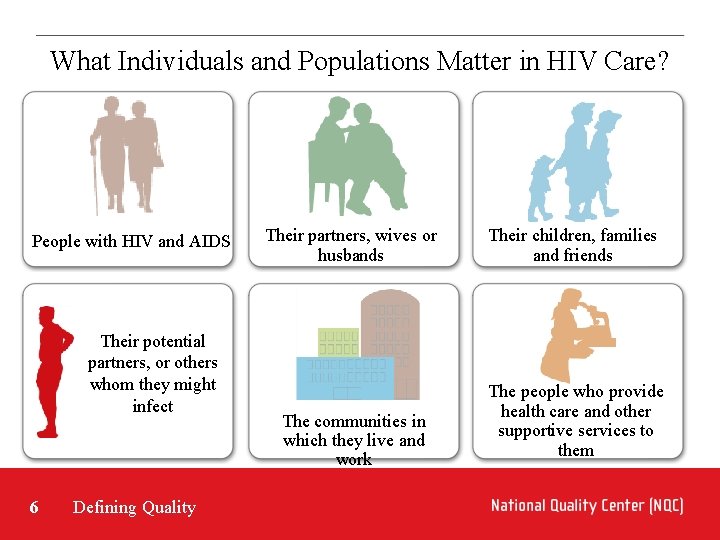
What Individuals and Populations Matter in HIV Care? People with HIV and AIDS Their potential partners, or others whom they might infect 6 Defining Quality Their partners, wives or husbands The communities in which they live and work Their children, families and friends The people who provide health care and other supportive services to them
What are Their Desired Health Outcomes? • Long life • Stable health • Ability to work, play, contribute to their families and their community 7 Defining Quality
Current Professional Knowledge: What Helps Us Achieve These Outcomes? • Evidence-based care • Antiretroviral treatment • Focus on TB, PCP, gynecological complications in women, etc. • Support for adherence to treatment • Education • Counseling • Support for infected individuals and loved ones • Care that is coordinated across disciplines 8 Defining Quality
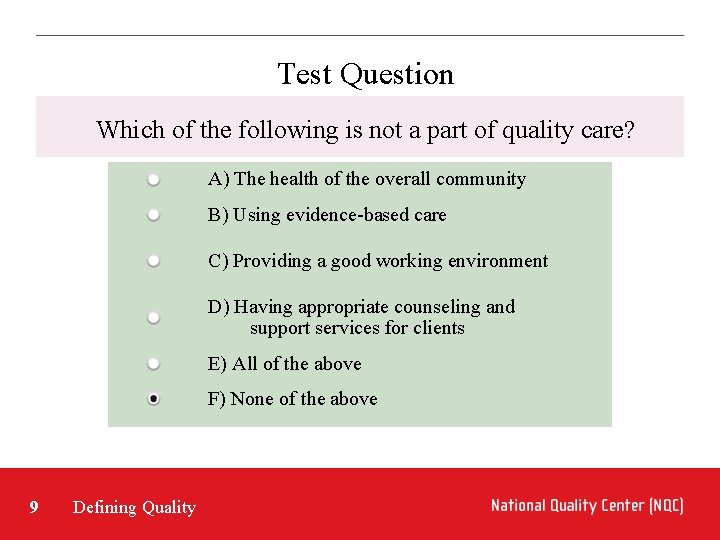
Test Question Which of the following is not a part of quality care? A) The health of the overall community B) Using evidence-based care C) Providing a good working environment D) Having appropriate counseling and support services for clients E) All of the above F) None of the above 9 Defining Quality
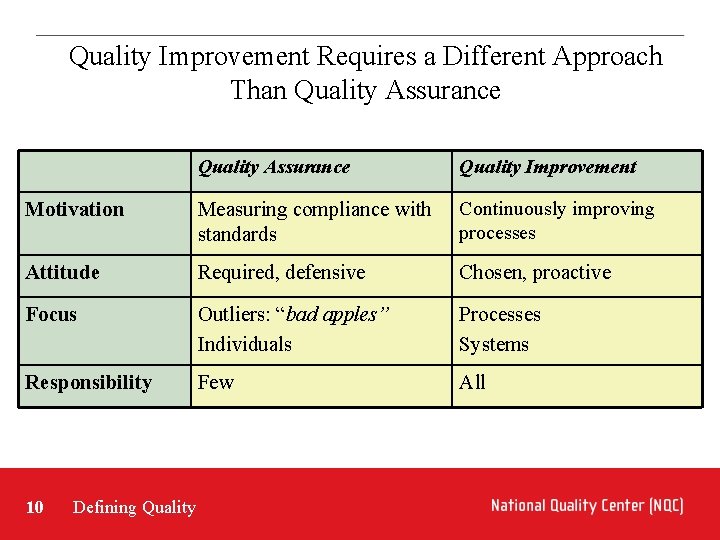
Quality Improvement Requires a Different Approach Than Quality Assurance Quality Improvement Motivation Measuring compliance with standards Continuously improving processes Attitude Required, defensive Chosen, proactive Focus Outliers: “bad apples” Individuals Processes Systems Responsibility Few All 10 Defining Quality
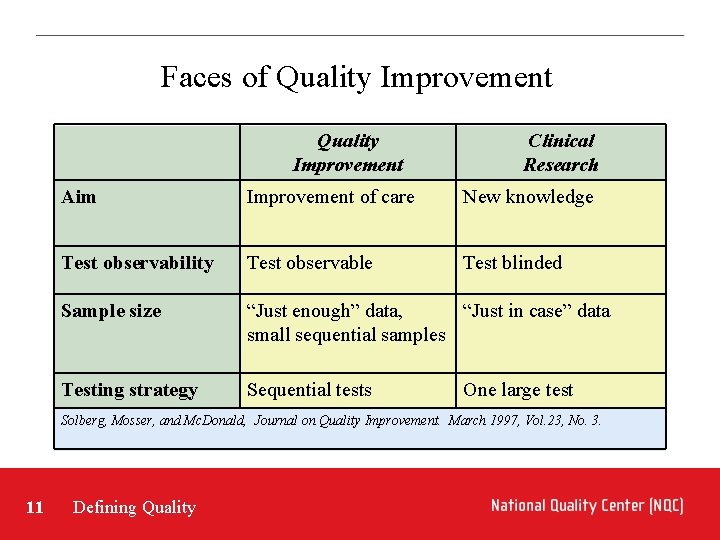
Faces of Quality Improvement Clinical Research Aim Improvement of care New knowledge Test observability Test observable Test blinded Sample size “Just enough” data, “Just in case” data small sequential samples Testing strategy Sequential tests One large test Solberg, Mosser, and Mc. Donald, Journal on Quality Improvement. March 1997, Vol. 23, No. 3. 11 Defining Quality
Principles on the Quality Improvement Journey… “Quality improvement is a journey of many small steps. ” 12 Defining Quality
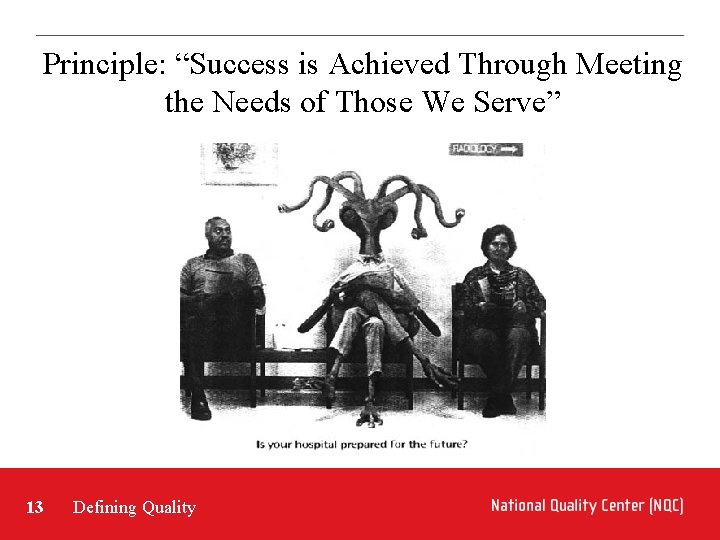
Principle: “Success is Achieved Through Meeting the Needs of Those We Serve” 13 Defining Quality
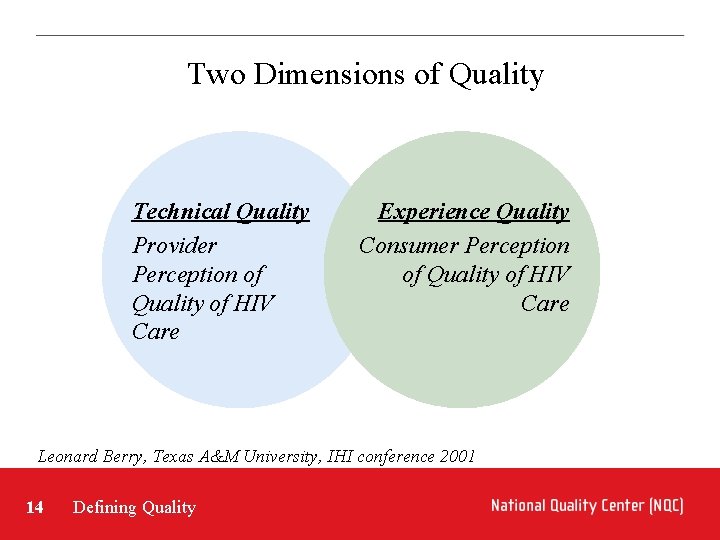
Two Dimensions of Quality Technical Quality Provider Perception of Quality of HIV Care Experience Quality Consumer Perception of Quality of HIV Care Leonard Berry, Texas A&M University, IHI conference 2001 14 Defining Quality
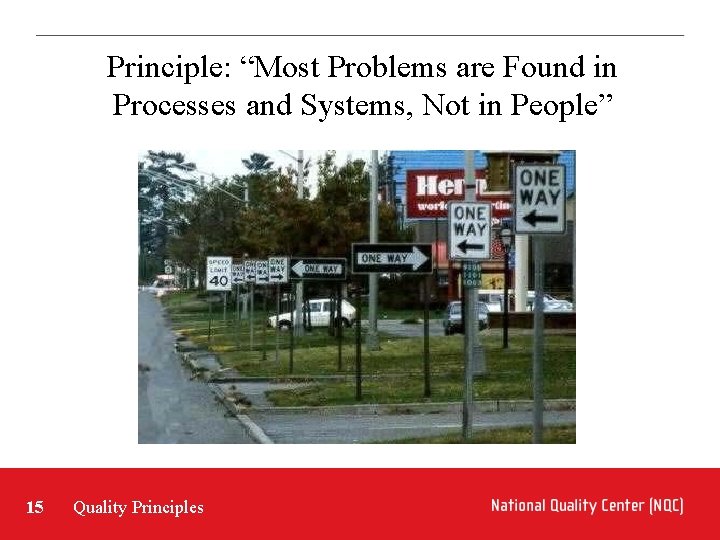
Principle: “Most Problems are Found in Processes and Systems, Not in People” 15 Quality Principles
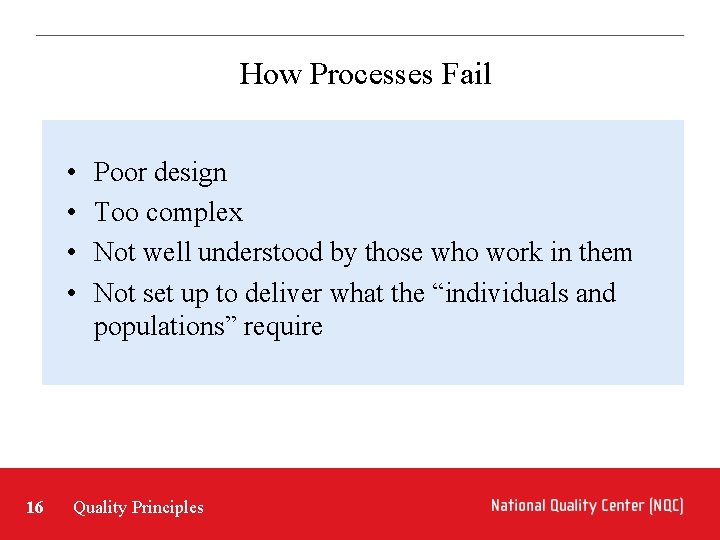
How Processes Fail • • 16 Poor design Too complex Not well understood by those who work in them Not set up to deliver what the “individuals and populations” require Quality Principles
Failed Processes Affect Employees as Well • They get frustrated • Their workload increases (more “non-real work”) • They can be unfairly blamed • They don’t get the satisfaction of doing a good job 17 Quality Principles
Why we Focus on Processes • “Each process is perfectly designed to get the results it achieves” • Getting a better result therefore requires redesigning the process 18 Quality Principles
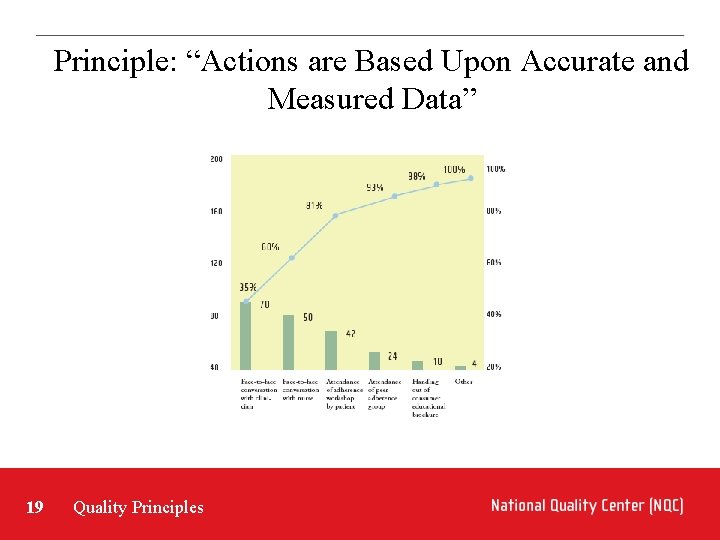
Principle: “Actions are Based Upon Accurate and Measured Data” 19 Quality Principles
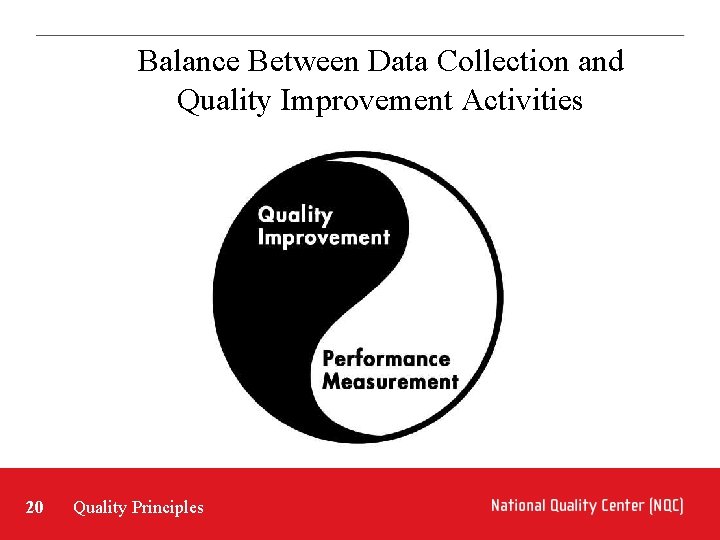
Balance Between Data Collection and Quality Improvement Activities 20 Quality Principles
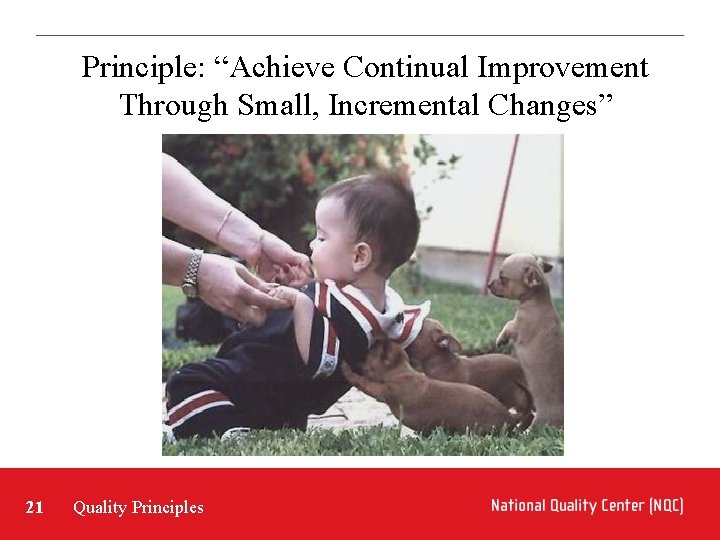
Principle: “Achieve Continual Improvement Through Small, Incremental Changes” 21 Quality Principles
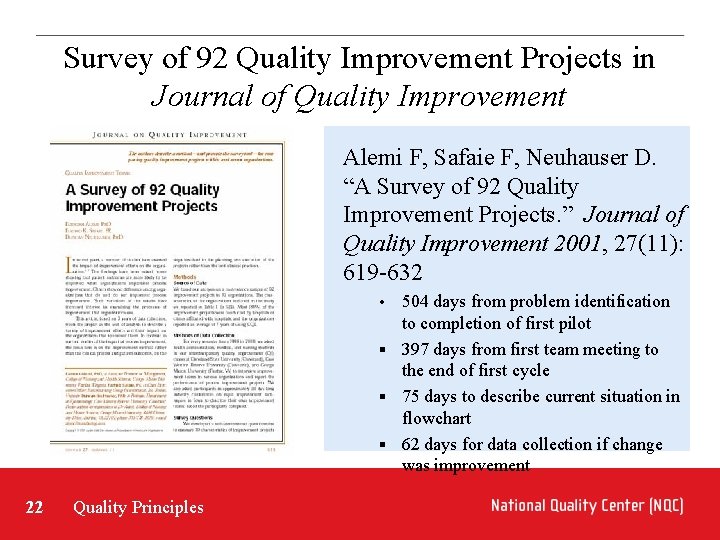
Survey of 92 Quality Improvement Projects in Journal of Quality Improvement Alemi F, Safaie F, Neuhauser D. “A Survey of 92 Quality Improvement Projects. ” Journal of Quality Improvement 2001, 27(11): 619 -632 504 days from problem identification to completion of first pilot § 397 days from first team meeting to the end of first cycle § 75 days to describe current situation in flowchart § 62 days for data collection if change was improvement • 22 Quality Principles
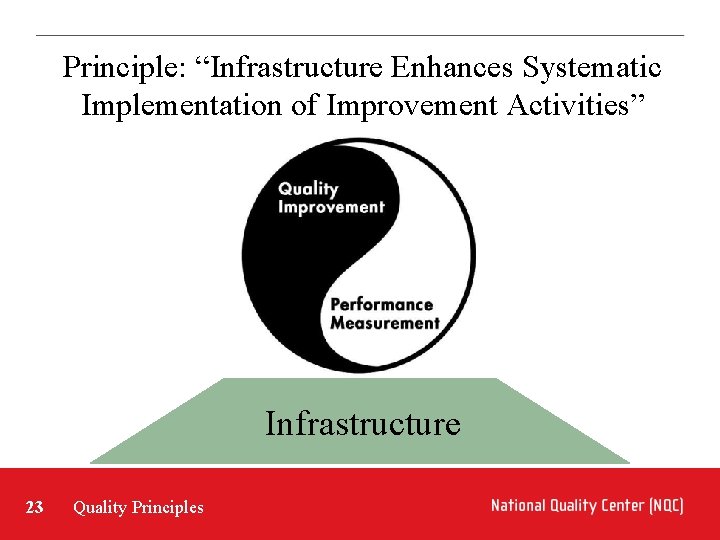
Principle: “Infrastructure Enhances Systematic Implementation of Improvement Activities” Infrastructure 23 Quality Principles
Principle: “Do not Reinvent the Wheel - Steal Shamelessly, Share Senselessly” 24 Quality Principles
Test Question What is the main difference between Quality Assurance and Quality Improvement? A) Quality Assurance uses mainly a team approach B) Quality Improvement focuses on statistical outliers for improvements C) Quality Assurance and Quality Improvement are practically the same D) None of the above 25 Quality Principles
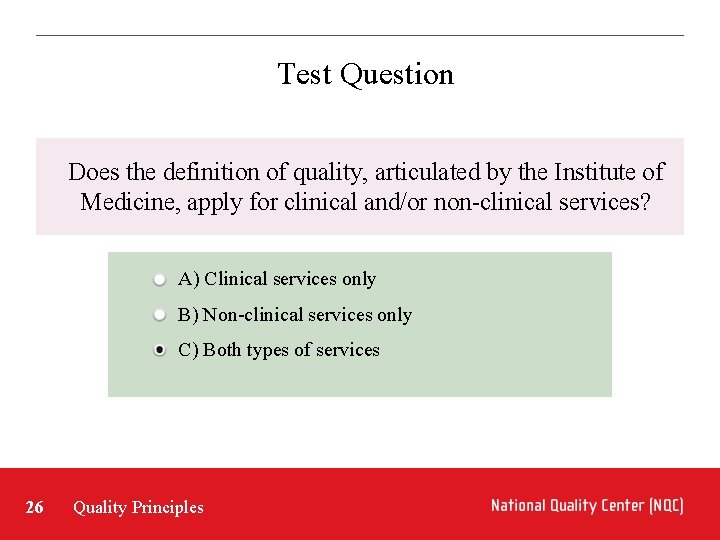
Test Question Does the definition of quality, articulated by the Institute of Medicine, apply for clinical and/or non-clinical services? A) Clinical services only B) Non-clinical services only C) Both types of services 26 Quality Principles
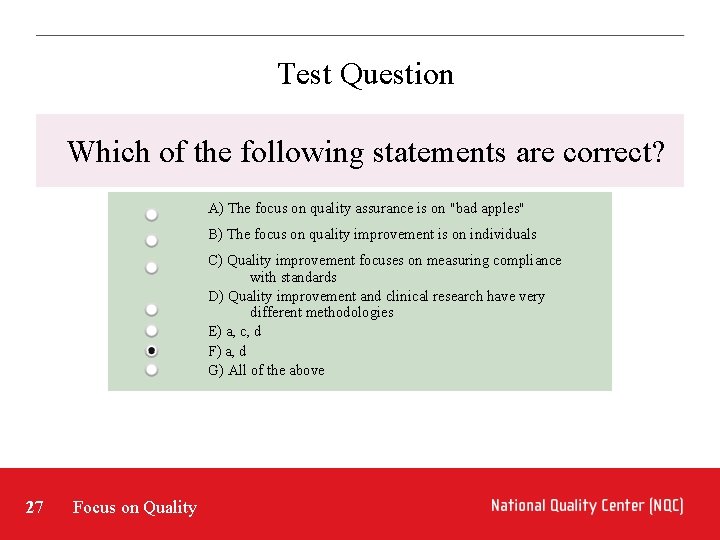
Test Question Which of the following statements are correct? A) The focus on quality assurance is on "bad apples" B) The focus on quality improvement is on individuals C) Quality improvement focuses on measuring compliance with standards D) Quality improvement and clinical research have very different methodologies E) a, c, d F) a, d G) All of the above 27 Focus on Quality
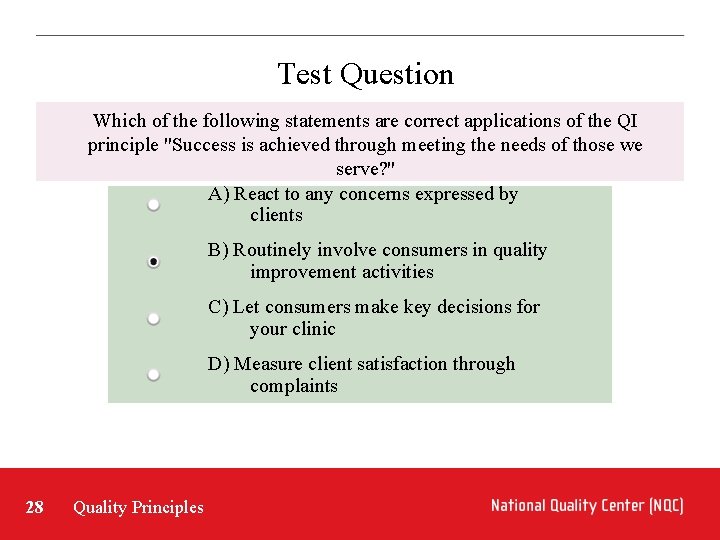
Test Question Which of the following statements are correct applications of the QI principle "Success is achieved through meeting the needs of those we serve? " A) React to any concerns expressed by clients B) Routinely involve consumers in quality improvement activities C) Let consumers make key decisions for your clinic D) Measure client satisfaction through complaints 28 Quality Principles
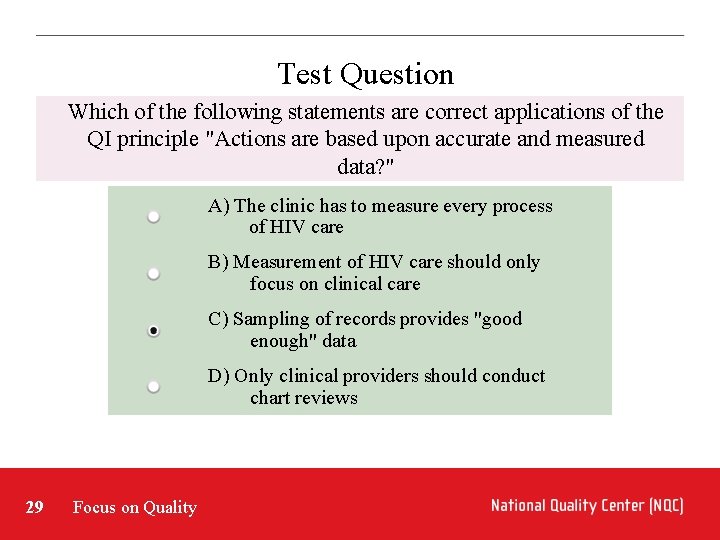
Test Question Which of the following statements are correct applications of the QI principle "Actions are based upon accurate and measured data? " A) The clinic has to measure every process of HIV care B) Measurement of HIV care should only focus on clinical care C) Sampling of records provides "good enough" data D) Only clinical providers should conduct chart reviews 29 Focus on Quality
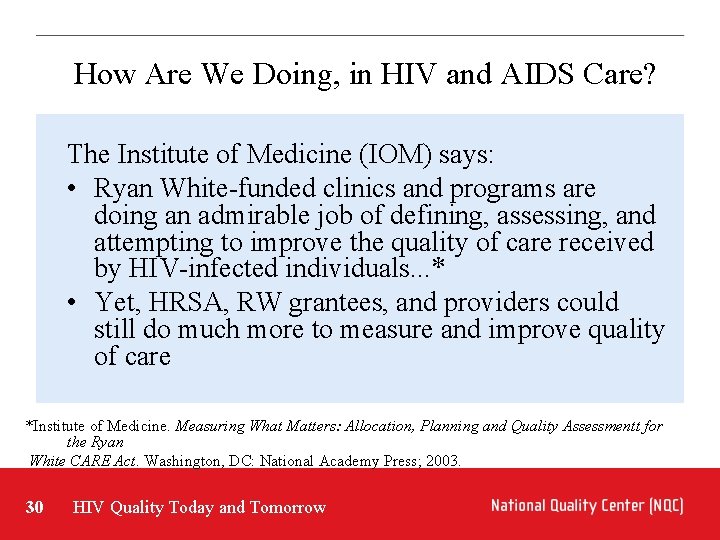
How Are We Doing, in HIV and AIDS Care? The Institute of Medicine (IOM) says: • Ryan White-funded clinics and programs are doing an admirable job of defining, assessing, and attempting to improve the quality of care received by HIV-infected individuals. . . * • Yet, HRSA, RW grantees, and providers could still do much more to measure and improve quality of care *Institute of Medicine. Measuring What Matters: Allocation, Planning and Quality Assessmentt for the Ryan White CARE Act. Washington, DC: National Academy Press; 2003. 30 HIV Quality Today and Tomorrow
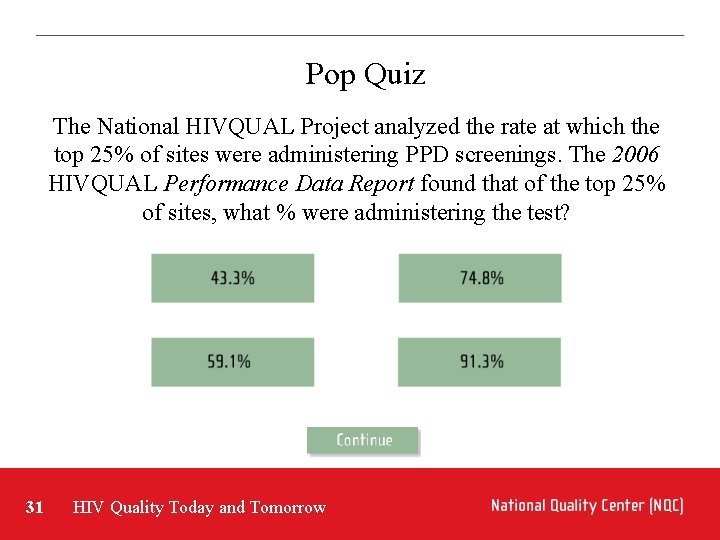
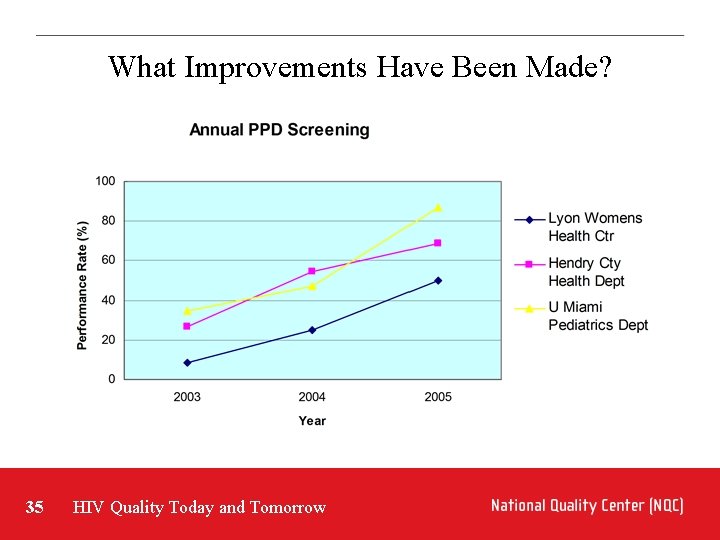
Pop Quiz The National HIVQUAL Project analyzed the rate at which the top 25% of sites were administering PPD screenings. The 2006 HIVQUAL Performance Data Report found that of the top 25% of sites, what % were administering the test? 31 HIV Quality Today and Tomorrow
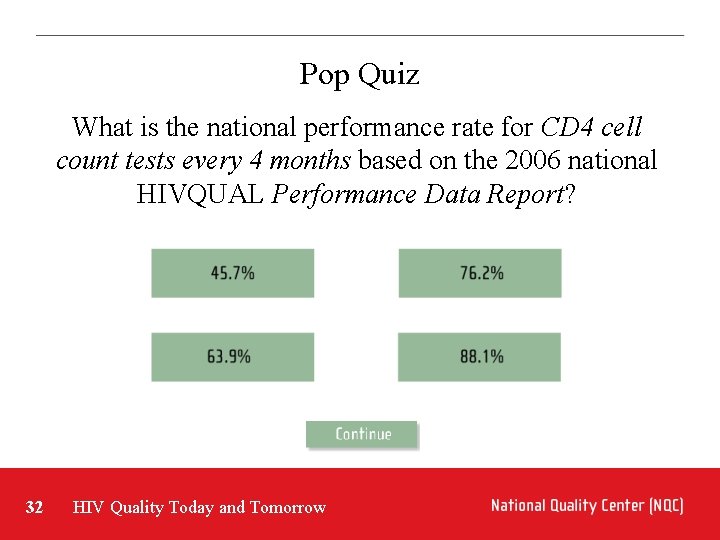
Pop Quiz What is the national performance rate for CD 4 cell count tests every 4 months based on the 2006 national HIVQUAL Performance Data Report? 32 HIV Quality Today and Tomorrow
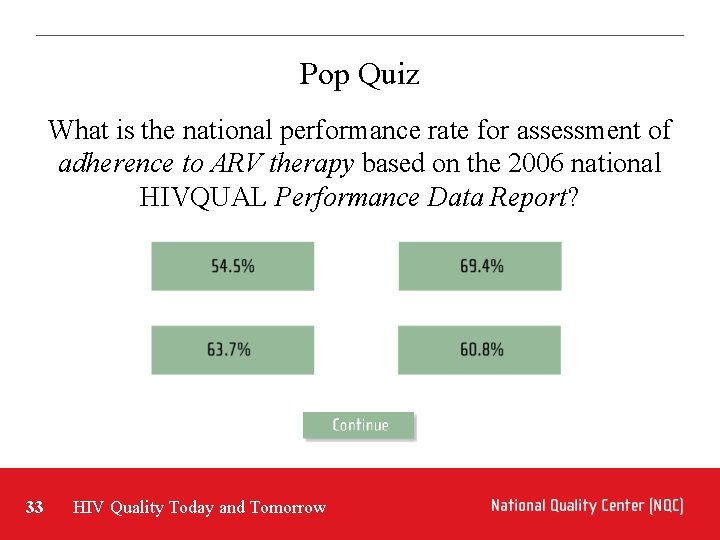
Pop Quiz What is the national performance rate for assessment of adherence to ARV therapy based on the 2006 national HIVQUAL Performance Data Report? 33 HIV Quality Today and Tomorrow
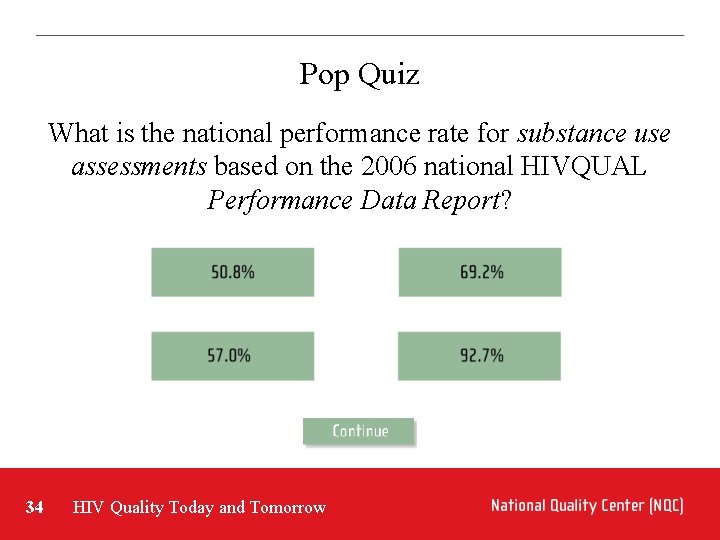
Pop Quiz What is the national performance rate for substance use assessments based on the 2006 national HIVQUAL Performance Data Report? 34 HIV Quality Today and Tomorrow
What Improvements Have Been Made? 35 HIV Quality Today and Tomorrow
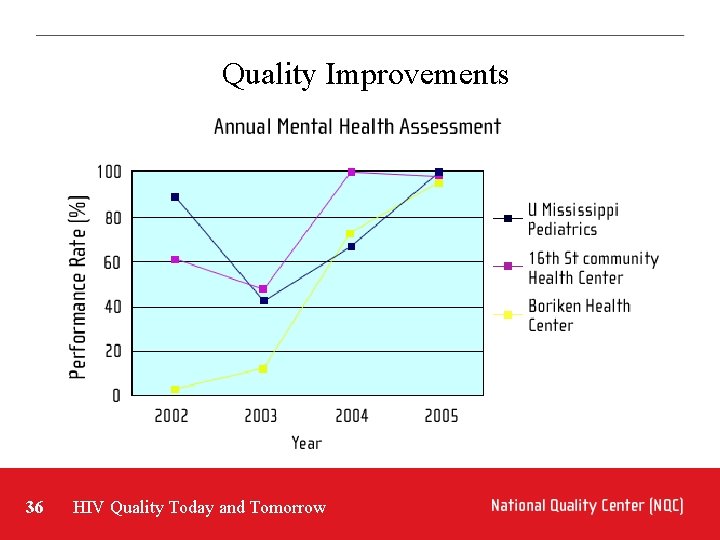
Quality Improvements 36 HIV Quality Today and Tomorrow
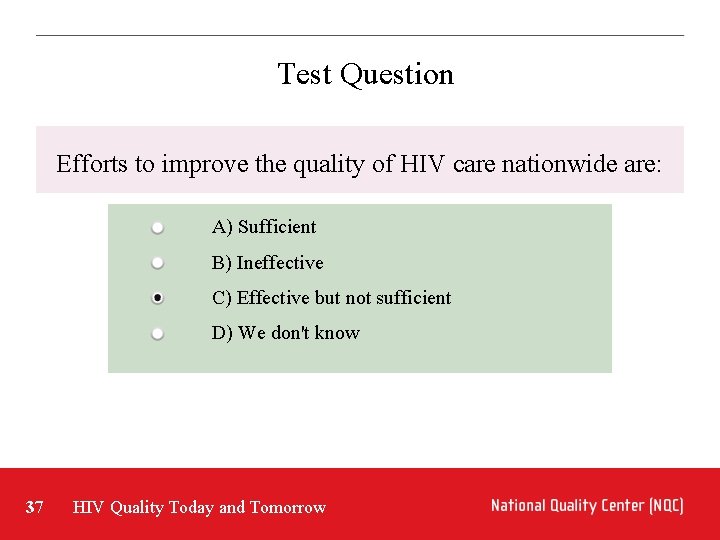
Test Question Efforts to improve the quality of HIV care nationwide are: A) Sufficient B) Ineffective C) Effective but not sufficient D) We don't know 37 HIV Quality Today and Tomorrow
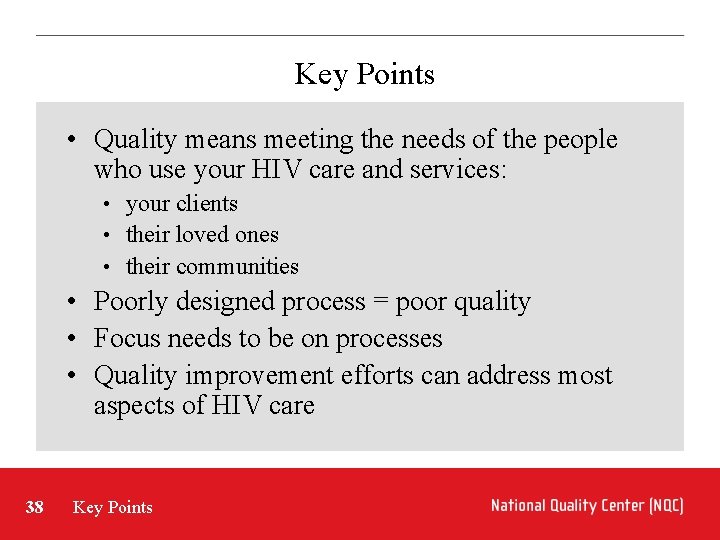
Key Points • Quality means meeting the needs of the people who use your HIV care and services: • your clients • their loved ones • their communities • Poorly designed process = poor quality • Focus needs to be on processes • Quality improvement efforts can address most aspects of HIV care 38 Key Points
Resources • Institute of Medicine. Measuring What Matters: Allocation, Planning, and Quality Assessment for the Ryan White CARE Act. Washington, DC: The National Academies Press, 2003. • Health Resources and Services Administration, HIV/AIDS Bureau. Quality Management: Technical Assistance Manual. Rockville, MD: HRSA/HAB, 2003. http: //66. 98. 100/NQC/index. cfm/5659 • Berwick, Donald M, et. al. , Curing Health Care. San Francisco, Jossey-Bass, 1990. • Improvement stories on HIV care can be found at http: //www. ihi. org/IHI/Topics/HIVAIDS/HIVDisease. General/Improve ment. Stories/ 39 Resources
tra N l o, no N t ve o, r no y m ta u t a ch ll tle eu lit N , a es Y Y es , a lo t Please Rate This Tutorial By Indicating How Your Response To The Following Statements. Was this Tutorial helpful to you? Did this Tutorial meet your expectations and goals? Was the Tutorial clearly organized and easy to use? Would you recommend this Tutorial to colleagues of yours? Submit 40 Evaluation
Related Tutorials • To learn more about the Ryan White Program, study Tutorial 3 • To learn more about PDSA Cycle, study Tutorial 13 • To learn more about quality improvement teams, study Tutorials 12 41 Related Tutorials
The Quality Academy For further information, contact: National Quality Center New York State Dept. of Health 90 Church Street, 13 th floor New York, NY 10007 -2919 Work: 212. 417. 4730 Fax: 212. 417. 4684 Email: Info@National. Quality. Center. org Or visit us online at National. Quality. Center. org 42 In Closing