
What Is Psychology What Is Psychology n n
- Slides: 25
What Is Psychology?
What Is Psychology? n n Thinking critically about psychology Psychology’s past Psychology’s present What psychologists do
Thinking Critically About Psychology n n Can you distinguish between psychobabble and empirical psychology? Critical thinking n The ability and willingness to assess claims and make judgments on the basis of wellsupported reasons and evidence, rather than emotion or anecdote.
Critical Thinking Guidelines n n Be willing to wonder Define your terms Examine the evidence Analyze assumptions and biases
Critical Thinking Guidelines n n Avoid emotional reasoning Don’t oversimplify Consider other interpretations Tolerate uncertainty
Psychology’s Past n Three early psychologies n n n Structuralism Functionalism Psychoanalysis
Structuralism n n n Early approach that emphasized the analysis of immediate experience into basic elements. Interested in what happens. Trained introspection n Volunteers were taught to observe, analyze and describe their own sensations, mental images, and emotional reactions.
Functionalism n n Early approach that emphasized the function or purpose of behaviour and consciousness. Interested in how and why something happens
Psychoanalysis n n A theory of personality and a method of psychotherapy, originally formulated by Sigmund Freud. Emphasizes unconscious motives and conflicts.
Psychology’s Present n n Major psychological perspectives Two influential movements
Major Psychological Perspectives n n n Biological Perspective Learning Perspective Cognitive Perspective Sociocultural Perspective Psychodynamic Perspective
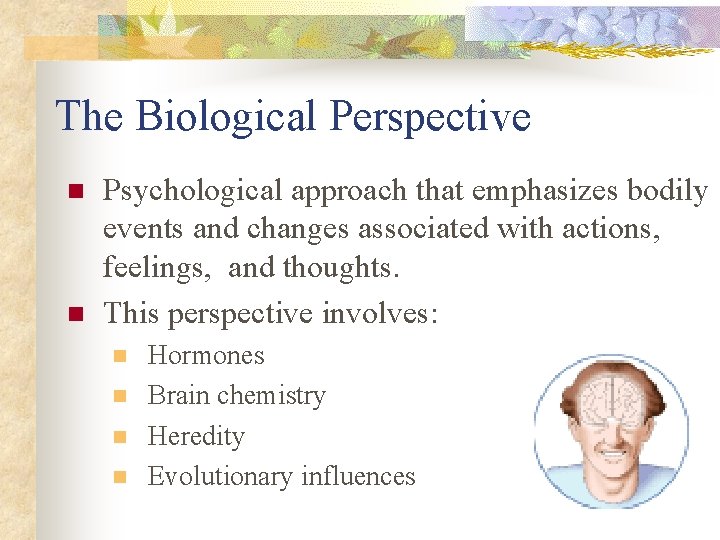
The Biological Perspective n n Psychological approach that emphasizes bodily events and changes associated with actions, feelings, and thoughts. This perspective involves: n n Hormones Brain chemistry Heredity Evolutionary influences
The Learning Perspective n A psychological approach that emphasizes how the environment and experience affect a person’s or animal’s actions. n This perspective involves: n Behaviourism n Social-cognitive learning theories
The Cognitive Perspective n A psychological approach that emphasizes mental processes in perception, memory, language, problem solving, and other areas of behaviour. n This perspective involves: Computer models of human thinking n Infant thinking n Intelligence testing n
Sociocultural perspective n n A psychological approach that emphasizes social and cultural influences on behaviour. This perspective includes: n n Social psychology, or the study of rules, roles groups, and relationships Cultural psychology, or the study of cultural norms, values, and expectations
Psychodynamic Perspective n A psychological approach that emphasizes unconscious dynamics within the individual, such as inner forces, conflicts or the movement of instinctual energy. n This perspective includes: n Unconscious thoughts, desires, and conflicts.
Two Influential Movements in Psychology n n Humanist psychology Feminist psychology
Humanist Psychology n n A psychological approach that emphasizes personal growth and the achievement of human potential, rather than the scientific understanding and assessment of behaviour. This approach: n n Rejected behaviourism and psychoanalysis. Emphasized creativity and achieving potential.
Feminist Psychology n n A psychological approach that analyzes the influence of social inequities on gender relations and on the behaviour of the two sexes. This approach: n n Recognized years of male bias in data collection and psychotherapy. Questions the use of research in justifying women’s lower status or elevating women’s status (female bias).
What Psychologists Do n n n Academic/research psychologists Psychological practitioners Psychologists in other settings
Academic/Research Psychologists n n Research in areas of basic or applied psychology. Examples include: n n n Experimental psychologists Educational psychologists Developmental psychologists Industrial/organizational psychologists Psychometric psychologists
Psychological Practitioners n n n Counselling psychologists help people deal with problems associated with everyday life. School psychologists work with parents, teachers, and students to enhance student performance. Clinical psychologists diagnose, treat, and study mental or emotional problems.
Clinical psychologists are not: n n n Psychotherapists Psychoanalysts Psychiatrists
Psychologists in Other Settings n n n Sports Consumer issues Advertising Organizational problems Environmental issues n n n Public policy Opinion polls Military training Animal behaviour Legal issues
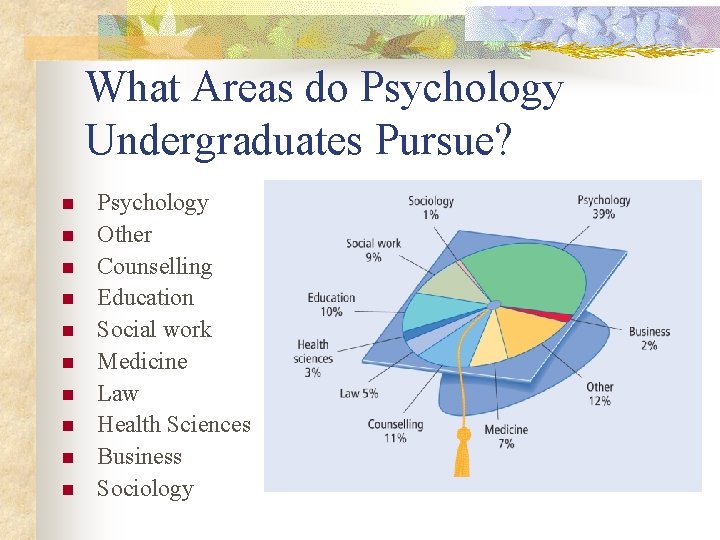
What Areas do Psychology Undergraduates Pursue? n n n n n Psychology Other Counselling Education Social work Medicine Law Health Sciences Business Sociology