
WHAT IS PRINCIPAL PHOTOGRAPHY A Power Point lesson
- Slides: 19
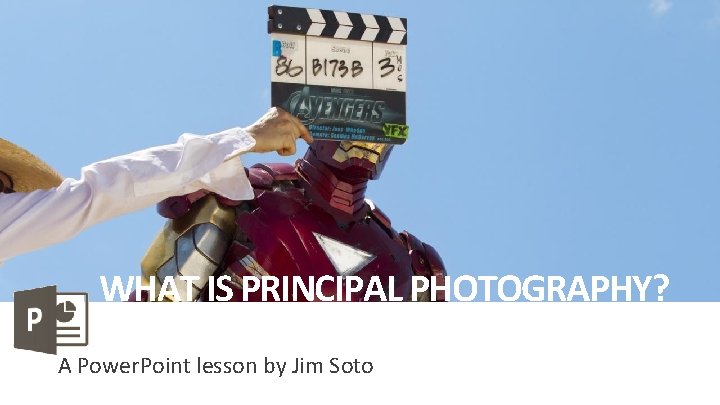
WHAT IS PRINCIPAL PHOTOGRAPHY? A Power. Point lesson by Jim Soto
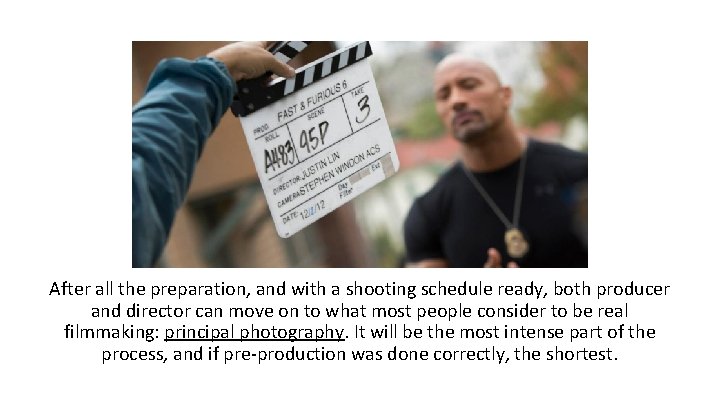
After all the preparation, and with a shooting schedule ready, both producer and director can move on to what most people consider to be real filmmaking: principal photography. It will be the most intense part of the process, and if pre-production was done correctly, the shortest.
About Principal Photography Principal photography is the phase of film production in which the movie is filmed, with actors on set and cameras rolling. Principal photography is usually the most expensive phase of film production, generally due to actor, director, and set crew salaries, the costs of certain shots, including any props or on-set special effects. Its start generally marks a point of no return for the financiers, because until it is complete there is unlikely to be enough material filmed to release a final product needed to recoup costs.
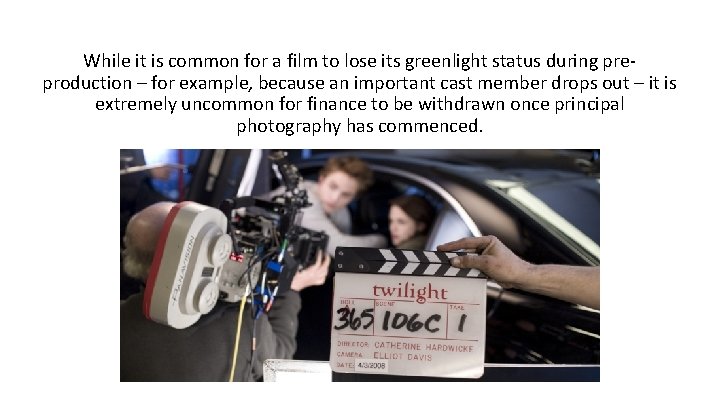
While it is common for a film to lose its greenlight status during preproduction – for example, because an important cast member drops out – it is extremely uncommon for finance to be withdrawn once principal photography has commenced.
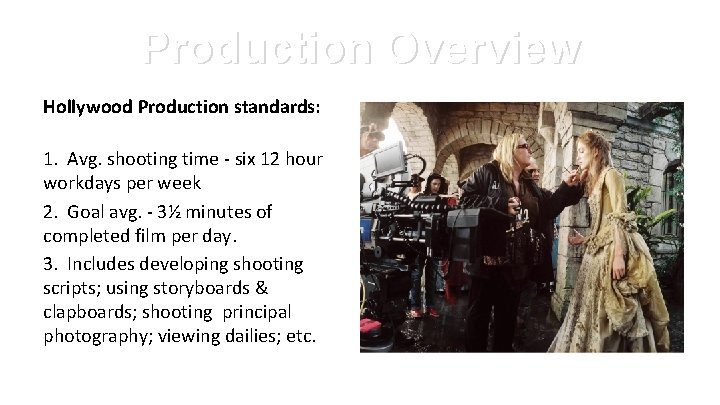
Production Overview Hollywood Production standards: 1. Avg. shooting time - six 12 hour workdays per week 2. Goal avg. - 3½ minutes of completed film per day. 3. Includes developing shooting scripts; using storyboards & clapboards; shooting principal photography; viewing dailies; etc.
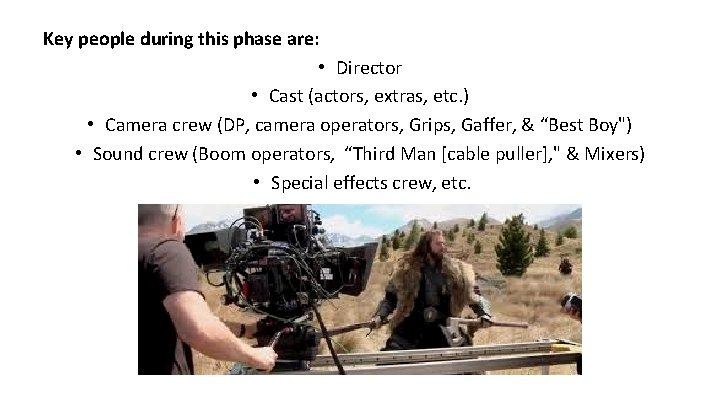
Key people during this phase are: • Director • Cast (actors, extras, etc. ) • Camera crew (DP, camera operators, Grips, Gaffer, & “Best Boy") • Sound crew (Boom operators, “Third Man [cable puller], " & Mixers) • Special effects crew, etc.
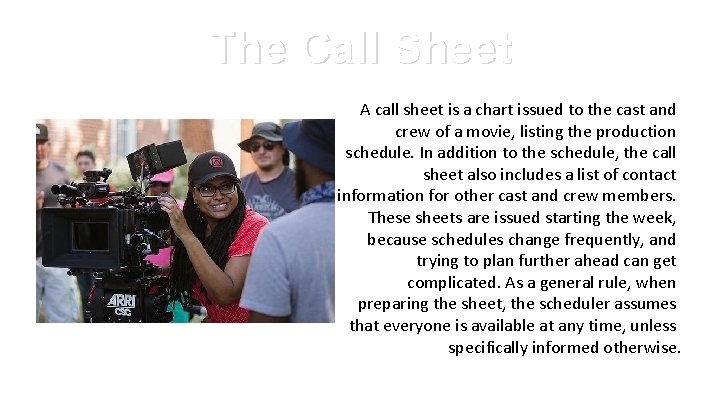
The Call Sheet A call sheet is a chart issued to the cast and crew of a movie, listing the production schedule. In addition to the schedule, the call sheet also includes a list of contact information for other cast and crew members. These sheets are issued starting the week, because schedules change frequently, and trying to plan further ahead can get complicated. As a general rule, when preparing the sheet, the scheduler assumes that everyone is available at any time, unless specifically informed otherwise.
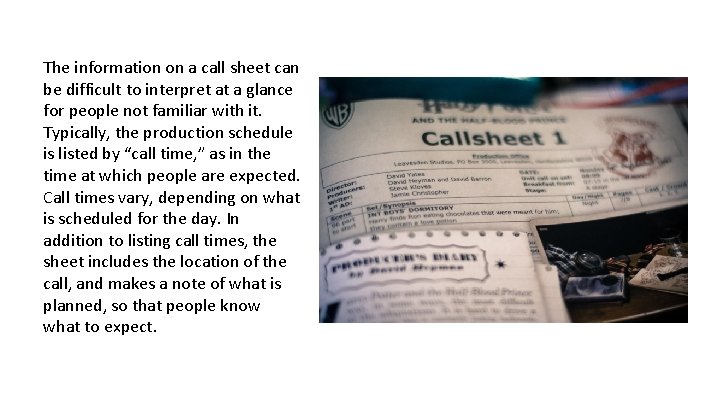
The information on a call sheet can be difficult to interpret at a glance for people not familiar with it. Typically, the production schedule is listed by “call time, ” as in the time at which people are expected. Call times vary, depending on what is scheduled for the day. In addition to listing call times, the sheet includes the location of the call, and makes a note of what is planned, so that people know what to expect.
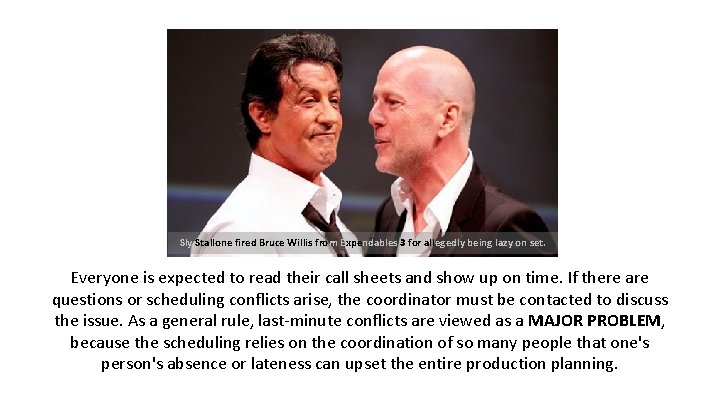
Sly Stallone fired Bruce Willis from Expendables 3 for allegedly being lazy on set. Everyone is expected to read their call sheets and show up on time. If there are questions or scheduling conflicts arise, the coordinator must be contacted to discuss the issue. As a general rule, last-minute conflicts are viewed as a MAJOR PROBLEM, because the scheduling relies on the coordination of so many people that one's person's absence or lateness can upset the entire production planning.
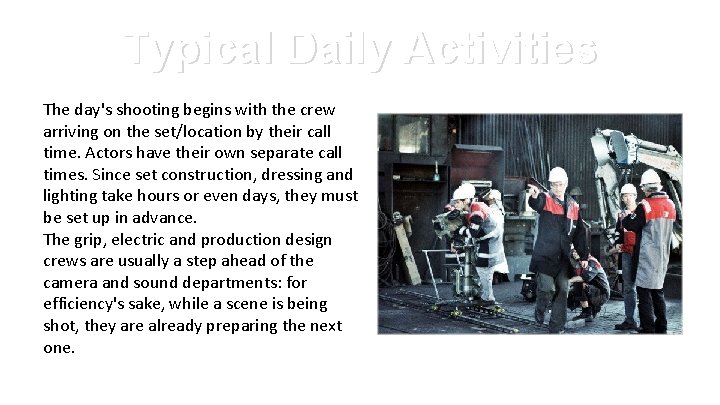
Typical Daily Activities The day's shooting begins with the crew arriving on the set/location by their call time. Actors have their own separate call times. Since set construction, dressing and lighting take hours or even days, they must be set up in advance. The grip, electric and production design crews are usually a step ahead of the camera and sound departments: for efficiency's sake, while a scene is being shot, they are already preparing the next one.
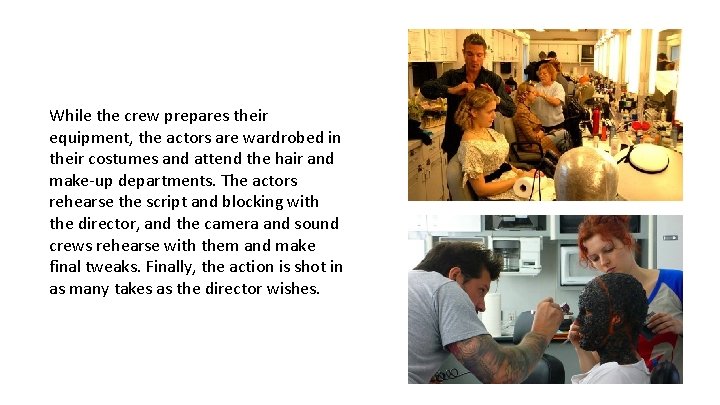
While the crew prepares their equipment, the actors are wardrobed in their costumes and attend the hair and make-up departments. The actors rehearse the script and blocking with the director, and the camera and sound crews rehearse with them and make final tweaks. Finally, the action is shot in as many takes as the director wishes.
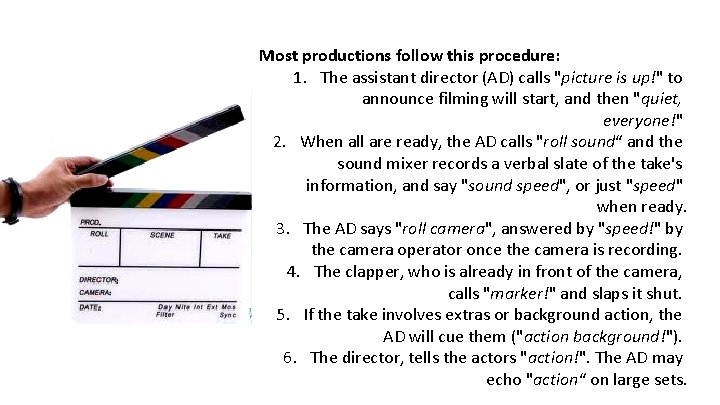
Most productions follow this procedure: 1. The assistant director (AD) calls "picture is up!" to announce filming will start, and then "quiet, everyone!" 2. When all are ready, the AD calls "roll sound“ and the sound mixer records a verbal slate of the take's information, and say "sound speed", or just "speed" when ready. 3. The AD says "roll camera", answered by "speed!" by the camera operator once the camera is recording. 4. The clapper, who is already in front of the camera, calls "marker!" and slaps it shut. 5. If the take involves extras or background action, the AD will cue them ("action background!"). 6. The director, tells the actors "action!". The AD may echo "action“ on large sets.
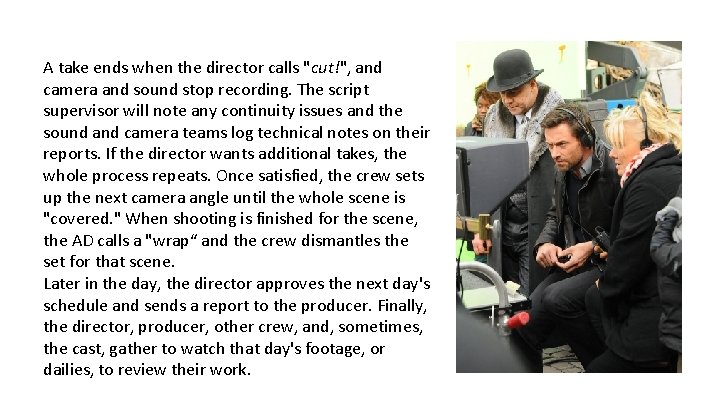
A take ends when the director calls "cut!", and camera and sound stop recording. The script supervisor will note any continuity issues and the sound and camera teams log technical notes on their reports. If the director wants additional takes, the whole process repeats. Once satisfied, the crew sets up the next camera angle until the whole scene is "covered. " When shooting is finished for the scene, the AD calls a "wrap“ and the crew dismantles the set for that scene. Later in the day, the director approves the next day's schedule and sends a report to the producer. Finally, the director, producer, other crew, and, sometimes, the cast, gather to watch that day's footage, or dailies, to review their work.
Continuity One area that seems to be an issue time and time again is that of continuity. If overlooked the film will suffer greatly. Continuity can be broken down into 3 areas. • Acting continuity • Props Continuity • Costume Continuity 1. Acting Continuity - Actors need to do the same action and say the same line in different shots and different takes. If an actor picks up a glass with the right hand then wave with their left hand, they have to do so in all the shots! Directors have to remind actors about continuity. The script supervisor and the AD usually help the director in this area. A good Continuity Person will pick up when actors have digressed from important actions or have forgotten part of their speech.
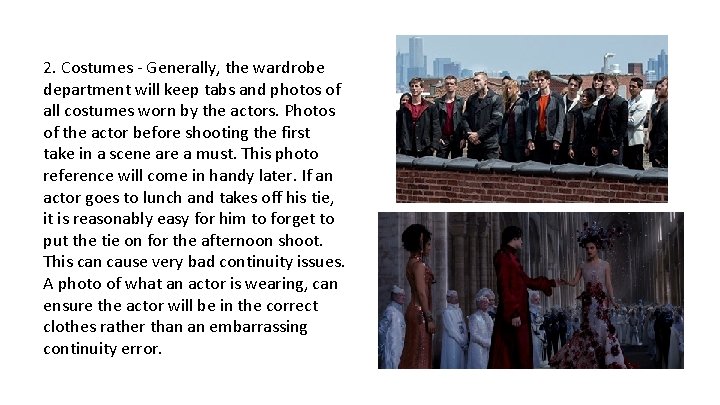
2. Costumes - Generally, the wardrobe department will keep tabs and photos of all costumes worn by the actors. Photos of the actor before shooting the first take in a scene are a must. This photo reference will come in handy later. If an actor goes to lunch and takes off his tie, it is reasonably easy for him to forget to put the tie on for the afternoon shoot. This can cause very bad continuity issues. A photo of what an actor is wearing, can ensure the actor will be in the correct clothes rather than an embarrassing continuity error.
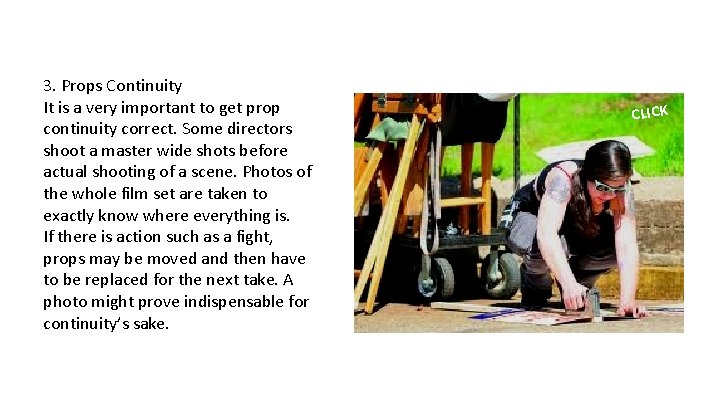
3. Props Continuity It is a very important to get prop continuity correct. Some directors shoot a master wide shots before actual shooting of a scene. Photos of the whole film set are taken to exactly know where everything is. If there is action such as a fight, props may be moved and then have to be replaced for the next take. A photo might prove indispensable for continuity’s sake. CLICK
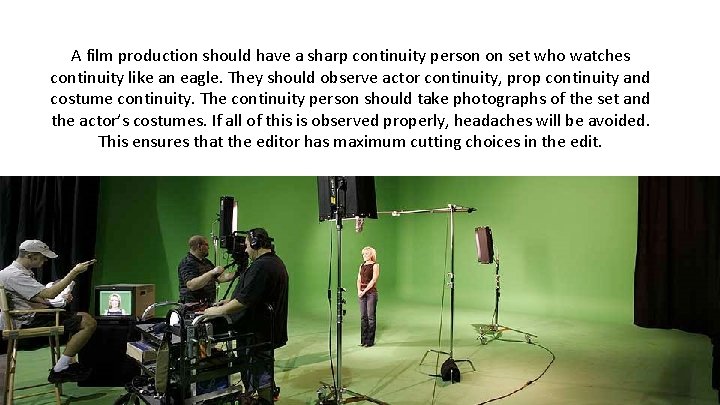
A film production should have a sharp continuity person on set who watches continuity like an eagle. They should observe actor continuity, prop continuity and costume continuity. The continuity person should take photographs of the set and the actor’s costumes. If all of this is observed properly, headaches will be avoided. This ensures that the editor has maximum cutting choices in the edit.
Reshoot 1. What is considered a major problem during the shooting of a movie? 2. Why is continuity extremely important before and during principal photography? 3. In which ways a Script Supervisor can monitor script continuity before and during the shoot? 4. Which are the types of continuity that must be monitored on the set? 5. What is a Call Sheet and who prepares it?
Scene Blocking Jim Soto © 2017