
What is Postmodernism Its Styles and Social Conditions





- Slides: 50
What is Postmodernism? Its Styles and Social Conditions North American Postmodern Fiction and Film 2006 Spring
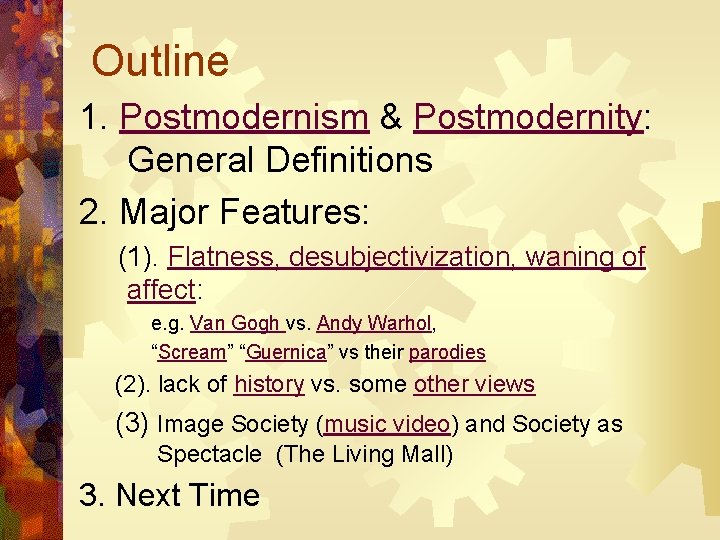
Outline 1. Postmodernism & Postmodernity: General Definitions 2. Major Features: (1). Flatness, desubjectivization, waning of affect: e. g. Van Gogh vs. Andy Warhol, “Scream” “Guernica” vs their parodies (2). lack of history vs. some other views (3) Image Society (music video) and Society as Spectacle (The Living Mall) 3. Next Time
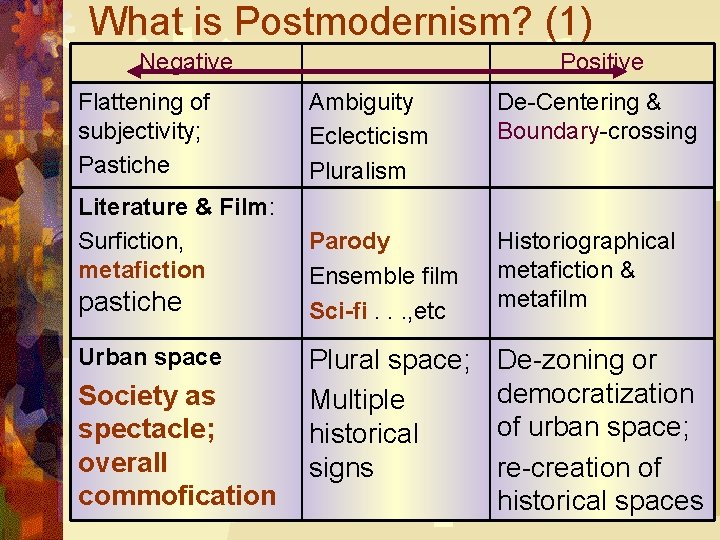
What is Postmodernism? (1) Negative Flattening of subjectivity; Pastiche Literature & Film: Surfiction, metafiction pastiche Urban space Society as spectacle; overall commofication Positive Ambiguity Eclecticism Pluralism De-Centering & Boundary-crossing Parody Ensemble film Sci-fi. . . , etc Historiographical metafiction & metafilm Plural space; Multiple historical signs De-zoning or democratization of urban space; re-creation of historical spaces
Postmodernism (2): as Boundary -Crossing ® Boundaries ® ® ® between – fact and fiction disciplines the private and the public high art and popular culture nations human and non-human ® Why? To be explained later.
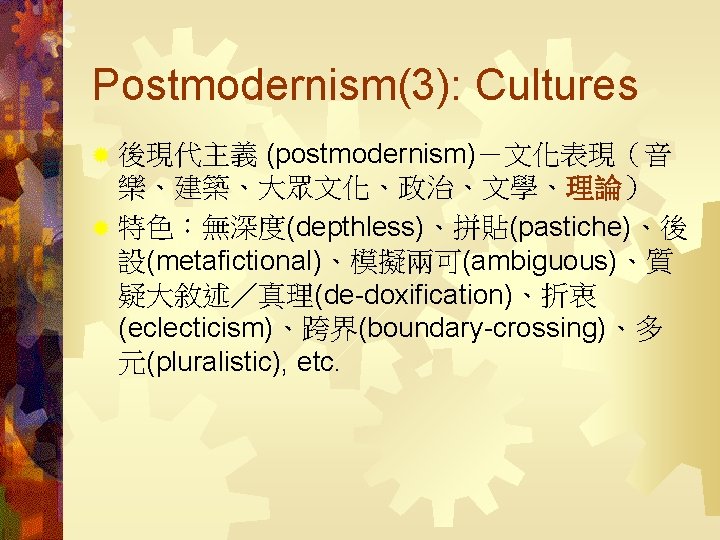
Postmodernism(3): Cultures (postmodernism)-文化表現(音 樂、建築、大眾文化、政治、文學、理論) ® 特色:無深度(depthless)、拼貼(pastiche)、後 設(metafictional)、模擬兩可(ambiguous)、質 疑大敘述/真理(de-doxification)、折衷 (eclecticism)、跨界(boundary-crossing)、多 元(pluralistic), etc. ® 後現代主義
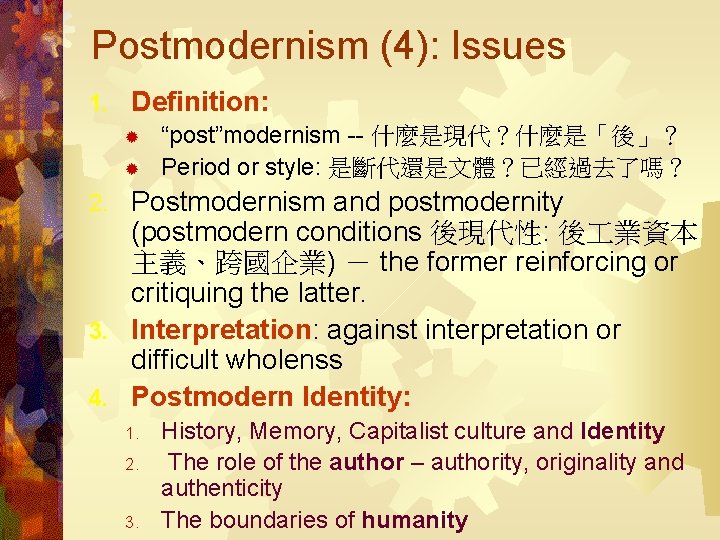
Postmodernism (4): Issues 1. Definition: ® ® “post”modernism -- 什麼是現代?什麼是「後」? Period or style: 是斷代還是文體?已經過去了嗎? Postmodernism and postmodernity (postmodern conditions 後現代性: 後 業資本 主義、跨國企業) - the former reinforcing or critiquing the latter. 3. Interpretation: against interpretation or difficult wholenss 4. Postmodern Identity: 2. 1. 2. 3. History, Memory, Capitalist culture and Identity The role of the author – authority, originality and authenticity The boundaries of humanity
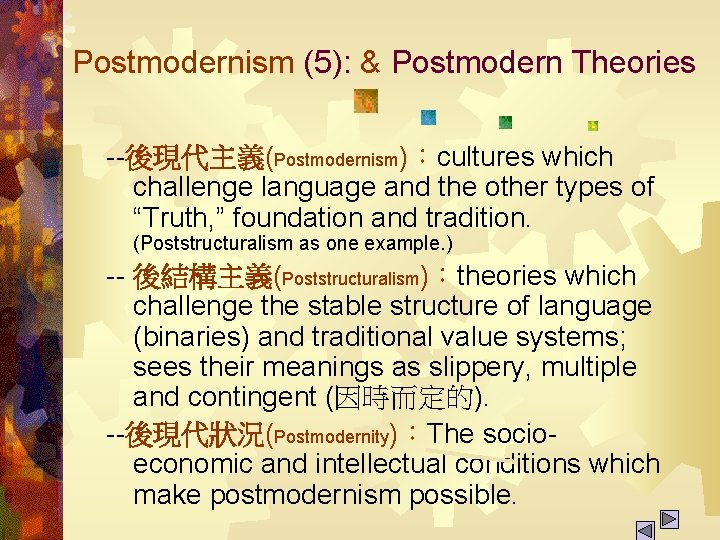
Postmodernism (5): & Postmodern Theories --後現代主義(Postmodernism)︰cultures which challenge language and the other types of “Truth, ” foundation and tradition. (Poststructuralism as one example. ) -- 後結構主義(Poststructuralism)︰theories which challenge the stable structure of language (binaries) and traditional value systems; sees their meanings as slippery, multiple and contingent (因時而定的). --後現代狀況(Postmodernity)︰The socioeconomic and intellectual conditions which make postmodernism possible.
Postmodernism: Historical Background Turning and turning in the widerning gyre The falcon cannot hear the falconer; Things fall apart; the center cannot hold; Mere anarchy is loosed upon the
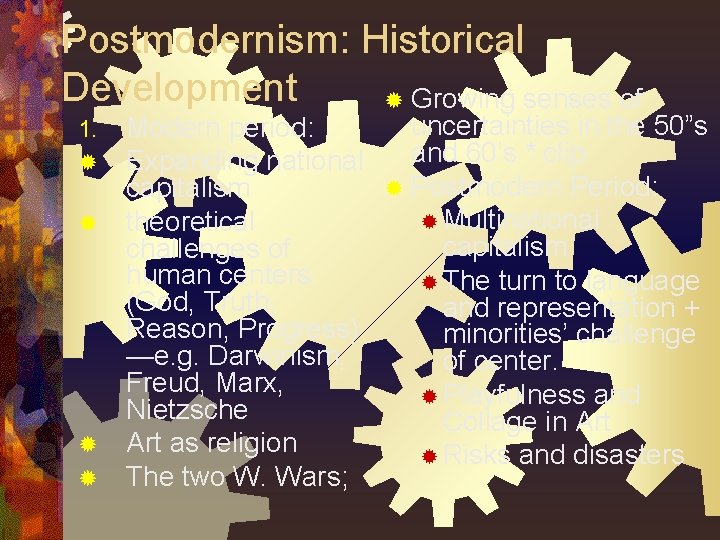
Postmodernism: Historical Development ® Growing senses of uncertainties in the 50”s Modern period: and 60’s * clip Expanding national ® Postmodern Period: capitalism ® Multinational ® theoretical capitalism challenges of human centers ® The turn to language (God, Truth, and representation + Reason, Progress) minorities’ challenge —e. g. Darwinism, of center. Freud, Marx, ® Playfulness and Nietzsche Collage in Art ® Art as religion ® Risks and disasters ® The two W. Wars; 1. ®
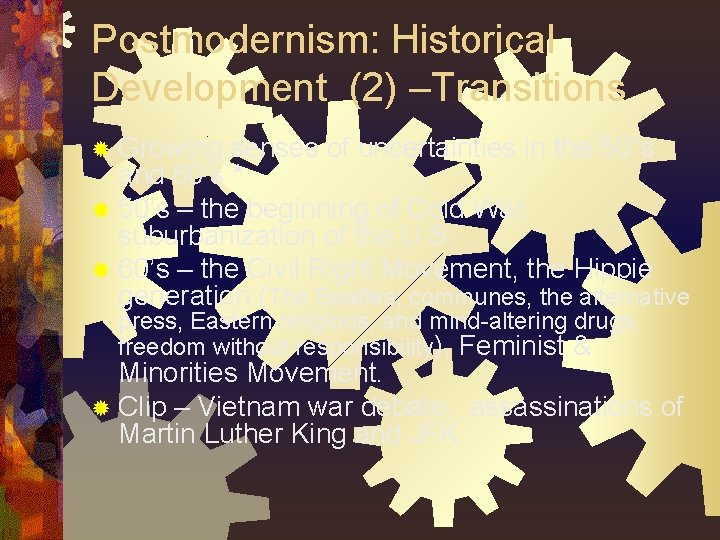
Postmodernism: Historical Development (2) –Transitions ® Growing senses of uncertainties in the 50”s and 60’s * ® 50’s – the beginning of Cold War, suburbanization of the U. S. ® 60’s – the Civil Right Movement, the Hippie generation (The Beatles; communes, the alternative press, Eastern religions, and mind-altering drugs, freedom without responsibility), Feminist & Minorities Movement. ® Clip – Vietnam war debate, assassinations of Martin Luther King and JFK
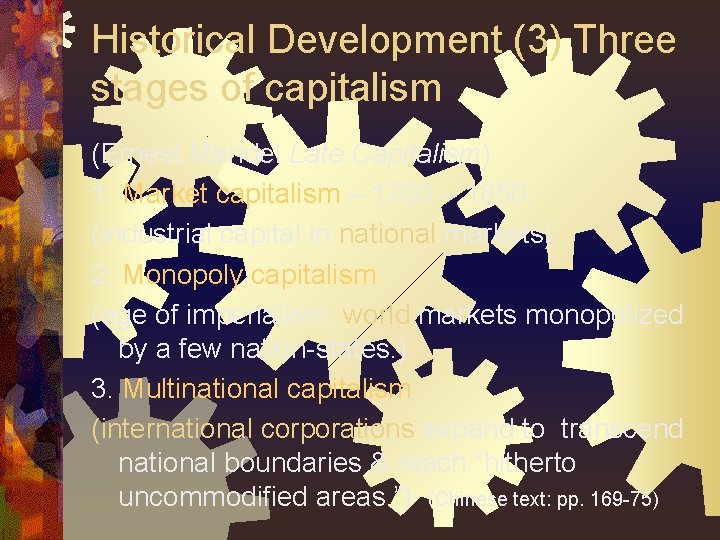
Historical Development (3) Three stages of capitalism (Ernest Mandel Late Capitalism) 1. Market capitalism – 1700 – 1850; (industrial capital in national markets) 2. Monopoly capitalism (age of imperialism; world markets monopolized by a few nation-states. ) 3. Multinational capitalism (international corporations expand to transcend national boundaries & reach “hitherto uncommodified areas. ”) (Chinese text: pp. 169 -75)
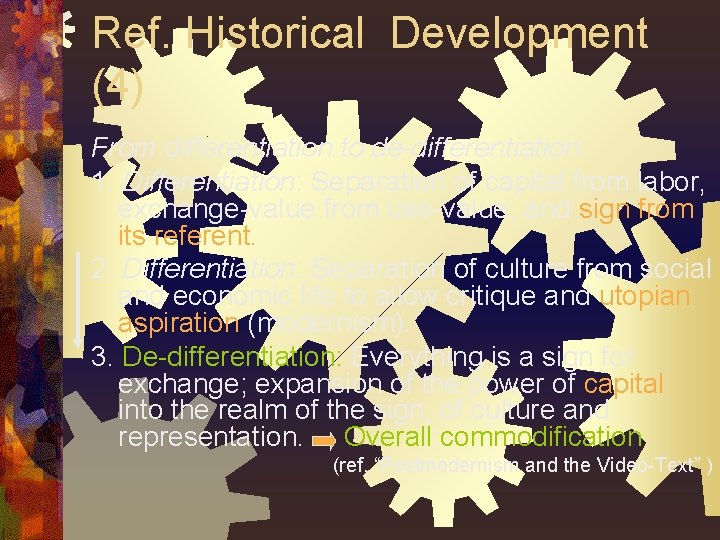
Ref. Historical Development (4) From differentiation to de-differentiation: 1. Differentiation: Separation of capital from labor, exchange-value from use-value, and sign from its referent. 2. Differentiation: Separation of culture from social and economic life to allow critique and utopian aspiration (modernism). 3. De-differentiation: Everything is a sign for exchange; expansion of the power of capital into the realm of the sign, of culture and representation. Overall commodification (ref. “Postmodernism and the Video-Text” )
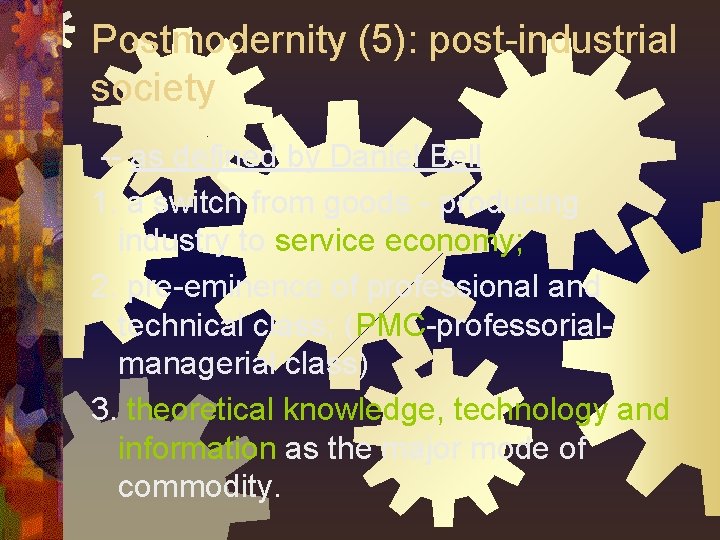
Postmodernity (5): post-industrial society -- as defined by Daniel Bell 1. a switch from goods - producing industry to service economy; 2. pre-eminence of professional and technical class; (PMC-professorialmanagerial class) 3. theoretical knowledge, technology and information as the major mode of commodity.
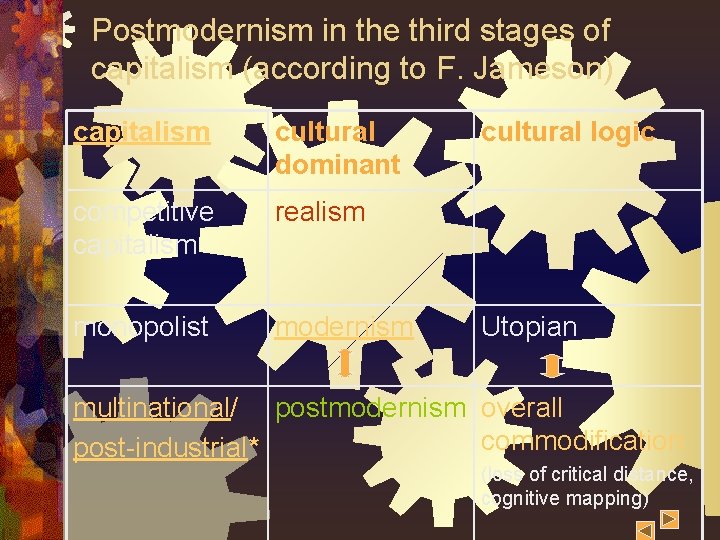
Postmodernism in the third stages of capitalism (according to F. Jameson) capitalism cultural dominant competitive capitalism realism monopolist modernism cultural logic Utopian multinational/ postmodernism overall commodification post-industrial* (loss of critical distance, cognitive mapping)
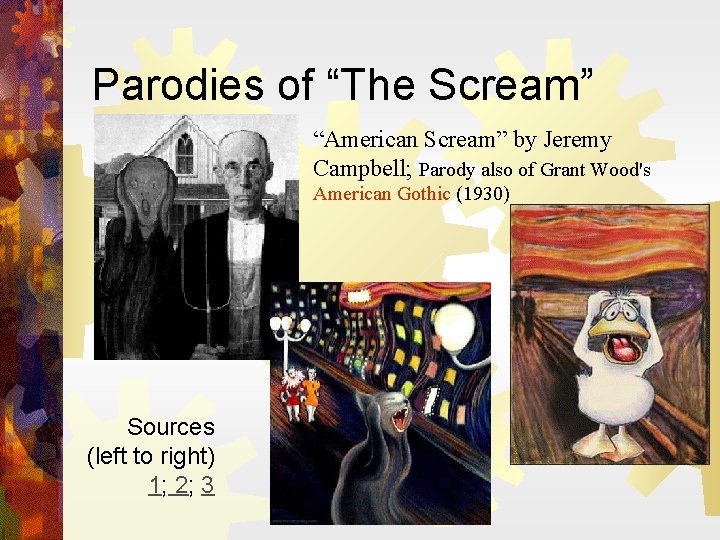
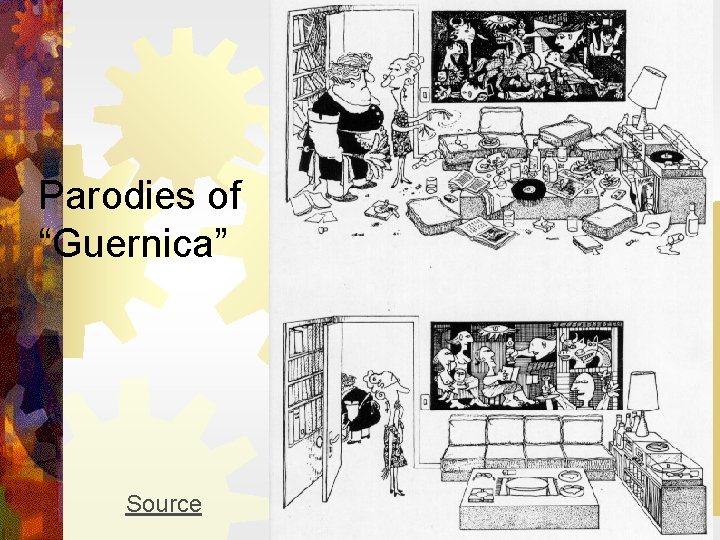
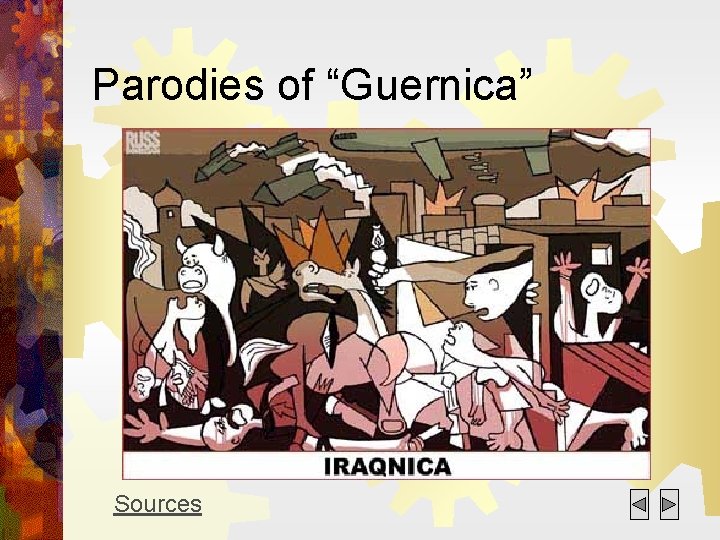
Postmodernisms Some Examples 1. Identities and Parodies ® Shoes; ® Screams ® Guernica 2. Loss of History or Presentness of histories. 3. Image Society (music video) and Society as Spectacle (The Living Mall)
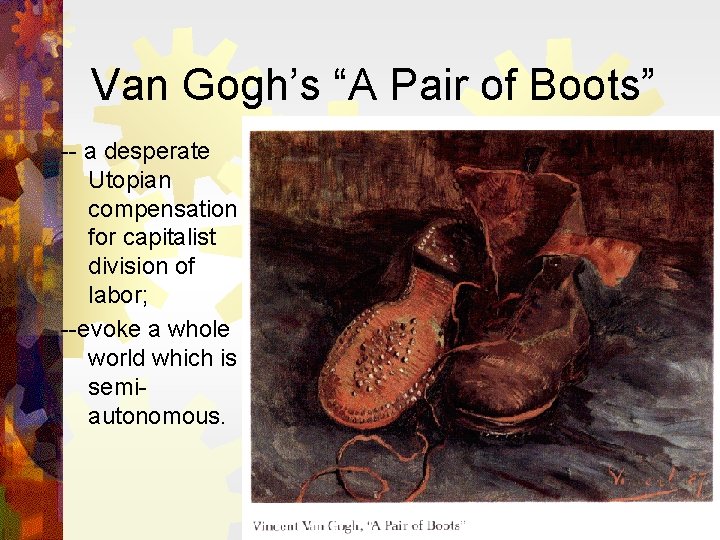
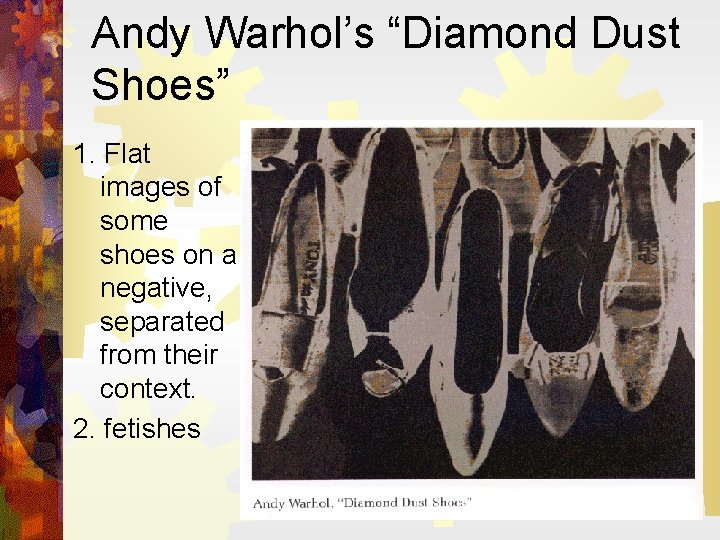
Major Feature 1: flatness & desubjectivization = 1. the waning of affect (感情消失). 2. the end of style, in the sense of the unique and the personal e. g. Van Gogh’s “A Pair of Boots” vs. Andy Warhol’s “Diamond Dust Shoes” 《後現代主義與文化理 論》,: pp. 192 - 221
Van Gogh’s “A Pair of Boots” -- a desperate Utopian compensation for capitalist division of labor; --evoke a whole world which is semiautonomous.
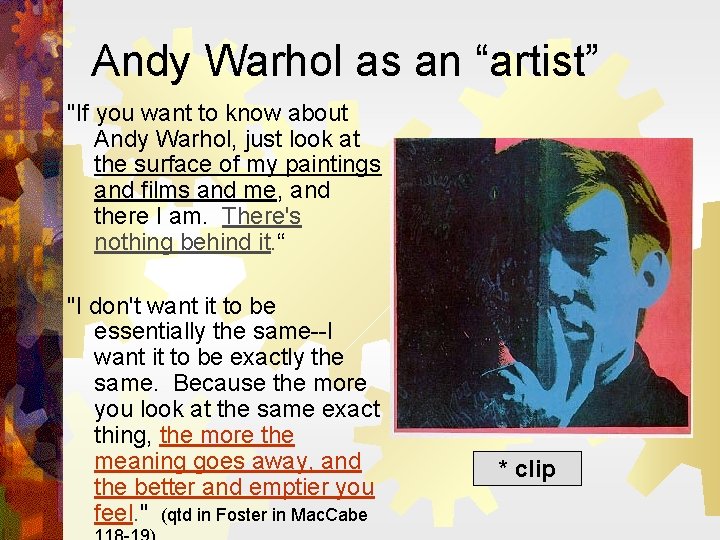
Andy Warhol’s “Diamond Dust Shoes” 1. Flat images of some shoes on a negative, separated from their context. 2. fetishes
Andy Warhol as an “artist” "If you want to know about Andy Warhol, just look at the surface of my paintings and films and me, and there I am. There's nothing behind it. “ "I don't want it to be essentially the same--I want it to be exactly the same. Because the more you look at the same exact thing, the more the meaning goes away, and the better and emptier you feel. " (qtd in Foster in Mac. Cabe * clip
Possible interpretations of Warhol His use of kitsch, commodities and celebrities: 1. Underneath the glamorous surface of commodity fetishes and media stars is 'the reality of suffering and death. ‘ 2. Superficial embrace of commercialism; (fetishism) 3. Traumatic realism: repetition of flat images to show the “traumatic real”: loss of meaning.
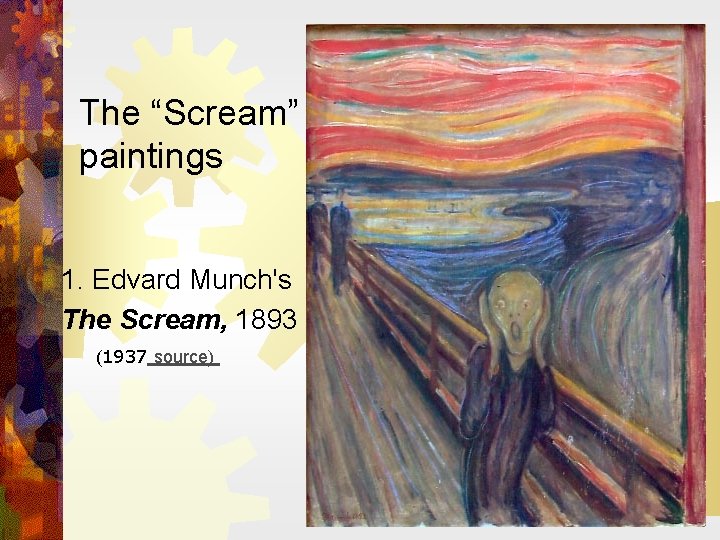
The “Scream” paintings 1. Edvard Munch's The Scream, 1893 (1937 source)
Jameson’s comments & Munch’s diary 1. The figure without ears or hair, hearing a scream or emitting one? The scream’s wave-like echo envelopes the whole world (the red sky and swirling, menacing sea. ) 2. 2. The priest-like figures are of no help. The bridge leads to nowhere. Ref. In Munch’s literary diary, the entry for 22 January 1892 reads: "I was walking along the road with two friends. The sun was setting. I felt a breath of melancholy Suddenly the sky turned blood-red. I stopped, and leaned against the railing, deathly tired looking out across the flaming clouds that hung like blood and a sword over the blue-black fjord and town. My friends walked on - I stood there, trembling with fear. And I sensed a great, infinite scream pass through nature. “
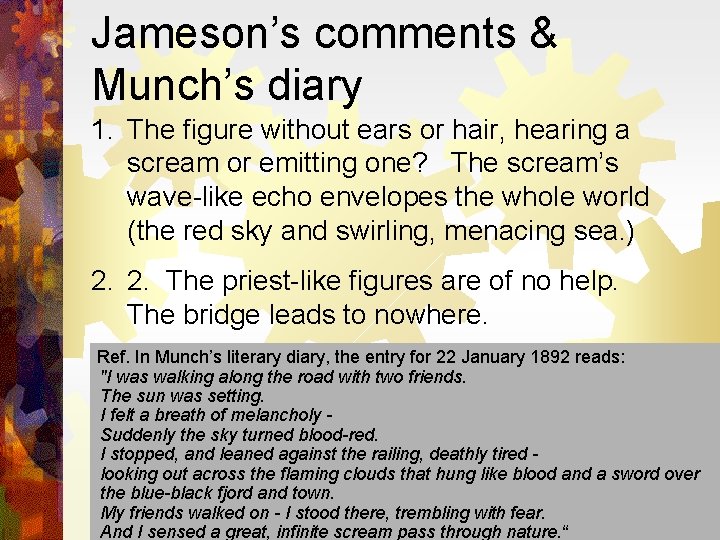
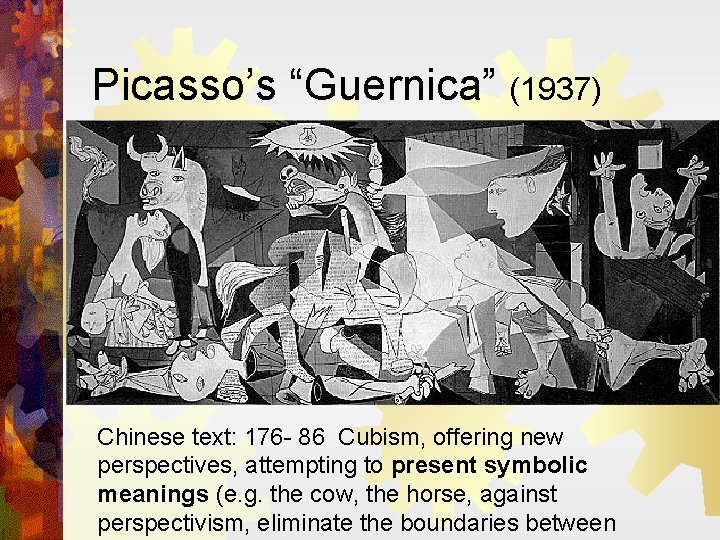
Picasso’s “Guernica” (1937) Chinese text: 176 - 86 Cubism, offering new perspectives, attempting to present symbolic meanings (e. g. the cow, the horse, against perspectivism, eliminate the boundaries between
Parodies of “The Scream” “American Scream” by Jeremy Campbell; Parody also of Grant Wood's American Gothic (1930) Sources (left to right) 1; 2; 3
Parodies of “Guernica” Source
Parodies of “Guernica” Sources
Feature 2: Loss of history “. . . we are now, in other words, in ‘intertextuality’ as a deliberate, built-in feature of the aesthetic effect and as the operator of a new connotation of ‘pastness’ and pseudohistorical depth, in which the history of aesthetic styles displaces "real" history. ” --e. g. nostalgia films: the past becomes a composite of stereotypes, spectacles; no stars (with 'personality' in the older sense), --e. g. historical novels
Another view: Co-existence multiple histories 1) Popularity of history 後現代大眾文化中歷史的風靡 1. retro chic in fashion: 懷舊風: 服飾、裝潢(Pop Art 的流行)、電影(《人間四月天》、《夜奔》、 Back to Future, Blue Velvet, Hot Shot ) 2. Simulated history 虛擬歷史︰《阿甘正傳》、Blade Runner 3. “presentness” of history: 歷史快速呈現︰SNG, 歷史 上的今天� 各種 20 世紀的回顧� 當代的歷史敘述. e. g. Presentation of types or stereotypes. e. g. 妹妹看MTV 2) Postmodernism problematizes official history and historical knowledge, and opens history to multiple narration.
Feature 3: image society & “hyperspace” A. Music video’s self-reflexive uses of video images “Money for Nothing” (1985) “Losing my Religion” (Out Of Time 1991) “If” (Janet 1993) “MTV’s and Channel V’s commercials – in 1999. Gradual loss of meanings?
1. Dire Straits -- took their name from their early financial status -- "Money for Nothing“- chanting that pop stars get their "money for nothing, and their chicks for free" -- “But rather than causing a stir in the music industry or unleashing a backlash by the video community, MTV embraced the song as their new anthem. The video, which featured sophisticated (for the time) 3 -D computer animation, went into heavy rotation, and the band became international superstars. The message of the song, meanwhile, was evidently lost on everyone. ”
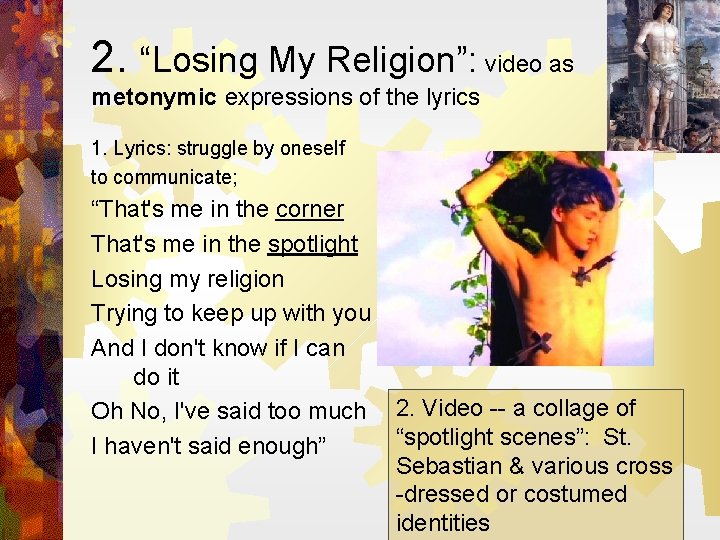
2. “Losing My Religion”: video as metonymic expressions of the lyrics 1. Lyrics: struggle by oneself to communicate; “That's me in the corner That's me in the spotlight Losing my religion Trying to keep up with you And I don't know if I can do it Oh No, I've said too much I haven't said enough” 2. Video -- a collage of “spotlight scenes”: St. Sebastian & various cross -dressed or costumed identities
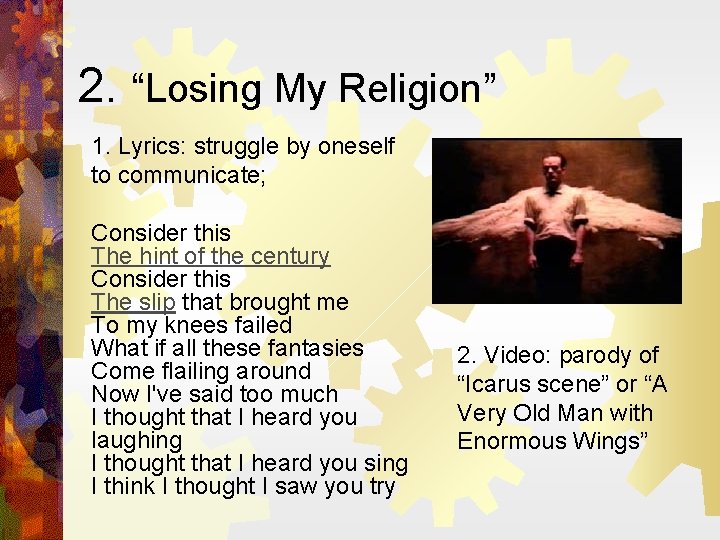
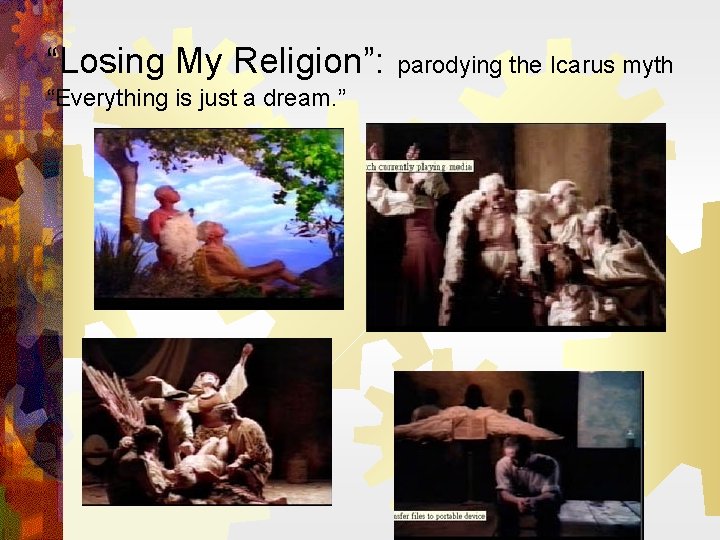
2. “Losing My Religion” 1. Lyrics: struggle by oneself to communicate; Consider this The hint of the century Consider this The slip that brought me To my knees failed What if all these fantasies Come flailing around Now I've said too much I thought that I heard you laughing I thought that I heard you sing I think I thought I saw you try 2. Video: parody of “Icarus scene” or “A Very Old Man with Enormous Wings”
“Losing My Religion”: “Everything is just a dream. ” parodying the Icarus myth
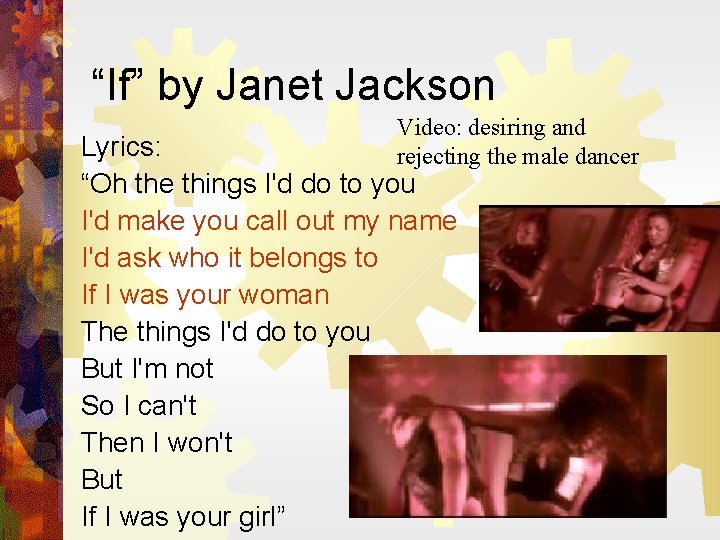
“If” by Janet Jackson Video: desiring and rejecting the male dancer Lyrics: “Oh the things I'd do to you I'd make you call out my name I'd ask who it belongs to If I was your woman The things I'd do to you But I'm not So I can't Then I won't But If I was your girl”
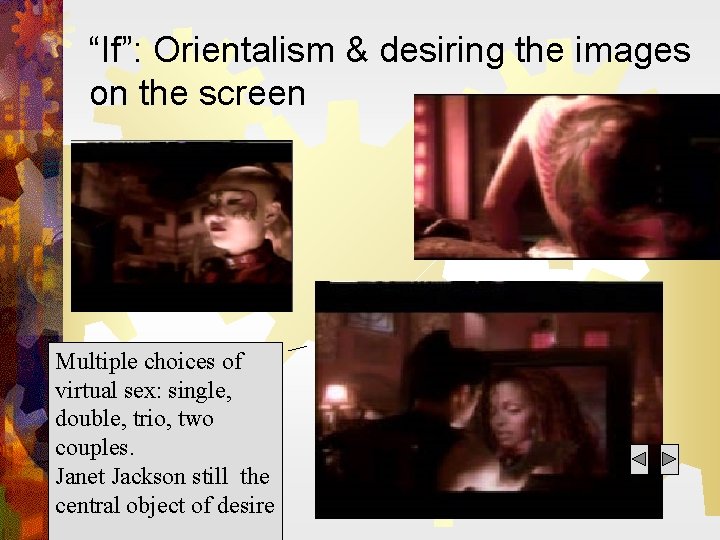
“If”: Orientalism & desiring the images on the screen Multiple choices of virtual sex: single, double, trio, two couples. Janet Jackson still the central object of desire
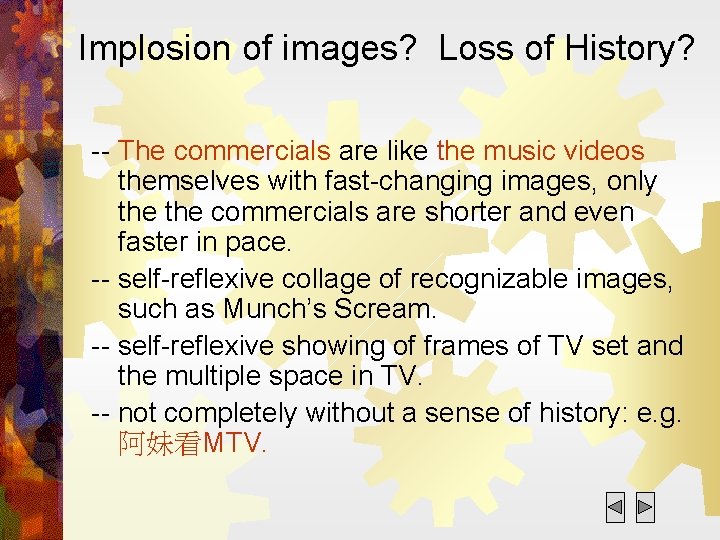
Implosion of images? Loss of History? -- The commercials are like the music videos themselves with fast-changing images, only the commercials are shorter and even faster in pace. -- self-reflexive collage of recognizable images, such as Munch’s Scream. -- self-reflexive showing of frames of TV set and the multiple space in TV. -- not completely without a sense of history: e. g. 阿妹看MTV.
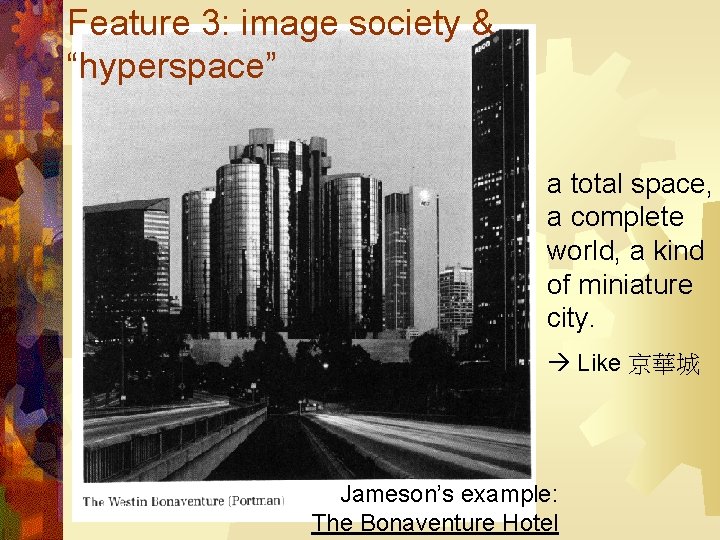
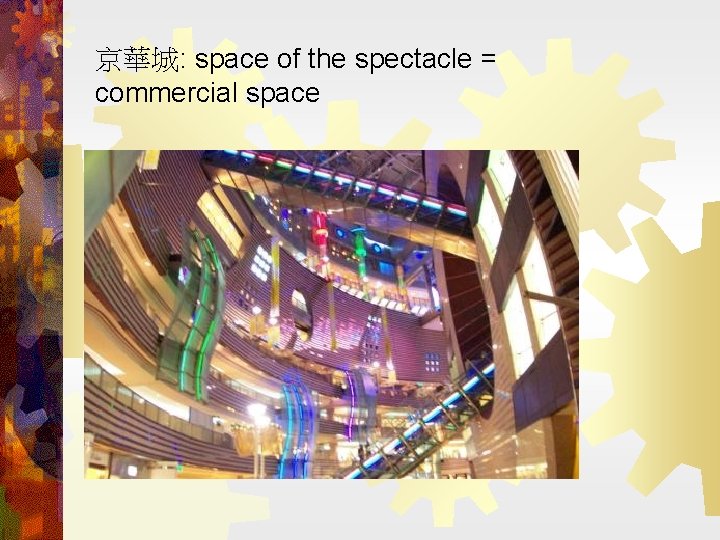
Feature 3: image society & “hyperspace” a total space, a complete world, a kind of miniature city. Like 京華城 Jameson’s example: The Bonaventure Hotel
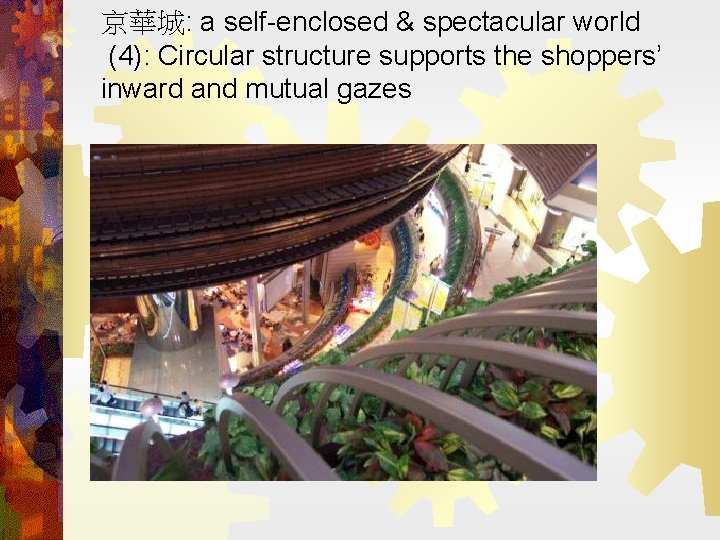
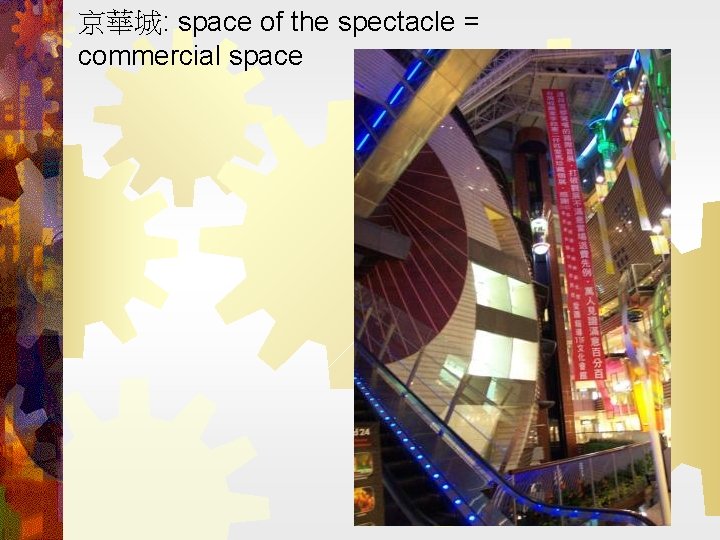
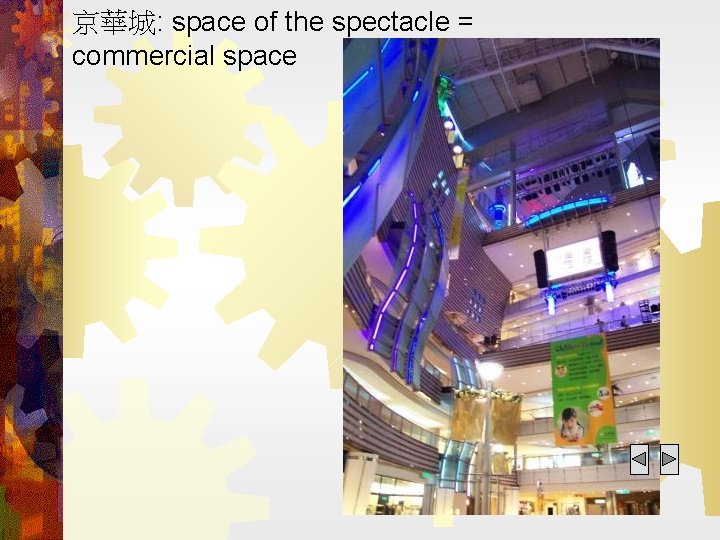
The Living Mall: a spectacular and self-enclosed space which either hide or naturalize its commercial reality by capturing the shoppers’ attention with its multitude of signs. the Living Mall 京華城 natural Capital as the Center of cultures, celebrities and talents Supported by its spectacular design
Commodification and Enclosure of Everyday Life: Spectacle & Hyperspace The Society of the Spectacle by Guy Debord, 1967 The spectacle is not a collection of images, but a social relation among people, mediated by images. (source) We live out the spectacle according to someone else’s design, like actors following a script.
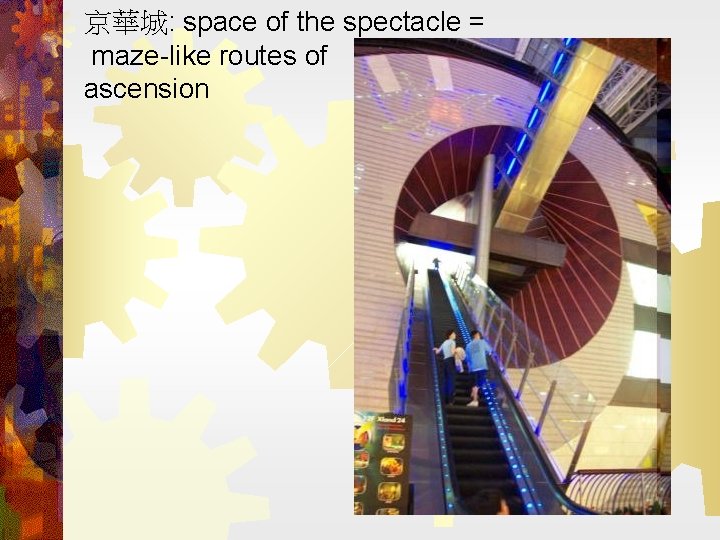
The mall: “commodification of everyday life” to make it work: 1) retail mix – to attract the desired mix of consumers; 2) “seductive” spatial design –to keep the shoppers there. maze-like structure, special design (of hallway and food court). 3) “ a surfeit of signs, each of which, . . . , serves to actively hide or mask the mall’s function, which is to make money. Or if it doesn't hide that function, then it certainly naturalizes it, such that the ‘commodification of reality’ becomes simply “God-given” (Mitchell 134 -35)
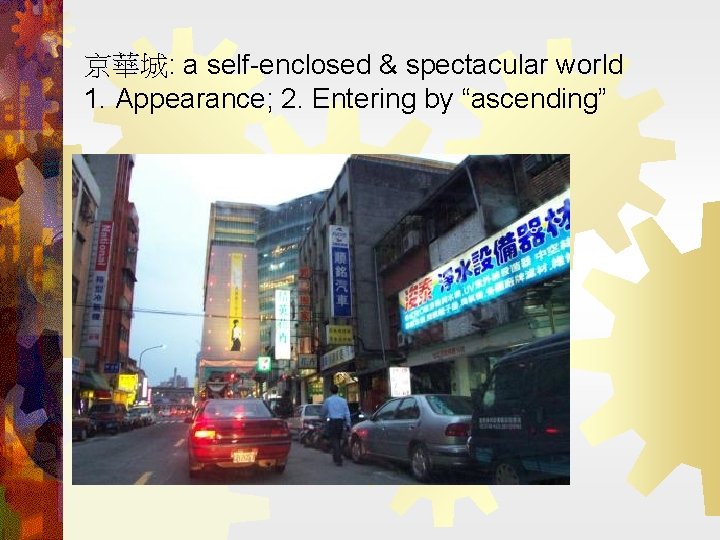
京華城: a self-enclosed & spectacular world 1. Appearance; 2. Entering by “ascending”
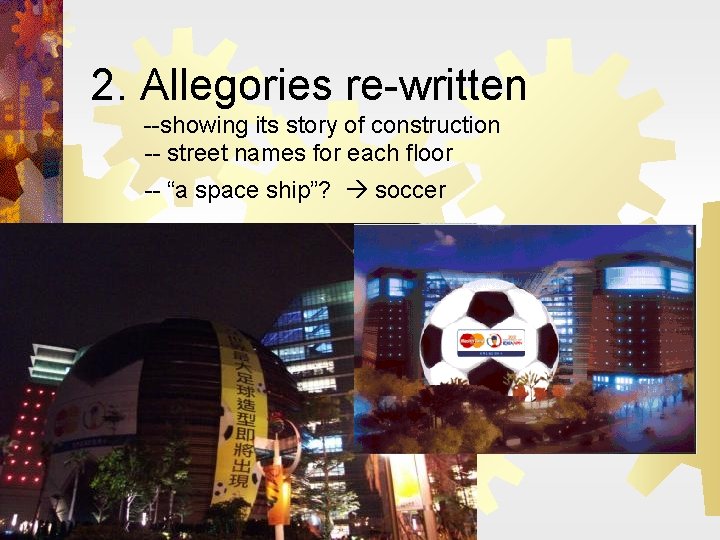
2. Allegories re-written --showing its story of construction -- street names for each floor -- “a space ship”? soccer
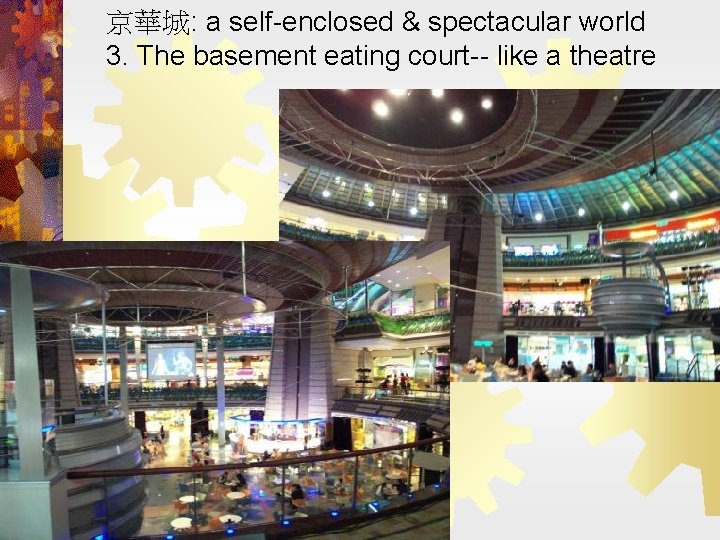
京華城: a self-enclosed & spectacular world 3. The basement eating court-- like a theatre
京華城: space of the spectacle = maze-like routes of ascension
京華城: a self-enclosed & spectacular world (4): Circular structure supports the shoppers’ inward and mutual gazes
京華城: space of the spectacle = commercial space
京華城: space of the spectacle = commercial space
京華城: space of the spectacle = commercial space
Next Time Ararat – by Atom Egoyan Slaughterhouse V: 2 chapters
References A. internet: 1. Outline and links 2. Jameson Article’s online version: (complete E-Text [with pictures] ; another E-Text excerpt; a multimedia text from MMT) B. Books: 1. 詹明信 (Fredric Jameson)� 《後現代主義與文化理論》,唐小兵譯,台 北:合志, 19906 2. “Postmodernism, or the Cultural Logic of Late Capitalism. ” New Left Review (1984). Also in version in Docherty, Thomas, ed. Postmodernism: A Reader. New York: Harvester, 1993 3. Postmodernism/Jameson/Critique. Ed. Douglas Kellner, . Maisonneuve P, 1989. 4. Mac. Cabe, Colin, et al, eds. Who Is Andy Warhol? Pittsburgh, PA: The British Film Institute and The Andy Warhol Museum, 1997. 5. Mitchell, Don. Cultural Geography: A Critical Introduction. Massachusetts: Blackwell, 2000.