
What is Political Science What makes up a
- Slides: 25
• What is Political Science? • What makes up a Political System? – Political Decision Makers (Who) – Political Decision Making Process (How, When, Why) – Political Institutions (Where)
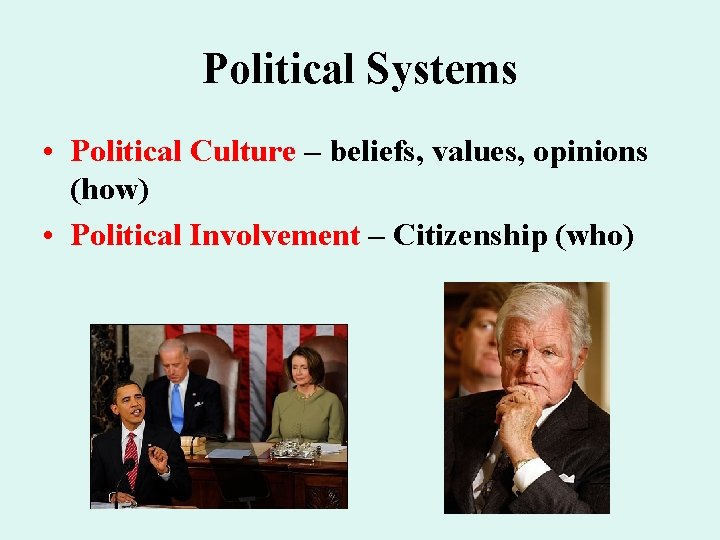
Political Systems • Political Culture – beliefs, values, opinions (how) • Political Involvement – Citizenship (who)
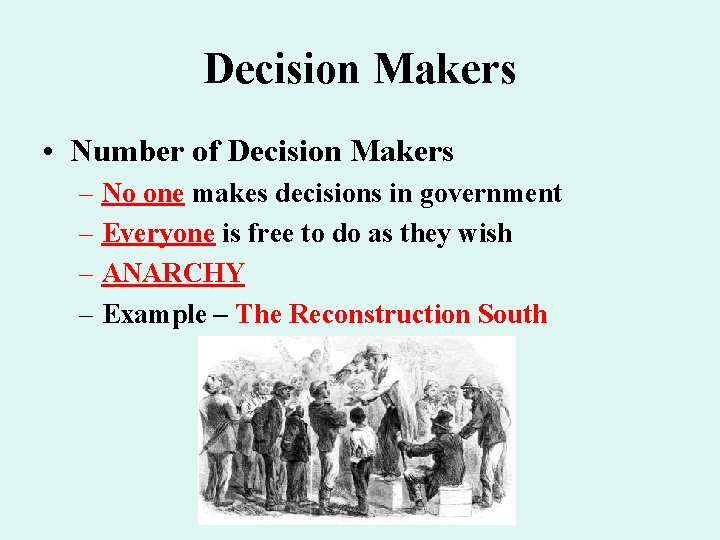
Decision Makers • Number of Decision Makers – No one makes decisions in government – Everyone is free to do as they wish – ANARCHY – Example – The Reconstruction South
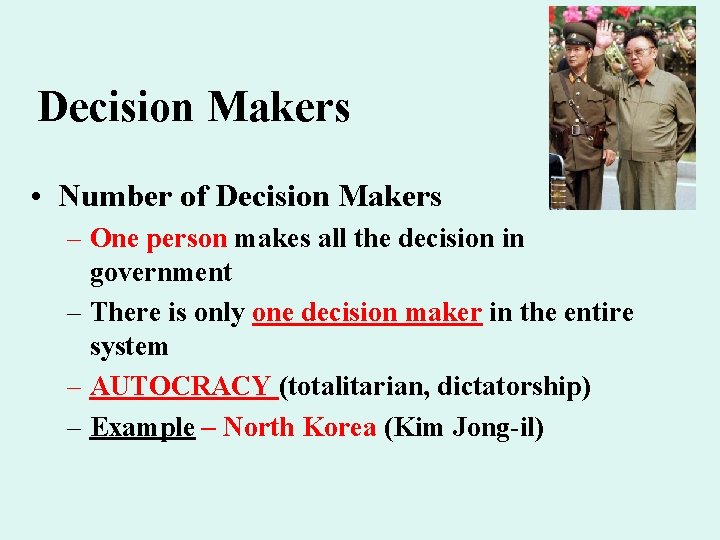
Decision Makers • Number of Decision Makers – One person makes all the decision in government – There is only one decision maker in the entire system – AUTOCRACY (totalitarian, dictatorship) – Example – North Korea (Kim Jong-il)
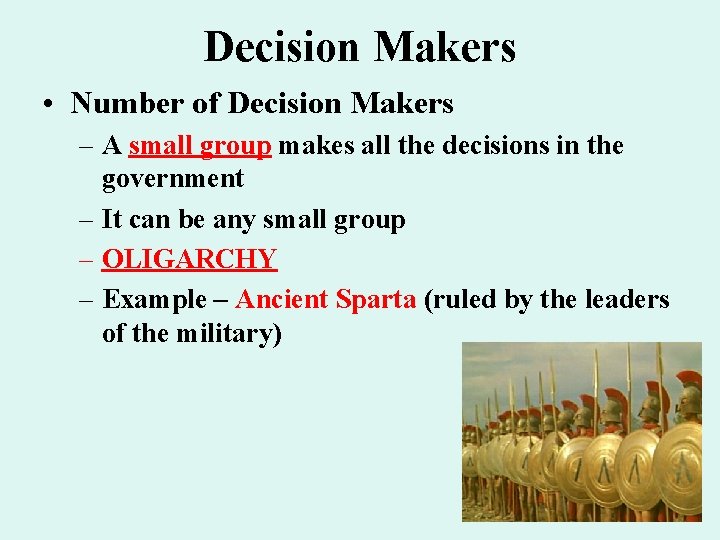
Decision Makers • Number of Decision Makers – A small group makes all the decisions in the government – It can be any small group – OLIGARCHY – Example – Ancient Sparta (ruled by the leaders of the military)
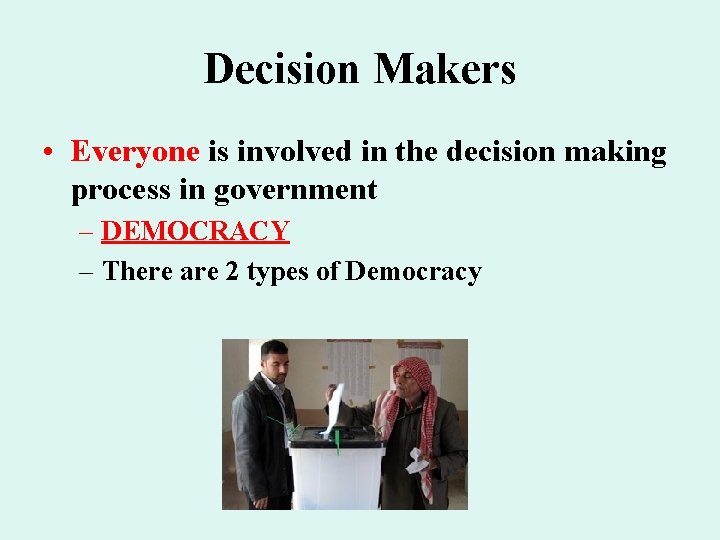
Decision Makers • Everyone is involved in the decision making process in government – DEMOCRACY – There are 2 types of Democracy
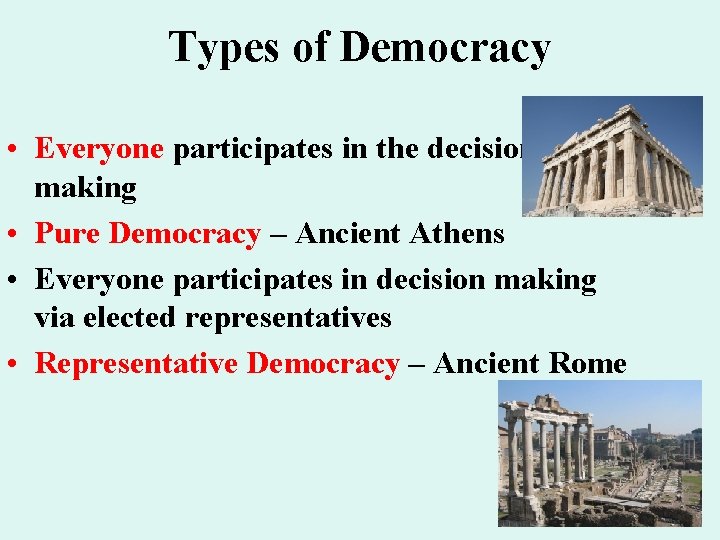
Types of Democracy • Everyone participates in the decision making • Pure Democracy – Ancient Athens • Everyone participates in decision making via elected representatives • Representative Democracy – Ancient Rome
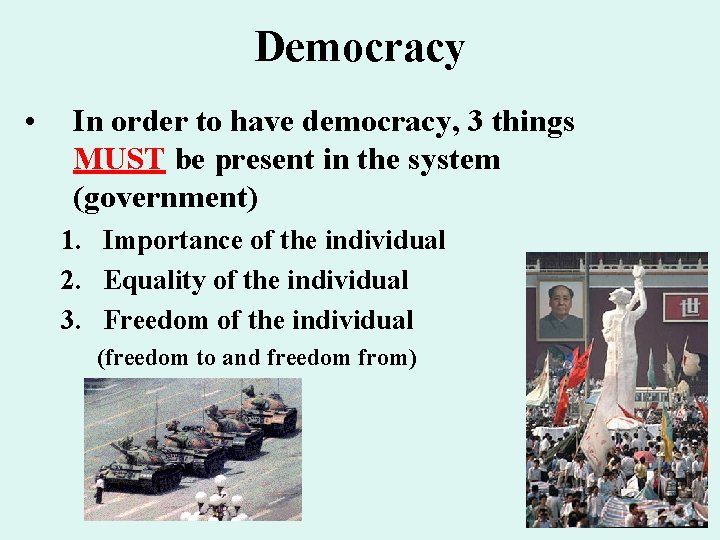
Democracy • In order to have democracy, 3 things MUST be present in the system (government) 1. Importance of the individual 2. Equality of the individual 3. Freedom of the individual (freedom to and freedom from)
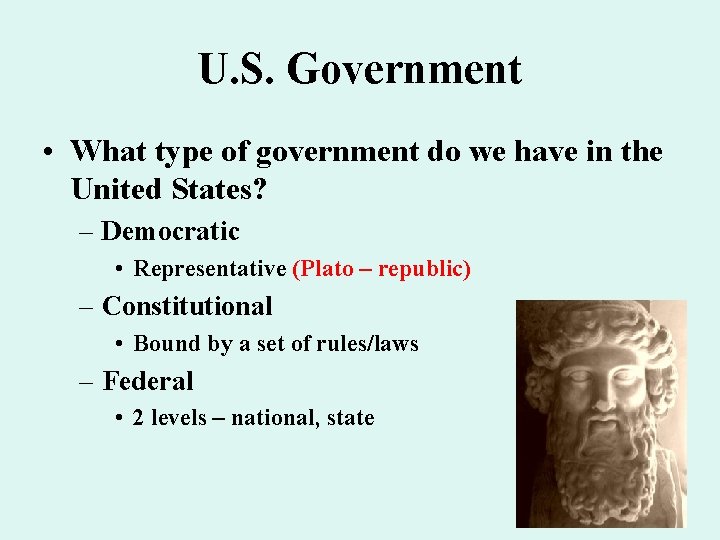
U. S. Government • What type of government do we have in the United States? – Democratic • Representative (Plato – republic) – Constitutional • Bound by a set of rules/laws – Federal • 2 levels – national, state
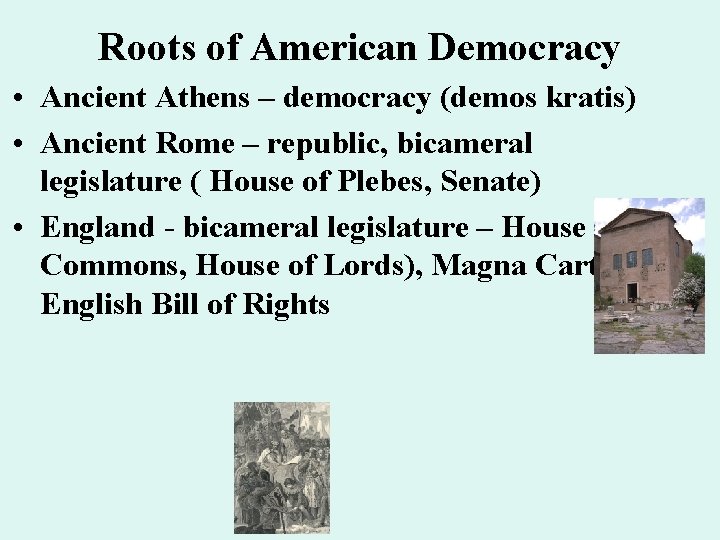
Roots of American Democracy • Ancient Athens – democracy (demos kratis) • Ancient Rome – republic, bicameral legislature ( House of Plebes, Senate) • England - bicameral legislature – House of Commons, House of Lords), Magna Carta, English Bill of Rights
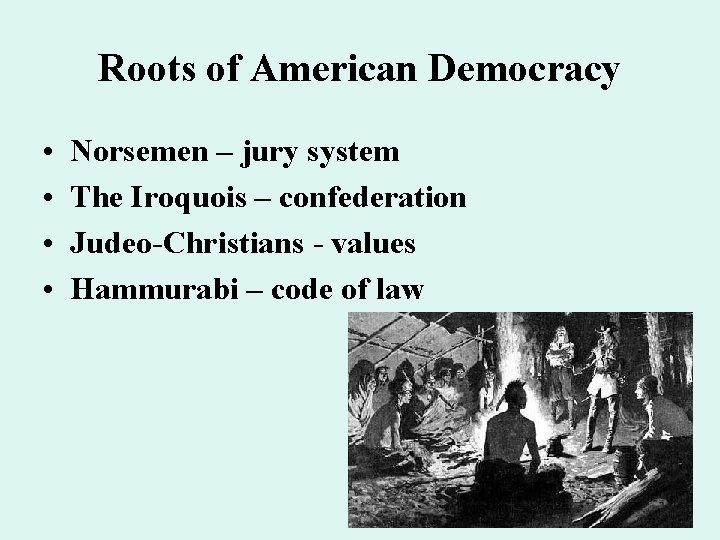
Roots of American Democracy • • Norsemen – jury system The Iroquois – confederation Judeo-Christians - values Hammurabi – code of law
Roots of American Democracy • European Philosophers (Enlightenment – Age of Reason) – Baron De Montesquieu – separation of power – Jean Rousseau – Social Contract – Voltaire (François-Marie Arouet) –freedoms (speech, religion), fair jury trial – Thomas Hobbes – government to protect the people (from themselves) – John Locke – The Law of Nature
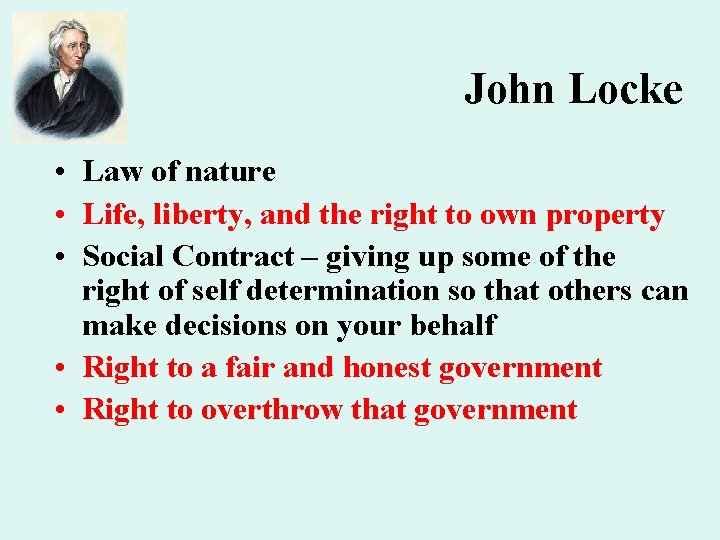
John Locke • Law of nature • Life, liberty, and the right to own property • Social Contract – giving up some of the right of self determination so that others can make decisions on your behalf • Right to a fair and honest government • Right to overthrow that government
Separation from England • Unfair treatment according to the law (Magna Carta, English Bill of Rights) • The Rights of Englishmen • Taxation without representation • Other reasons: religious, economic, social, historical, geographic, ascension of Parliament in England
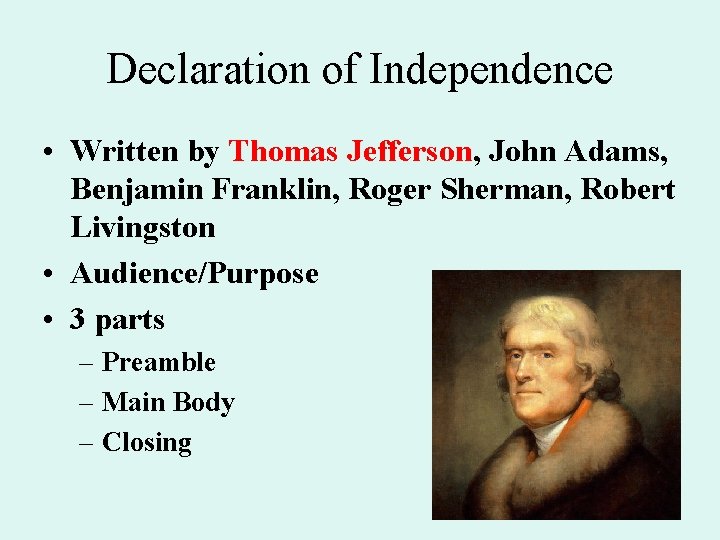
Declaration of Independence • Written by Thomas Jefferson, John Adams, Benjamin Franklin, Roger Sherman, Robert Livingston • Audience/Purpose • 3 parts – Preamble – Main Body – Closing
Declaration of Independence • Preamble – Reasons for separation – John Locke (unalienable rights) – Explain why the need for separation • Main Body – Listing of grievances – Most blamed on the King of England • Closing – Actual declaration – Formation of new nation – Willingness to fight for that independence » Adopted in Congress – July 4, 1776
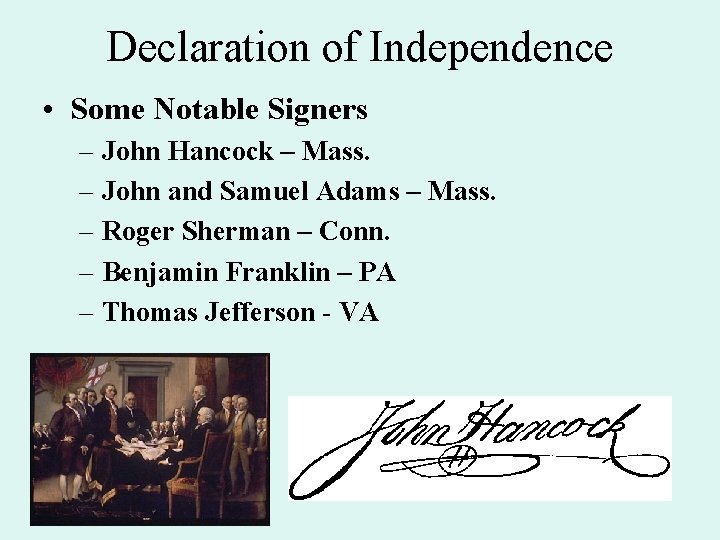
Declaration of Independence • Some Notable Signers – John Hancock – Mass. – John and Samuel Adams – Mass. – Roger Sherman – Conn. – Benjamin Franklin – PA – Thomas Jefferson - VA
The Shipwreck Adventure Will You Survive? ?
• Your ship has crashed on a reef during a bad tropical storm. You are able to swim to a nearby island. The next morning you discover that there are 30 other survivors. You search the island determine it is deserted. There a few wild animals and some edible vegetation. A few trees dot the landscape. As supplies from the ship are washed ashore and gathered, you find that besides what you are wearing, you have the following items: 1. 2. 3. 4. 5. 6. 7. 8. 9. 10. 6 ladies cosmetic compacts 1 box of 200 balloons 7 automobile tires 3 crates of oranges 1 telescope 1 parachute 1 medical kit (standard) 5 pair of scissors 4 baseball bats 2 boxes of trash bags • Using only the materials you have in hand, describe EXACTLY how your group will survive until rescued. GOOD LUCK!
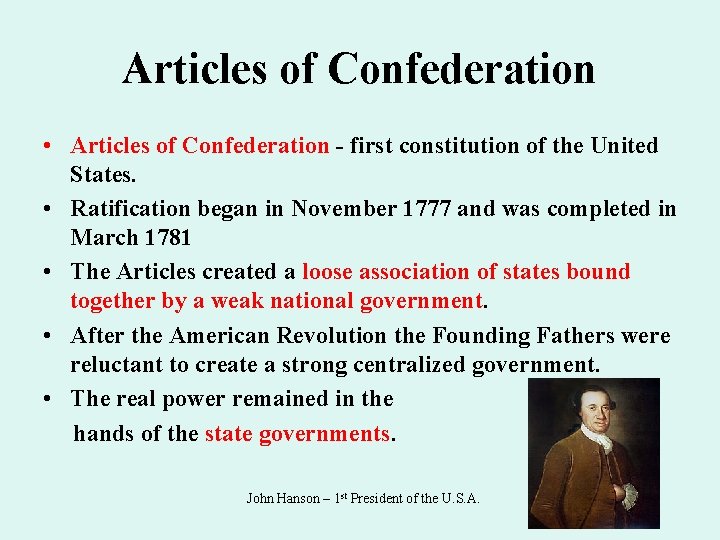
Articles of Confederation • Articles of Confederation - first constitution of the United States. • Ratification began in November 1777 and was completed in March 1781 • The Articles created a loose association of states bound together by a weak national government. • After the American Revolution the Founding Fathers were reluctant to create a strong centralized government. • The real power remained in the hands of the state governments. John Hanson – 1 st President of the U. S. A.
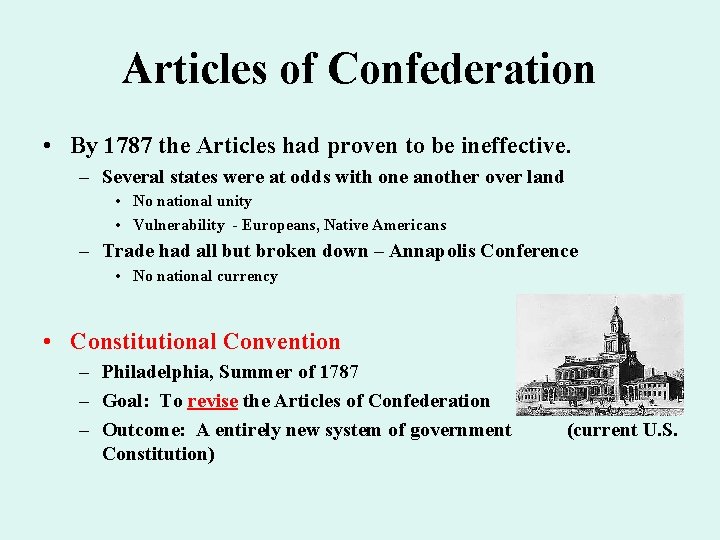
Articles of Confederation • By 1787 the Articles had proven to be ineffective. – Several states were at odds with one another over land • No national unity • Vulnerability - Europeans, Native Americans – Trade had all but broken down – Annapolis Conference • No national currency • Constitutional Convention – Philadelphia, Summer of 1787 – Goal: To revise the Articles of Confederation – Outcome: A entirely new system of government Constitution) (current U. S.
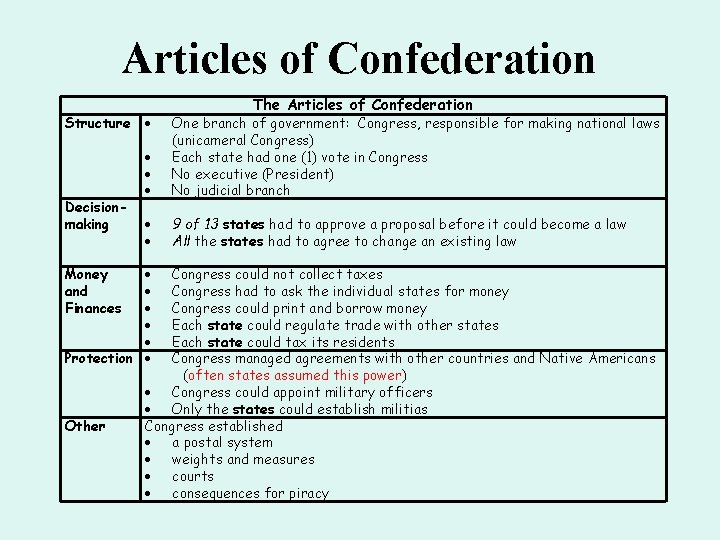
Articles of Confederation Structure Decisionmaking Money and Finances One branch of government: Congress, responsible for making national laws (unicameral Congress) Each state had one (1) vote in Congress No executive (President) No judicial branch 9 of 13 states had to approve a proposal before it could become a law All the states had to agree to change an existing law Congress could not collect taxes Congress had to ask the individual states for money Congress could print and borrow money Each state could regulate trade with other states Each state could tax its residents Congress managed agreements with other countries and Native Americans (often states assumed this power) Congress could appoint military officers Only the states could establish militias Congress established a postal system weights and measures courts consequences for piracy Protection Other The Articles of Confederation
Philadelphia Convention • George Washington presided over the meeting. • If the representatives could not “fix” the Articles, the nation would face dire consequences. • The meeting was closed to the public. • Most of the “real work” was done in taverns. • Instead of revising the Articles, a completely new form of government resulted.
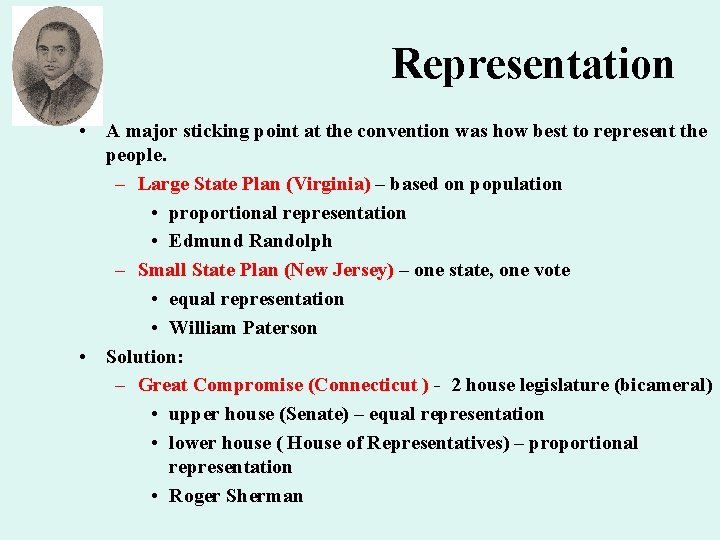
Representation • A major sticking point at the convention was how best to represent the people. – Large State Plan (Virginia) – based on population • proportional representation • Edmund Randolph – Small State Plan (New Jersey) – one state, one vote • equal representation • William Paterson • Solution: – Great Compromise (Connecticut ) - 2 house legislature (bicameral) • upper house (Senate) – equal representation • lower house ( House of Representatives) – proportional representation • Roger Sherman
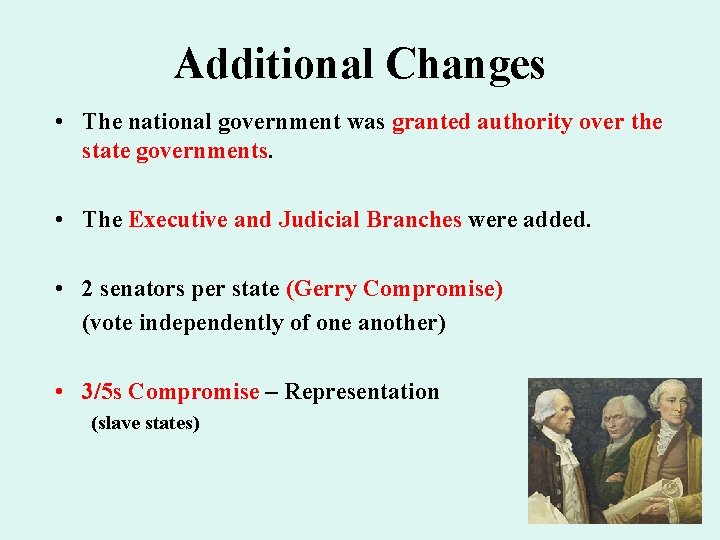
Additional Changes • The national government was granted authority over the state governments. • The Executive and Judicial Branches were added. • 2 senators per state (Gerry Compromise) (vote independently of one another) • 3/5 s Compromise – Representation (slave states)