
What is Poetry By Eleanor Farjeon What is
What is Poetry? By: Eleanor Farjeon What is Poetry? Who knows? Not a rose, but the scent of a rose; Not the sky, but the light in the sky; Not the fly, but the gleam of a fly; Not the sea, but the sound of the sea; Not myself, but what makes me See, hear, and feel something that prose Cannot: and what it is, who knows?
Outline for this Power Point: 1. 2. 3. 4. 5. 6. 7. 8. Format of Writing Structure of Poetry Sound of Poetry Language of Poetry Purpose of Poetry Imagery in Poetry Figurative Language Theme in Poetry

Format of Writing ¡ ¡ Prose – a format written in sentences (novels, short stories, essays, articles, etc) Poetry - literary works written in verse (many different forms of verse)

Structure of Poetry Prose relies on complete sentences; poetry does not. Poetry needs form. 1. Verses/stanzas can repeat a pattern. Eg: 4 line stanza 2. When a poem doesn’t follow a set pattern it is called “Free Verse”

Sound of Poetry uses patterns in the words to create interesting sounds with: l Rhyme – a pattern within the line or the word at the end of the line sounds the same…. Rain…. Pain…Gain l Rhythm – a pattern of sound/pace that adds to the writing. ¡ Rhythm patterns can sound like a drum beat or a skipping sound of the words.
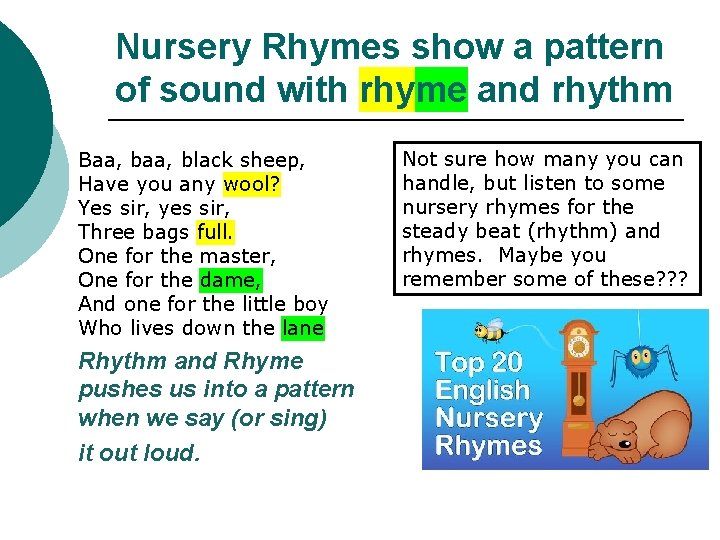
Nursery Rhymes show a pattern of sound with rhyme and rhythm Baa, black sheep, Have you any wool? Yes sir, yes sir, Three bags full. One for the master, One for the dame, And one for the little boy Who lives down the lane Rhythm and Rhyme pushes us into a pattern when we say (or sing) it out loud. Not sure how many you can handle, but listen to some nursery rhymes for the steady beat (rhythm) and rhymes. Maybe you remember some of these? ? ?

Language of Poetry is concise and uses language in a compact form. Poetry must choose effective and strong words in order to be concise. …. no rambling or boring adjectives. Eg: “big” (boring/general) “humungous” (specific)
Purpose of Poetry ¡ Poetry is primarily about our strongest feelings and emotions. ¡ Poetry can also make us think deeper about a given topic
Imagery in Poetry ¡ ¡ ¡ Descriptive Poetry uses imagery to help the reader experience a moment or a place in a poem. Imagery includes: visual, auditory, tactile, olfactory, gustatory Imagery helps the reader “be” in that place.
Figurative Language Poetry uses figurative language to help the reader understand: l l Abstract ideas (Eg: intelligence) Feelings (Eg: love) Figurative Language includes: • Simile • Metaphor • Personification • Symbols • Hyperbole • Understatement
Theme in a Poem Theme is a message about ourselves. ¡ Theme tries to help us notice something in the world ¡ Theme is not a moral statement, but sometimes is a difficult/painful truth the writer shares. For example: Moral Statement: War is wrong Thematic Statement: People can be cruel in war. ¡
How to analyze a theme in a poem 1. 2. 3. 4. What can the reader relate to or understand in the poem? Look carefully at the emotions/mood created in the poem What does the figurative language mean? Look carefully at the thoughts/ideas of the speaker in the poem.
What is theme of “What is Poetry? ” Use the 4 points from the previous slide to write a short paragraph explaining a theme for the poem “What is Poetry? ” by Eleanor Farjeon. The next slide is a sample response. What is Poetry? Who knows? Not a rose, but the scent of a rose; Not the sky, but the light in the sky; Not the fly, but the gleam of a fly; Not the sea, but the sound of the sea; Not myself, but what makes me See, hear, and feel something that prose Cannot: and what it is, who knows?
Thematic response for “What is Poetry? ” is a poem that is trying to understand poetry. The speaker shows examples of imagery that poetry is not just the thing like sea, sky, etc. , but a quality of that thing that is tied to a positive mood. For example: scent of a rose is a pleasing smell and light in the sky draws our attention. The speaker feels a connection with poetry and their own identity when she says “What makes me” and sees the value in writing in a poetic form that the sentences of prose cannot do. It’s like prose is the business of writing, and poetry is the creativity in writing. The speaker is content at the end with the mystery of poetry.
Poetry Analysis Open the following link to a word document for a poem to analyze. ¡ Instructions are on the document. ¡ Tomorrow I’ll post an answer key so you can review and compare your answers with mine. ¡ ¡ Link to Word document for Hockey poem
- Slides: 15