
What is Poetry An Introduction expression of thoughts
- Slides: 32
What is Poetry? An Introduction
expression of thoughts and feelings, with highly specific and concise musical and emotionally charged language, written in specific forms, lines, rhythms, meters and rhymes.
Why study and analyze poetry? v Analyzing anything teaches you the skills to break something down to it’s important elements and explain how they work together to create an effect or reinforce meaning. v You will gain a better understanding of certain intellectual movements, how our way of thinking evolved and changed throughout history. Literature is indicative of the time in which it was written! v You will learn to think critically about culture and society v You will learn to appreciate thought that goes into creative processes.
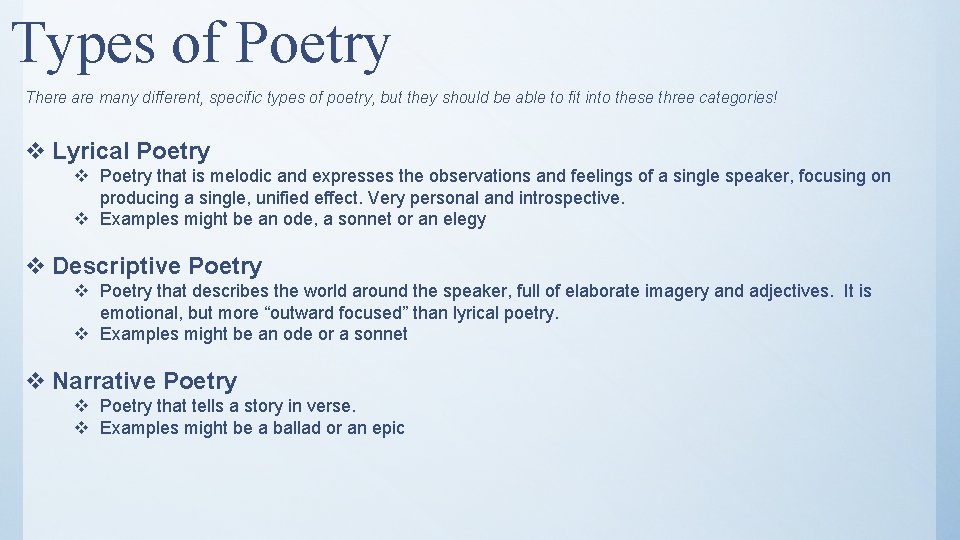
Types of Poetry There are many different, specific types of poetry, but they should be able to fit into these three categories! v Lyrical Poetry v Poetry that is melodic and expresses the observations and feelings of a single speaker, focusing on producing a single, unified effect. Very personal and introspective. v Examples might be an ode, a sonnet or an elegy v Descriptive Poetry v Poetry that describes the world around the speaker, full of elaborate imagery and adjectives. It is emotional, but more “outward focused” than lyrical poetry. v Examples might be an ode or a sonnet v Narrative Poetry v Poetry that tells a story in verse. v Examples might be a ballad or an epic
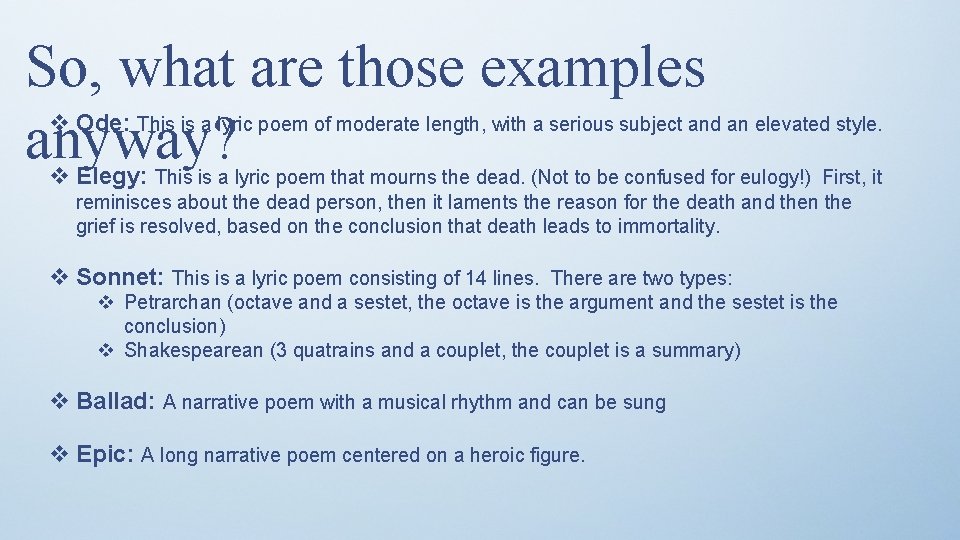
So, what are those examples v anyway? v Ode: This is a lyric poem of moderate length, with a serious subject and an elevated style. Elegy: This is a lyric poem that mourns the dead. (Not to be confused for eulogy!) First, it reminisces about the dead person, then it laments the reason for the death and then the grief is resolved, based on the conclusion that death leads to immortality. v Sonnet: This is a lyric poem consisting of 14 lines. There are two types: v Petrarchan (octave and a sestet, the octave is the argument and the sestet is the conclusion) v Shakespearean (3 quatrains and a couplet, the couplet is a summary) v Ballad: A narrative poem with a musical rhythm and can be sung v Epic: A long narrative poem centered on a heroic figure.
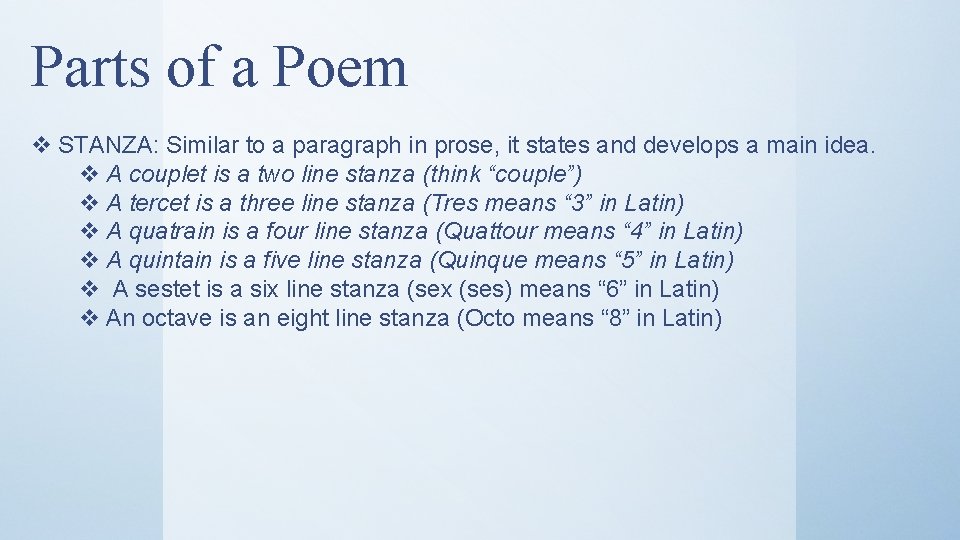
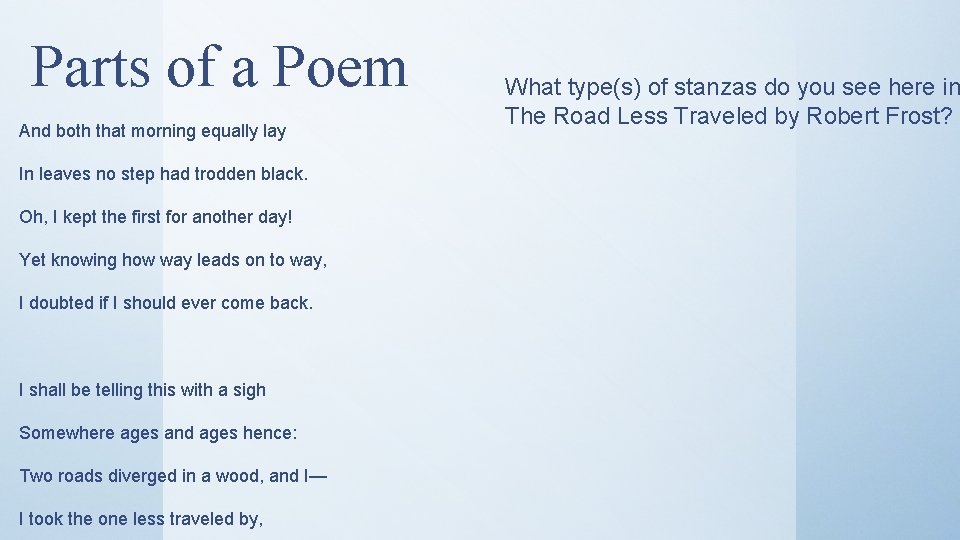
Parts of a Poem v STANZA: Similar to a paragraph in prose, it states and develops a main idea. v A couplet is a two line stanza (think “couple”) v A tercet is a three line stanza (Tres means “ 3” in Latin) v A quatrain is a four line stanza (Quattour means “ 4” in Latin) v A quintain is a five line stanza (Quinque means “ 5” in Latin) v A sestet is a six line stanza (sex (ses) means “ 6” in Latin) v An octave is an eight line stanza (Octo means “ 8” in Latin)
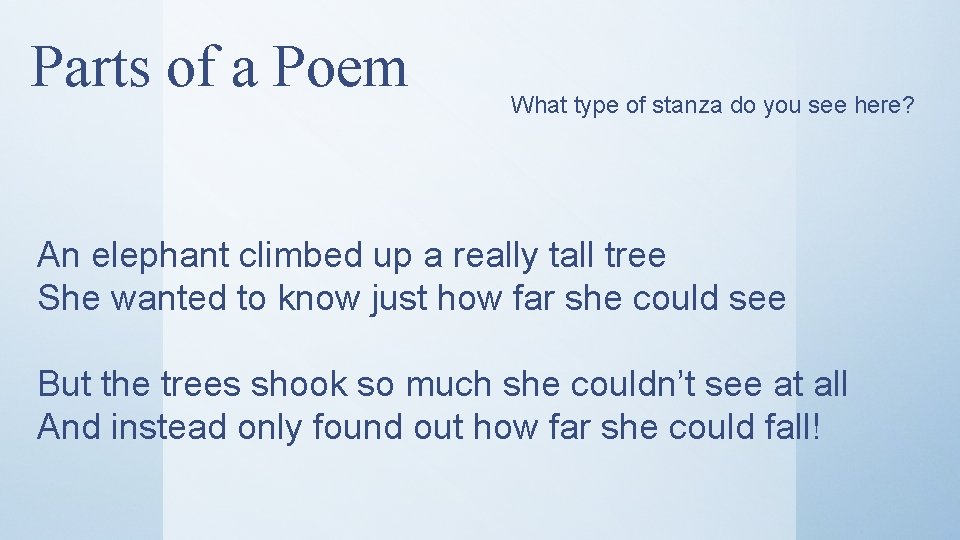
Parts of a Poem What type of stanza do you see here? An elephant climbed up a really tall tree She wanted to know just how far she could see But the trees shook so much she couldn’t see at all And instead only found out how far she could fall!
Parts of a Poem And both that morning equally lay In leaves no step had trodden black. Oh, I kept the first for another day! Yet knowing how way leads on to way, I doubted if I should ever come back. I shall be telling this with a sigh Somewhere ages and ages hence: Two roads diverged in a wood, and I— I took the one less traveled by, What type(s) of stanzas do you see here in The Road Less Traveled by Robert Frost?
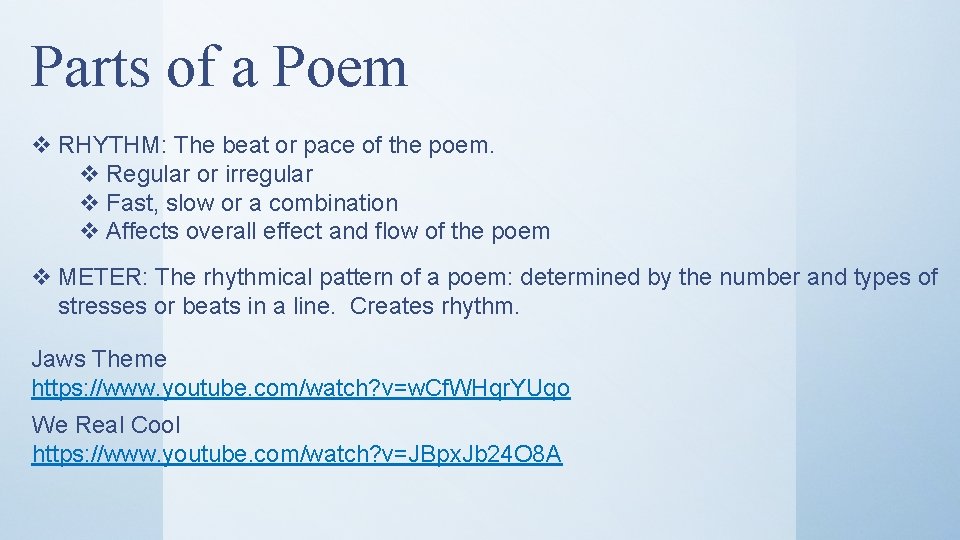
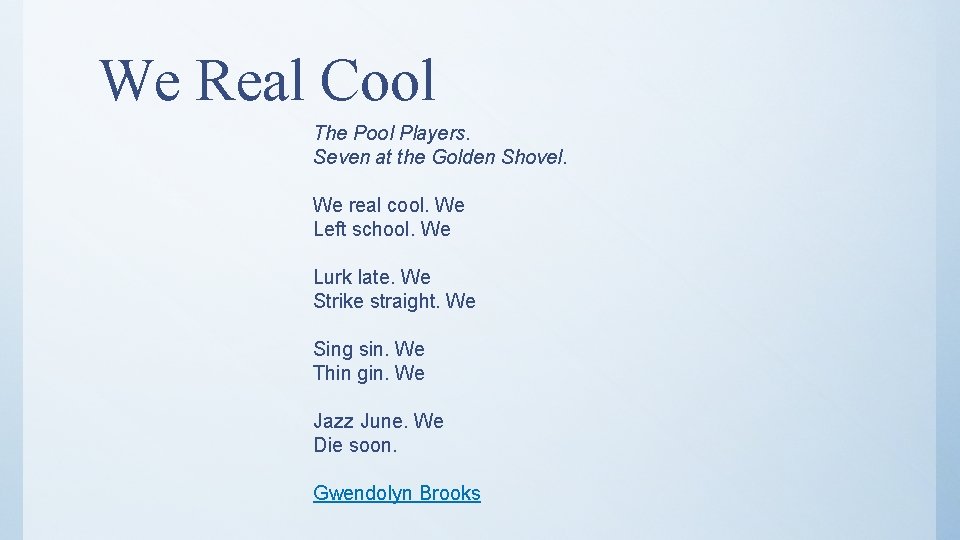
Parts of a Poem v RHYTHM: The beat or pace of the poem. v Regular or irregular v Fast, slow or a combination v Affects overall effect and flow of the poem v METER: The rhythmical pattern of a poem: determined by the number and types of stresses or beats in a line. Creates rhythm. Jaws Theme https: //www. youtube. com/watch? v=w. Cf. WHqr. YUqo We Real Cool https: //www. youtube. com/watch? v=JBpx. Jb 24 O 8 A
We Real Cool The Pool Players. Seven at the Golden Shovel. We real cool. We Left school. We Lurk late. We Strike straight. We Sing sin. We Thin gin. We Jazz June. We Die soon. Gwendolyn Brooks
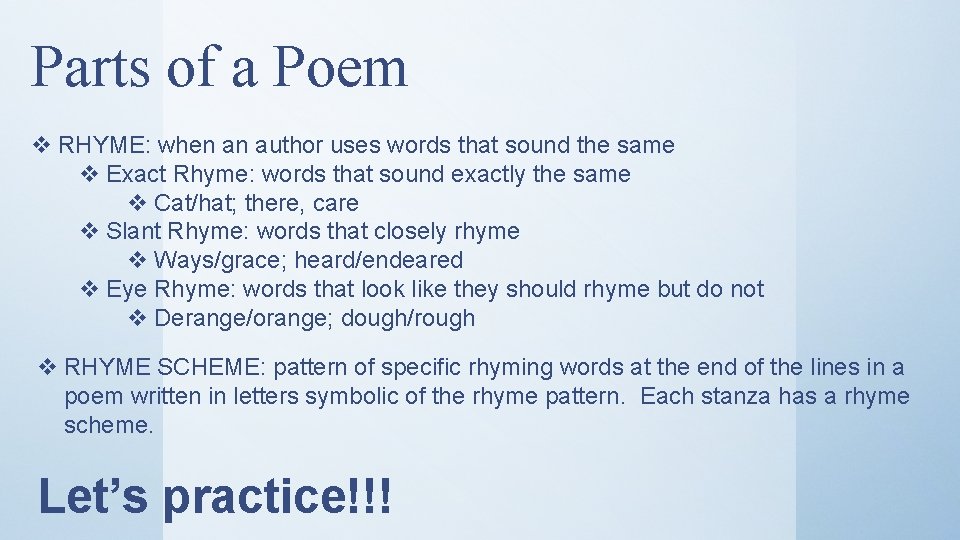
Parts of a Poem v RHYME: when an author uses words that sound the same v Exact Rhyme: words that sound exactly the same v Cat/hat; there, care v Slant Rhyme: words that closely rhyme v Ways/grace; heard/endeared v Eye Rhyme: words that look like they should rhyme but do not v Derange/orange; dough/rough v RHYME SCHEME: pattern of specific rhyming words at the end of the lines in a poem written in letters symbolic of the rhyme pattern. Each stanza has a rhyme scheme. Let’s practice!!!
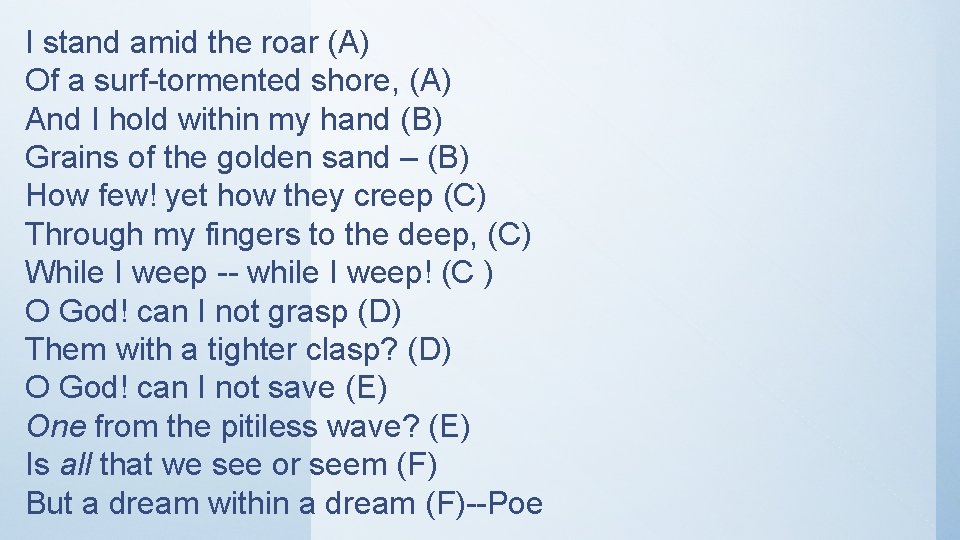
I stand amid the roar (A) Of a surf-tormented shore, (A) And I hold within my hand (B) Grains of the golden sand – (B) How few! yet how they creep (C) Through my fingers to the deep, (C) While I weep -- while I weep! (C ) O God! can I not grasp (D) Them with a tighter clasp? (D) O God! can I not save (E) One from the pitiless wave? (E) Is all that we see or seem (F) But a dream within a dream (F)--Poe
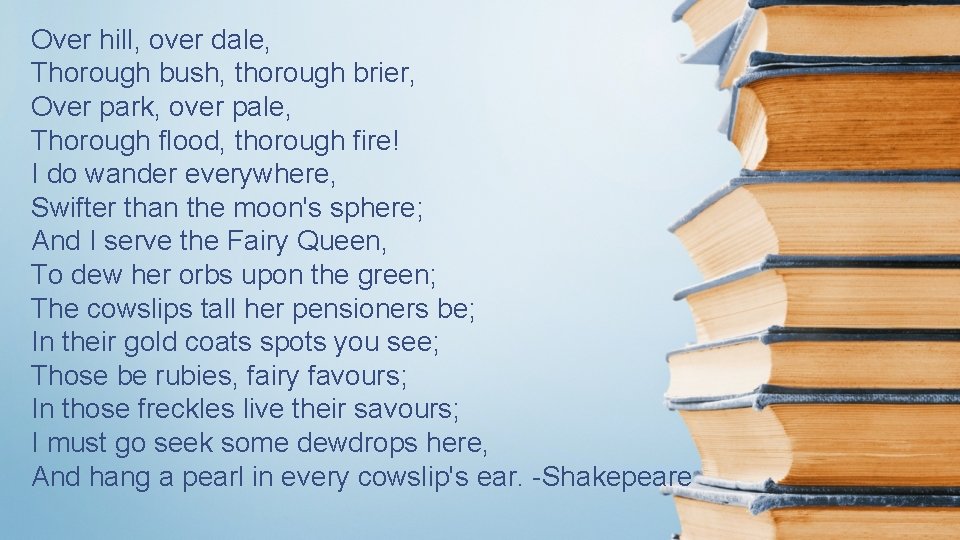
Over hill, over dale, Thorough bush, thorough brier, Over park, over pale, Thorough flood, thorough fire! I do wander everywhere, Swifter than the moon's sphere; And I serve the Fairy Queen, To dew her orbs upon the green; The cowslips tall her pensioners be; In their gold coats spots you see; Those be rubies, fairy favours; In those freckles live their savours; I must go seek some dewdrops here, And hang a pearl in every cowslip's ear. -Shakepeare
Word Choice in Poetry v. Word choice is vital to poetry, the poet must hone our language in order to communicate a thought, idea or theme to the reader. v. Poets use figurative language and imagery to express meaning and create emotion.
Imagery is descriptive language used to stimulate the reader’s senses, drawing the reader into the poem and heightening the effect of the poem on the reader. Olfactory: appeals to sense of smell Gustatory: appeals to sense of taste Tactile: appeals to sense of touch Auditory: appeals to sense of hearing Visual: appeals to sense of sight
Figurative Language Figurative language is writing or speech that is not meant to be taken literally or is intended to have more than one meaning. Let’s play a game to test your knowledge of figurative language!
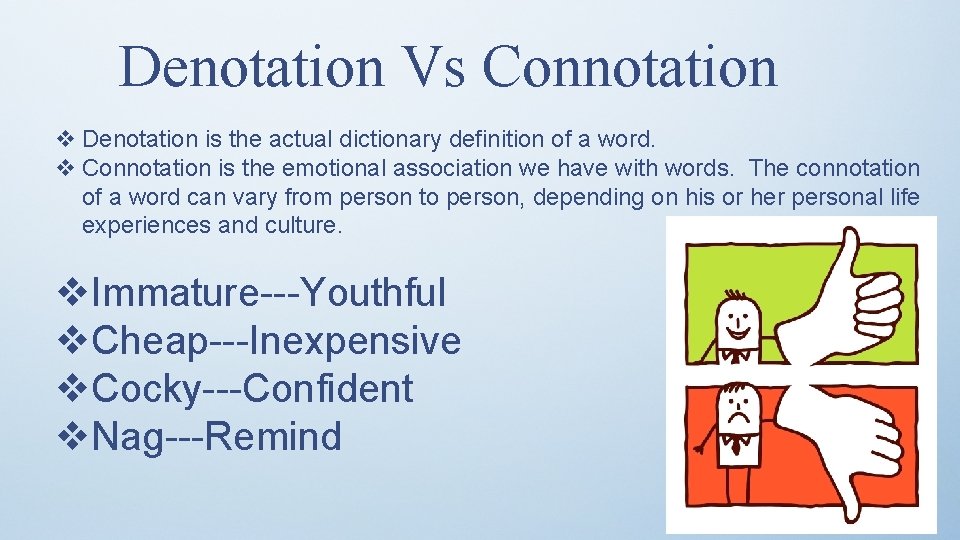
Denotation Vs Connotation v Denotation is the actual dictionary definition of a word. v Connotation is the emotional association we have with words. The connotation of a word can vary from person to person, depending on his or her personal life experiences and culture. v. Immature---Youthful v. Cheap---Inexpensive v. Cocky---Confident v. Nag---Remind
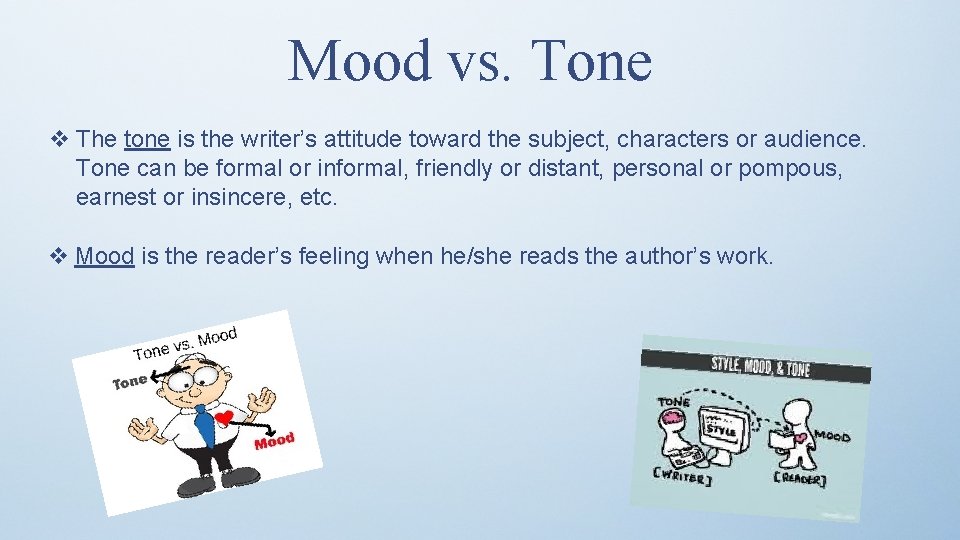
Mood vs. Tone v The tone is the writer’s attitude toward the subject, characters or audience. Tone can be formal or informal, friendly or distant, personal or pompous, earnest or insincere, etc. v Mood is the reader’s feeling when he/she reads the author’s work.
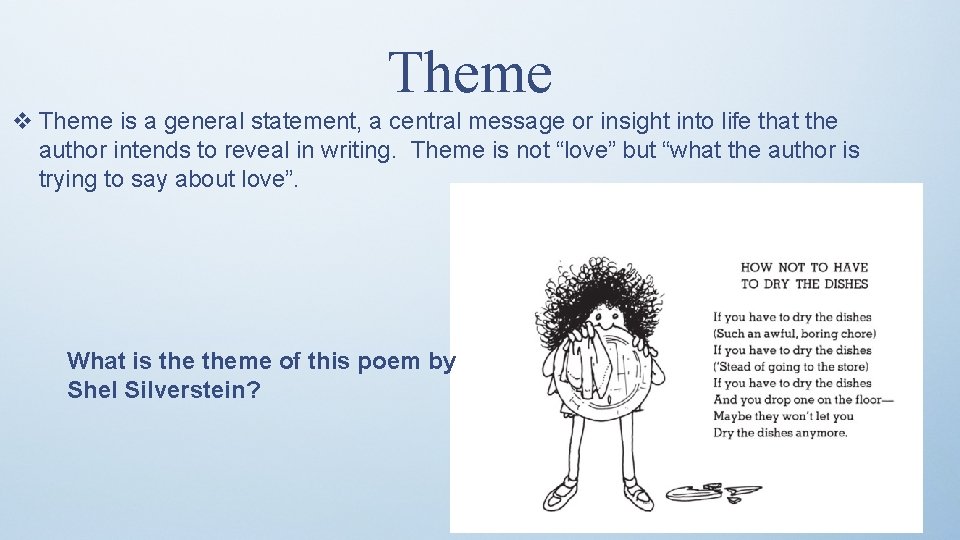
Theme v Theme is a general statement, a central message or insight into life that the author intends to reveal in writing. Theme is not “love” but “what the author is trying to say about love”. What is theme of this poem by Shel Silverstein?
And now it’s time for another poetry game…
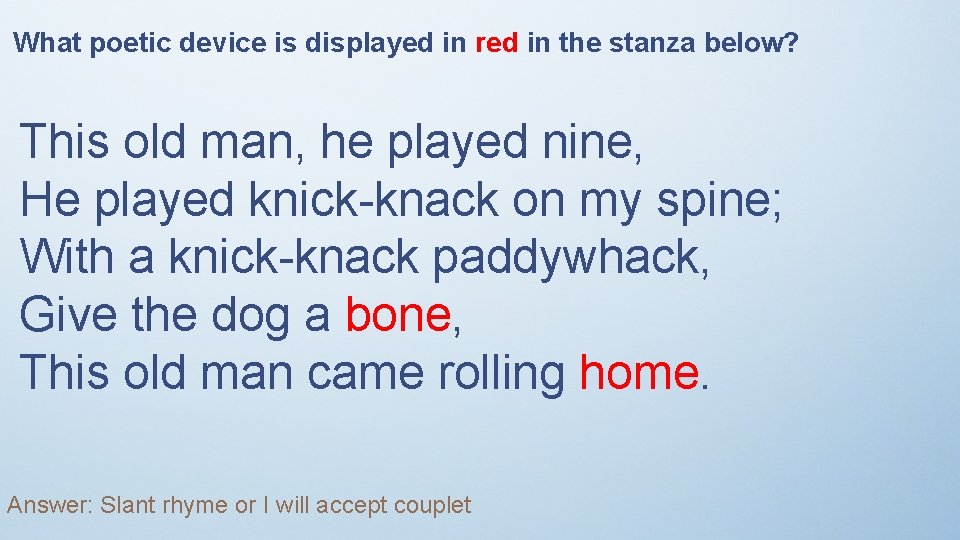
What poetic device is displayed in red in the stanza below? This old man, he played nine, He played knick-knack on my spine; With a knick-knack paddywhack, Give the dog a bone, This old man came rolling home. Answer: Slant rhyme or I will accept couplet
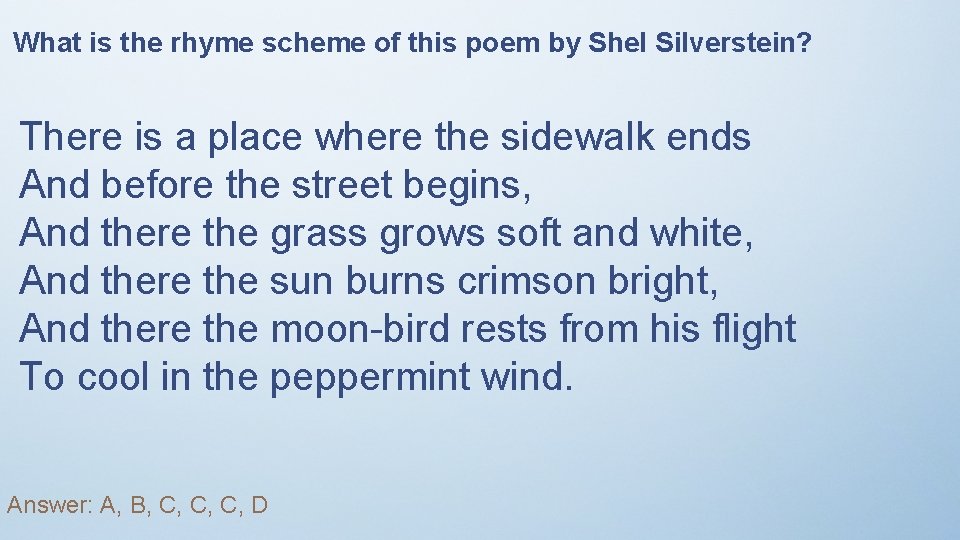
What is the rhyme scheme of this poem by Shel Silverstein? There is a place where the sidewalk ends And before the street begins, And there the grass grows soft and white, And there the sun burns crimson bright, And there the moon-bird rests from his flight To cool in the peppermint wind. Answer: A, B, C, C, C, D
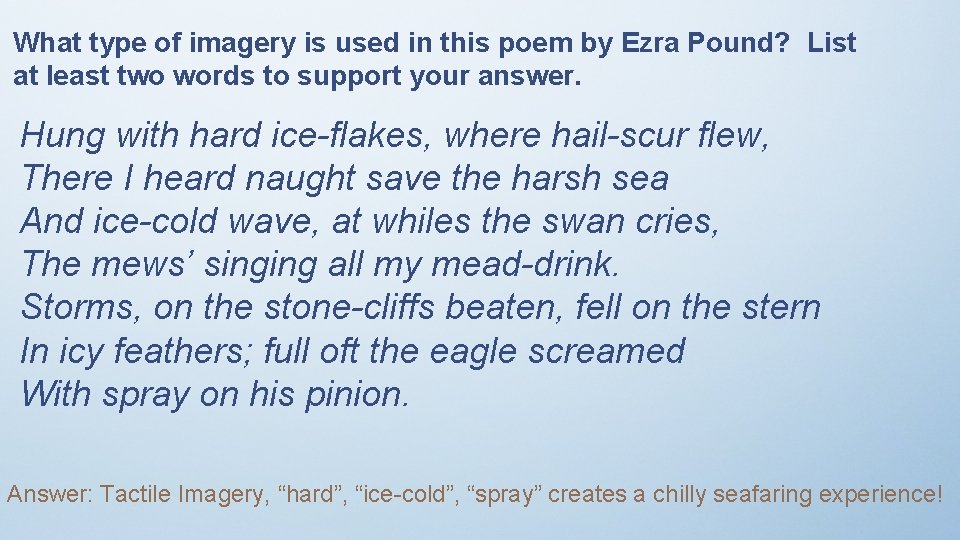
What type of imagery is used in this poem by Ezra Pound? List at least two words to support your answer. Hung with hard ice-flakes, where hail-scur flew, There I heard naught save the harsh sea And ice-cold wave, at whiles the swan cries, The mews’ singing all my mead-drink. Storms, on the stone-cliffs beaten, fell on the stern In icy feathers; full oft the eagle screamed With spray on his pinion. Answer: Tactile Imagery, “hard”, “ice-cold”, “spray” creates a chilly seafaring experience!
Read the first stanza from “Concord Hymn” by Ralph Waldo Emerson. What is this an example of? By the rude bridge that arched the flood, Their flag to April’s breeze unfurled, Here once the embattled farmers stood And fired the shot heard round the world. Answer: Hyperbole
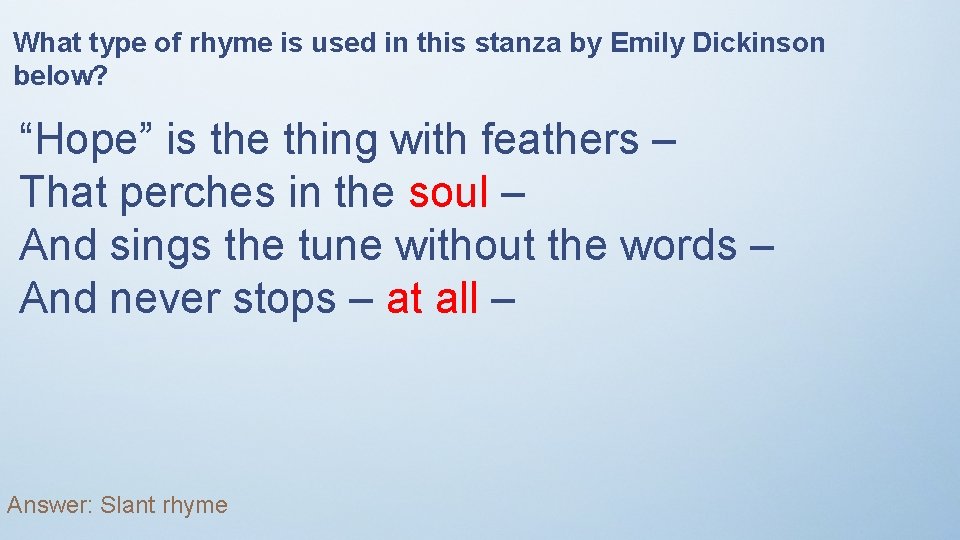
What type of rhyme is used in this stanza by Emily Dickinson below? “Hope” is the thing with feathers – That perches in the soul – And sings the tune without the words – And never stops – at all – Answer: Slant rhyme
What poetic device is Robert Burns using in this poem? O my Luve is like a red, red rose That’s newly sprung in June; O my Luve is like the melody That’s sweetly played in tune. Answer: similie
What mood does this stanza from Thomas Gray’s “Elegy Written in a Country Church. Yard” convey? The curfew tolls the knell of parting day, The lowing herd wind slowly o'er the lea, The ploughman homeward plods his weary way, And leaves the world to darkness and to me. Answer: hopeless, sad, depressed…anything negative!
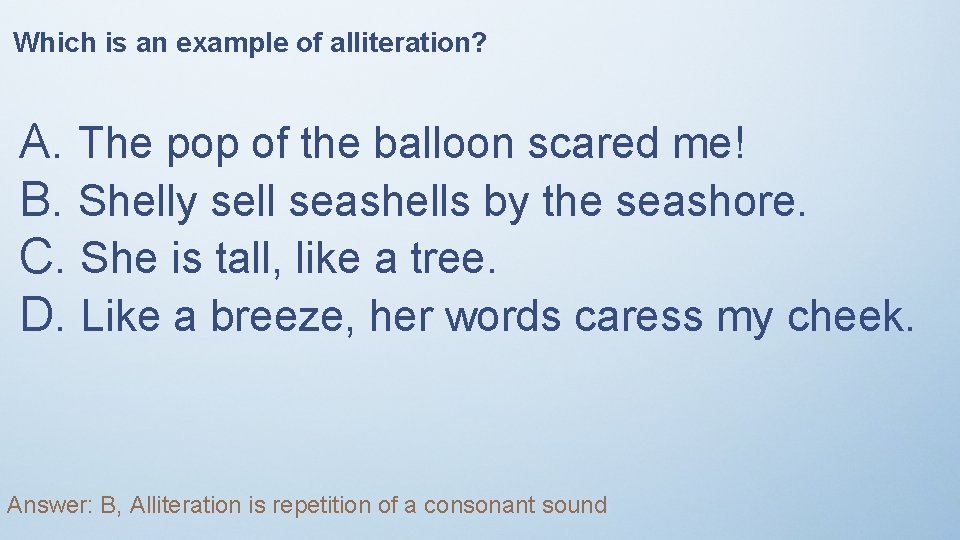
Which is an example of alliteration? A. The pop of the balloon scared me! B. Shelly sell seashells by the seashore. C. She is tall, like a tree. D. Like a breeze, her words caress my cheek. Answer: B, Alliteration is repetition of a consonant sound
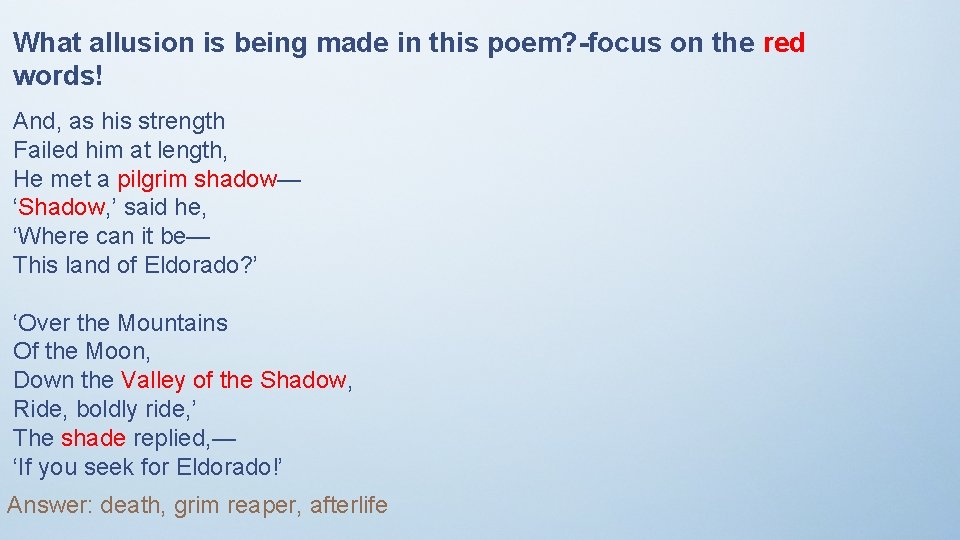
What allusion is being made in this poem? -focus on the red words! And, as his strength Failed him at length, He met a pilgrim shadow— ‘Shadow, ’ said he, ‘Where can it be— This land of Eldorado? ’ ‘Over the Mountains Of the Moon, Down the Valley of the Shadow, Ride, boldly ride, ’ The shade replied, — ‘If you seek for Eldorado!’ Answer: death, grim reaper, afterlife
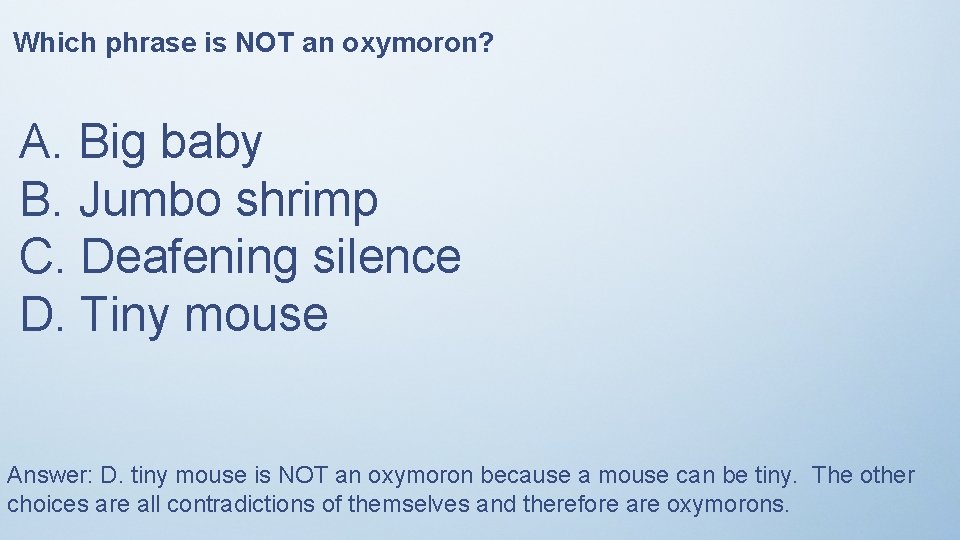
Which phrase is NOT an oxymoron? A. Big baby B. Jumbo shrimp C. Deafening silence D. Tiny mouse Answer: D. tiny mouse is NOT an oxymoron because a mouse can be tiny. The other choices are all contradictions of themselves and therefore are oxymorons.
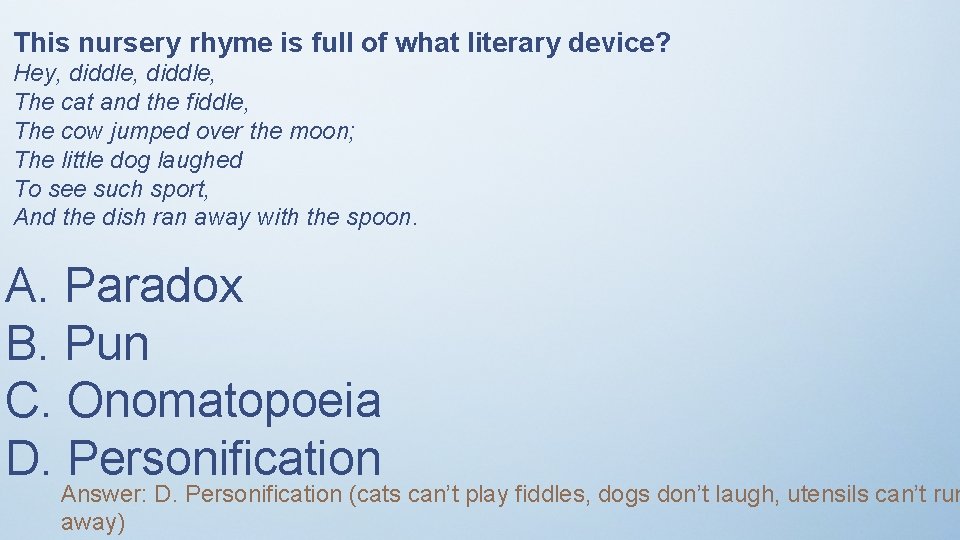
This nursery rhyme is full of what literary device? Hey, diddle, The cat and the fiddle, The cow jumped over the moon; The little dog laughed To see such sport, And the dish ran away with the spoon. A. Paradox B. Pun C. Onomatopoeia D. Personification Answer: D. Personification (cats can’t play fiddles, dogs don’t laugh, utensils can’t run away)