
What is Plagiarism How to Avoid It LIBRARY
What is Plagiarism? & How to Avoid It LIBRARY 01 th Oct, 2018
Introduction �Writings, presentations, discussions, deliberations, debates etc. are integral part academic & research works � Generating new ideas, building upon others ideas is also major part of academic & research work � Important to know how to borrow others ideas, where & when to use acknowledge them appropriately � Academic institutions are symbol of ethical values � Respect for others ideas & words is a must �Some where down the line, we are ignoring these values & started plagiarizing others works � Knowledge of use of resources a basic requirement
What is Plagiarism? . . . Merriam- Webster Dictionary �“to use the words or ideas of another person as if they were your own words or ideas �to steal & pass off (ideas or words of another) as one's own � to use (another's production) without crediting source �to commit literary theft �to present as new & original an idea or product derived from an existing source” http: //www. merriam-webster. com/dictionary/plagiarize

What constitutes a Plagiarism? . . . q. Copying & pasting material from online resources q Getting a paper from web & submitting as your own q Using another persons work & claiming it as your own q Using photographs, video, audio without acknowledgement q Quoting a source without using quotation marks-even if you do cite it
Why do People Plagiarize? . . . v. Lack of awareness - why it is important to cite sources v Simply not knowing what constitutes plagiarism v Lack confidence in own ideas & writing abilities v Not able to figure out how to respond to writing assignment/task v Never used or not aware of citation styles (MLA, APA, IEEE Style Guides, Chicago Manual etc. ) v. Lack of knowledge on the ethics of academic / poor writing skills
Types of Plagiarism Deliberate/intentional q Copying from another source without citing q Buying, stealing, or borrowing a paper q Copying a friend’s work q Cutting & pasting blocks of text from electronic sources without proper citing Unintentional/accidental/ignorance q Careless paraphrasing q Quoting excessively q Poor documentation q Building on someone else’s ideas without citation q Using source too closely when paraphrasing q Failure to use your own “voice”
What are the consequences? v Depends on set policies & guidelines v Depends on severity of act v Warning- from instructor, higher-ups v Reprimanding & punishment v Failing in assignment/course v Suspension v Expulsion v Noting on transcription v Any other- depending on act of plagiarism v Remember- academic integrity & self esteem at stake
How to Avoid Plagiarism? § Effective management of time § Developing good research skills
Effective management of time q. Every task has timeline, due date, deadline Note these dates & allocate time & follow schedule accordingly q Collecting information q Reading & taking notes q Drawing an outline q Preparing rough draft q Final draft q Extra time for last minute changes
Developing Good Research Skills… v Follow instructions from your course instructor v Use library & web-based resources v Identify scholarly resources v Search for information from these sources v Evaluate & select right source of information v Organize collected information sources v Read & take proper notes of content & source v Use right tools- databases, citation style & software v Seek assistance from library staff
Quoting o Quotations are exact words of an author, copied directly from a source, word for word o Quotations must be cited! Use in text citation Use quotations when you want to, o Add power of an author’s words to support your argument o Disagree with an author’s argument o Highlight eloquent or powerful phrases or passages o Comparing & contrasting specific points of view o Note important research that precedes your own
Paraphrasing �Paraphrasing means rephrasing words of an author, putting his/her thoughts in your own words � When you paraphrase, you rework source’s ideas, words, phrases & sentence structures with your own � Like quotations, paraphrased material must be followed with in-text documentation & cited Paraphrase when you want to: �Use information on your note cards & wish to avoid plagiarizing �Avoid overusing quotations �Use your own voice to present information
Summarizing �Summarizing involves putting main idea(s) of one or several writers into your own words along with main point(s) �Summaries significantly shorter than original & take broad overview of source material �Necessary to attribute summarized ideas to their original sources Summarize when you want to: �Establish background or offer an overview of a topic �Describe knowledge (from several sources) about a topic �Determine main ideas of single source
Using content in Common knowledge/domain No citation required, if information is �Widely accessible or commonly known e. g Indian population, first President of India �Likely to be known by a lot of people �Found in a general reference resources, such as a dictionary orencyclopaedia �Advisable to cite, if you are not clear

Detecting Plagiarism �Plagiarizing & detecting it was difficult in print era �Technology- made it easier to track down & identify plagiarism �Search engines can easily detect �Full-text journal articles in library databases �Computer-assisted detection allows vast collections of documents to be compared to each other �Free & Commercial plagiarism detection services available �Your instructor may well recognize source
Plagiarism Detection Software Commercial üIthenitcate http: //www. ithenticate. com/ üPlagium http: //www. plagium. com/ üTurnitin http: //www. turnitin. com/ üURKUND http: //www. urkund. com/en/ üPlag. Scan http: //plagscan. com
Free Resources to check Plagiarism Free § Dupli. Checker http: //www. duplichecker. com/ § Copy. Leaks https: //copyleaks. com/ § Paper. Rater http: //www. paperrater. com/ § Plagiarism. Checker http: //www. plagiarismchecker. com/help-teachers. php § Quetext http: //www. quetext. com/ § Viper http: //www. scanmyessay. com/
UGC (Promotion of Academic Integrity and Prevention of Plagiarism In Higher Educational Institutions) Regulations, 2018 (Notification) Main Objectives �To create awareness �To establish institutional mechanism �To develop systems to detect plagiarism �To set up mechanism to prevent plagiarism and punish Source: UGC Regulations, 2018
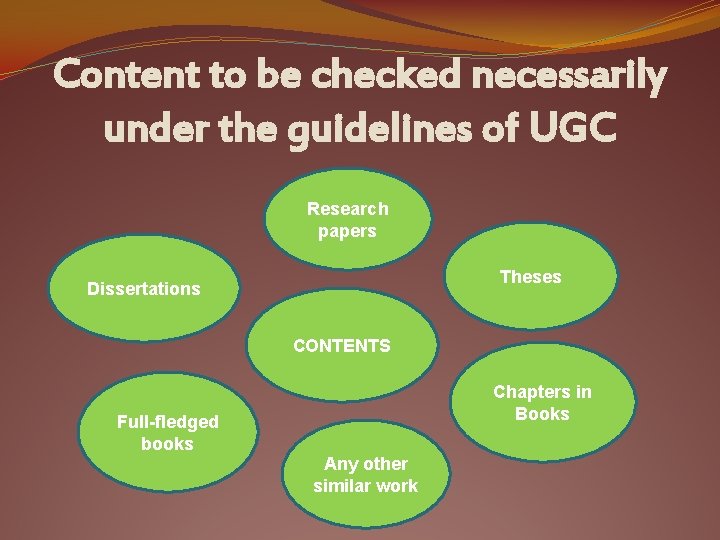
Content to be checked necessarily under the guidelines of UGC Research papers Theses Dissertations CONTENTS Chapters in Books Full-fledged books Any other similar work
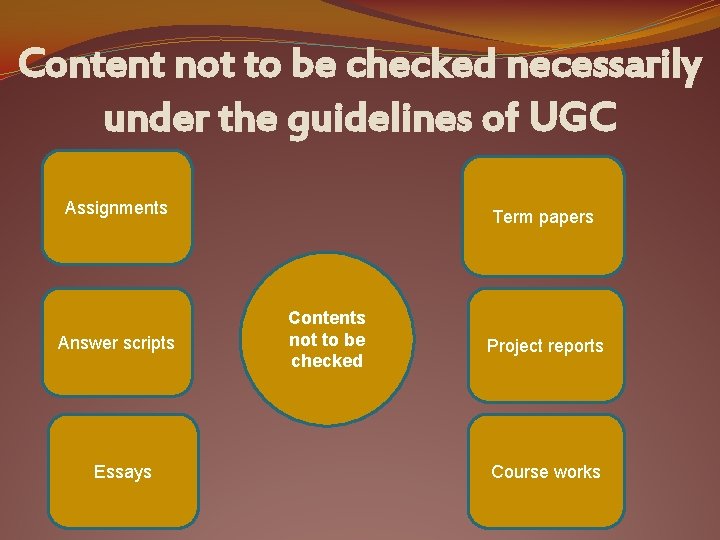
Content not to be checked necessarily under the guidelines of UGC Assignments Answer scripts Essays Term papers Contents not to be checked Project reports Course works
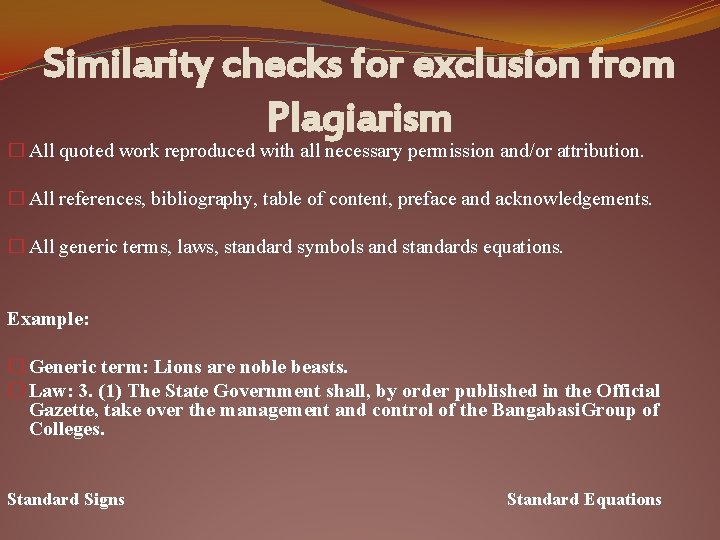
Similarity checks for exclusion from Plagiarism � All quoted work reproduced with all necessary permission and/or attribution. � All references, bibliography, table of content, preface and acknowledgements. � All generic terms, laws, standard symbols and standards equations. Example: � Generic term: Lions are noble beasts. � Law: 3. (1) The State Government shall, by order published in the Official Gazette, take over the management and control of the Bangabasi. Group of Colleges. Standard Signs Standard Equations
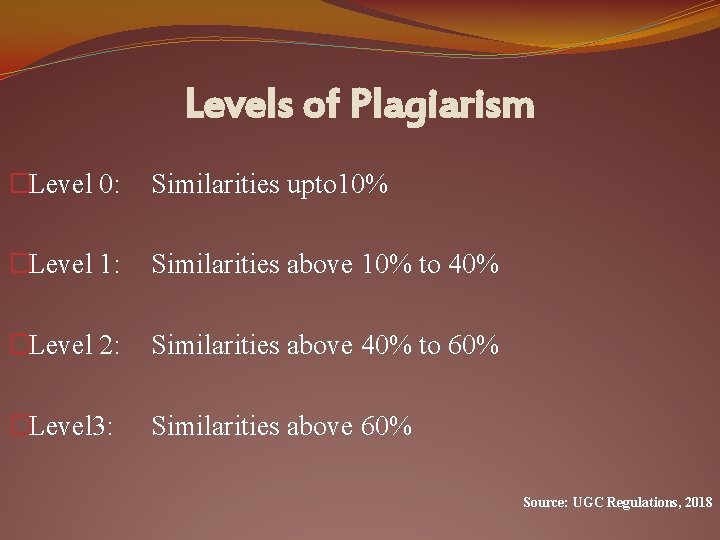
Levels of Plagiarism �Level 0: �Level 1: �Level 2: Similarities upto 10% �Level 3: Similarities above 60% Similarities above 10% to 40% Similarities above 40% to 60% Source: UGC Regulations, 2018
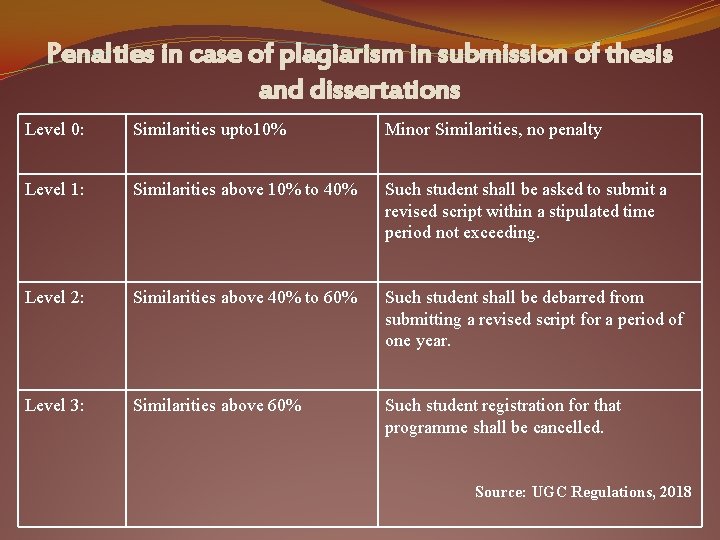
Penalties in case of plagiarism in submission of thesis and dissertations Level 0: Similarities upto 10% Minor Similarities, no penalty Level 1: Similarities above 10% to 40% Such student shall be asked to submit a revised script within a stipulated time period not exceeding. Level 2: Similarities above 40% to 60% Such student shall be debarred from submitting a revised script for a period of one year. Level 3: Similarities above 60% Such student registration for that programme shall be cancelled. Source: UGC Regulations, 2018
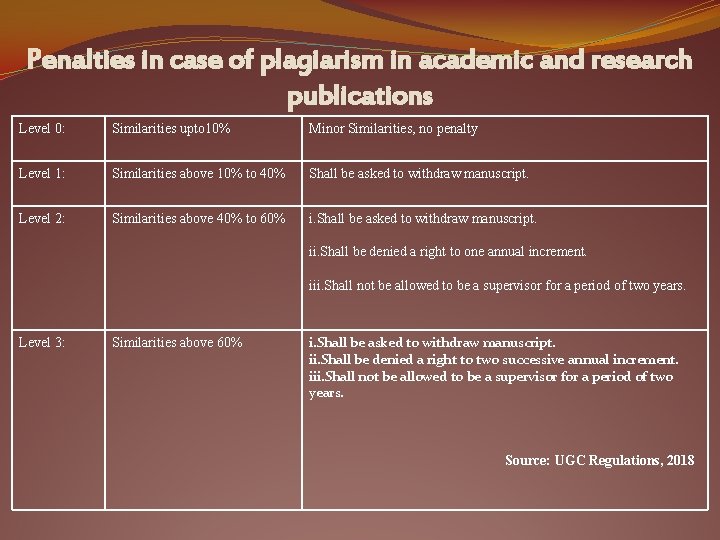
Penalties in case of plagiarism in academic and research publications Level 0: Similarities upto 10% Minor Similarities, no penalty Level 1: Similarities above 10% to 40% Shall be asked to withdraw manuscript. Level 2: Similarities above 40% to 60% i. Shall be asked to withdraw manuscript. ii. Shall be denied a right to one annual increment. iii. Shall not be allowed to be a supervisor for a period of two years. Level 3: Similarities above 60% i. Shall be asked to withdraw manuscript. ii. Shall be denied a right to two successive annual increment. iii. Shall not be allowed to be a supervisor for a period of two years. Source: UGC Regulations, 2018
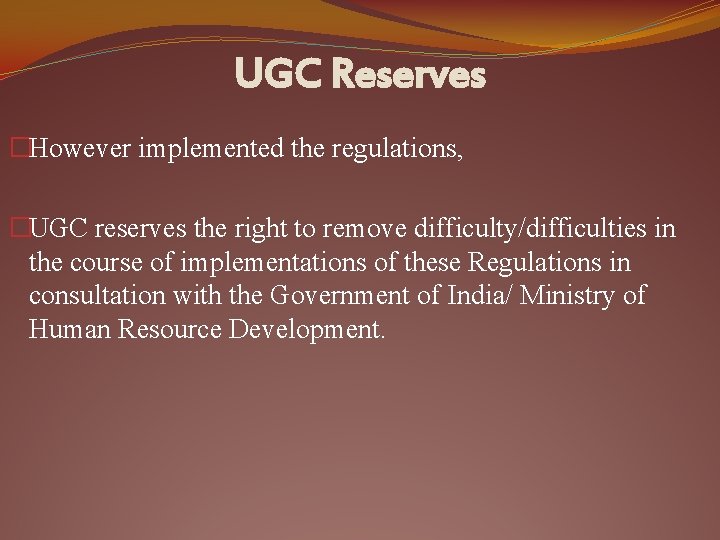
UGC Reserves �However implemented the regulations, �UGC reserves the right to remove difficulty/difficulties in the course of implementations of these Regulations in consultation with the Government of India/ Ministry of Human Resource Development.
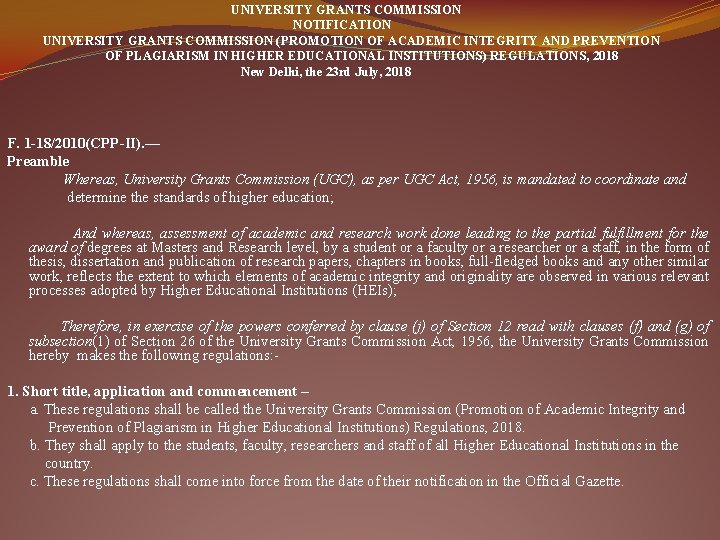
UNIVERSITY GRANTS COMMISSION NOTIFICATION UNIVERSITY GRANTS COMMISSION (PROMOTION OF ACADEMIC INTEGRITY AND PREVENTION OF PLAGIARISM IN HIGHER EDUCATIONAL INSTITUTIONS) REGULATIONS, 2018 New Delhi, the 23 rd July, 2018 F. 1 -18/2010(CPP-II). — Preamble Whereas, University Grants Commission (UGC), as per UGC Act, 1956, is mandated to coordinate and determine the standards of higher education; And whereas, assessment of academic and research work done leading to the partial fulfillment for the award of degrees at Masters and Research level, by a student or a faculty or a researcher or a staff, in the form of thesis, dissertation and publication of research papers, chapters in books, full-fledged books and any other similar work, reflects the extent to which elements of academic integrity and originality are observed in various relevant processes adopted by Higher Educational Institutions (HEIs); Therefore, in exercise of the powers conferred by clause (j) of Section 12 read with clauses (f) and (g) of subsection(1) of Section 26 of the University Grants Commission Act, 1956, the University Grants Commission hereby makes the following regulations: 1. Short title, application and commencement – a. These regulations shall be called the University Grants Commission (Promotion of Academic Integrity and Prevention of Plagiarism in Higher Educational Institutions) Regulations, 2018. b. They shall apply to the students, faculty, researchers and staff of all Higher Educational Institutions in the country. c. These regulations shall come into force from the date of their notification in the Official Gazette.
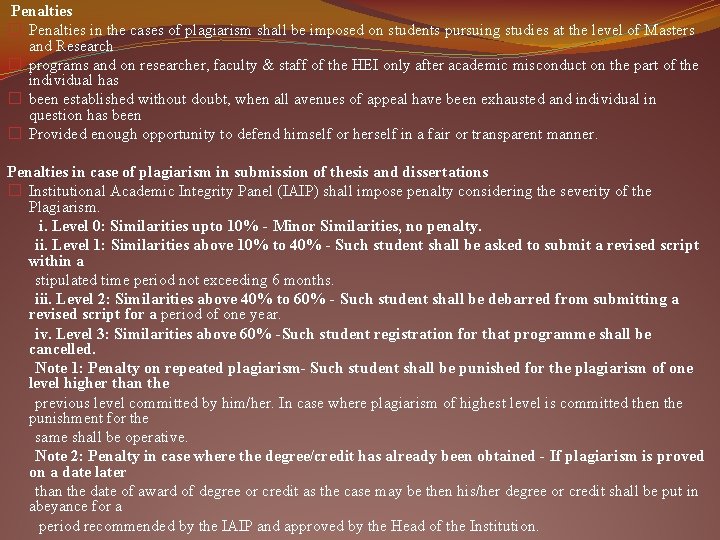
Penalties � Penalties in the cases of plagiarism shall be imposed on students pursuing studies at the level of Masters and Research � programs and on researcher, faculty & staff of the HEI only after academic misconduct on the part of the individual has � been established without doubt, when all avenues of appeal have been exhausted and individual in question has been � Provided enough opportunity to defend himself or herself in a fair or transparent manner. Penalties in case of plagiarism in submission of thesis and dissertations � Institutional Academic Integrity Panel (IAIP) shall impose penalty considering the severity of the Plagiarism. i. Level 0: Similarities upto 10% - Minor Similarities, no penalty. ii. Level 1: Similarities above 10% to 40% - Such student shall be asked to submit a revised script within a stipulated time period not exceeding 6 months. iii. Level 2: Similarities above 40% to 60% - Such student shall be debarred from submitting a revised script for a period of one year. iv. Level 3: Similarities above 60% -Such student registration for that programme shall be cancelled. Note 1: Penalty on repeated plagiarism- Such student shall be punished for the plagiarism of one level higher than the previous level committed by him/her. In case where plagiarism of highest level is committed then the punishment for the same shall be operative. Note 2: Penalty in case where the degree/credit has already been obtained - If plagiarism is proved on a date later than the date of award of degree or credit as the case may be then his/her degree or credit shall be put in abeyance for a period recommended by the IAIP and approved by the Head of the Institution.
URKUND
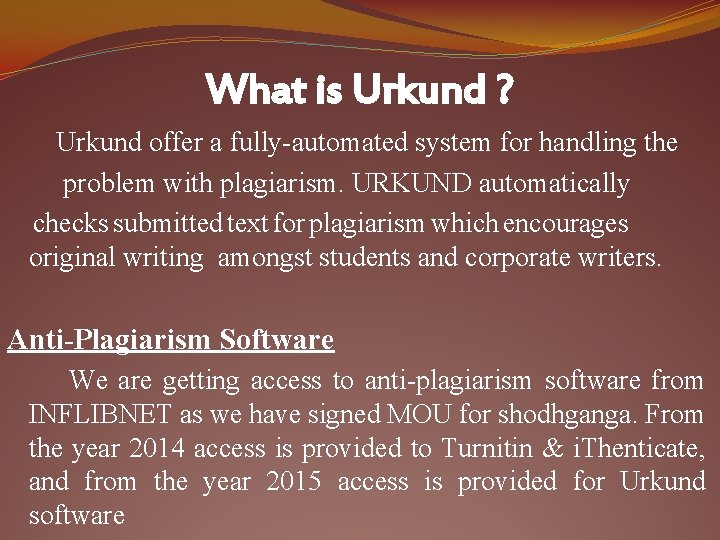
What is Urkund ? Urkund offer a fully-automated system for handling the problem with plagiarism. URKUND automatically checks submitted text for plagiarism which encourages original writing amongst students and corporate writers. Anti-Plagiarism Software We are getting access to anti-plagiarism software from INFLIBNET as we have signed MOU for shodhganga. From the year 2014 access is provided to Turnitin & i. Thenticate, and from the year 2015 access is provided for Urkund software
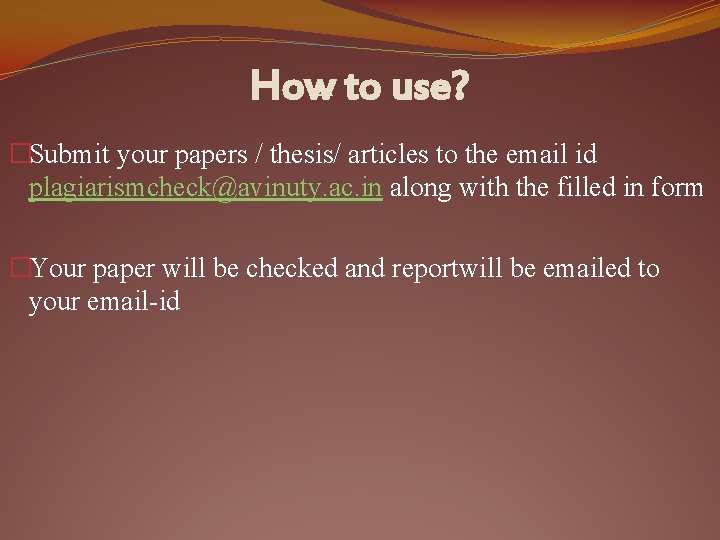
How to use? �Submit your papers / thesis/ articles to the email id plagiarismcheck@avinuty. ac. in along with the filled in form �Your paper will be checked and reportwill be emailed to your email-id
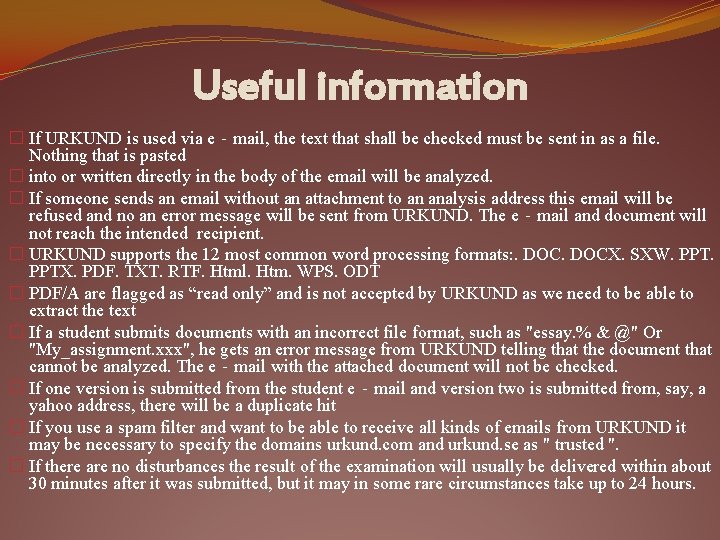
Useful information � If URKUND is used via e‐mail, the text that shall be checked must be sent in as a file. Nothing that is pasted � into or written directly in the body of the email will be analyzed. � If someone sends an email without an attachment to an analysis address this email will be refused and no an error message will be sent from URKUND. The e‐mail and document will not reach the intended recipient. � URKUND supports the 12 most common word processing formats: . DOCX. SXW. PPTX. PDF. TXT. RTF. Html. Htm. WPS. ODT � PDF/A are flagged as “read only” and is not accepted by URKUND as we need to be able to extract the text � If a student submits documents with an incorrect file format, such as "essay. % & @" Or "My_assignment. xxx", he gets an error message from URKUND telling that the document that cannot be analyzed. The e‐mail with the attached document will not be checked. � If one version is submitted from the student e‐mail and version two is submitted from, say, a yahoo address, there will be a duplicate hit � If you use a spam filter and want to be able to receive all kinds of emails from URKUND it may be necessary to specify the domains urkund. com and urkund. se as " trusted ". � If there are no disturbances the result of the examination will usually be delivered within about 30 minutes after it was submitted, but it may in some rare circumstances take up to 24 hours.
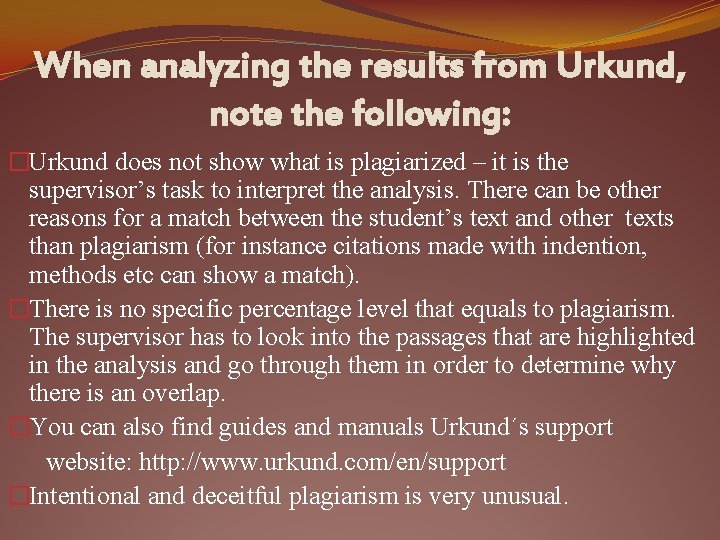
When analyzing the results from Urkund, note the following: �Urkund does not show what is plagiarized – it is the supervisor’s task to interpret the analysis. There can be other reasons for a match between the student’s text and other texts than plagiarism (for instance citations made with indention, methods etc can show a match). �There is no specific percentage level that equals to plagiarism. The supervisor has to look into the passages that are highlighted in the analysis and go through them in order to determine why there is an overlap. �You can also find guides and manuals Urkund´s support website: http: //www. urkund. com/en/support �Intentional and deceitful plagiarism is very unusual.
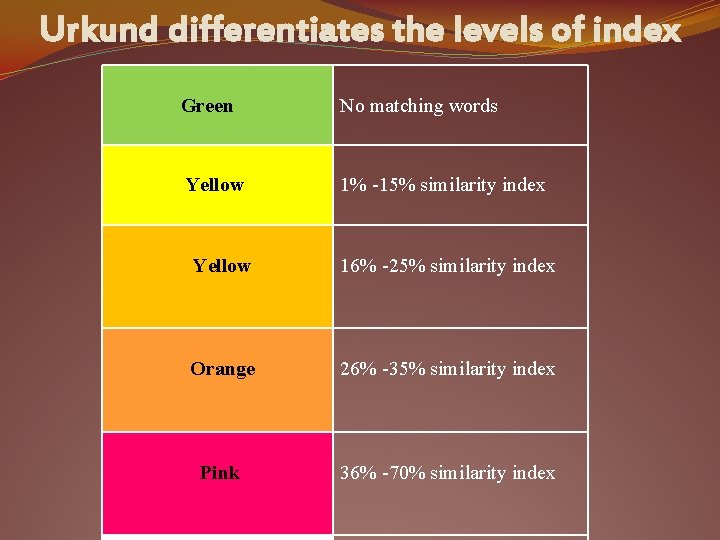
Urkund differentiates the levels of index Green No matching words Yellow 1% -15% similarity index Yellow 16% -25% similarity index Orange Pink 26% -35% similarity index 36% -70% similarity index


Our Procedure for Plagiarism Check While submitting the soft copy of the Ph. D. theses for the check with plagiarism detection software, the research scholars and supervisors, who are submitting their theses to the Avinashilingam Institute for Home Science and Higher Education for Women are solicited to consider the following guidelines v The CD (or such device) containing the soft copy of the doctoral theses has to be in PDF or Word file (or as directed from time to time). v Theses covering all the chapters, from the introduction to bibliography/references shall be in a single file, excluding preliminary pages: declaration, acknowledgment, abstract, list of charts and abbreviations, tables of contents, etc. , and succeeding pages: glossary, index, questionnaire, etc. v Duration of one day is allowed for scanning the text of theses and the issue of the report depicting the percentage of similar content. v In case the percentage of similar content is beyond the permitted limit or any plagiarized content is detected, the researchers have to take appropriate measures under the supervision of their guides as to ensure originality of research output.
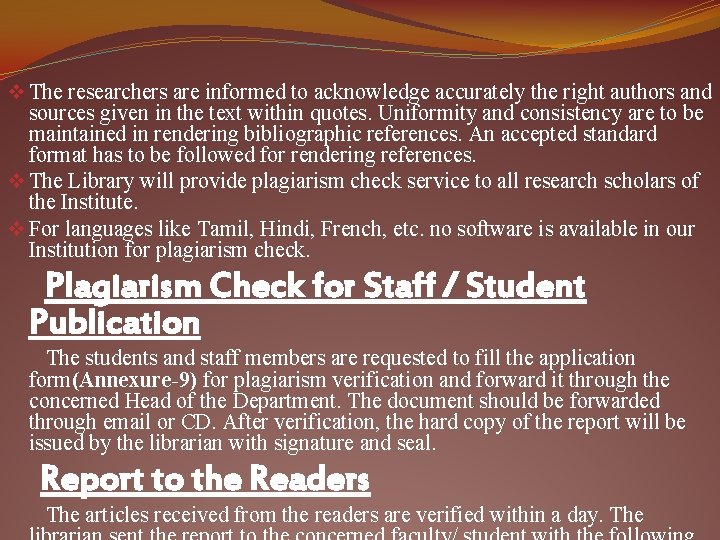
v The researchers are informed to acknowledge accurately the right authors and sources given in the text within quotes. Uniformity and consistency are to be maintained in rendering bibliographic references. An accepted standard format has to be followed for rendering references. v The Library will provide plagiarism check service to all research scholars of the Institute. v For languages like Tamil, Hindi, French, etc. no software is available in our Institution for plagiarism check. Plagiarism Publication Check for Staff / Student The students and staff members are requested to fill the application form(Annexure-9) for plagiarism verification and forward it through the concerned Head of the Department. The document should be forwarded through email or CD. After verification, the hard copy of the report will be issued by the librarian with signature and seal. Report to the Readers The articles received from the readers are verified within a day. The

Avinashilingam Institute for Home Science and Higher Education for Women (Deemed to be University under Category ‘A’ by MHRD, Estd. u/s 3 of UGC Act 1956) Re-accredited with ‘A’ Grade by NAAC. Recognised by UGC Under Section 12 B Coimbatore – 641 043. , Tamil Nadu, India REQUEST FOR PLAGIARISM VERIFICATION REPORT FOR THESIS / DISSERTATION To, The Librarian Subject : Request for Plagiarism check report of M. Phil dissertation / Ph. D thesis Respected Madam, I am submitting herewith a softcopy of my M. Phil dissertation / Ph. D thesis. You are kindly requested to check plagiarism and issue me a report to that effect. Name of the Research scholar: Ms. _______________________ Department : _________________________ Address : _________________________ __________________________ Title of the M. Phil dissertation / Ph. D thesis : ____________________________________________________________ I declare that, I am aware of anti-plagiarism policy of Avinashilingam University, I further declare that the soft copy being submitted for plagiarism check is the same as print copy of dissertation / thesis. Signature of Research Scholar : Date of Registration : Mobile No: Email Id : Signature of the Research Guide : Designation : Mobile No: Email Id : Forwarded by the HOD : Department :

Avinashilingam Institute for Home Science and Higher Education for Women (Deemed to be University under Category ‘A’ by MHRD, Estd. u/s 3 of UGC Act 1956) Re-accredited with ‘A’ Grade by NAAC. Recognised by UGC Under Section 12 B Coimbatore – 641 043. , Tamil Nadu, India Request for Plagiarism Verification (Other than Thesis) Staff / Student / Research Scholar ORIGINAL / REVISION ( ) PLEASE NOTE EMAIL Your document to - plagiarismcheck@avinuty. ac. in The SIMILARITY REPORT will be sent to you through same mail. It requires minimum half a day. Your document should be FINAL and ready for submission. Document should consists of only chapters (Introduction to Conclusion) in Word format This service is limited to university academic community. Name (Staff/Student/Research scholar) Class Faculty/ Ph. d / M. phil Enrolment ID: Department Mobile : Email ID Type (Tick in box) Abstract Paper Project Conference Journal Article Write in CAPS Title of Abstract/Paper/Theses/Dissertation/ Project/Conference/Journal Article Recommended and forwarded to the Library for similarity verification of the above documents through URKUND. Date : SIGNATURE OF SUPERVISOR/HEAD Signature and date of the Library Staff
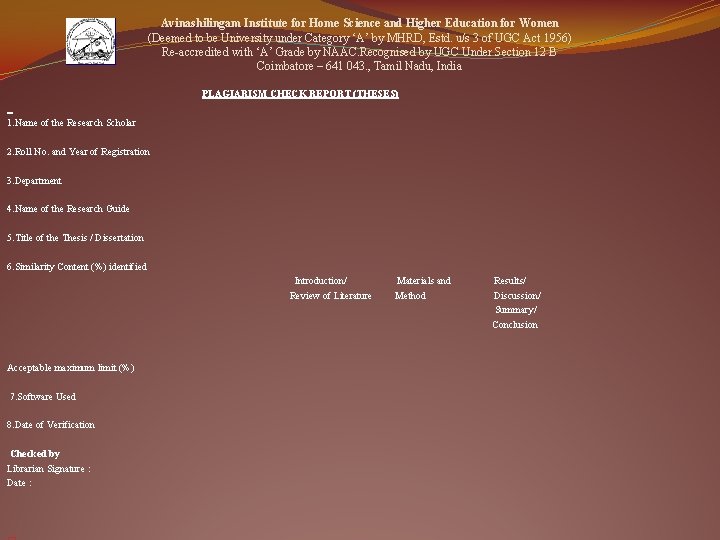
Avinashilingam Institute for Home Science and Higher Education for Women (Deemed to be University under Category ‘A’ by MHRD, Estd. u/s 3 of UGC Act 1956) Re-accredited with ‘A’ Grade by NAAC. Recognised by UGC Under Section 12 B Coimbatore – 641 043. , Tamil Nadu, India PLAGIARISM CHECK REPORT (THESES) 1. Name of the Research Scholar 2. Roll No. and Year of Registration 3. Department 4. Name of the Research Guide 5. Title of the Thesis / Dissertation 6. Similarity Content (%) identified Introduction/ Materials and Results/ Review of Literature Method Discussion/ Summary/ Conclusion Acceptable maximum limit (%) 7. Software Used 8. Date of Verification Checked by Librarian Signature : Date :
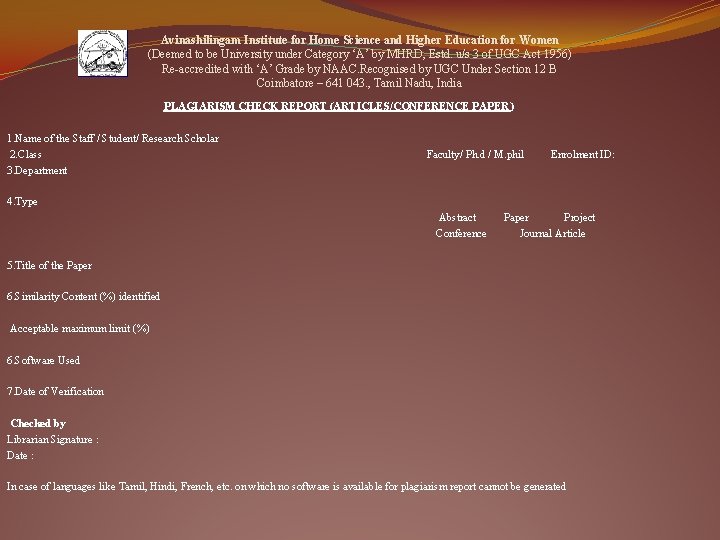
Avinashilingam Institute for Home Science and Higher Education for Women (Deemed to be University under Category ‘A’ by MHRD, Estd. u/s 3 of UGC Act 1956) Re-accredited with ‘A’ Grade by NAAC. Recognised by UGC Under Section 12 B Coimbatore – 641 043. , Tamil Nadu, India PLAGIARISM CHECK REPORT (ARTICLES/CONFERENCE PAPER ) 1. Name of the Staff / Student/ Research Scholar 2. Class Faculty/ Ph. d / M. phil Enrolment ID: 3. Department 4. Type Abstract Paper Project Conference Journal Article 5. Title of the Paper 6. Similarity Content (%) identified Acceptable maximum limit (%) 6. Software Used 7. Date of Verification Checked by Librarian Signature : Date : In case of languages like Tamil, Hindi, French, etc. on which no software is available for plagiarism report cannot be generated

Thank You
- Slides: 41