
What is Persuasive Writing Argumentative writing Used to



- Slides: 19
What is Persuasive Writing? • Argumentative writing • Used to convince the reader to believe the writer’s view point on a debatable issue • Want to convince the reader to do something or believe something
Persuasive Writing Must… • Know both sides of an argument • Present both different sides then TAKE A STAND • Give evidence to back up your position • Offer more than one reason • Save the best argument for last • Tone is important for this type of writing
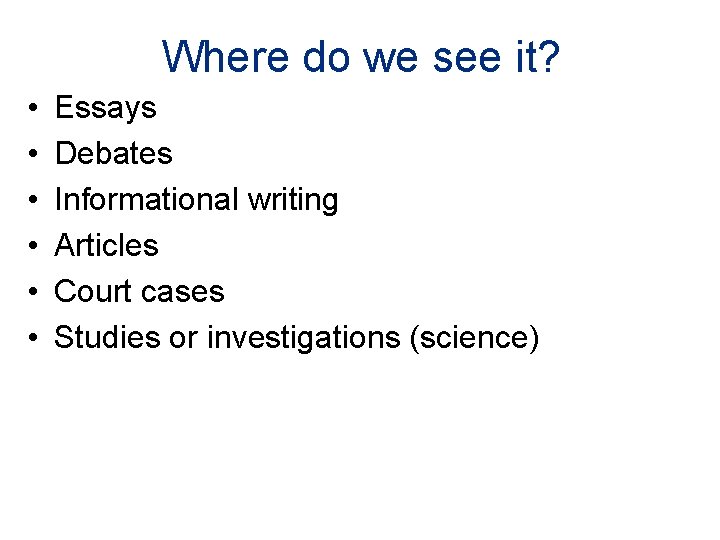
Where do we see it? • • • Essays Debates Informational writing Articles Court cases Studies or investigations (science)
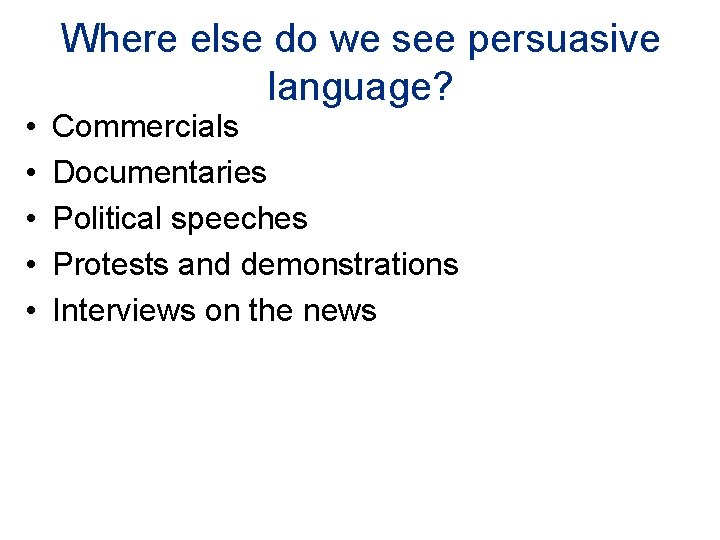
• • • Where else do we see persuasive language? Commercials Documentaries Political speeches Protests and demonstrations Interviews on the news
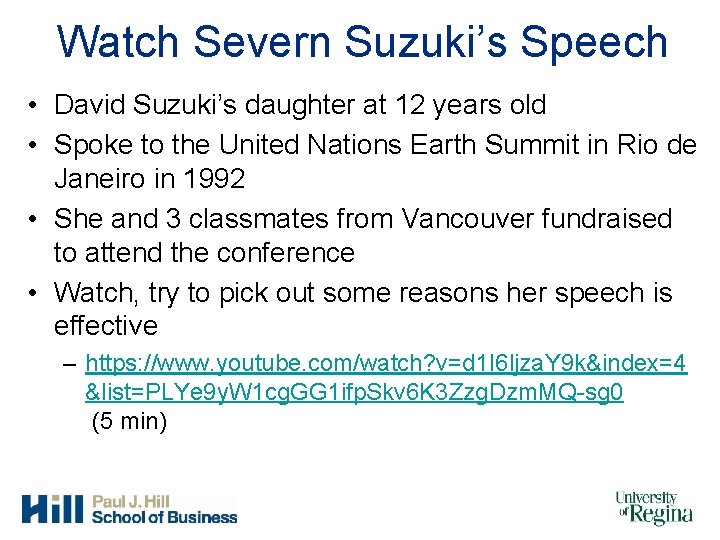
Watch Severn Suzuki’s Speech • David Suzuki’s daughter at 12 years old • Spoke to the United Nations Earth Summit in Rio de Janeiro in 1992 • She and 3 classmates from Vancouver fundraised to attend the conference • Watch, try to pick out some reasons her speech is effective – https: //www. youtube. com/watch? v=d 1 I 6 ljza. Y 9 k&index=4 &list=PLYe 9 y. W 1 cg. GG 1 ifp. Skv 6 K 3 Zzg. Dzm. MQ-sg 0 (5 min)
Using Rhetoric and Effective Speech Delivery Adapted from Dr. Lisa Watson
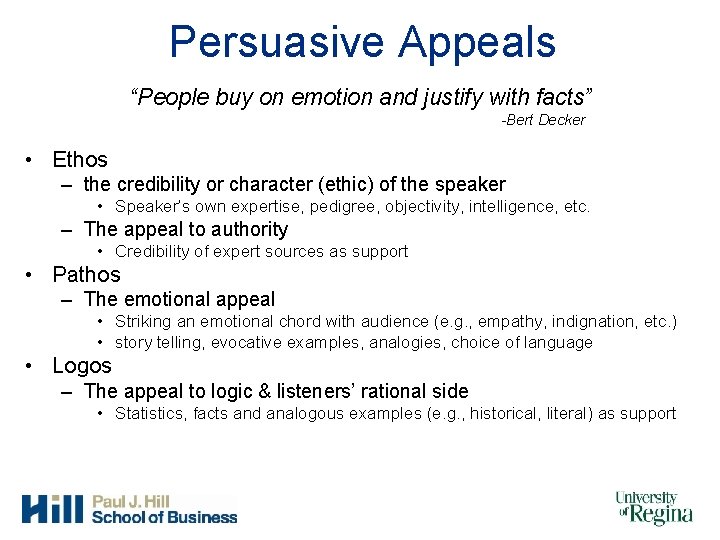
Persuasive Appeals “People buy on emotion and justify with facts” -Bert Decker • Ethos – the credibility or character (ethic) of the speaker • Speaker’s own expertise, pedigree, objectivity, intelligence, etc. – The appeal to authority • Credibility of expert sources as support • Pathos – The emotional appeal • Striking an emotional chord with audience (e. g. , empathy, indignation, etc. ) • story telling, evocative examples, analogies, choice of language • Logos – The appeal to logic & listeners’ rational side • Statistics, facts and analogous examples (e. g. , historical, literal) as support
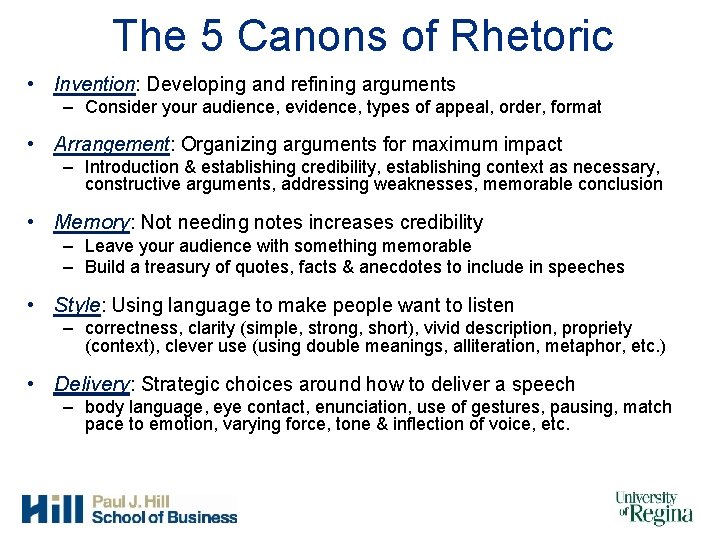
The 5 Canons of Rhetoric • Invention: Developing and refining arguments – Consider your audience, evidence, types of appeal, order, format • Arrangement: Organizing arguments for maximum impact – Introduction & establishing credibility, establishing context as necessary, constructive arguments, addressing weaknesses, memorable conclusion • Memory: Not needing notes increases credibility – Leave your audience with something memorable – Build a treasury of quotes, facts & anecdotes to include in speeches • Style: Using language to make people want to listen – correctness, clarity (simple, strong, short), vivid description, propriety (context), clever use (using double meanings, alliteration, metaphor, etc. ) • Delivery: Strategic choices around how to deliver a speech – body language, eye contact, enunciation, use of gestures, pausing, match pace to emotion, varying force, tone & inflection of voice, etc.
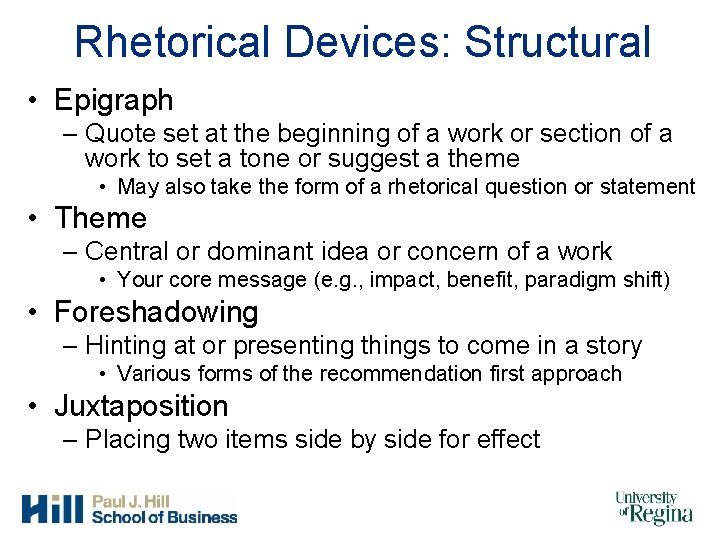
Rhetorical Devices: Structural • Epigraph – Quote set at the beginning of a work or section of a work to set a tone or suggest a theme • May also take the form of a rhetorical question or statement • Theme – Central or dominant idea or concern of a work • Your core message (e. g. , impact, benefit, paradigm shift) • Foreshadowing – Hinting at or presenting things to come in a story • Various forms of the recommendation first approach • Juxtaposition – Placing two items side by side for effect
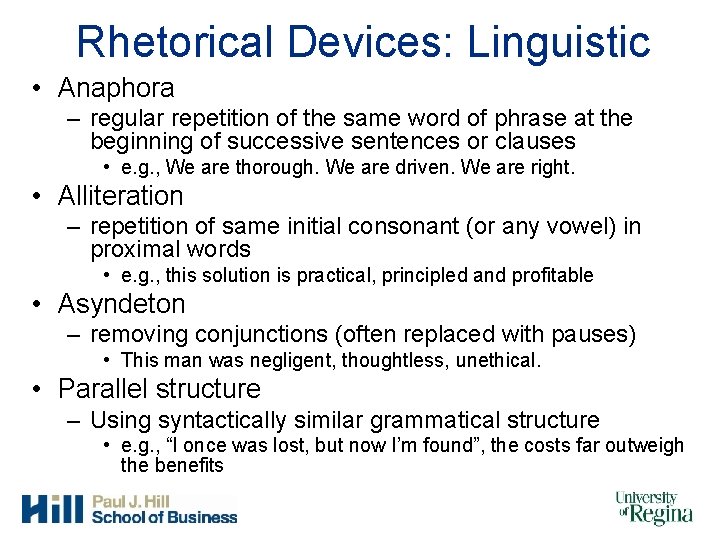
Rhetorical Devices: Linguistic • Anaphora – regular repetition of the same word of phrase at the beginning of successive sentences or clauses • e. g. , We are thorough. We are driven. We are right. • Alliteration – repetition of same initial consonant (or any vowel) in proximal words • e. g. , this solution is practical, principled and profitable • Asyndeton – removing conjunctions (often replaced with pauses) • This man was negligent, thoughtless, unethical. • Parallel structure – Using syntactically similar grammatical structure • e. g. , “I once was lost, but now I’m found”, the costs far outweigh the benefits
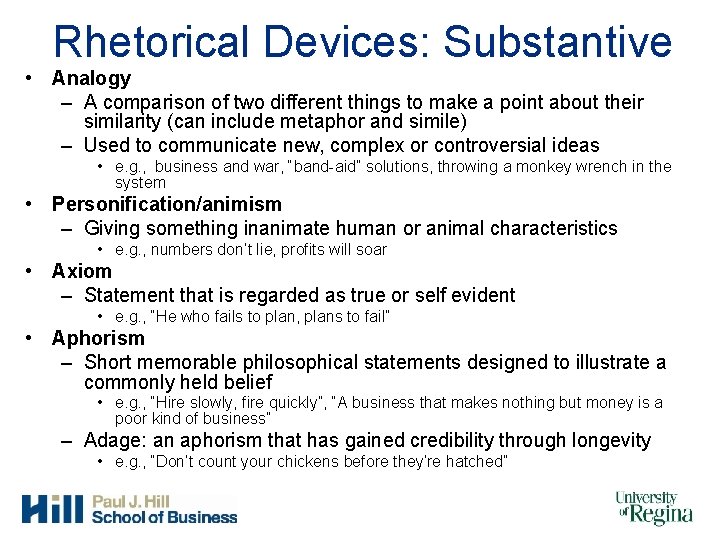
Rhetorical Devices: Substantive • Analogy – A comparison of two different things to make a point about their similarity (can include metaphor and simile) – Used to communicate new, complex or controversial ideas • e. g. , business and war, “band-aid” solutions, throwing a monkey wrench in the system • Personification/animism – Giving something inanimate human or animal characteristics • e. g. , numbers don’t lie, profits will soar • Axiom – Statement that is regarded as true or self evident • e. g. , “He who fails to plan, plans to fail” • Aphorism – Short memorable philosophical statements designed to illustrate a commonly held belief • e. g. , “Hire slowly, fire quickly”, “A business that makes nothing but money is a poor kind of business” – Adage: an aphorism that has gained credibility through longevity • e. g. , “Don’t count your chickens before they’re hatched”
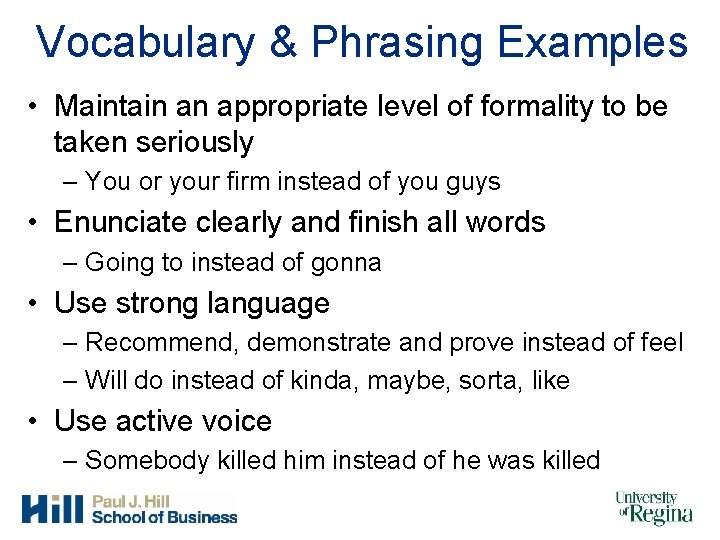
Vocabulary & Phrasing Examples • Maintain an appropriate level of formality to be taken seriously – You or your firm instead of you guys • Enunciate clearly and finish all words – Going to instead of gonna • Use strong language – Recommend, demonstrate and prove instead of feel – Will do instead of kinda, maybe, sorta, like • Use active voice – Somebody killed him instead of he was killed
Analyze Severn Suzuki’s Speech • We’ll watch it one more time – How does she use Ethos, Pathos, and Logos? – Pick out some examples of rhetorical devices • Structural • Linguistic • Substantive • Then you’ll work in your groups to fill out the analysis worksheet, using a transcript of the speech – Find specific examples
Passion & Conviction • Show conviction in everything you say, even if you don’t believe it – It has to sound like you prepared your own speech and are speaking straight from the heart • Makes you memorable – What is going to make judges remember what you had to say instead of your competitors?
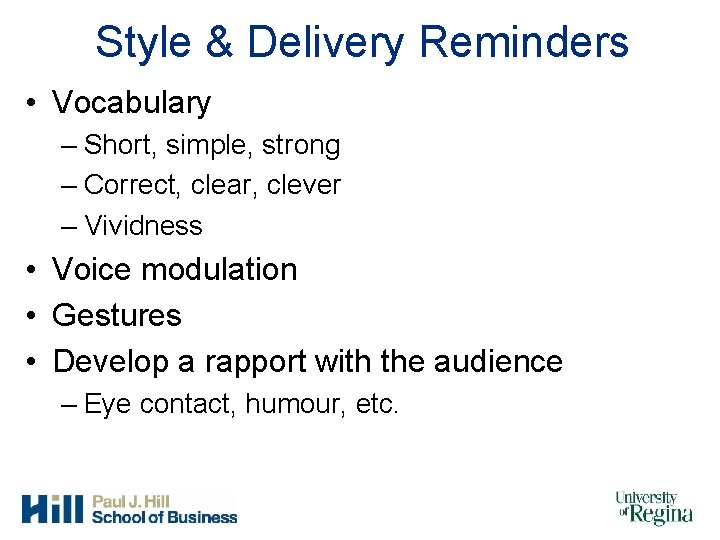
Style & Delivery Reminders • Vocabulary – Short, simple, strong – Correct, clear, clever – Vividness • Voice modulation • Gestures • Develop a rapport with the audience – Eye contact, humour, etc.
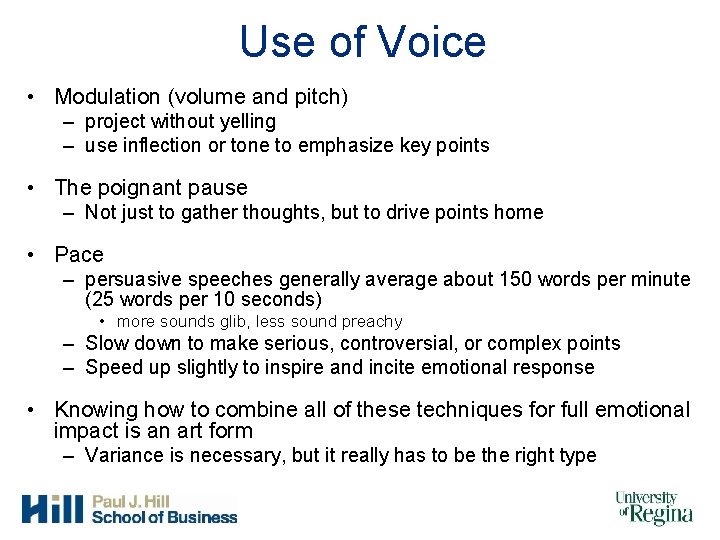
Use of Voice • Modulation (volume and pitch) – project without yelling – use inflection or tone to emphasize key points • The poignant pause – Not just to gather thoughts, but to drive points home • Pace – persuasive speeches generally average about 150 words per minute (25 words per 10 seconds) • more sounds glib, less sound preachy – Slow down to make serious, controversial, or complex points – Speed up slightly to inspire and incite emotional response • Knowing how to combine all of these techniques for full emotional impact is an art form – Variance is necessary, but it really has to be the right type
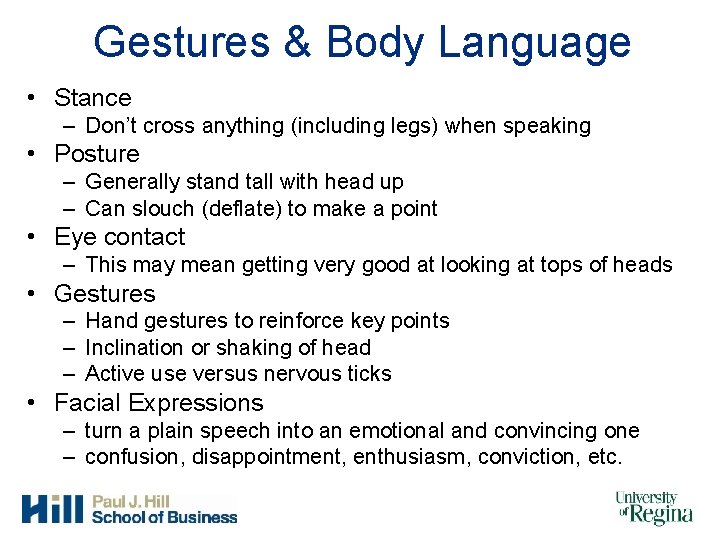
Gestures & Body Language • Stance – Don’t cross anything (including legs) when speaking • Posture – Generally stand tall with head up – Can slouch (deflate) to make a point • Eye contact – This may mean getting very good at looking at tops of heads • Gestures – Hand gestures to reinforce key points – Inclination or shaking of head – Active use versus nervous ticks • Facial Expressions – turn a plain speech into an emotional and convincing one – confusion, disappointment, enthusiasm, conviction, etc.
Presidential Debate Speeches Persuasive techniques in action First presidential debate 2012