
What is PECARN PECARN Pediatric Emergency Care Applied







- Slides: 27
What is PECARN?
PECARN (Pediatric Emergency Care Applied Research Network) is a collaborative research network: • 18 Hospital Emergency Department Affiliates (HEDAs) • Six Research Node Centers (RNC) • A data coordinating center (DCC)
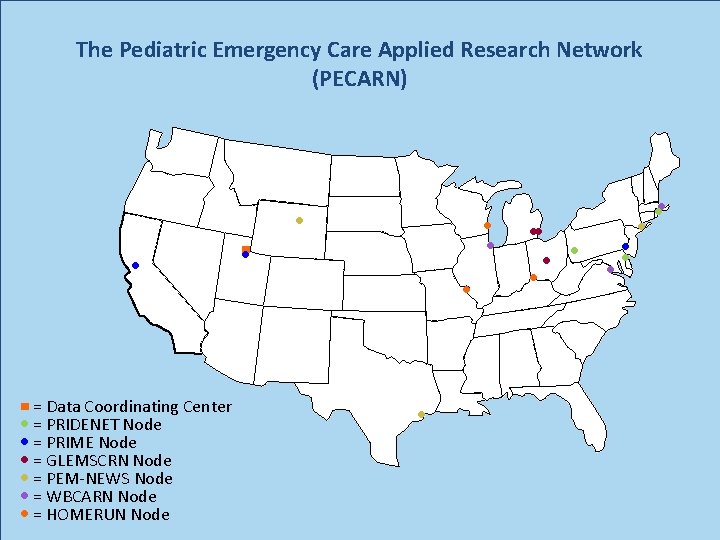
The Pediatric Emergency Care Applied Research Network (PECARN) ● ● ■ = Data Coordinating Center ● = PRIDENET Node ● = PRIME Node ● = GLEMSCRN Node ● = PEM-NEWS Node ● = WBCARN Node ● = HOMERUN Node ● ●● ● ● ● ●●
PECARN provides the leadership and infrastructure to: • Conduct multi-center research studies • Support research collaboration among EMSC investigators • Promote informational exchanges between EMSC investigators and providers
GOAL OF PECARN
Conduct meaningful and rigorous multi-institutional research into the prevention and management of acute illnesses and injuries in children and youth across the continuum of emergency medicine health care.
STRENGTHS OF PECARN
PECARN's strength is in its wide geographical and hospital representation serving over 1, 000 ill and injured children annually within a network of Hospital Emergency Department Affiliates.
The PECARN hospitals represent diverse demographic and geographic areas, such as: • • • Academic hospitals Community hospitals Urban hospitals General hospitals Children's hospitals
PECARN is comprised of senior-level EMSC researchers and clinicians with expertise in epidemiology, statistics and health services research.
RESEARCH PRIORITIES
Research Priorities Include: • Respiratory illnesses/asthma • Prediction rules for high stakes/low likelihood diseases • Medication error reduction • Injury prevention • Urgency and acuity scaling
Research Priorities Include: • Race, ethnic, class disparities in health • Mental health • Treatment of infectious diseases • Best practices in patient care • Pain and anxiety management
Research Priorities Include: • Education/training outcomes • Development of treatment algorithms • Improvement in health outcomes for cardiac arrest • Practice protocols • Seizure management • C-spine immobilization
PECARN STRUCTURE
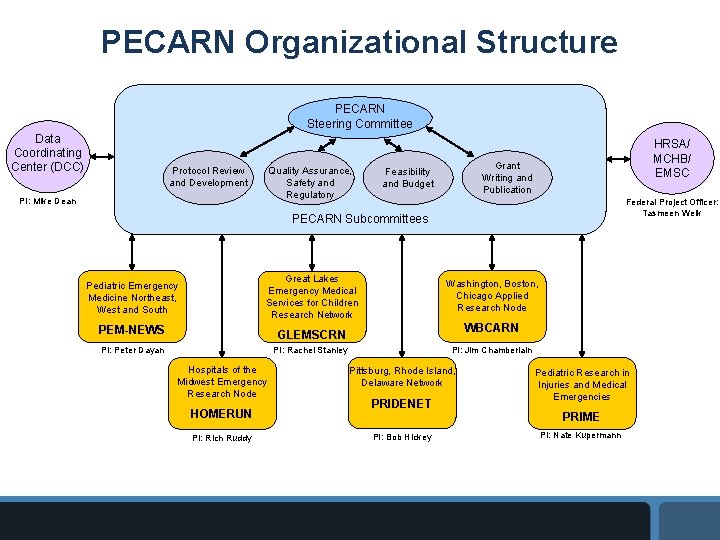
PECARN consists of: • A steering committee with representation from each HEDA and the DCC • Subcommittees to address specific aspects of research
PECARN Organizational Structure PECARN Steering Committee Data Coordinating Center (DCC) Quality Assurance, Safety and Regulatory Protocol Review and Development PI: Mike Dean HRSA/ MCHB/ EMSC Grant Writing and Publication Feasibility and Budget Federal Project Officer: Tasmeen Weik PECARN Subcommittees Pediatric Emergency Medicine Northeast, West and South Great Lakes Emergency Medical Services for Children Research Network PEM-NEWS GLEMSCRN PI: Peter Dayan PI: Rachel Stanley Hospitals of the Midwest Emergency Research Node HOMERUN PI: Rich Ruddy Washington, Boston, Chicago Applied Research Node WBCARN PI: Jim Chamberlain Pittsburg, Rhode Island, Delaware Network PRIDENET PI: Bob Hickey Pediatric Research in Injuries and Medical Emergencies PRIME PI: Nate Kupermann
HOW TO SUBMIT A RESEARCH IDEA
In PECARN, each node works collaboratively with the others and with HRSA/MCHB to initiate, implement, and administer network research.
Specific research projects require nodes to obtain extramural research funding for a project to be conducted through PECARN.
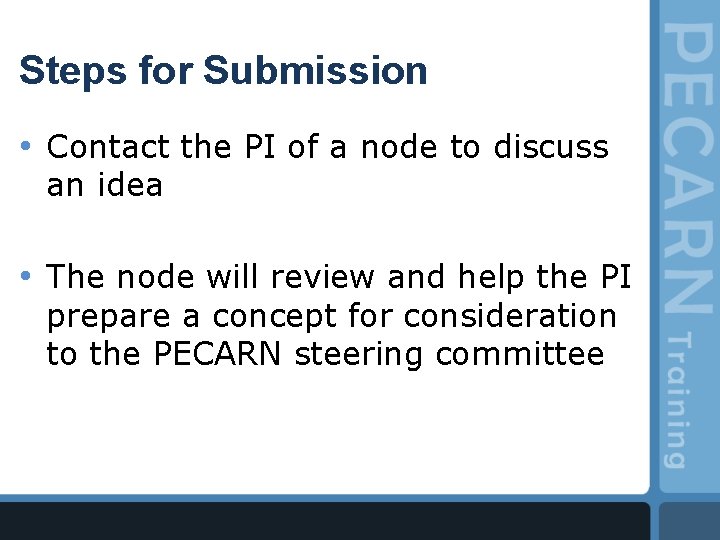
Idea submission • Outside investigators should contact one of the PECARN investigators to express interest in submitting a study idea. • The general steps for concept approval and protocol development are as follows:
Steps for Submission • Contact the PI of a node to discuss an idea • The node will review and help the PI prepare a concept for consideration to the PECARN steering committee
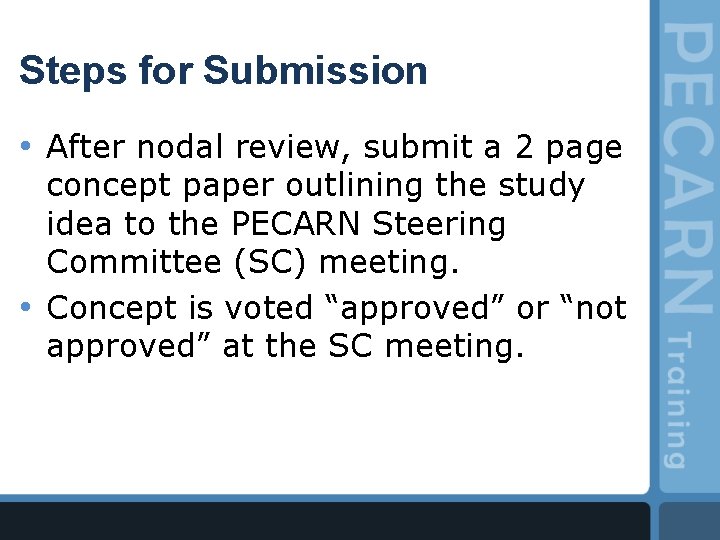
Steps for Submission • After nodal review, submit a 2 page concept paper outlining the study idea to the PECARN Steering Committee (SC) meeting. • Concept is voted “approved” or “not approved” at the SC meeting.
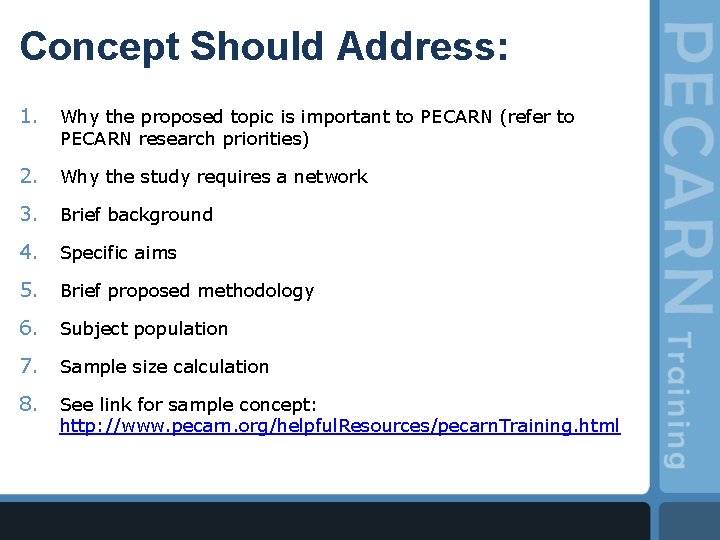
Concept Should Address: 1. Why the proposed topic is important to PECARN (refer to PECARN research priorities) 2. Why the study requires a network 3. Brief background 4. Specific aims 5. Brief proposed methodology 6. Subject population 7. Sample size calculation 8. See link for sample concept: http: //www. pecarn. org/helpful. Resources/pecarn. Training. html
If Approved • Investigator works with DCC and working group to develop concept into protocol • Protocol is presented at next SC meeting • Subcommittees provide feedback • Protocol is revised then voted on by SC for submission as a grant
Contact Information For current PECARN contact information, see this link: http: //www. pecarn. org/contact. Info/index. html