
What is Particle Physics and Horst Wahl October
What is Particle Physics --and (Horst Wahl, October 2001) l Particle physics n l n Accelerator, detector DØ detector as example Overview of the Standard Model n n n l Goals and issues -- Why do it? How to do a particle physics experiment n l why I like doing it Symmetry, constituents, interactions Problems of standard model -- look beyond The “Holy Grail” of (present) particle physics Going beyond the SM – new experiments Upgraded DØ detector n Triggering n The Silicon Track Trigger Webpages of interest n l n n n http: //www. hep. fsu. edu/~wahl/Quarknet (has links to many particle physics sites) http: //www. fnal. gov (Fermilab homepage) http: //www. fnal. gov/pub/tour. html (Fermilab particle physics tour) http: //Particle. Adventure. org/ (Lawrence Berkeley Lab. ) http: //www. cern. ch (CERN -- European Laboratory for Particle Physics)
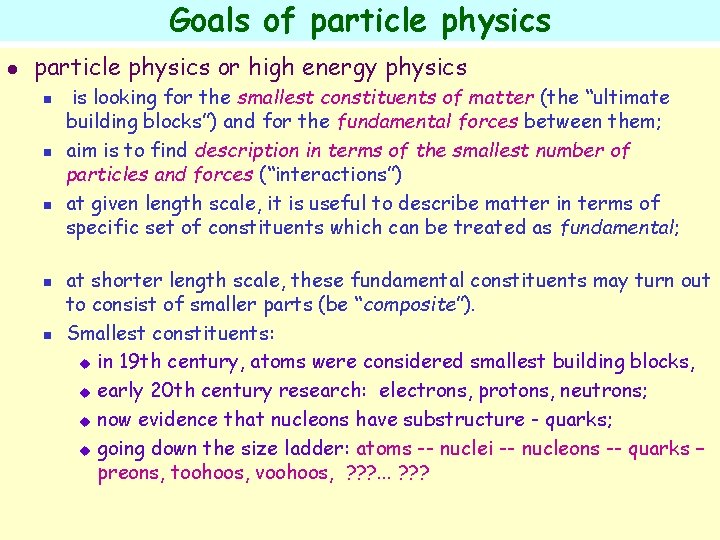
Goals of particle physics l particle physics or high energy physics n is looking for the smallest constituents of matter (the “ultimate • building blocks”) and for the fundamental forces between them; n n aim is to find description in terms of the smallest number of particles and forces (“interactions”) at given length scale, it is useful to describe matter in terms of specific set of constituents which can be treated as fundamental; at shorter length scale, these fundamental constituents may turn out to consist of smaller parts (be “composite”). Smallest constituents: u in 19 th century, atoms were considered smallest building blocks, u early 20 th century research: electrons, protons, neutrons; u now evidence that nucleons have substructure - quarks; u going down the size ladder: atoms -- nuclei -- nucleons -- quarks – preons, toohoos, voohoos, ? ? ? . . . ? ? ?
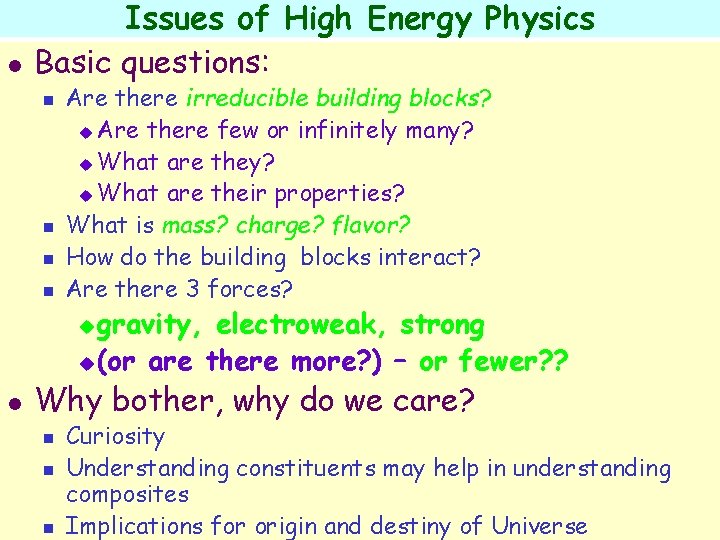
l Issues of High Energy Physics Basic questions: n n Are there irreducible building blocks? u Are there few or infinitely many? u What are their properties? What is mass? charge? flavor? How do the building blocks interact? Are there 3 forces? gravity, electroweak, strong u (or are there more? ) – or fewer? ? u l Why bother, why do we care? n n n Curiosity Understanding constituents may help in understanding composites Implications for origin and destiny of Universe
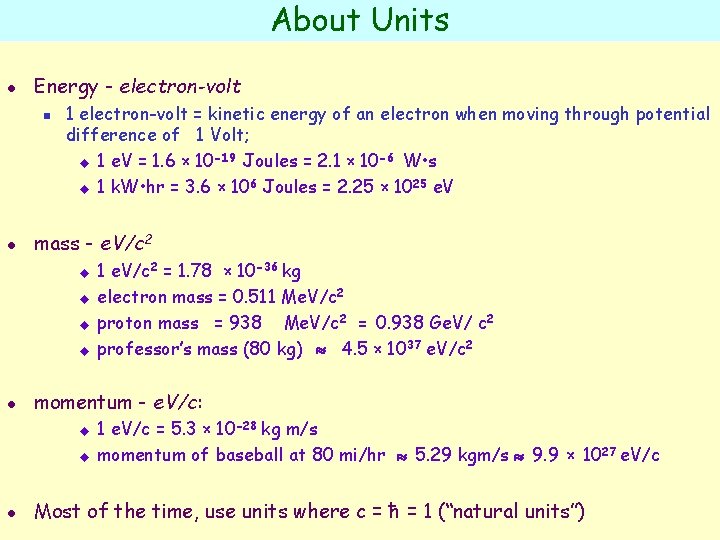
About Units l Energy - electron-volt n l 1 electron-volt = kinetic energy of an electron when moving through potential difference of 1 Volt; u 1 e. V = 1. 6 × 10 -19 Joules = 2. 1 × 10 -6 W • s u 1 k. W • hr = 3. 6 × 10⁶ Joules = 2. 25 × 1025 e. V mass - e. V/c 2 u u l momentum - e. V/c: u u l 1 e. V/c 2 = 1. 78 × 10 -36 kg electron mass = 0. 511 Me. V/c 2 proton mass = 938 Me. V/c 2 = 0. 938 Ge. V/ c 2 professor’s mass (80 kg) 4. 5 × 1037 e. V/c 2 1 e. V/c = 5. 3 × 10 -28 kg m/s momentum of baseball at 80 mi/hr 5. 29 kgm/s 9. 9 × 1027 e. V/c Most of the time, use units where c = ħ = 1 (“natural units”)
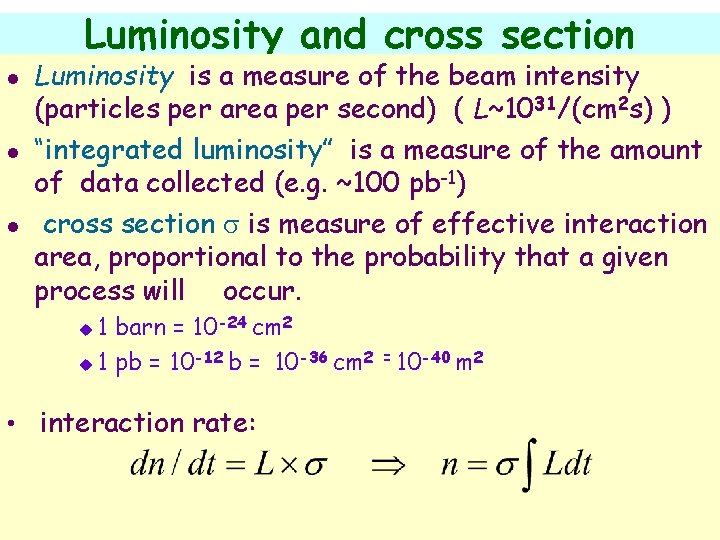
Luminosity and cross section l l l Luminosity is a measure of the beam intensity (particles per area per second) ( L~1031/(cm 2 s) ) “integrated luminosity” is a measure of the amount of data collected (e. g. ~100 pb-1) cross section s is measure of effective interaction area, proportional to the probability that a given process will occur. 1 barn = 10 -24 cm 2 u 1 pb = 10 -12 b = 10 -36 cm 2 = 10 -40 m 2 u l interaction rate:
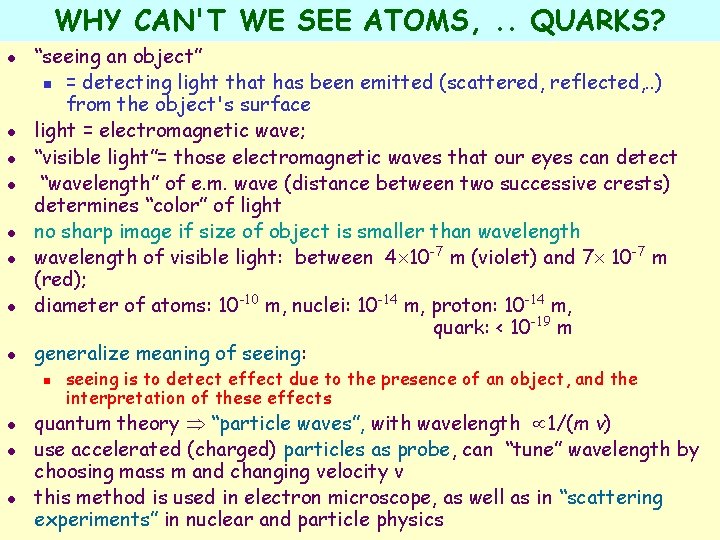
WHY CAN'T WE SEE ATOMS, . . QUARKS? l l l l “seeing an object” n = detecting light that has been emitted (scattered, reflected, . . ) from the object's surface light = electromagnetic wave; “visible light”= those electromagnetic waves that our eyes can detect “wavelength” of e. m. wave (distance between two successive crests) determines “color” of light no sharp image if size of object is smaller than wavelength of visible light: between 4 10 -7 m (violet) and 7 10 -7 m (red); diameter of atoms: 10 -10 m, nuclei: 10 -14 m, proton: 10 -14 m, quark: < 10 -19 m generalize meaning of seeing: n l l l seeing is to detect effect due to the presence of an object, and the interpretation of these effects quantum theory “particle waves”, with wavelength 1/(m v) use accelerated (charged) particles as probe, can “tune” wavelength by choosing mass m and changing velocity v this method is used in electron microscope, as well as in “scattering experiments” in nuclear and particle physics
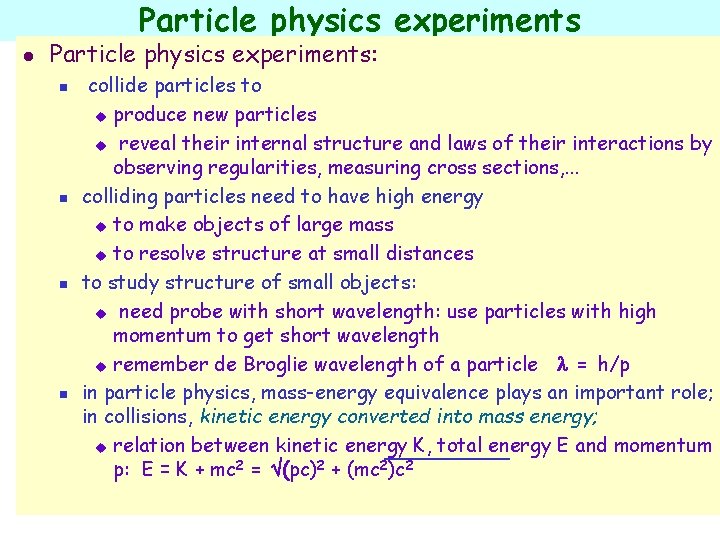
Particle physics experiments l Particle physics experiments: n n collide particles to u produce new particles u reveal their internal structure and laws of their interactions by observing regularities, measuring cross sections, . . . colliding particles need to have high energy u to make objects of large mass u to resolve structure at small distances to study structure of small objects: u need probe with short wavelength: use particles with high momentum to get short wavelength u remember de Broglie wavelength of a particle = h/p in particle physics, mass-energy equivalence plays an important role; in collisions, kinetic energy converted into mass energy; u relation between kinetic energy K, total energy E and momentum ______ p: E = K + mc 2 = (pc)2 + (mc 2)c 2
How to do a particle physics experiment l Outline of experiment: n n n l get particles (e. g. protons, antiprotons, …) accelerate them throw them against each other observe and record what happens analyze and interpret the data ingredients needed: n n n n particle source accelerator and aiming device detector trigger (decide what to record) recording device many people to: u design, build, test, operate accelerator u design, build, test, calibrate, operate, and understand detector u analyze data lots of money to pay for all of this
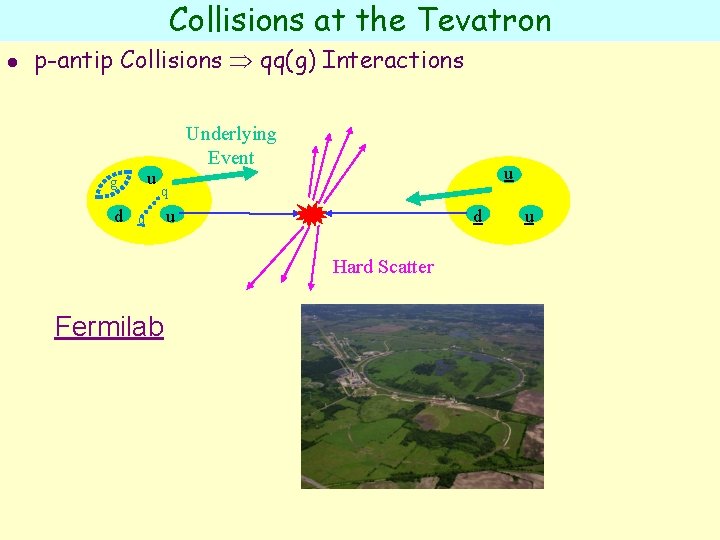
Collisions at the Tevatron l p-antip Collisions qq(g) Interactions u g d Underlying Event u q q d u Hard Scatter Fermilab u
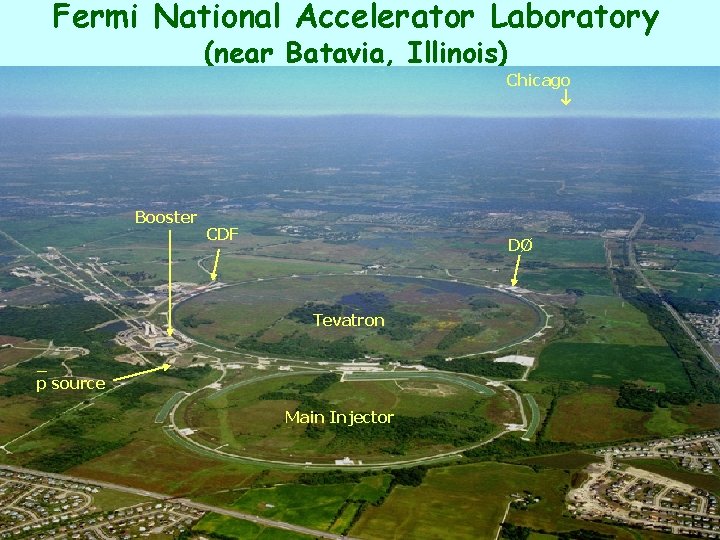
Fermi National Accelerator Laboratory (near Batavia, Illinois) Chicago Booster CDF DØ Tevatron _ p source Main Injector
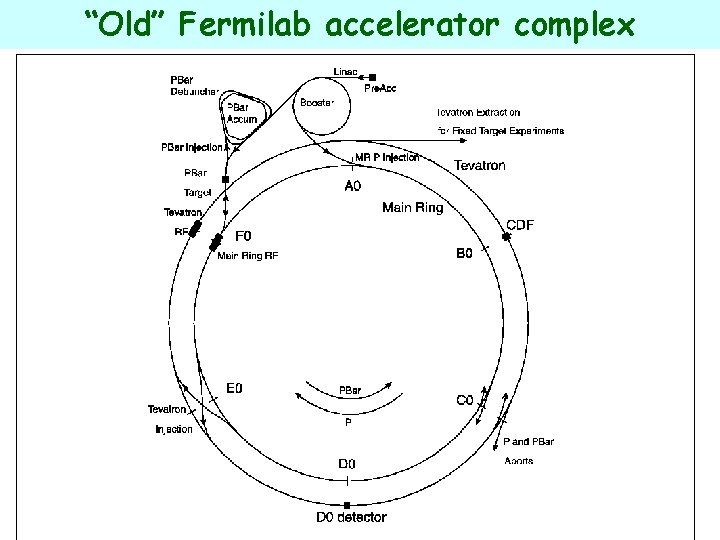
“Old” Fermilab accelerator complex
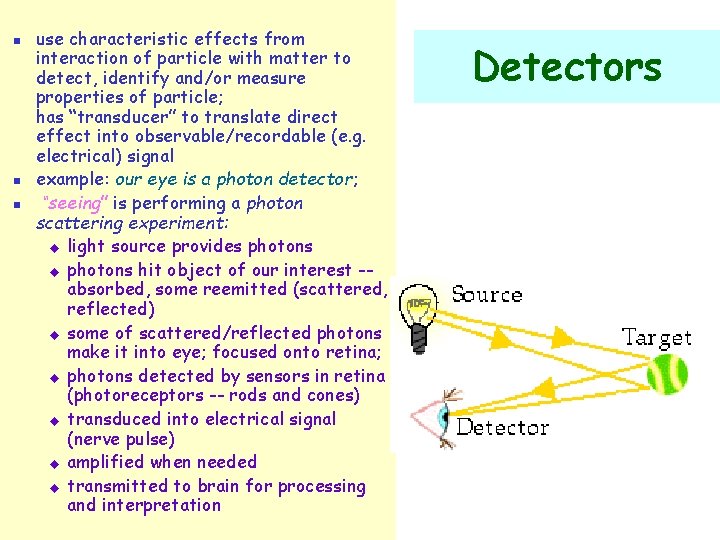
n n n use characteristic effects from interaction of particle with matter to detect, identify and/or measure properties of particle; has “transducer” to translate direct effect into observable/recordable (e. g. electrical) signal example: our eye is a photon detector; “seeing” is performing a photon scattering experiment: u light source provides photons u photons hit object of our interest -absorbed, some reemitted (scattered, reflected) u some of scattered/reflected photons make it into eye; focused onto retina; u photons detected by sensors in retina (photoreceptors -- rods and cones) u transduced into electrical signal (nerve pulse) u amplified when needed u transmitted to brain for processing and interpretation Detectors
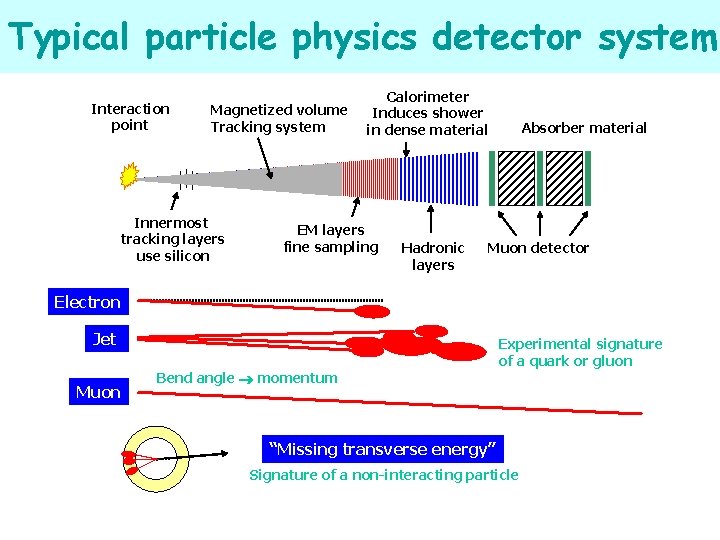
Typical particle physics detector system Interaction point Magnetized volume Tracking system Innermost tracking layers use silicon Calorimeter Induces shower in dense material EM layers fine sampling Hadronic layers Absorber material Muon detector Electron Jet Muon Experimental signature of a quark or gluon Bend angle momentum “Missing transverse energy” Signature of a non-interacting particle
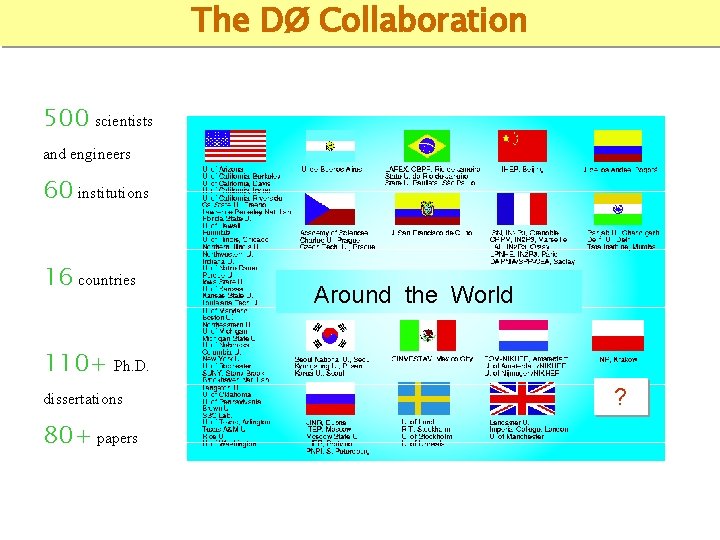
The DØ Collaboration 500 scientists and engineers 60 institutions 16 countries Around the World 110+ Ph. D. dissertations 80+ papers ?
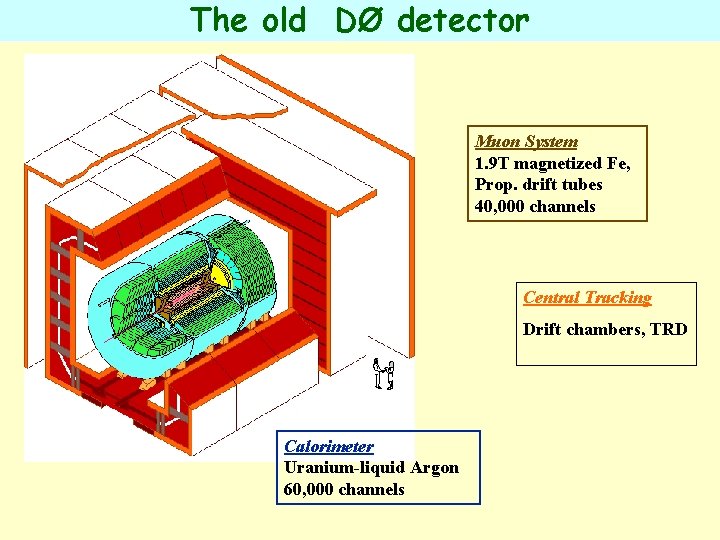
The old DØ detector Muon System 1. 9 T magnetized Fe, Prop. drift tubes 40, 000 channels Central Tracking Drift chambers, TRD Calorimeter Uranium-liquid Argon 60, 000 channels
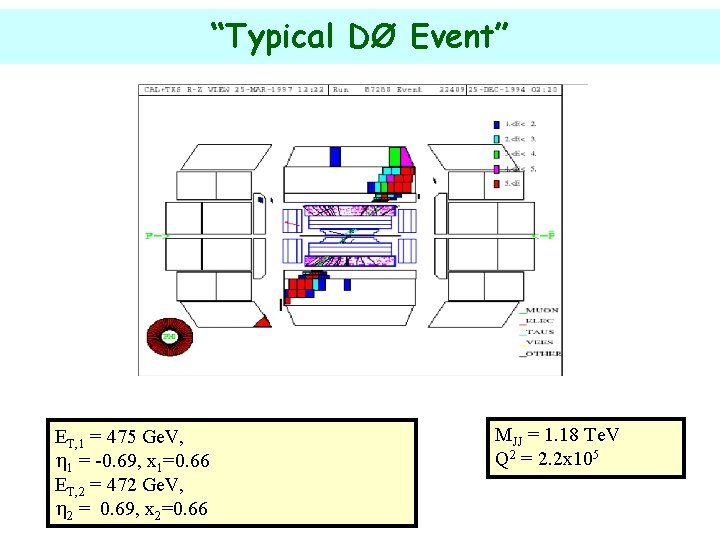
“Typical DØ Event” ET, 1 = 475 Ge. V, h 1 = -0. 69, x 1=0. 66 ET, 2 = 472 Ge. V, h 2 = 0. 69, x 2=0. 66 MJJ = 1. 18 Te. V Q 2 = 2. 2 x 10⁵
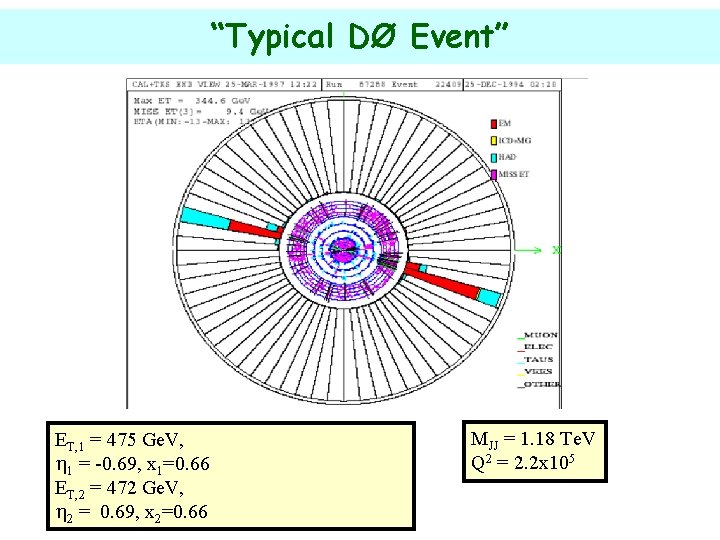
“Typical DØ Event” ET, 1 = 475 Ge. V, h 1 = -0. 69, x 1=0. 66 ET, 2 = 472 Ge. V, h 2 = 0. 69, x 2=0. 66 MJJ = 1. 18 Te. V Q 2 = 2. 2 x 10⁵
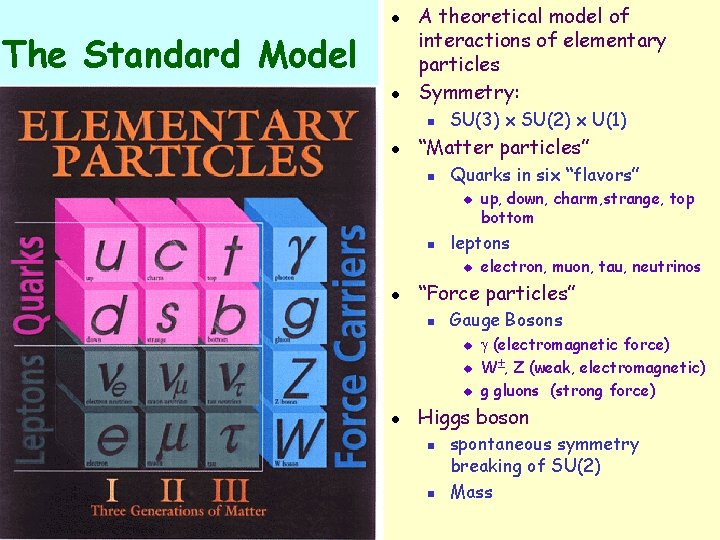
l The Standard Model l A theoretical model of interactions of elementary particles Symmetry: n l SU(3) x SU(2) x U(1) “Matter particles” n Quarks in six “flavors” u n leptons u l electron, muon, tau, neutrinos “Force particles” n Gauge Bosons u u u l up, down, charm, strange, top bottom (electromagnetic force) W , Z (weak, electromagnetic) g gluons (strong force) Higgs boson n n spontaneous symmetry breaking of SU(2) Mass
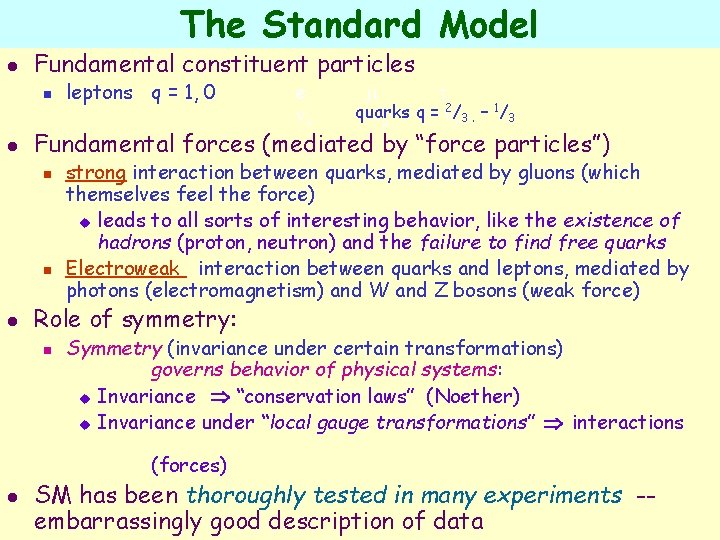
The Standard Model l Fundamental constituent particles n l n quarks q = 2/ 3. – 1/3 strong interaction between quarks, mediated by gluons (which themselves feel the force) u leads to all sorts of interesting behavior, like the existence of hadrons (proton, neutron) and the failure to find free quarks Electroweak interaction between quarks and leptons, mediated by photons (electromagnetism) and W and Z bosons (weak force) Role of symmetry: n Symmetry (invariance under certain transformations) governs behavior of physical systems: u Invariance “conservation laws” (Noether) u Invariance under “local gauge transformations” interactions (forces) l e e Fundamental forces (mediated by “force particles”) n l leptons q = 1, 0 SM has been thoroughly tested in many experiments -embarrassingly good description of data
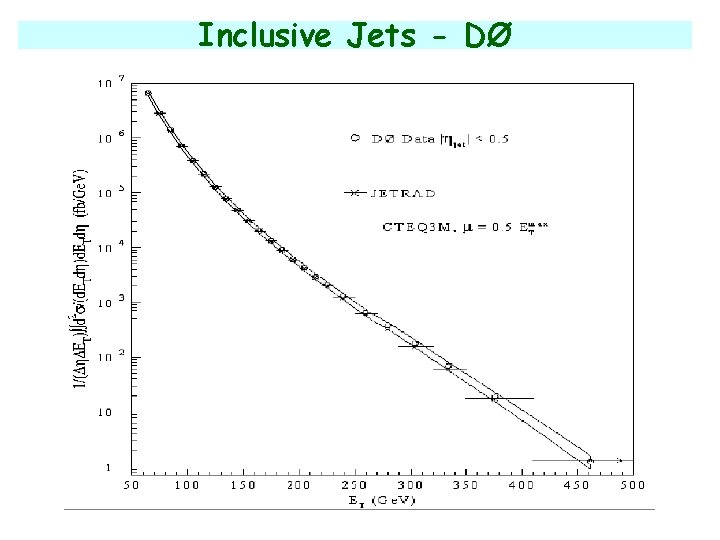
Inclusive Jets - DØ
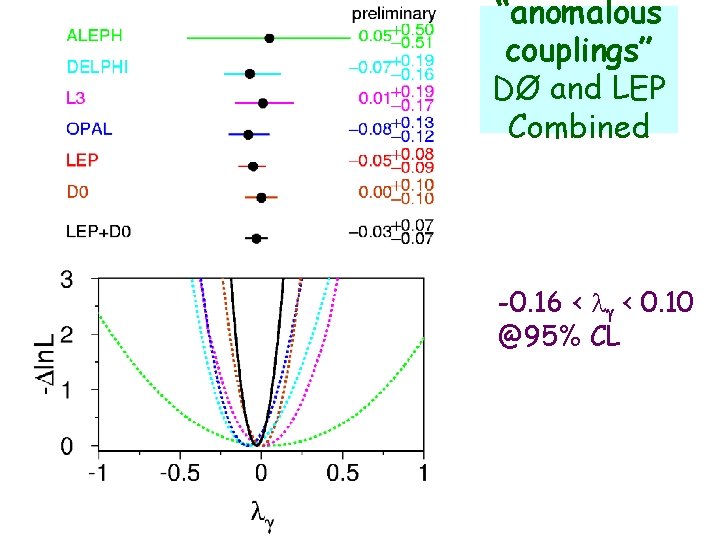
“anomalous couplings” DØ and LEP Combined -0. 16 < < 0. 10 @95% CL
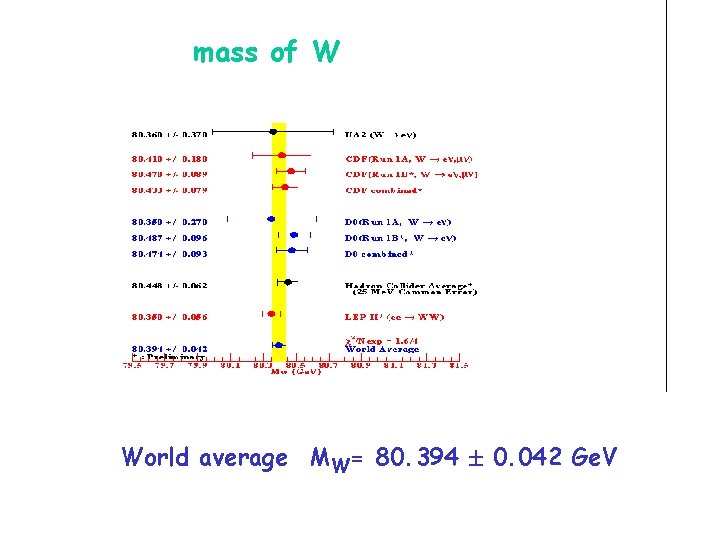
W Boson Mass mass of W World average MW= 80. 394 0. 042 Ge. V
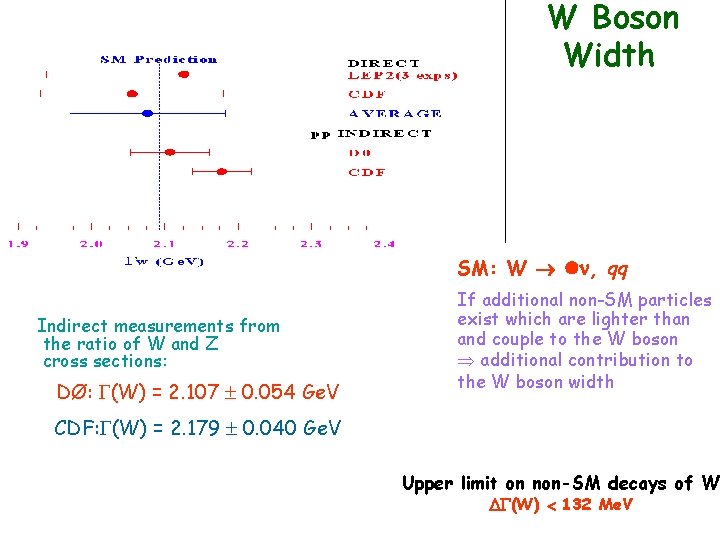
W Boson Width SM: W , qq Indirect measurements from the ratio of W and Z cross sections: DØ: (W) = 2. 107 0. 054 Ge. V If additional non-SM particles exist which are lighter than and couple to the W boson additional contribution to the W boson width CDF: (W) = 2. 179 0. 040 Ge. V Upper limit on non-SM decays of W (W) 132 Me. V
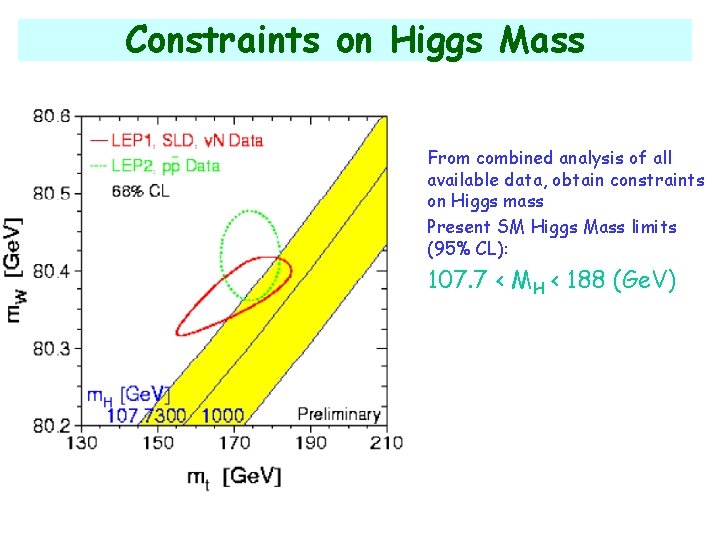
Constraints on Higgs Mass From combined analysis of all available data, obtain constraints on Higgs mass Present SM Higgs Mass limits (95% CL): 107. 7 < MH < 188 (Ge. V)
The SM works great ! l l SM, developed in the 1970’s, has been thoroughly tested in many experiments -- embarrassingly good description of data Why are we not happy with it? n n n l Why change it ? has 18 arbitrary parameters (e. g. quark, lepton masses) Where do they come from ? does not include gravity E. M. symmetry breaking mechanism via Higgs Boson is “put in by hand” u Is the Higgs really what we think it should be ? Higgs mass calculation within SM is not stable – “quadratic divergences; ” SM at very high energies inconsistent (violates “unitarity”) Looking for the “Theory of Everything” (TOE) that contains SM as approximation – many extensions proposed and considered: n n n GUTs, technicolor, SUSY, … superstring theory, … Need guidance from experiment Frantically looking for deviations from SM
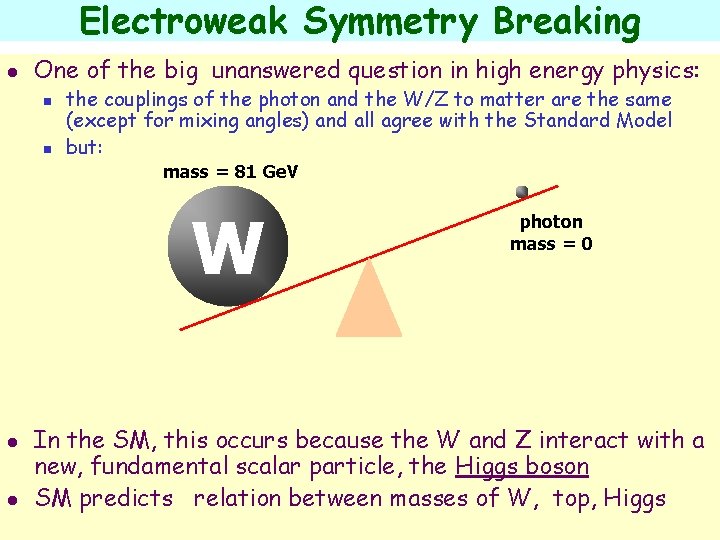
Electroweak Symmetry Breaking l One of the big unanswered question in high energy physics: n n the couplings of the photon and the W/Z to matter are the same (except for mixing angles) and all agree with the Standard Model but: mass = 81 Ge. V W l l photon mass = 0 In the SM, this occurs because the W and Z interact with a new, fundamental scalar particle, the Higgs boson SM predicts relation between masses of W, top, Higgs
Looking beyond the SM l Strategies n n l Tools needed for this: n n n l look harder -- do more precise tests of SM get a bigger hammer –- more energy, and look for “new phenomena” not compatible with SM Accelerator with higher energy u to make massive particles predicted by some of the SM extensions u to look closer into structure of proton and antiproton Higher beam intensity u new phenomena are rare u to improve precision, need lots of data better detectors u cope with higher collision rates u provide more end more precise information u be more selective in what is recorded Fermilab upgrade program n n Accelerator: energy from 1. 8 to 2. 0 Te. V, raise luminosity by factor > 5 upgraded detectors DØ and CDF
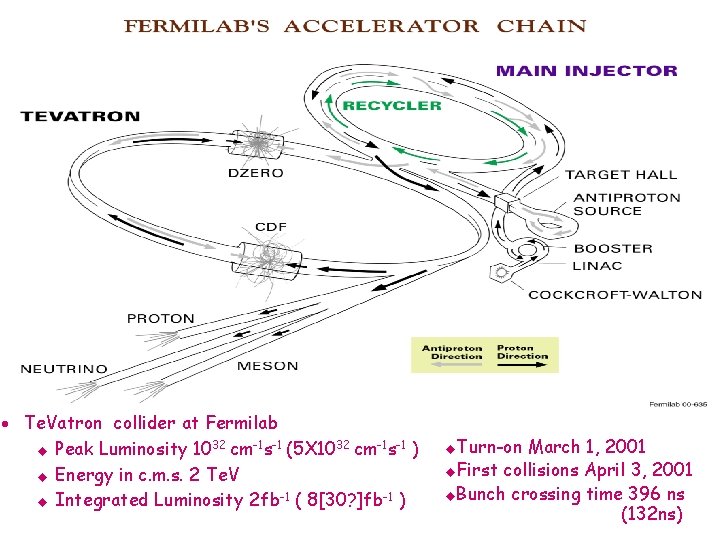
· Te. Vatron collider at Fermilab u Peak Luminosity 1032 cm-1 s-1 (5 X 1032 cm-1 s-1 ) u Energy in c. m. s. 2 Te. V u Integrated Luminosity 2 fb-1 ( 8[30? ]fb-1 ) u. Turn-on March 1, 2001 u. First collisions April 3, 2001 u. Bunch crossing time 396 ns (132 ns)
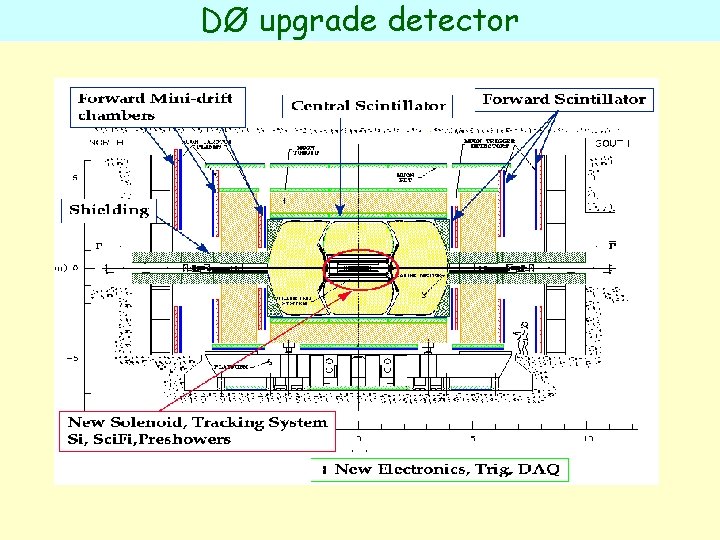
DØ upgrade detector
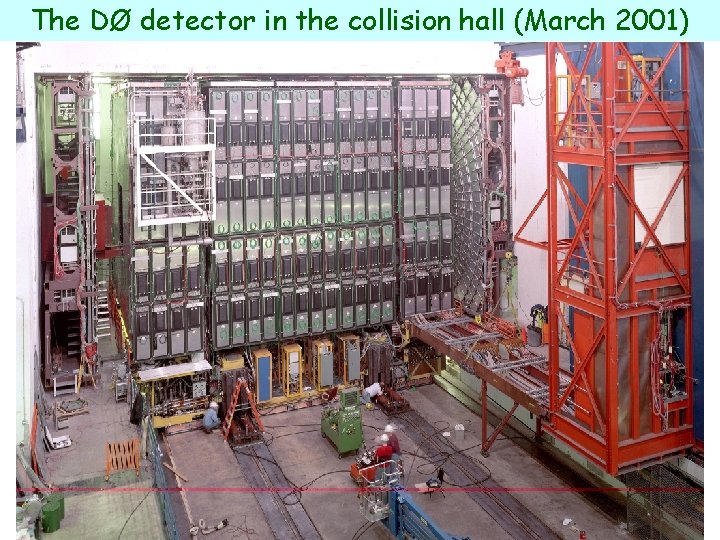
The DØ detector in the collision hall (March 2001)
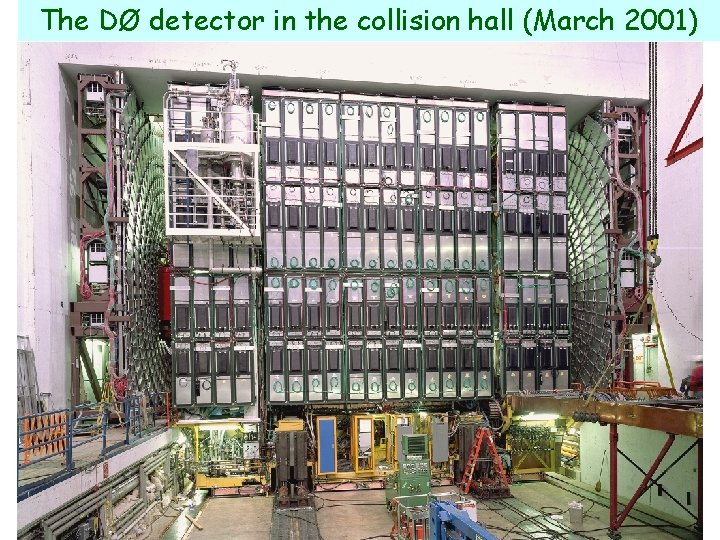
The DØ detector in the collision hall (March 2001)
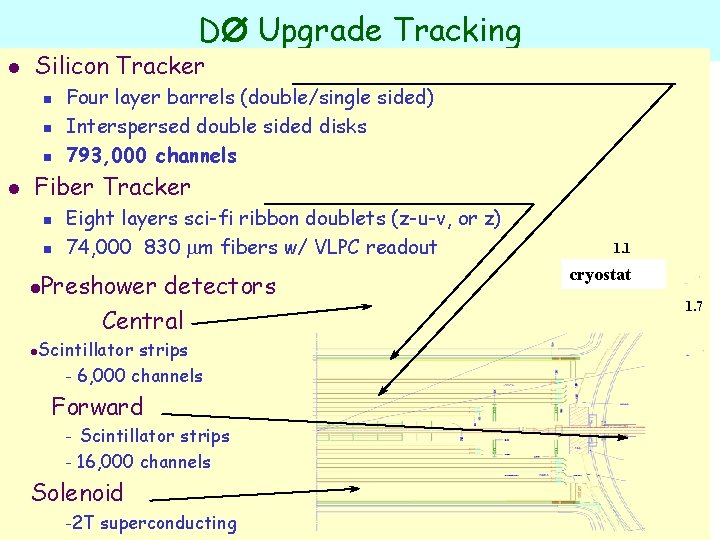
DÆ Upgrade Tracking l Silicon Tracker n n n l Four layer barrels (double/single sided) Interspersed double sided disks 793, 000 channels Fiber Tracker n n l Eight layers sci-fi ribbon doublets (z-u-v, or z) 74, 000 830 m fibers w/ VLPC readout Preshower detectors Central l. Scintillator strips – 6, 000 channels Forward Scintillator strips – 16, 000 channels – Solenoid – 2 T superconducting 1. 1 cryostat 1. 7
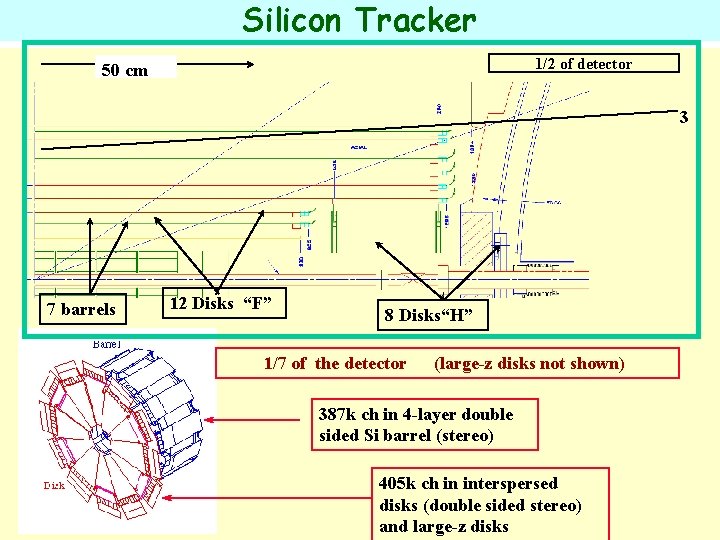
Silicon Tracker 1/2 of detector 50 cm 3 7 barrels 12 Disks “F” 8 Disks“H” 1/7 of the detector (large-z disks not shown) 387 k ch in 4 -layer double sided Si barrel (stereo) 405 k ch in interspersed disks (double sided stereo) and large-z disks
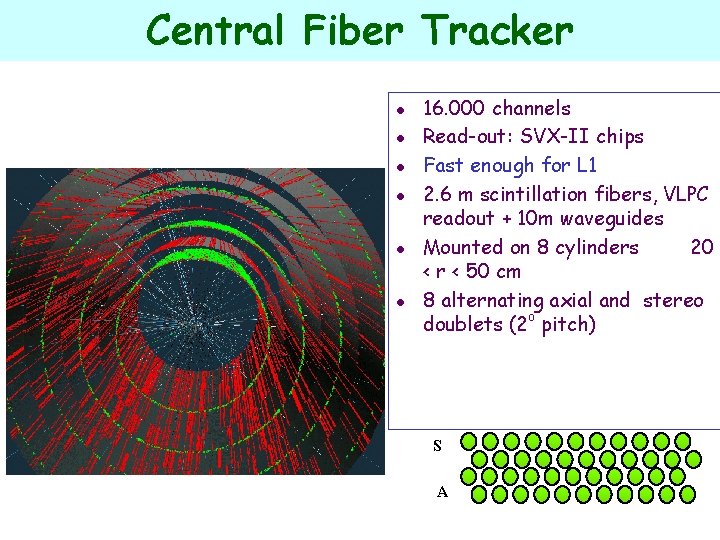
Central Fiber Tracker l l l 16. 000 channels Read-out: SVX-II chips Fast enough for L 1 2. 6 m scintillation fibers, VLPC readout + 10 m waveguides Mounted on 8 cylinders 20 < r < 50 cm 8 alternating axial and stereo doublets (2 o pitch) S A
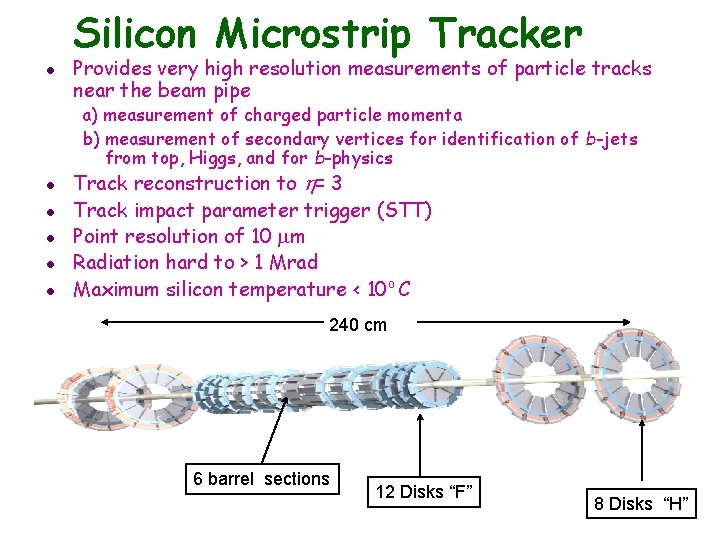
Silicon Microstrip Tracker l Provides very high resolution measurements of particle tracks near the beam pipe a) measurement of charged particle momenta b) measurement of secondary vertices for identification of b-jets from top, Higgs, and for b-physics l l l Track reconstruction to h= 3 Track impact parameter trigger (STT) Point resolution of 10 m Radiation hard to > 1 Mrad Maximum silicon temperature < 10 o C 240 cm 6 barrel sections 12 Disks “F” 8 Disks “H”
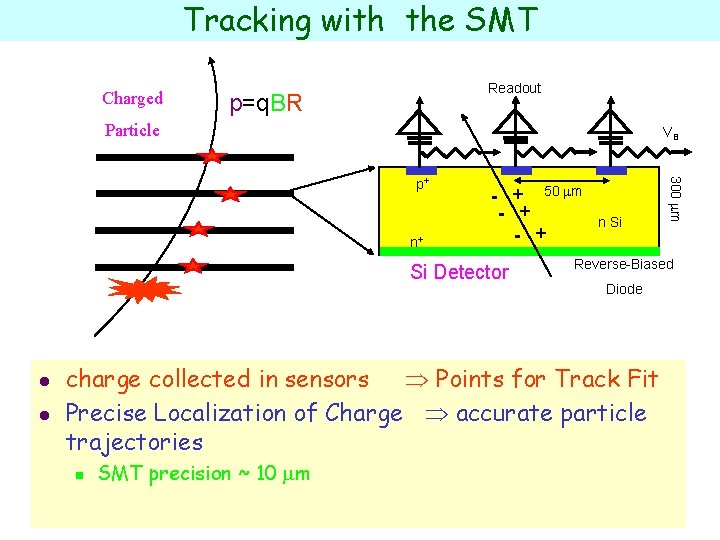
Tracking with the SMT Charged Readout p=q. BR Particle VB n+ - + 50 m - + Si Detector l l n Si Reverse-Biased Diode charge collected in sensors Points for Track Fit Precise Localization of Charge accurate particle trajectories n SMT precision ~ 10 m 300 m p+
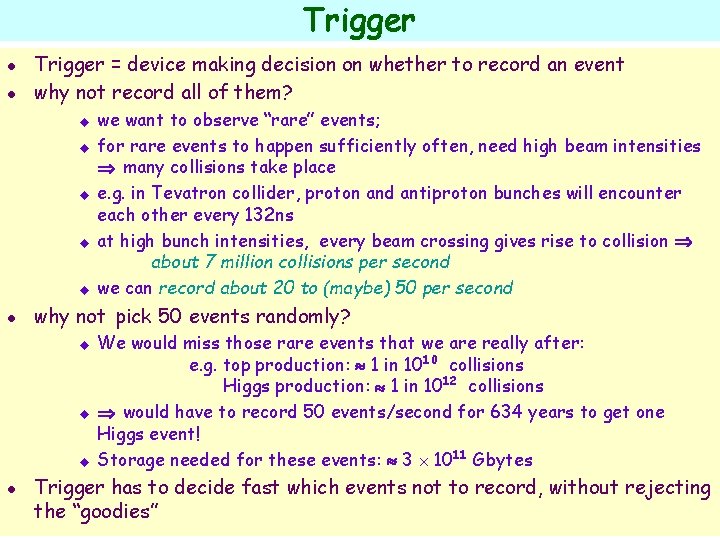
Trigger l l Trigger = device making decision on whether to record an event why not record all of them? u u u l why not pick 50 events randomly? u u u l we want to observe “rare” events; for rare events to happen sufficiently often, need high beam intensities many collisions take place e. g. in Tevatron collider, proton and antiproton bunches will encounter each other every 132 ns at high bunch intensities, every beam crossing gives rise to collision about 7 million collisions per second we can record about 20 to (maybe) 50 per second We would miss those rare events that we are really after: e. g. top production: 1 in 1010 collisions Higgs production: 1 in 1012 collisions would have to record 50 events/second for 634 years to get one Higgs event! Storage needed for these events: 3 1011 Gbytes Trigger has to decide fast which events not to record, without rejecting the “goodies”
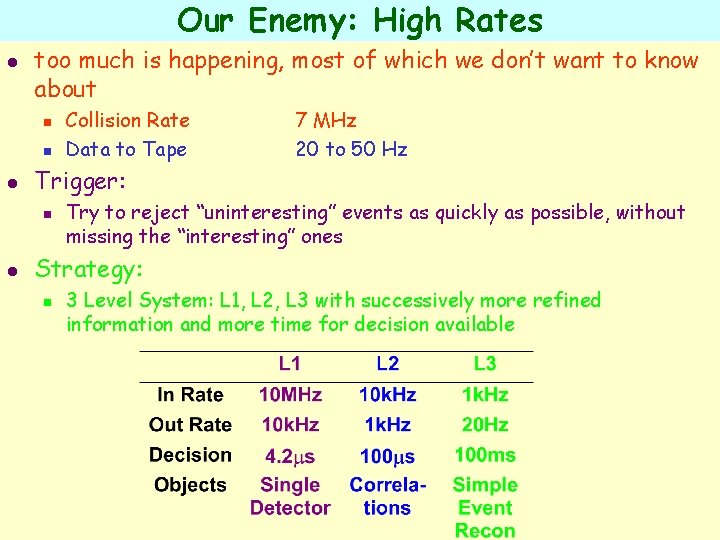
Our Enemy: High Rates l too much is happening, most of which we don’t want to know about n n l 7 MHz 20 to 50 Hz Trigger: n l Collision Rate Data to Tape Try to reject “uninteresting” events as quickly as possible, without missing the “interesting” ones Strategy: n 3 Level System: L 1, L 2, L 3 with successively more refined information and more time for decision available
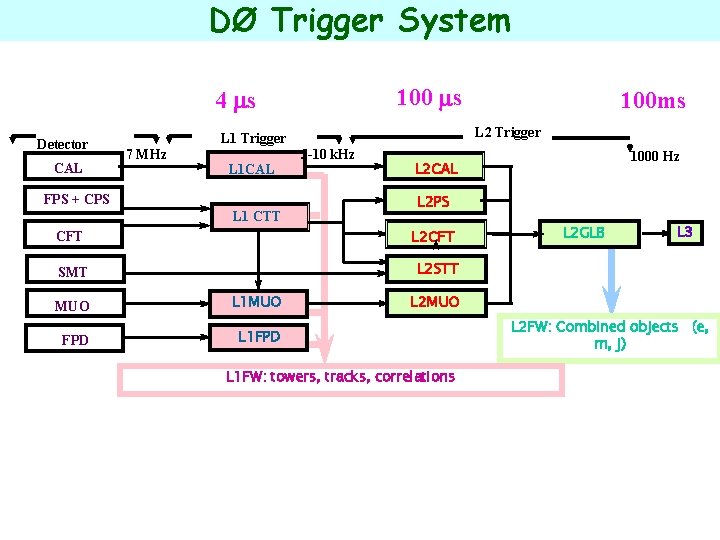
DØ Trigger System 100 s 4 s Detector CAL L 2 Trigger L 1 Trigger 7 MHz L 1 CAL FPS + CPS L 1 CTT CFT 100 ms 5 -10 k. Hz 1000 Hz L 2 CAL L 2 PS L 2 CFT L 2 GLB L 3 L 2 STT SMT MUO L 1 MUO FPD L 1 FPD L 2 MUO L 1 FW: towers, tracks, correlations L 2 FW: Combined objects (e, m, j)
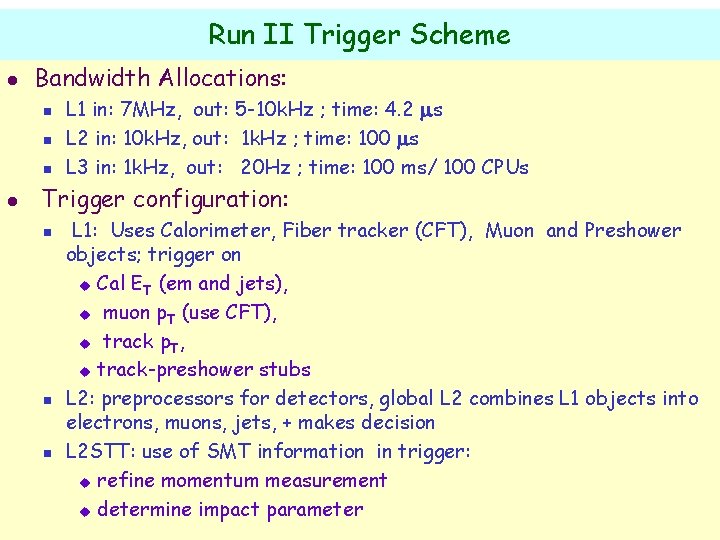
Run II Trigger Scheme l Bandwidth Allocations: n n n l L 1 in: 7 MHz, out: 5 -10 k. Hz ; time: 4. 2 s L 2 in: 10 k. Hz, out: 1 k. Hz ; time: 100 s L 3 in: 1 k. Hz, out: 20 Hz ; time: 100 ms/ 100 CPUs Trigger configuration: n n n L 1: Uses Calorimeter, Fiber tracker (CFT), Muon and Preshower objects; trigger on u Cal ET (em and jets), u muon p. T (use CFT), u track p. T, u track-preshower stubs L 2: preprocessors for detectors, global L 2 combines L 1 objects into electrons, muons, jets, + makes decision L 2 STT: use of SMT information in trigger: u refine momentum measurement u determine impact parameter
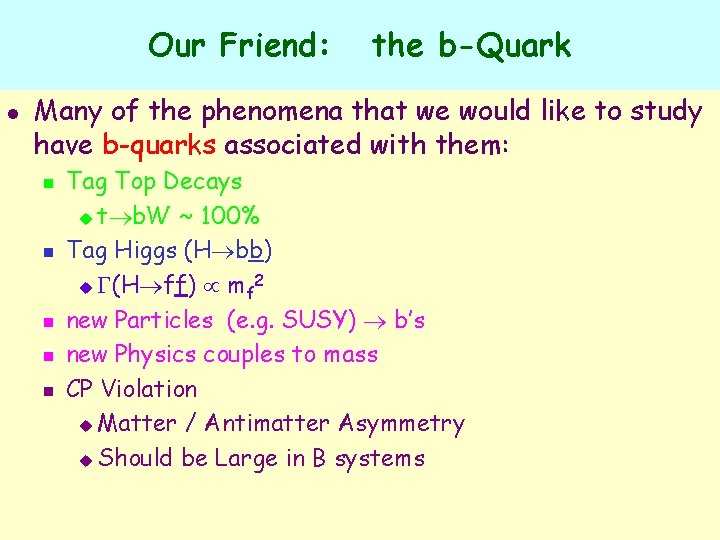
Our Friend: l the b-Quark Many of the phenomena that we would like to study have b-quarks associated with them: n n n Tag Top Decays u t b. W ~ 100% Tag Higgs (H bb) u (H ff) mf 2 new Particles (e. g. SUSY) b’s new Physics couples to mass CP Violation u Matter / Antimatter Asymmetry u Should be Large in B systems
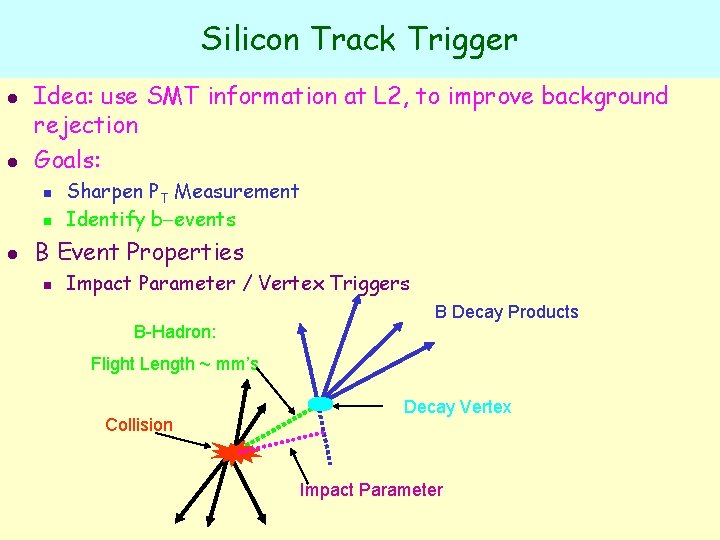
Silicon Track Trigger l l Idea: use SMT information at L 2, to improve background rejection Goals: n n l Sharpen PT Measurement Identify b-events B Event Properties n Impact Parameter / Vertex Triggers B Decay Products B-Hadron: Flight Length ~ mm’s Collision Decay Vertex Impact Parameter
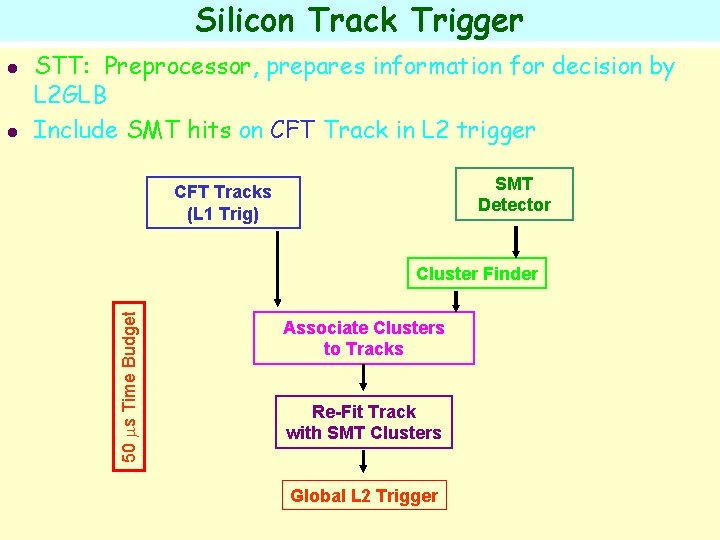
Silicon Track Trigger l STT: Preprocessor, prepares information for decision by L 2 GLB Include SMT hits on CFT Track in L 2 trigger SMT Detector CFT Tracks (L 1 Trig) Cluster Finder 50 s Time Budget l Associate Clusters to Tracks Re-Fit Track with SMT Clusters Global L 2 Trigger
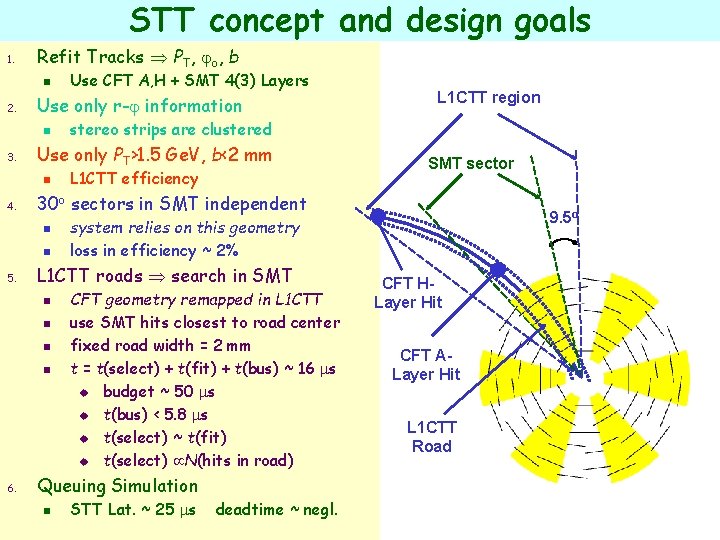
STT concept and design goals 1. Refit Tracks PT, o, b n 2. Use only r- information n 3. n n CFT geometry remapped in L 1 CTT use SMT hits closest to road center fixed road width = 2 mm t = t(select) + t(fit) + t(bus) ~ 16 s u budget ~ 50 s u t(bus) < 5. 8 s u t(select) ~ t(fit) u t(select) N(hits in road) Queuing Simulation n 9. 5 o system relies on this geometry loss in efficiency ~ 2% L 1 CTT roads search in SMT n 6. L 1 CTT efficiency SMT sector 30 o sectors in SMT independent n 5. L 1 CTT region stereo strips are clustered Use only PT>1. 5 Ge. V, b<2 mm n 4. Use CFT A, H + SMT 4(3) Layers STT Lat. ~ 25 s deadtime ~ negl. CFT HLayer Hit CFT ALayer Hit L 1 CTT Road
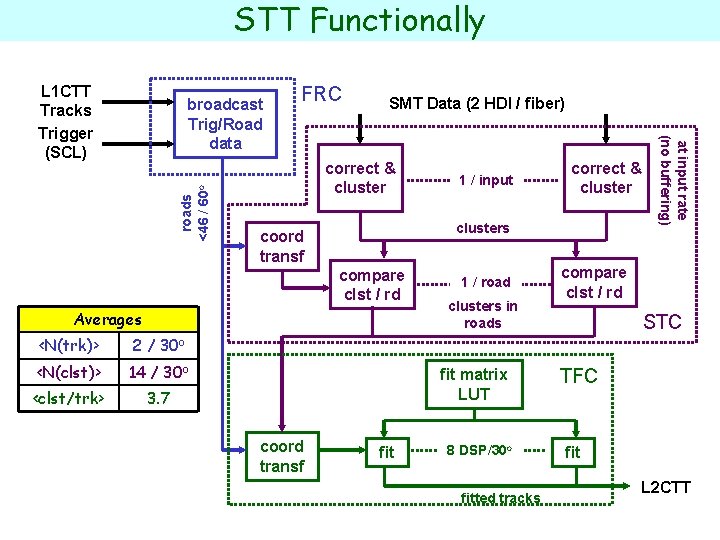
STT Functionally roads <46 / 60 o broadcast Trig/Road data FRC SMT Data (2 HDI / fiber) correct & cluster Averages 2 / 30 o <N(clst)> 14 / 30 o <clst/trk> 3. 7 1 / road clusters in roads fit matrix LUT coord transf correct & clusters coord transf compare clst / rd <N(trk)> 1 / input fit 8 DSP/30 o fitted tracks at input rate (no buffering) L 1 CTT Tracks Trigger (SCL) compare clst / rd STC TFC fit L 2 CTT
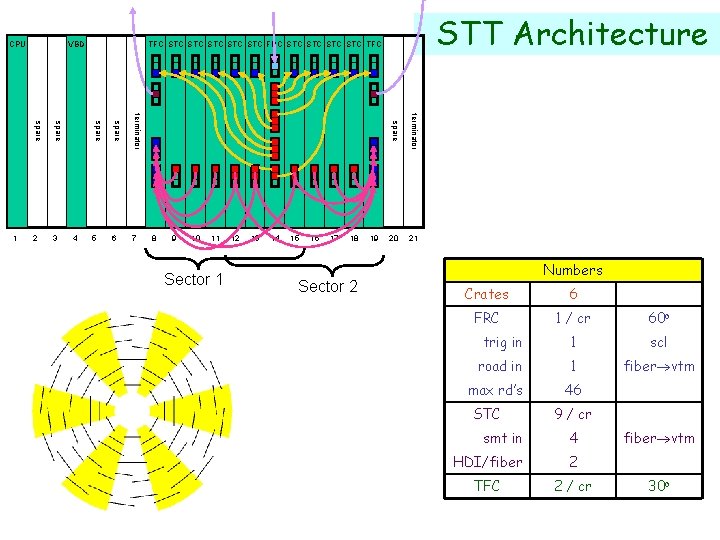
CPU 6 7 8 9 10 11 Sector 1 12 13 14 15 16 17 18 Sector 2 19 terminator 5 spare 4 terminator 3 spare 2 STT Architecture TFC STC STC STC FRC STC STC TFC spare 1 VBD 20 21 Numbers Crates 6 FRC 1 / cr 60 o trig in 1 scl road in 1 fiber vtm max rd’s STC 46 9 / cr smt in 4 HDI/fiber 2 TFC 2 / cr fiber vtm 30 o
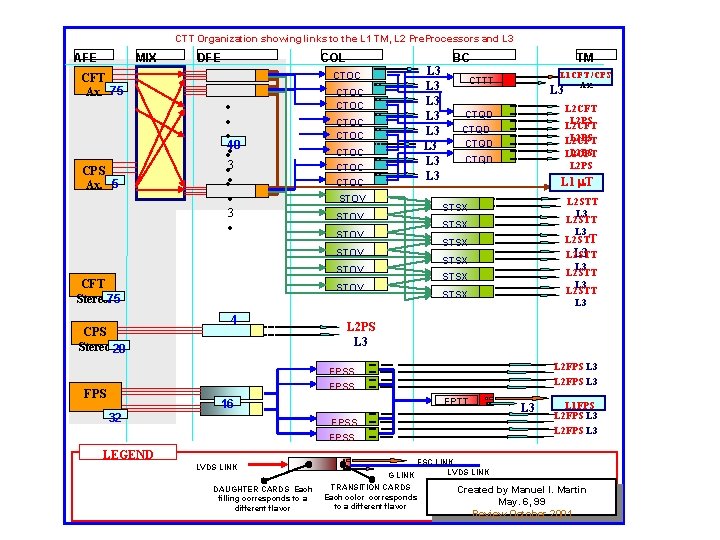
CTT Organization showing links to the L 1 TM, L 2 Pre. Processors and L 3 AFE MIX DFE- COLCTOC CFT Ax. 75 CPS Ax. 5 L 3 L 3 · · · 40 ·· · 3 · CTOC CTOC STOV L 3 L 2 CFT L 2 PS L 2 CFT CTQD L 2 PS L 2 CFT L 2 PS CTQD L 1 T L 2 STT L 3 L 2 STT L 3 STSX STOV 4 L 1 CFT /CPS Ax. CTTT STSX STOV CPS Stereo 20 TM STSX STOV CFT Stereo. 75 BC- STSX L 2 PS L 3 L 2 FPS L 3 FPSS FPS FPTT 16 32 FPSS LEGEND LVDS LINK DAUGHTER CARDS Each filling corresponds to a different flavor L 3 L 1 FPS L 2 FPS L 3 FSC LINK LVDS LINK G LINK TRANSITION CARDS Each color corresponds to a different flavor Created by Manuel I. Martin May. 6, 99 Review October 2001
STT history and status l l Project started in 1996 (first feasibility studies, assess physics merit) 1997 to 1999: proposals to DØ, Fermilab PAC, NSF Summer 1999: consortium of 4 universities (Boston U. , Columbia. U. , FSU, Stony Brook obtains funding (1. 8 M$ from NSF and DOE) Dec. 1999: Reginald Perry joins; n l l He and his students (Shweta Lolage, Vindi Lalam, Sean Roper, …. ) developed the VHDL code for the cluster finder and hitfilter part, probably the most challenging part of the project Sept. – Nov 2001: system tests with first prototypes, first at BU, now at Fermilab in the DØ environment Second (final? ) prototype tests Nov. – Dec. Production Jan – March 2002 Installation in DØ
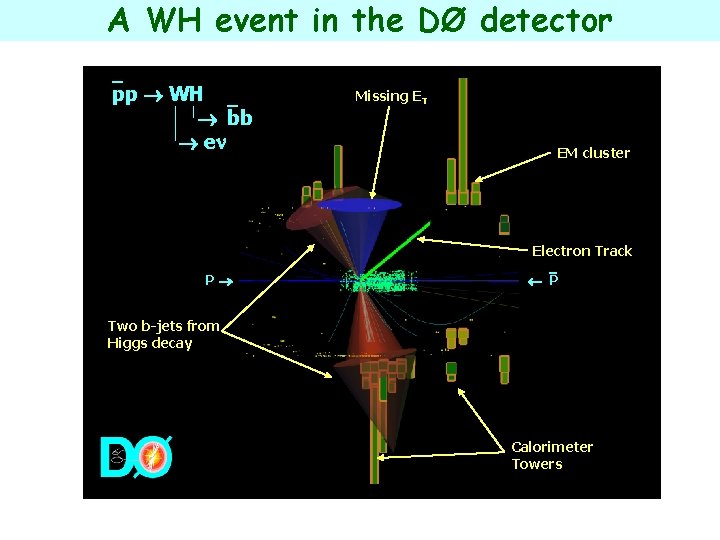
A WH event in the DØ detector pp WH bb e Missing ET EM cluster Electron Track P P Two b-jets from Higgs decay Calorimeter Towers
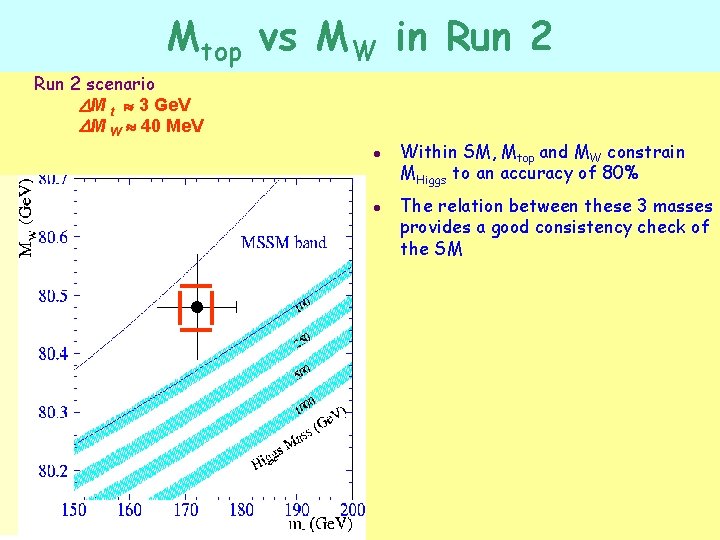
Mtop vs MW in Run 2 scenario DM t 3 Ge. V DM W 40 Me. V l l Within SM, Mtop and MW constrain MHiggs to an accuracy of 80% The relation between these 3 masses provides a good consistency check of the SM
Summary l DØ has a new detector which promises to be up to the task of incisive testing of the SM, and capable of discovering new physics phenomena; New trigger, in particular the STT, greatly enhances potential; We are looking forward to finally seeing something which clearly disagrees with the SM! Many thanks to Reginald Perry and ECE Dept. l Hope for continued collaboration l l l
- Slides: 51