
What Is Parenthesis Parenthesis is the addition of
- Slides: 6
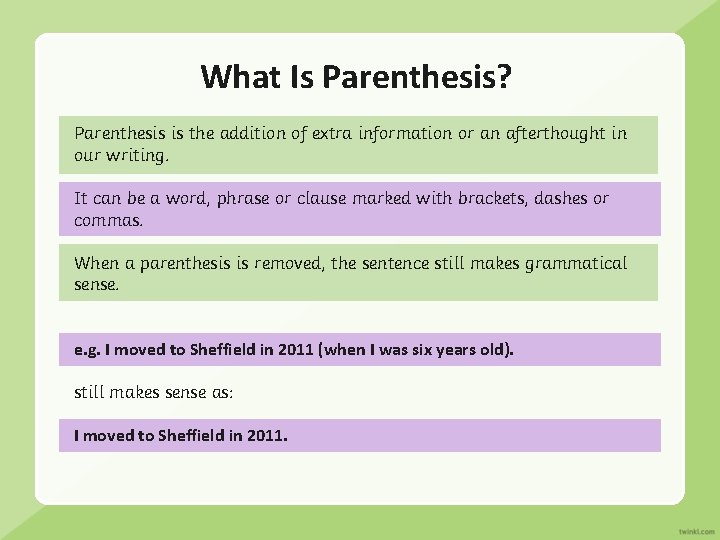
What Is Parenthesis? Parenthesis is the addition of extra information or an afterthought in our writing. It can be a word, phrase or clause marked with brackets, dashes or commas. When a parenthesis is removed, the sentence still makes grammatical sense. e. g. I moved to Sheffield in 2011 (when I was six years old). still makes sense as: I moved to Sheffield in 2011.
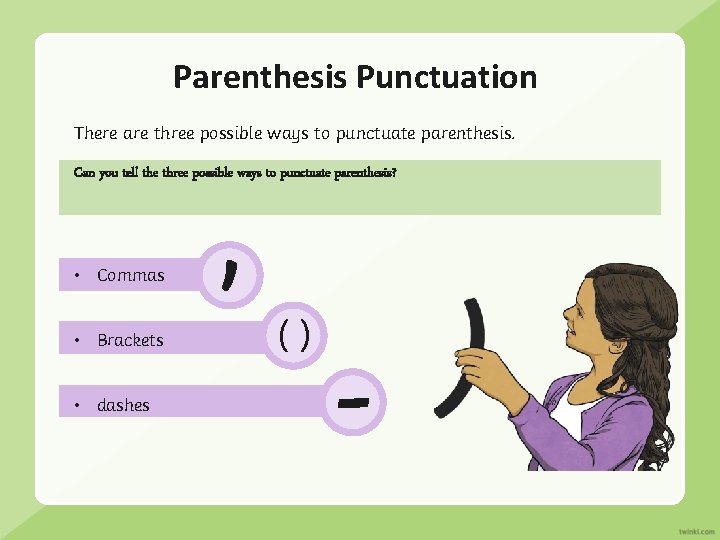
Parenthesis Punctuation There are three possible ways to punctuate parenthesis. , Can you tell the three possible ways to punctuate parenthesis? • Commas • Brackets • dashes () -
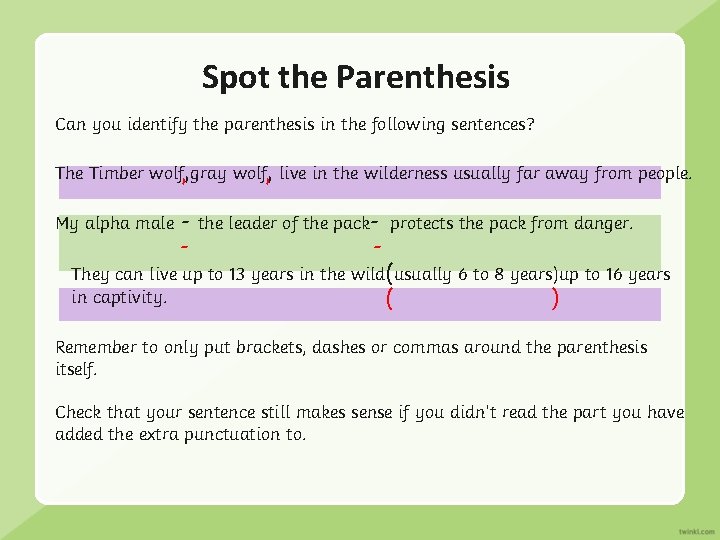
Spot the Parenthesis Can you identify the parenthesis in the following sentences? The Timber wolf, , gray wolf, live in the wilderness usually far away from people. My alpha male - the leader of the pack- protects the pack from danger. - They can live up to 13 years in the wild(usually 6 to 8 years)up to 16 years in captivity. ( ) Remember to only put brackets, dashes or commas around the parenthesis itself. Check that your sentence still makes sense if you didn’t read the part you have added the extra punctuation to.
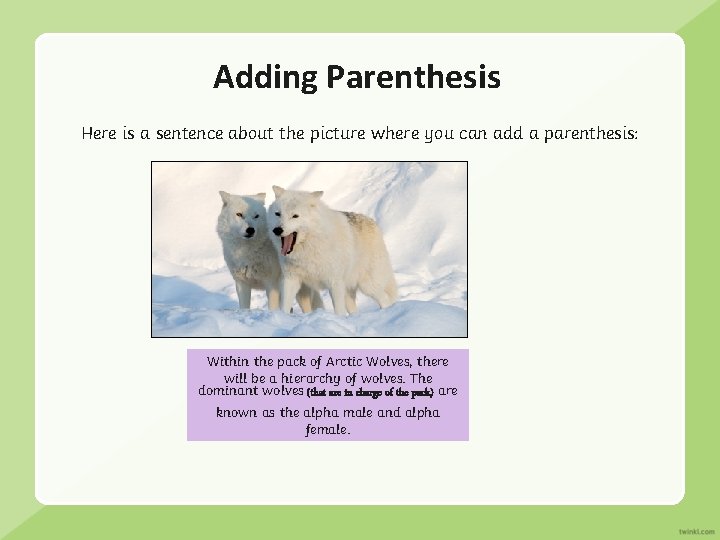
Adding Parenthesis Here is a sentence about the picture where you can add a parenthesis: Within the pack of Arctic Wolves, there will be a hierarchy of wolves. The dominant wolves (that are in charge of the pack) are known as the alpha male and alpha female.
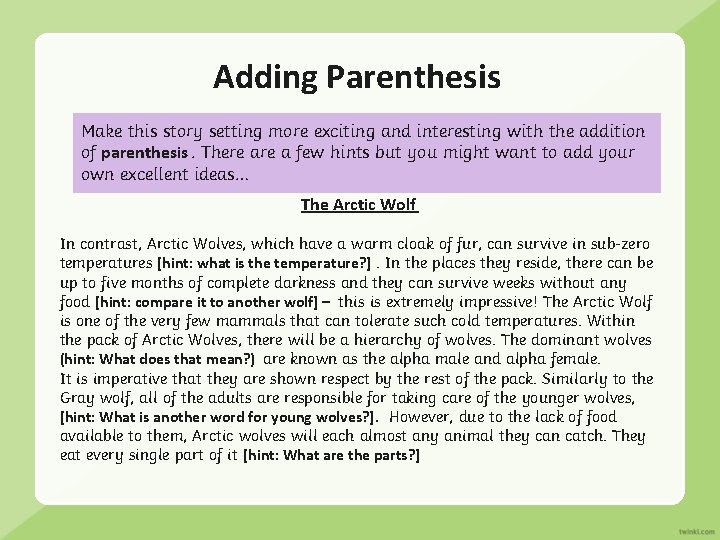
Adding Parenthesis Make this story setting more exciting and interesting with the addition of parenthesis. There a few hints but you might want to add your own excellent ideas… The Arctic Wolf In contrast, Arctic Wolves, which have a warm cloak of fur, can survive in sub-zero temperatures [hint: what is the temperature? ]. In the places they reside, there can be up to five months of complete darkness and they can survive weeks without any food [hint: compare it to another wolf] – this is extremely impressive! The Arctic Wolf is one of the very few mammals that can tolerate such cold temperatures. Within the pack of Arctic Wolves, there will be a hierarchy of wolves. The dominant wolves (hint: What does that mean? ) are known as the alpha male and alpha female. It is imperative that they are shown respect by the rest of the pack. Similarly to the Gray wolf, all of the adults are responsible for taking care of the younger wolves, [hint: What is another word for young wolves? ]. However, due to the lack of food available to them, Arctic wolves will each almost any animal they can catch. They eat every single part of it [hint: What are the parts? ]
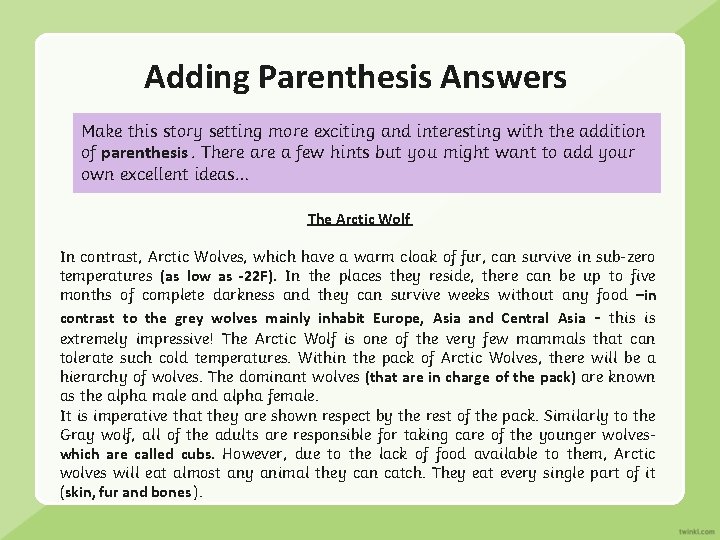
Adding Parenthesis Answers Make this story setting more exciting and interesting with the addition of parenthesis. There a few hints but you might want to add your own excellent ideas… The Arctic Wolf In contrast, Arctic Wolves, which have a warm cloak of fur, can survive in sub-zero temperatures (as low as -22 F). In the places they reside, there can be up to five months of complete darkness and they can survive weeks without any food –in contrast to the grey wolves mainly inhabit Europe, Asia and Central Asia - this is extremely impressive! The Arctic Wolf is one of the very few mammals that can tolerate such cold temperatures. Within the pack of Arctic Wolves, there will be a hierarchy of wolves. The dominant wolves (that are in charge of the pack) are known as the alpha male and alpha female. It is imperative that they are shown respect by the rest of the pack. Similarly to the Gray wolf, all of the adults are responsible for taking care of the younger wolveswhich are called cubs. However, due to the lack of food available to them, Arctic wolves will eat almost any animal they can catch. They eat every single part of it (skin, fur and bones ).