
What is our current picture of this Universe
- Slides: 28
What is our current picture of this Universe we live in? Let’s start with what we know today, and discuss the History and Philosophy later!
Stephen Jay Gould: ‘We have to extract meaning out of the confusion of the world around us. We do it by telling stories, and by looking for patterns. And whenever we see a pattern, we have to tell a story about it. ’ David Layzer: ‘There is a peculiar synergy between mathematics and ordinary language. Without adequate verbal support, formulas and diagrams tend to lose their meaning; without formulas and diagrams, words and phrases refuse to take on new meanings. ’ Richard Dawkins: ‘if solid things are mostly empty space, why don't we see them as empty space? " The answer lies in our own evolution. You might think that our sense organs would be shaped to give us a ‘true’ picture of the world as it ‘really’ is. Instead they have been shaped to give us a useful picture, designed to understand the mundane details of how to survive in the stone-age African savannah’
THE NATURE OF MATTER _____________________________ All matter consists of little bits of positive and negative electricity: in perpetual motion; attract each other at short distances; repel each other when pressed too close together. ____________________________ The most important discovery ever made. If all other scientific information we know were lost in some cataclysmic event, and only this information survived, all could be rediscovered in a very short time. - Richard P. Feynman
ATOMS: Democritus ~450 BC Unproven conjecture until 1905 Brownian Motion (pollen grains in water) Robert Brown 1827 Atomic size deduced from Brownian Motion Albert Einstein 1905 ATOMS became FACT, not THEORY
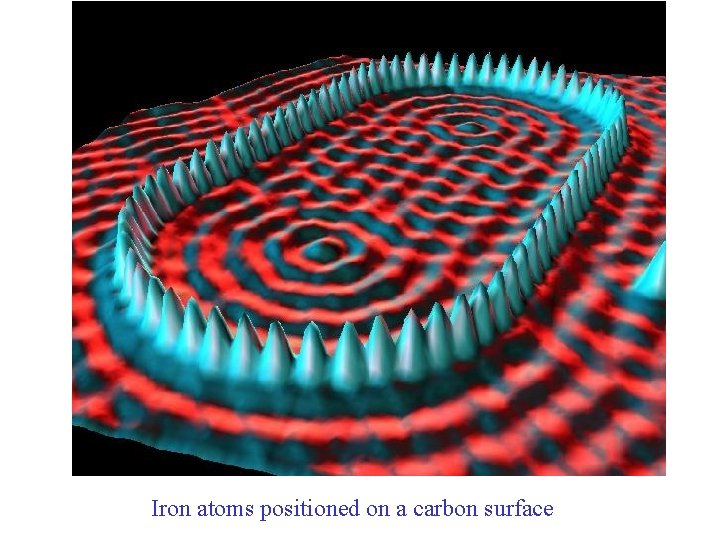
Iron atoms positioned on a carbon surface
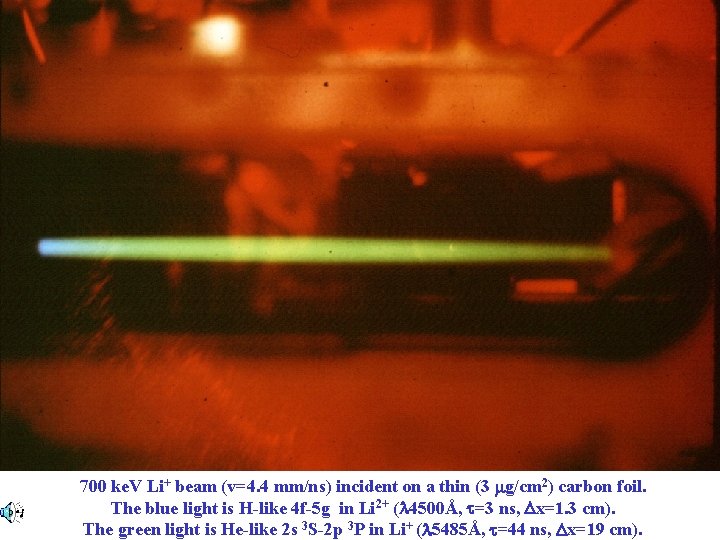
700 ke. V Li+ beam (v=4. 4 mm/ns) incident on a thin (3 g/cm 2) carbon foil. The blue light is H-like 4 f-5 g in Li 2+ ( 4500Å, =3 ns, x=1. 3 cm). The green light is He-like 2 s 3 S-2 p 3 P in Li+ ( 5485Å, =44 ns, x=19 cm).
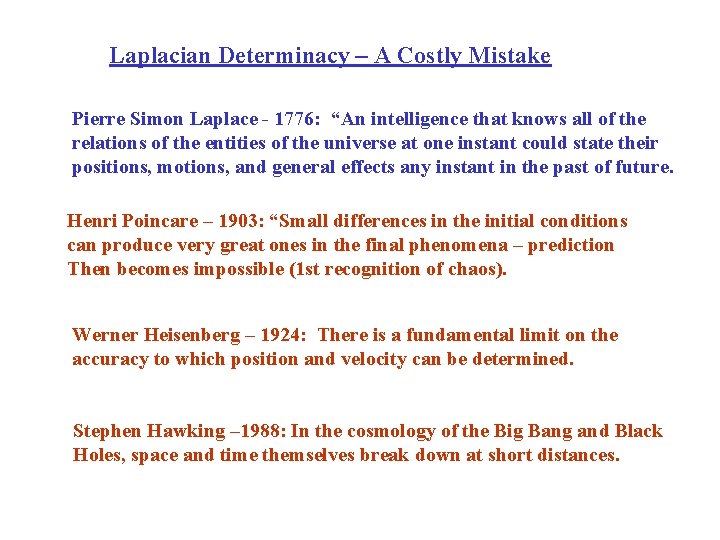
Laplacian Determinacy – A Costly Mistake Pierre Simon Laplace - 1776: “An intelligence that knows all of the relations of the entities of the universe at one instant could state their positions, motions, and general effects any instant in the past of future. Henri Poincare – 1903: “Small differences in the initial conditions can produce very great ones in the final phenomena – prediction Then becomes impossible (1 st recognition of chaos). Werner Heisenberg – 1924: There is a fundamental limit on the accuracy to which position and velocity can be determined. Stephen Hawking – 1988: In the cosmology of the Big Bang and Black Holes, space and time themselves break down at short distances.
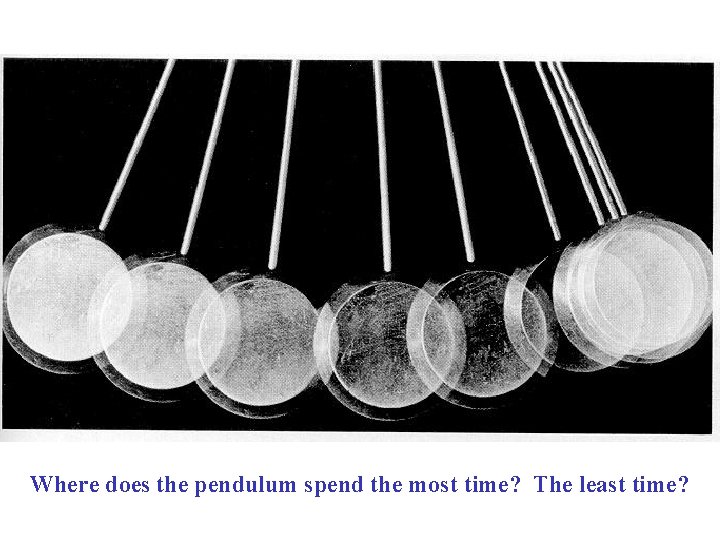
Where does the pendulum spend the most time? The least time?
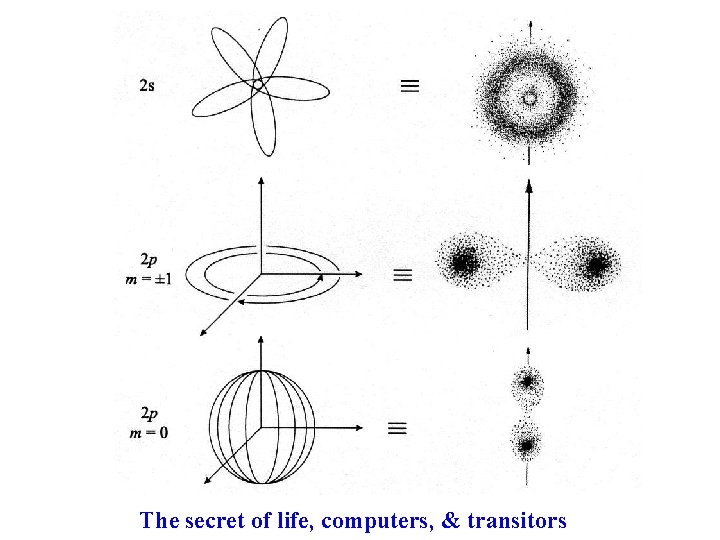
The secret of life, computers, & transitors
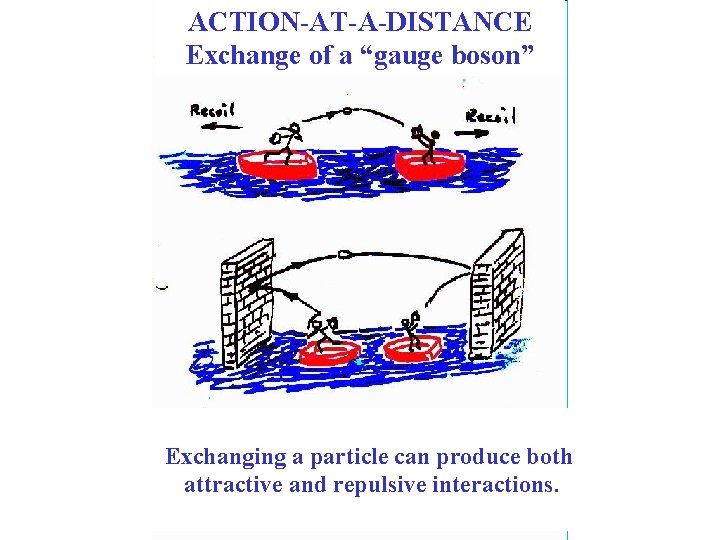
Can we picture attractive and repulsive interactions without the force concept? Quantum Field Theory is conceptually easy!
ACTION-AT-A-DISTANCE Exchange of a “gauge boson” Exchanging a particle can produce both attractive and repulsive interactions.
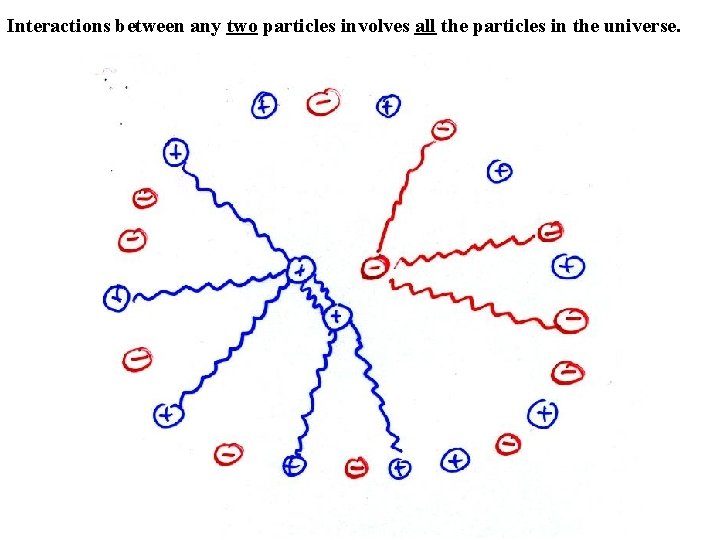
Interactions between any two particles involves all the particles in the universe.
Electron-positron pair production
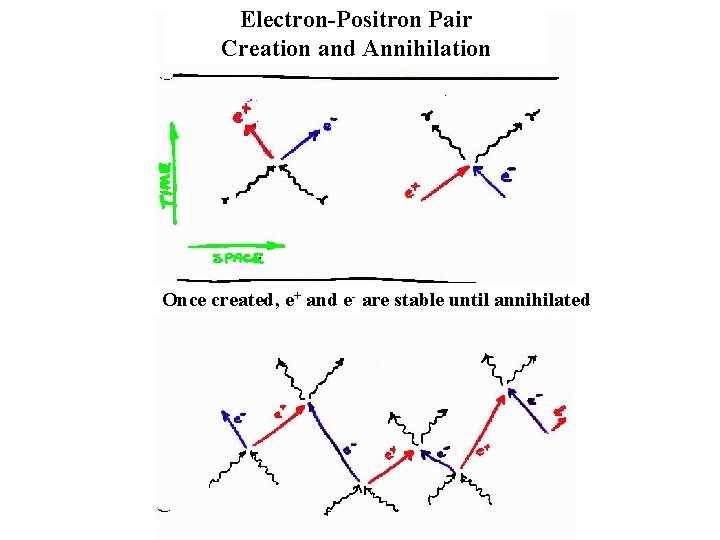
Electron-Positron Pair Creation and Annihilation Once created, e+ and e- are stable until annihilated
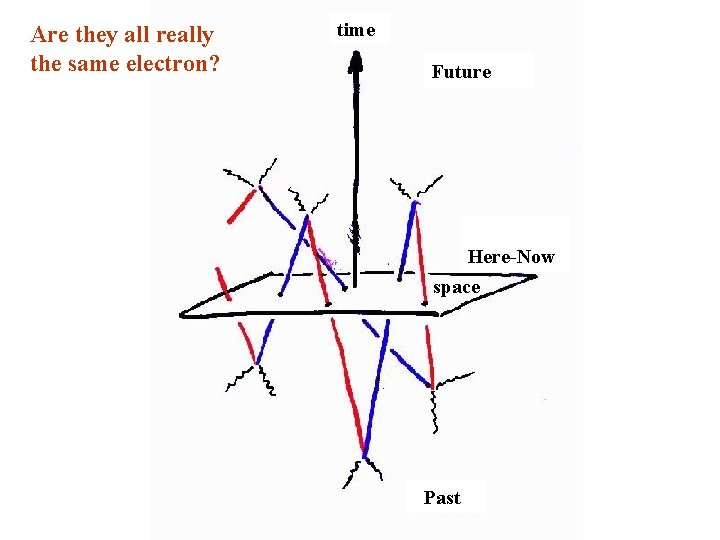
Are they all really the same electron? time Future Here-Now space Past
Richard P. Feynman, Theory of Positrons, Physical Review 76, 749 -759 (September 15, 1949). “It is as though a bombardier flying low over a road suddenly sees three roads and it is only when two of them come together and disappear again that he realizes that he has simply passed over a switchback in a single road. This over-all space-time point of view leads to considerable simplification in many problems. One can take into account at the same time processes which ordinarily would have to be considered separately. ”
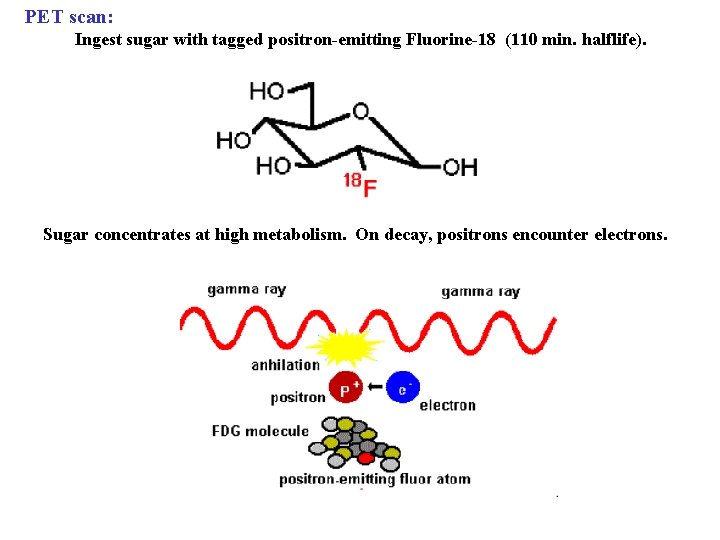
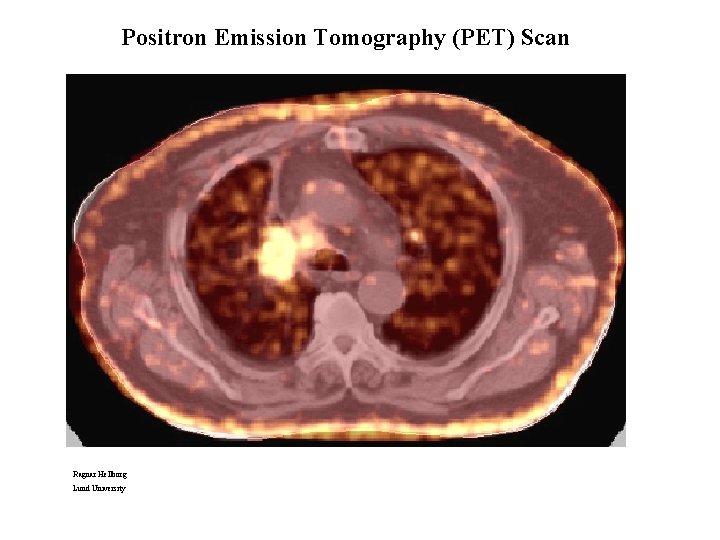
PET scan: Ingest sugar with tagged positron-emitting Fluorine-18 (110 min. halflife). Sugar concentrates at high metabolism. On decay, positrons encounter electrons.
Positron Emission Tomography (PET) Scan Ragnar Hellborg Lund University
TIME “Time is what keeps everything from happening at once. ” - Attributed to John Archibald Wheeler Quoted by Woody Allen “Time flies like an arrow; fruit flies like a banana. ” - Groucho Marx ‘Backward turn, turn backward, O time in your flight. Make me a child again, just for tonight. ’ - Elizabeth Akers Allen
Nature has revealed a beautiful secret! The behavior of the Universe becomes very simple if it is described in a way in which space and time are symmetric. What makes it seem hard, is the fact the we must live our lives by standing at a point in space and watching time pass, but not the reverse. It’s like our perspective in riding the Earth around the Sun, which seems as if the Sun were going around us. However, the heliocentric equations are much simpler.
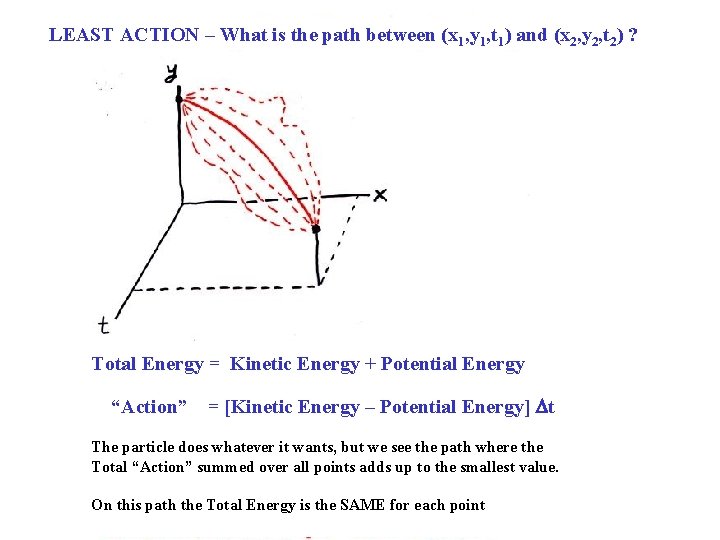
LEAST ACTION – What is the path between (x 1, y 1, t 1) and (x 2, y 2, t 2) ? Total Energy = Kinetic Energy + Potential Energy “Action” = [Kinetic Energy – Potential Energy] t The particle does whatever it wants, but we see the path where the Total “Action” summed over all points adds up to the smallest value. On this path the Total Energy is the SAME for each point
Principle of Least Action Interactive
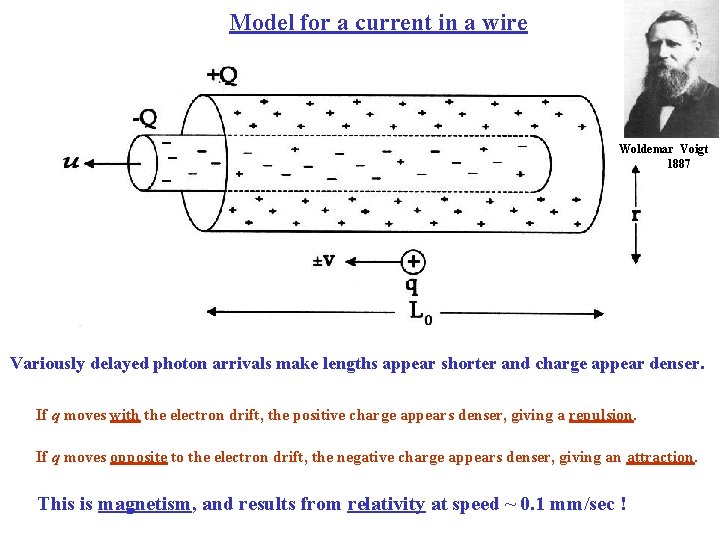
Model for a current in a wire Woldemar Voigt 1887 Variously delayed photon arrivals make lengths appear shorter and charge appear denser. If q moves with the electron drift, the positive charge appears denser, giving a repulsion. If q moves opposite to the electron drift, the negative charge appears denser, giving an attraction. This is magnetism, and results from relativity at speed ~ 0. 1 mm/sec !
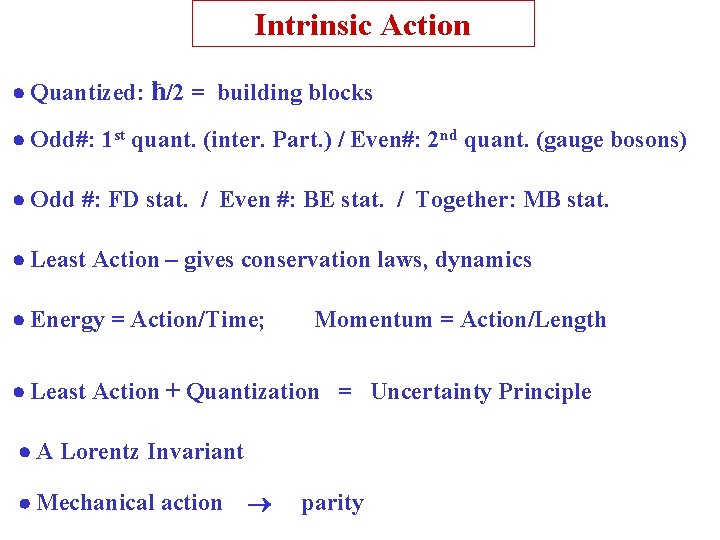
Intrinsic Action Quantized: ħ/2 = building blocks Odd#: 1 st quant. (inter. Part. ) / Even#: 2 nd quant. (gauge bosons) Odd #: FD stat. / Even #: BE stat. / Together: MB stat. Least Action – gives conservation laws, dynamics Energy = Action/Time; Momentum = Action/Length Least Action + Quantization = Uncertainty Principle A Lorentz Invariant Mechanical action parity