
What is NIMS A comprehensive national approach to
- Slides: 75
What is NIMS? • A comprehensive, national approach to incident management • Applicable at all jurisdictional levels and across disciplines
NIMS Compliance Your jurisdiction must adopt NIMS: • ICS by Oct 1, 2004 • Other aspects by a later date (to be determined)
Why Do We Need NIMS? Lessons learned have shown the need for: • A coordinated response. • Standardization. • Interoperability.
NIMS Concepts and Principles NIMS is: • Flexible to enable all responding organizations to work together. • Standardized to improve overall response and interoperability.
NIMS Standard Structures • Incident Command System (ICS) • Multiagency Coordination Systems • Public Information Systems
Preparedness • Planning, training, and exercises • Personnel qualification and certification • Equipment acquisition and certification • Publication management • Mutual aid/Emergency Management Assistance Compacts
Resource Management Includes standardized: • Descriptions • Inventories • Mobilization • Dispatch • Tracking • Recovery
Communications/Information Management NIMS identifies requirements for: • Communications. • Information management. • Information sharing.
Supporting Technologies NIMS provides systems to standardize: • Voice and data communications. • Information management. • Data displays.
Lesson Overview • Command management under NIMS • Incident Command System overview
Lesson Objectives • Identify the benefits of using ICS as the model incident management system. • Identify the organizational structure of ICS. • Identify five major management functions. • Describe the purpose of unique position titles in ICS. • Explain the roles and responsibilities of the Command General staff.
ICS • Proven on-scene, all-hazard concept • Interdisciplinary and organizationally flexible • Appropriate for all types of incidents
ICS Features • • Common terminology Organizational resources Manageable span of control Organizational facilities Use of position titles Reliance on an Incident Action Plan Integrated communications Accountability
Common Terminology ICS requires: • Common terminology. • “Clear” text.
Organizational Resources • Includes: • Personnel • Facilities • Equipment and supplies • Requires “typing” by capability
Span of Control • From 3 to 7 reporting elements per supervisor • 5 reporting elements per supervisor is optimum
Incident Facilities • Established as required by the incident • An ICP is always established
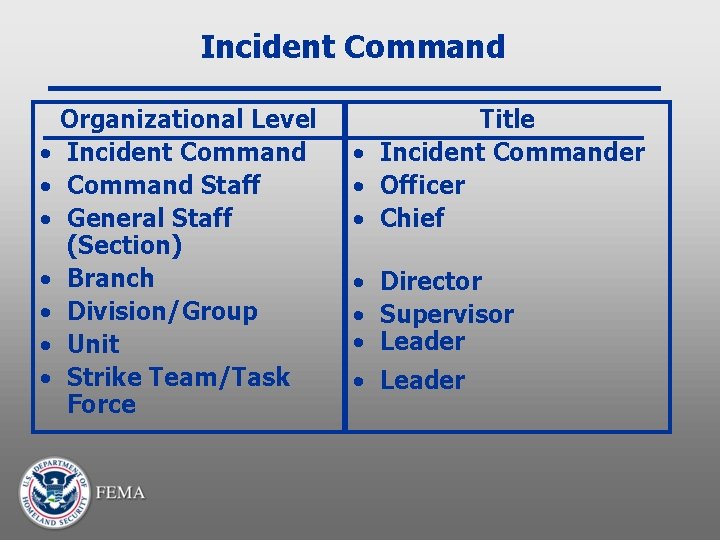
Incident Command • • Organizational Level Incident Command Staff General Staff (Section) Branch Division/Group Unit Strike Team/Task Force Title • Incident Commander • Officer • Chief • Director • Supervisor • Leader
Incident Action Plans • Communicate incident objectives • Are based on operational periods • Are disseminated throughout the incident organization
Integrated Communications • Hardware systems • Planning for use of all frequencies and resources • Procedures for transferring information internally and externally
Accountability • Orderly chain of command • Check-in for all responders • Assignment of only one supervisor per individual (unity of command)
Lesson Overview Command Management of: • Multiple concurrent incidents • Incidents that are nonsite specific, such as biological terrorist incidents • Incidents that are geographically dispersed • Incidents that evolve over time
Lesson Objectives • Determine when it is appropriate to institute a Unified or Area Command. • Describe the functions and purpose of Multiagency Coordination Systems.
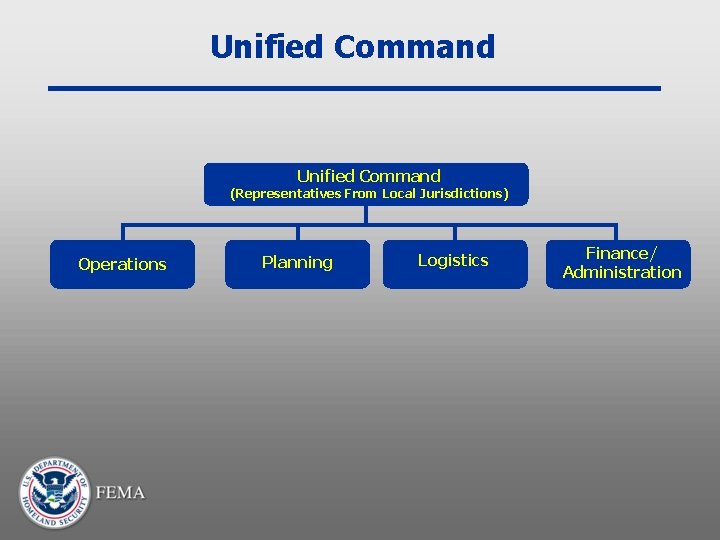
Unified Command (Representatives From Local Jurisdictions) Operations Planning Logistics Finance/ Administration
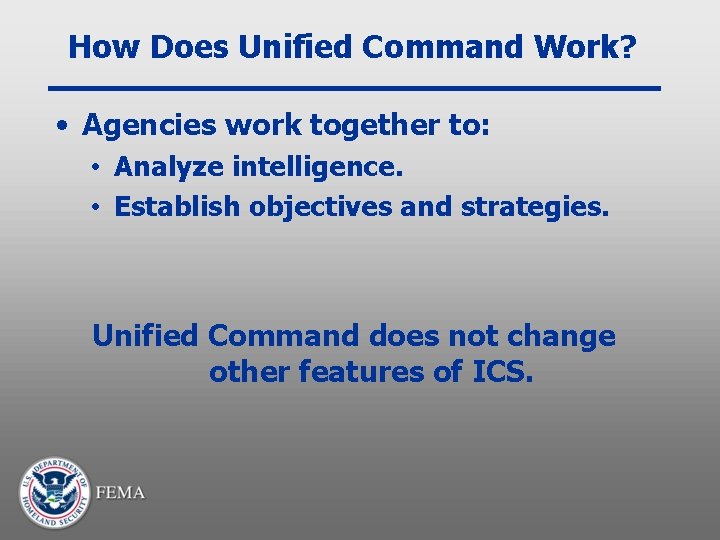
How Does Unified Command Work? • Agencies work together to: • Analyze intelligence. • Establish objectives and strategies. Unified Command does not change other features of ICS.
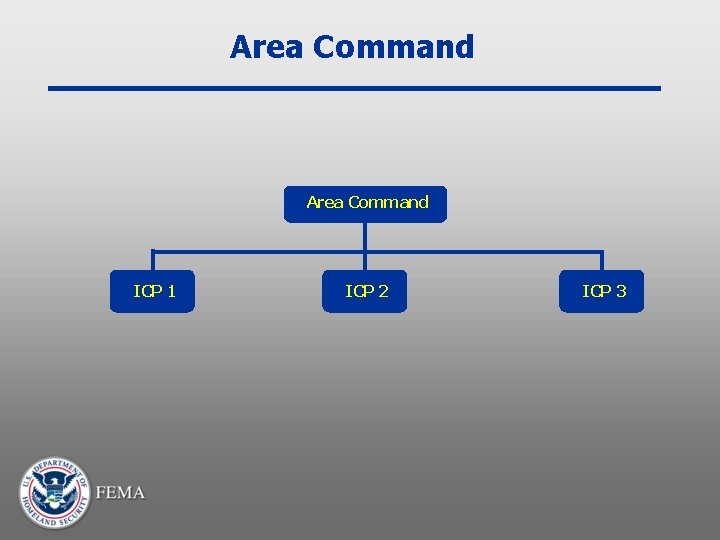
Area Command ICP 1 ICP 2 ICP 3
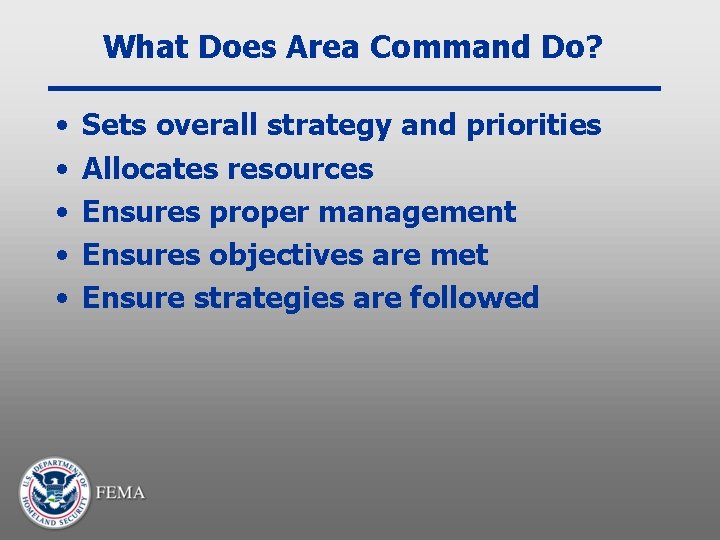
What Does Area Command Do? • • • Sets overall strategy and priorities Allocates resources Ensures proper management Ensures objectives are met Ensure strategies are followed
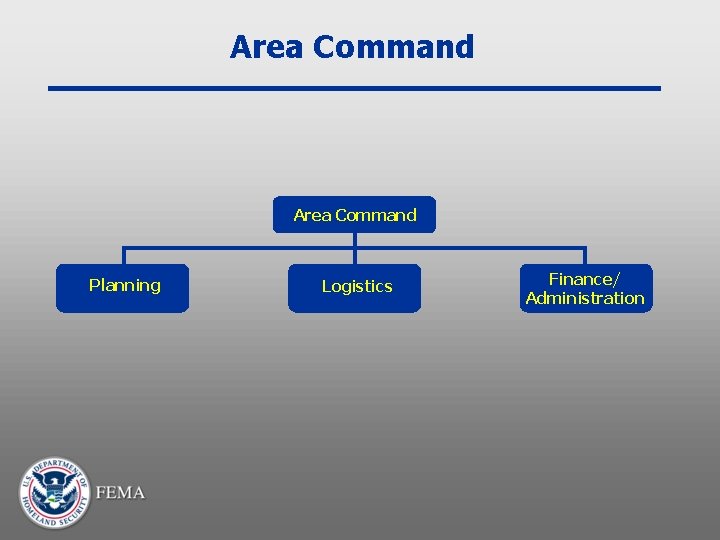
Area Command Planning Logistics Finance/ Administration
Multiagency Coordination Systems • A combination of resources • Integrated into a common framework • Used to coordinate and support incident management activities
Multiagency Coordination Systems • Support incident management policies and priorities • Facilitate logistics support and resource tracking • Make resource allocation decisions based on incident management priorities • Coordinate incident-related information • Coordinate interagency and intergovernmental issues regarding incident management policies, priorities, and strategies
Multiagency Coordination System Elements • EOC • Other entities
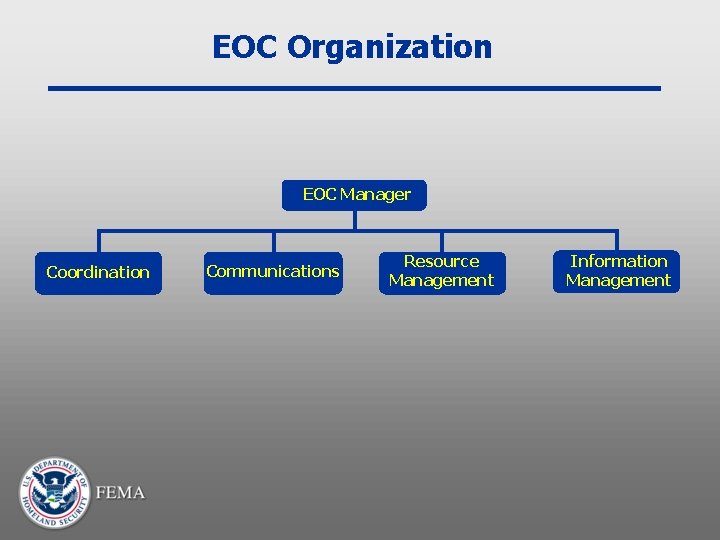
EOC Organization EOC Manager Coordination Communications Resource Management Information Management
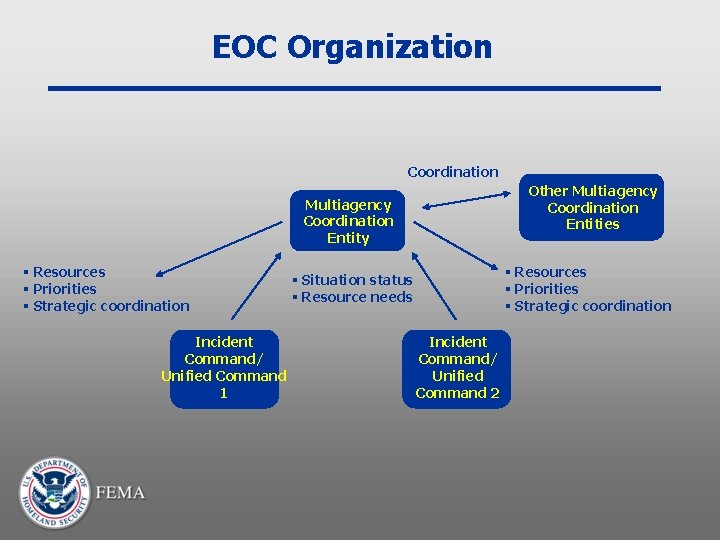
EOC Organization Coordination Other Multiagency Coordination Entities Multiagency Coordination Entity § Resources § Priorities § Strategic coordination Incident Command/ Unified Command 1 § Resources § Priorities § Strategic coordination § Situation status § Resource needs Incident Command/ Unified Command 2
Lesson Overview • Principles to support effective Public Information Systems • Public Information Systems required by NIMS
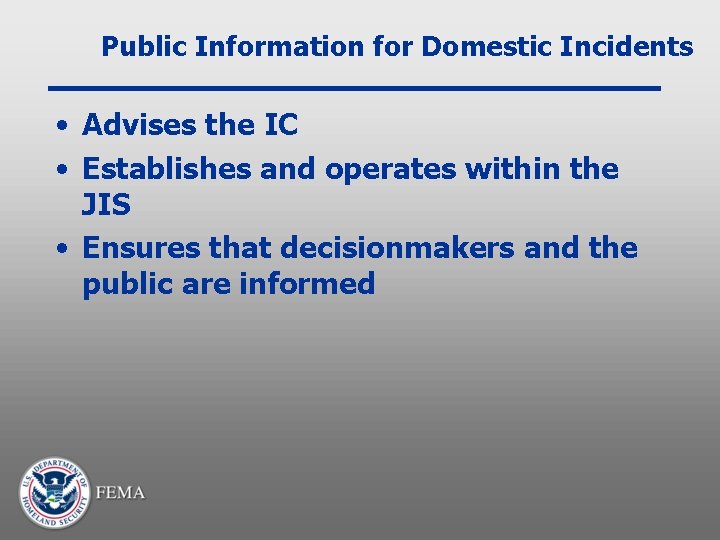
Public Information for Domestic Incidents • Advises the IC • Establishes and operates within the JIS • Ensures that decisionmakers and the public are informed
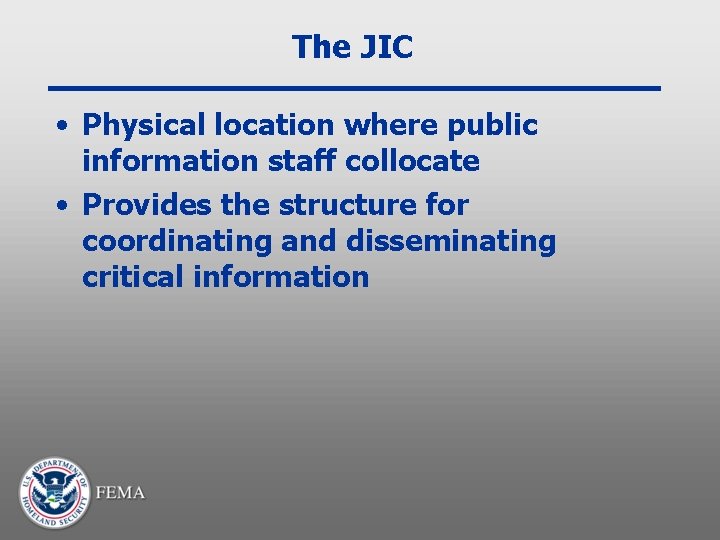
The JIC • Physical location where public information staff collocate • Provides the structure for coordinating and disseminating critical information
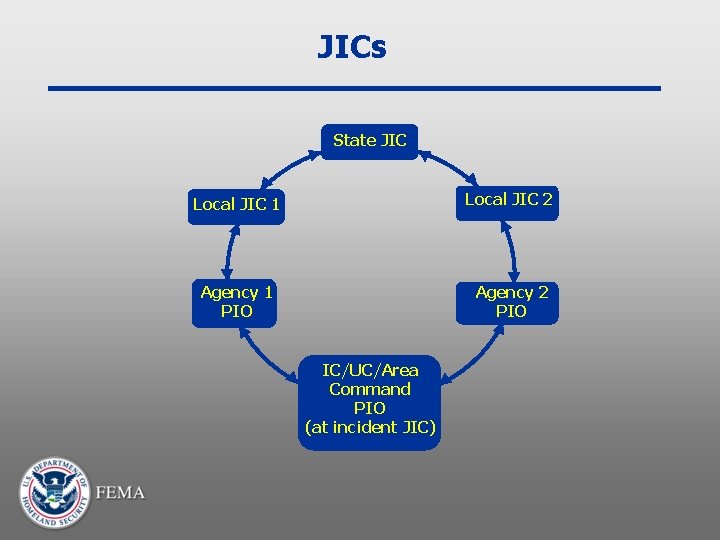
JICs State JIC Local JIC 1 Local JIC 2 Agency 1 PIO Agency 2 PIO IC/UC/Area Command PIO (at incident JIC)
JIC Characteristics • Includes representatives of all players in the response • Has procedures and protocols for communicating and coordinating with other JICs
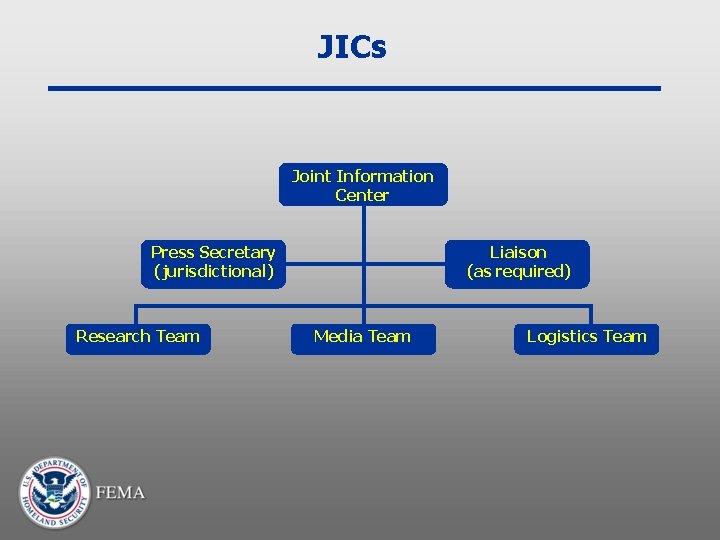
JICs Joint Information Center Press Secretary (jurisdictional) Research Team Liaison (as required) Media Team Logistics Team
What Is Preparedness? • Actions to establish and sustain prescribed levels of capability • Ensures mission integration and interoperability
Responsibilities of Preparedness Organizations • Establishing/coordinating plans and protocols • Integrating/coordinating activities • Establishing guidelines and protocols to promote interoperability • Adopting guidelines for resource management • Establishing response priorities • Establishing/maintaining multiagency coordination mechanisms
Preparedness Planning • Plans describe how resources will be used. • Plans describe mechanisms for: • • Setting priorities. Integrating entities/functions. Establishing relationships. Ensuring that systems support all incident management activities.
Types of Plans • • Emergency Operations Plans Procedures Preparedness Plans Corrective Action and Mitigation Plans • Recovery Plans
Training and Exercises The NIMS Integration Center will: • Facilitate development and dissemination of national standards, guidelines, and protocols. • Facilitate use of modeling/simulation. • Define general training requirements and approved courses. • Review/approve discipline-specific training requirements.
Personnel Qualifications and Certification Development of standards, including: • Training • Experience • Credentialing • Currency requirements • Physical and medical fitness
Equipment Certifications • Facilitate development of national equipment standards, guidelines, and protocols • Review and approve equipment meeting national standards
Mutual Aid and EMACs Jurisdictions at all levels are encouraged to enter into agreements with: • Other jurisdictions. • Private-sector and NGOs. • Private organizations.
Publication Management • The development of naming and numbering conventions • Review and certification of publications • Methods for publications control • Identification of sources and suppliers for publications and related services • Management of publication distribution
Lesson Overview Resource management includes coordination and oversight of: • Tools. • Processes. • Systems. NIMS affects the way resources are managed.
What Is Resource Management? Four tasks: • Establishing systems • Activating the systems • Dispatching resources • Deactivating resources
Resource Management Concepts • Standardize identification, allocation, and tracking • Classify by kind and type • Implement credentialing system • Incorporate resources from private sector and NGOs
Resource Management Principles 1. 2. 3. 4. 5. Advance planning Resource identification and ordering Resource categorization Use of agreements Effective management
Lesson Overview • Advantages of common communication and information management standards • How NIMS will influence technology/technological systems
Communications and Information Management Principles: • Common operating picture • Accessible across jurisdictions and agencies • Common communications and data standards
Supporting Technologies Principles: 1. Interoperability and compatibilities 2. Technology support 3. Technology standards 4. Broad-based requirements 5. Strategic planning and R & D
Communications and Information Facilitate a common operating picture for: • Incident management • Information management • Interoperability standards
NIMS Intent • Broad applicability • Improve coordination and cooperation among all response organizations
NIMS Concepts and Principles • Flexible framework that: • Facilitates working together. . . • At any type of incident. . . • Regardless of size, location, or complexity • Flexible structures • Requirements for processes, procedures, and systems
NIMS Components • • Command management Preparedness Resource management Communications and information management • Supporting technologies • Ongoing management and maintenance
Command Management • Incident Command System (ICS) • Multiagency Coordination Systems
ICS Features • • Common terminology Organizational resources Manageable span of control Organizational facilities Use of position titles Reliance on an Incident Action Plan Integrated communications Accountability
Unified Command • More than one responding agency within a jurisdiction • Incidents cross jurisdictions
Area Command • Multiple incidents within a jurisdiction • Large incidents that cross jurisdictions
Multiagency Coordination Systems • Support incident management • Facilitate logistic support and resource tracking • Allocate resources • Coordinate information • Coordinate issue resolution
Multiagency Coordination Systems • EOC • Multiagency Coordination Entities
Public Information • Provides information to: • Command • The Public • Ensures information provided is: • Accurate • Timely • Coordinated
Preparedness • Actions involved to establish/maintain prescribed capability • NIMS focuses on guidelines, protocols, and standards
Types of Plans • • • EOP Procedures Preparedness Plans Corrective Action and Mitigation Recovery
Training and Exercises • Facilitate national standards, guidelines, and protection • Facilitate use of modeling/simulation • Define general training requirements • Review/approve discipline specific requirements/courses
Personnel Qualifications • Preparedness based on standards for qualification/certification • Includes minimum: • Knowledge • Skills • Experience
Equipment Certification • Ensure performance to standards and interoperability • Facilitate development of national standards and protocols • Review and approve equipment meeting standards
Resource Management • Establish systems for: • • Describing Inventorying Requesting Tracking • Activating systems • Dispatching resources • Deactivating/recalling resources
Managing Resources • • • Identifying and typing resources Certifying and credentialing personnel Inventorying resources Identifying resource requirements Ordering and acquiring resources Tracking and reporting resources Mobilizing resources Recovering resources Reimbursement
NIMS Focus on Supporting Technology 1. 2. 3. 4. 5. Interoperability and compatibility Technology support Technology standards Broad-based requirements Strategic planning and R&D
Managing Communications and Information • Incident management communications • Information management • Interoperability standards